zenpundit.com » 2011 » June

Archive for June, 2011

Apocalypse Not Yet?

Sunday, June 12th, 2011

[ by Charles Cameron – comparative eschatologies ]

.

FYI or A:
quo-apocalypse-not-yet.gif

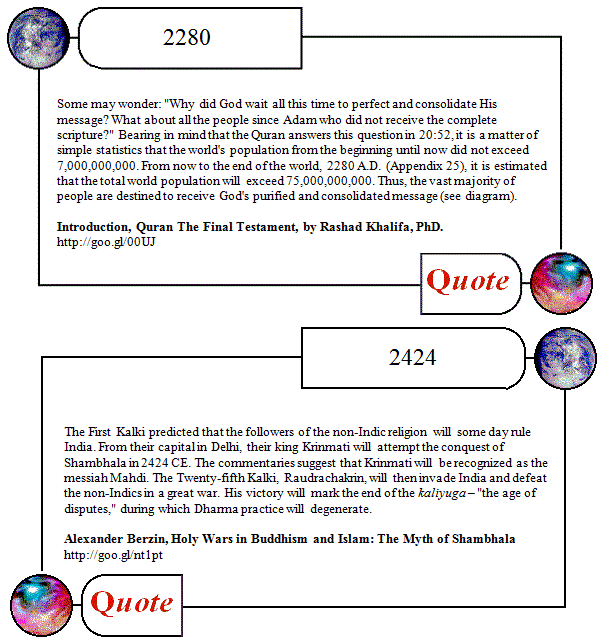
Sources: KhalifaBerzin

*

Seriously, though…

Alexander Berzin has been tutored by HH the Dalai Lama and HHDLs own tutors on the interpretation of the Kalachakra Tantra, and served for some years as HHDL’s translator when HHDL was giving the Kalachakra initiation: indeed his book on the Kalachakra initiation carries a Foreword by HHDL.  His writings are thus among the most scholarly and trustworthy available in the western world on the topic of the initiation which the Dalai Lama will impart for world peace again this July.

Berzin’s words introducing the topic of Holy Wars in relation to the Kalachakra, Buddhism and Islam, are therefore important:

Often, when people think of the Muslim concept of jihad or holy war, they associate with it the negative connotation of a self-righteous campaign of vengeful destruction in the name of God to convert others by force. They may acknowledge that Christianity had an equivalent with the Crusades, but do not usually view Buddhism as having anything similar. After all, they say, Buddhism is a religion of peace and does not have the technical term holy war.

A careful examination of the Buddhist texts, however, particularly The Kalachakra Tantra literature, reveals both external and internal levels of battle that could easily be called “holy wars.” An unbiased study of Islam reveals the same. In both religions, leaders may exploit the external dimensions of holy war for political, economic, or personal gain, by using it to rouse their troops to battle. Historical examples regarding Islam are well known; but one must not be rosy-eyed about Buddhism and think that it has been immune to this phenomenon. Nevertheless, in both religions, the main emphasis is on the internal spiritual battle against one’s own ignorance and destructive ways.

Specifically, he writes:

In The Abridged Kalachakra Tantra, Manjushri Yashas explains that the fight with the non-Indic people of Mecca is not an actual war, since the real battle is within the body. The fifteenth-century CE Gelug commentator Kaydrubjey elaborates that Manjushri Yashas’s words do not suggest an actual campaign to kill the followers of the non-Indic religion. The First Kalki’s intention in describing the details of the war was to provide a metaphor for the inner battle…

To provide a metaphor…
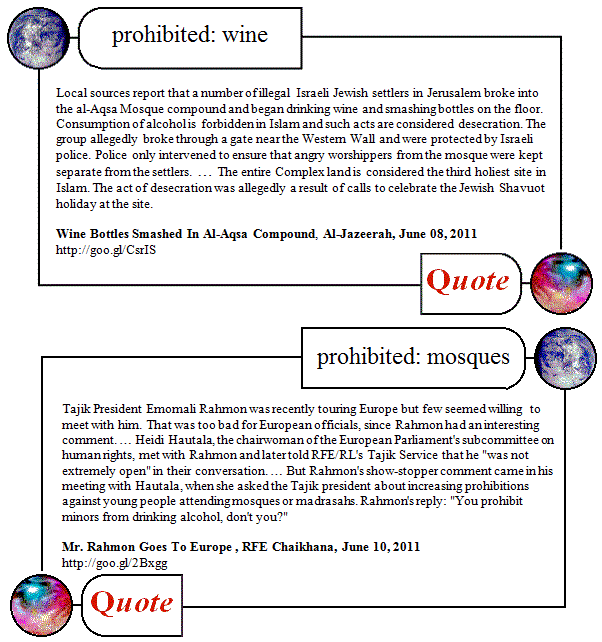
Of mosques and wine

Saturday, June 11th, 2011

[ by Charles Cameron — quirky world news ]

.

quo-wine-and-mosques.gif

Returning from NSS, Brief Note

Friday, June 10th, 2011

En route from Carlisle, where I met a host of smart, imaginative and highly capable men and women from our armed forces, State Department, Intelligence community and other agencies, dedicated to protecting our national interests. It was a great week of strategy, national security and the occasional adult beverage.

Going out of fashion, fast…

Thursday, June 9th, 2011

[ by Charles Cameron — humor, analytic indicators, fashion, dictators ]
.
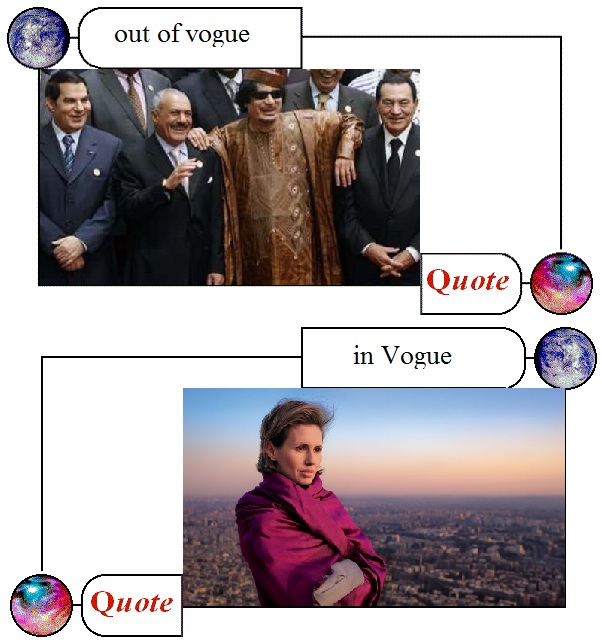
It seems likely from the first of these two images [Ben Ali, Saleh, Qaddafi, Mubarak, April] that manner of dress may be a valuable early indicator of how long a given dictator can hold onto power in the Middle East —

quo-vogue.jpg

— but where does that leave the lovely Asma al-Assad [in Vogue this February] today?

Answer:

oops.jpg

Patterns, Language, and Knowledge

Monday, June 6th, 2011

[by J. Scott Shipman]

John Boyd’s work led me to zenpundit a few years ago, and I am flattered and grateful to be small part of such an intellectually stimulating community.

One Boydian theme that has driven my reading is the “observe” node of his OODA (observe, orient, decide, act). While “orientation” gets most of the attention in Boydian circles, I have come to consider “observe” to be the foundation of knowledge, thus action.  “What” we see, or as my friend Dr. Terry Barnhart points out, what we “sense” directs orientations, decisions, and actions.

This short post is something of a preview (and an opportunity to try-out WordPress which does not like Safari—I’m using an old laptop that is slower than slow). I’d like to share four books that have influenced my thinking and I plan to review the first two of them here in the coming weeks.

patterns.jpg

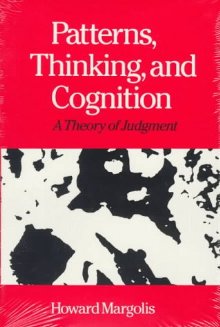
Patterns, Thinking, and Cognition, A Theory of Judgment, by Howard Margolis

Margolis’ thesis is “thinking and judgment…everything is reduced to pattern recognition.” Accordingly, he offers what he calls a P’ Cognition spiral, where the “spirals” represent a cognitive cycle and at the tops of the cycles represent a pattern recognition process. A review is in the works.

language.jpg

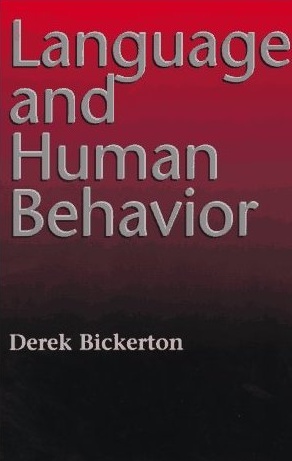
Language and Human Behavior, by Derek Bickerton Bickerton’s thesis is that “human cognition came out of language.” In this work, he defines language, explains the connection of language and evolution, and how language is integral to intelligence and consciousness. A review is in the works.

The final two books are  Personal Knowledge: Towards a Post-Critical Philosophy, and Meaning, by Michael Polanyi

“We know more than we can tell.” Michael Polanyi

There are several points of intersection between Polanyi’s work and that of Margolis and Bickerton, but what I found interesting were Polanyi’s treatment of what he refers to as two types of awareness; subsidiary and focal awareness. In Personal Knowledge, he offers an example of driving a nail, “I have a subsidiary awareness [also called from awareness in Meaning] of the feeling in the palm of my hand which is merged into my focal awareness of my driving the nail.” Subsidiary and focal awareness, according to Polanyi, are mutually exclusive where if one diverts one’s attention to the “feeling in the palm” one is likely to miss the nail. Musicians will recognize the distinction of “looking” at one’s hands will almost always divert from the music on the sheet.In Meaning, Polanyi goes further and assembles what he calls “three centers of tacit knowledge: first, the subsidiary particulars; second, the focal target; and third the knower who links the first to the second. We can place these three things in the three corners of a triangle. Or we can think of them as forming a triad, controlled by a person, the knower, who causes the subsidiaries to bear on the focus of his attention.”

Synthesis: I believe these ideas connect. For if Margolis is correct, then the “awareness” expressed by Polanyi would be apprehended using pattern recognition; recognition of patterns using Bickerton’s ideas with respect to language. Language is pattern-based, and we use language patterns in sense-making/creation of meaning.

More to come.


Switch to our mobile site