zenpundit.com » 2016

Archive for 2016

Binocular vision on the Trump phenom

Tuesday, July 19th, 2016

[ by Charles Cameron — why the support, why the avoidance ]
.

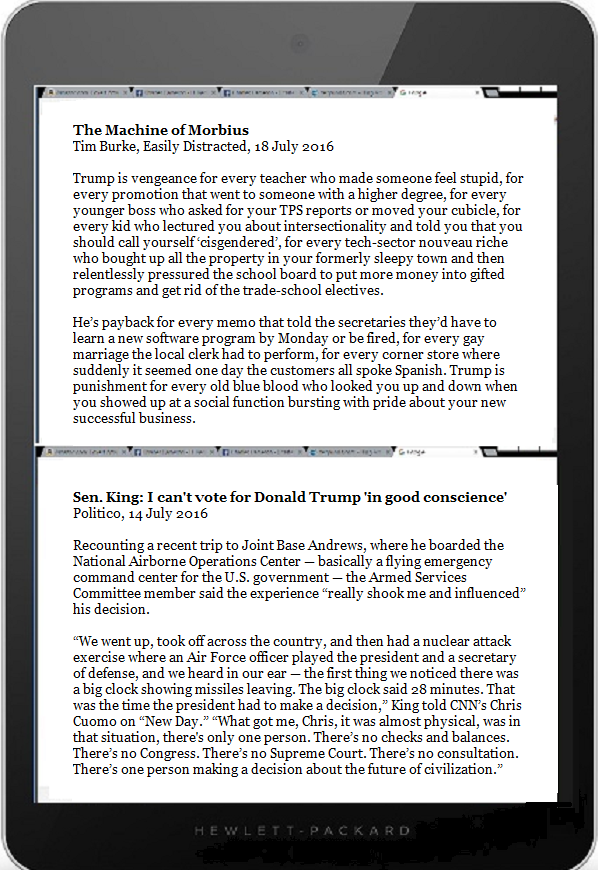
I thought it would be interesting to juxtapose these two quotes about Donald Trump.

One comes from my friend Timothy Burke of Swarthmore and the Easily Distracted blog (upper panel, below) — Tim describes himself as holding generally left or progressive views, though he likes to think of himself as “dedicated to unpredictability”. Tim’s comment goes a long way towards explaining Trump’s appeal.

Tablet DQ Trump Burke & King

The other (lower panel, above) is from Independent Senator Angus King, who generally caucuses with the Democrats, and explains in all too vivid terms why he cannot support Donald Trump for President.

Between the two of them, they nicely illustrate the two poles of opinion around Trump. Tim gives voice to the personal frustrations carried by so many of Trump’s supporters — grievous frustrations which have gone too long unheeded by both parties. And Sen. King voices the agonizing uncertainty surrounding Trump’s reliability as a potential major player in the high-stakes game of geopolitics and nuclear alerts — for his contrast between Trump and Clinton in this regard, read his whole piece at the link below.

I am grateful to both for their succinct expressions of the two very real sides here.

**

Sources:

  • Timothy Burke, The Machine of Morbius
  • Sen. Angus King: I can’t vote for Donald Trump ‘in good conscience’
  • The Shoehorn — two into one won’t go

    Monday, July 18th, 2016

    [ by Charles Cameron — these things are multi-factorial, and can’t truthfully be shoehorned to fit two categories — “terrorist” or “deranged” — as realtors might say, it’s nuance, nuance, nuance ]
    .

    Mark Mazzetti and Eric Schmitt have an interesting piece in the NYT today, titled In the Age of ISIS, Who’s a Terrorist, and Who’s Simply Deranged? It hinges on a comparison of two similar events in France, two years apart, in Dijon and Nice.

    Here, I’ve presented them as a DoubleQuote. The Dijon article (upper panel, below) comes from an NYT report dated December 23, 2014:

    Tablet DQ 600 Terrorist or Deranged

    The Nice report (lower panel, above) comes from Mazzetti and Schmitt’s piece today.

    **

    Mazzetti and Schmitt point out that shortly before the Dijon attack,

    In September 2014, the spokesman for the Islamic State put out a call for the group’s followers to attack Westerners by any means possible, and to do so without awaiting further instructions from the group’s leaders.

    “Smash his head with a rock, or slaughter him with a knife, or run him over with your car, or throw him down from a high place, or choke him, or poison him,” the spokesman, Abu Muhammad al-Adnani, said during a 42-minute recorded statement.

    The whole Mazzetti and Schmitt piece is worth your reading. Categorization, as they explain, is changing —

    “A lot of this stuff is at the fringes of what we would historically think of as terrorism,” said Daniel Benjamin, a former State Department coordinator for counterterrorism and a professor at Dartmouth College. But, he said, “the Islamic State and jihadism has become a kind of refuge for some unstable people who are at the end of their rope and decide they can redeem their screwed-up lives” by dying in the name of a cause.

    Mr. Benjamin said this also led the news media and government officials to treat violence like the Nice attack differently from other mass attacks, like shootings at schools and churches that have been carried out by non-Muslims.

    “If there is a mass killing and there is a Muslim involved, all of a sudden it is by definition terrorism,” he said

    — and this has impacts far beyond the horrific crimes themselves.

    For instance, here’s one conclusion with significant foreign policy implications:

    But terrorism experts caution that because the Islamic State seems to have broad appeal to the mentally unbalanced, the displaced and others on the fringes of society, there are limits to how much any military campaign in Syria and Iraq can reduce violence carried out in other countries on the group’s behalf.

    **

    As Will McCants puts it in a Time piece titled The Difference Between ISIS and ISIS-ish:

    The pattern is tragically familiar: a troubled youth with a criminal past attacks in the name of ISIS. Charlie Hebdo, Orlando, San Bernardino and perhaps now Nice. They are not ISIS, exactly, but ISISish men and women who have no organizational ties to ISIS but murder in its name.

    And Heraclitus:

    No man ever steps in the same river twice.

    Soundbites and hasty headlines don’t chew what they bite. Each case is its own case — sui generis. Classical philosophy used to posit four types of cause: formal and material, efficient and final. In terms of acts of sudden violence, we may want to consider a variety of contextual influences, subconscious drives (James Gilligan‘s work on violnce and shame is deeply relevant here), overt signalling by perps including claims of bayat, methods employed and their history in previous actions and inspoirational or technical literature, and post-action claims by known terrorist groups

    Life does not pretend to be simple. Convenience is no substitute for careful analysis.
    Force and Faith — Turkey

    Monday, July 18th, 2016

    [ by Charles Cameron — “we wrestle not against flesh and blood” ]
    .

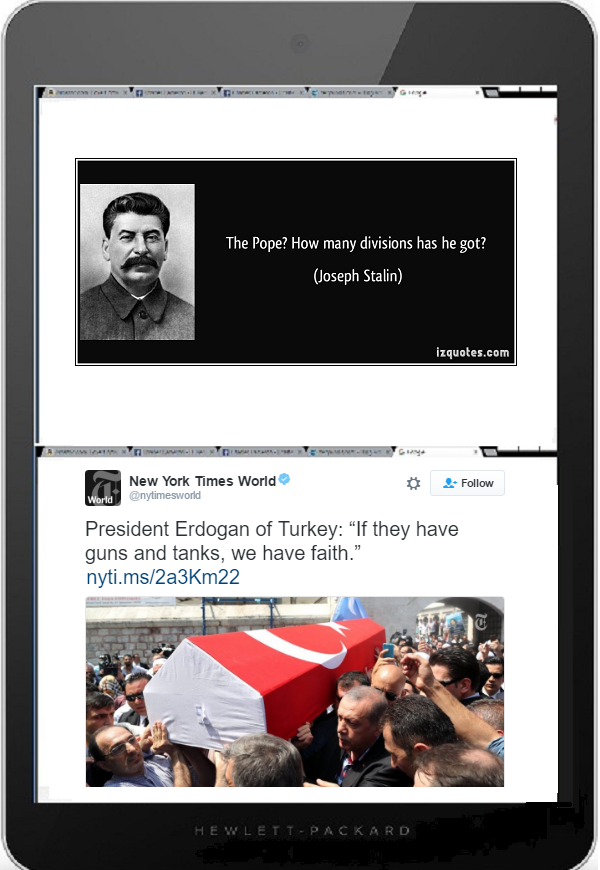
    Stalin’s sneering rhetorical question meets Erdogan’s declaration of faith:

    Tablet DQ 600 stalin erdogan

    **

    The idea of spiritual force is an old one, found eg in both New Testament and Qur’an

  • For we wrestle not against flesh and blood, but against principalities, against powers, against the rulers of the darkness of this world, against spiritual wickedness in high places. — Ephesians 6.12
  • When you were calling upon your Lord for succour, and He answered you, ‘I shall reinforce you with a thousand angels riding behind you.’ — Qur’an 8.9
  • — and von Clausewitz:

  • One might say that the physical factors seem little more than the wooden hilt, while the moral factors are the precious metal, the real weapon, the finely-honed blade.
  • Sunday’s second surprise — the Van Gogh DoubleQuote

    Sunday, July 17th, 2016

    [ by Charles Cameron — Van Gogh, Rilke, El Greco, Von Kármán. Hokusai, Jakob — rich correspondences between singificant items in widely separate disciplines ]
    .

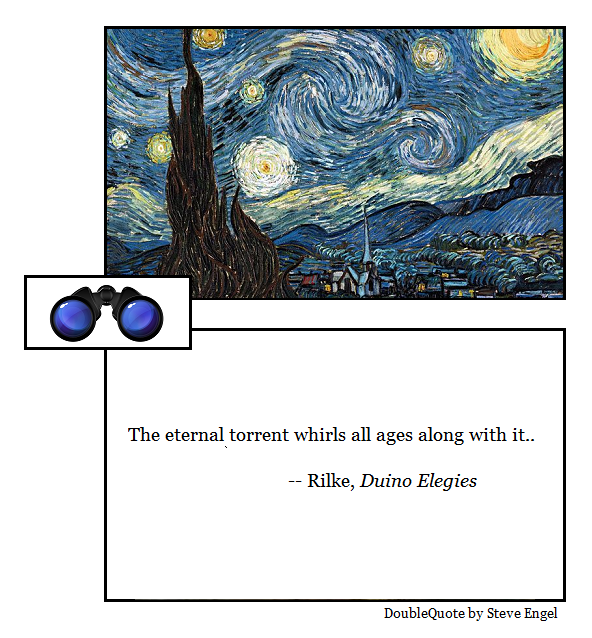
    My friend Steve Engel suggested this variant on my personal favorite DoubleQuote — the one pairing Van Gogh with Von Kármán — and as a lover of Rainer Maria Rilke I very much appreciate his suggestion, which bridges painting and poetry as my original DQ brdges arts and sciences:

    SPEC DQ Gogh Rilke Steve Engel

    **

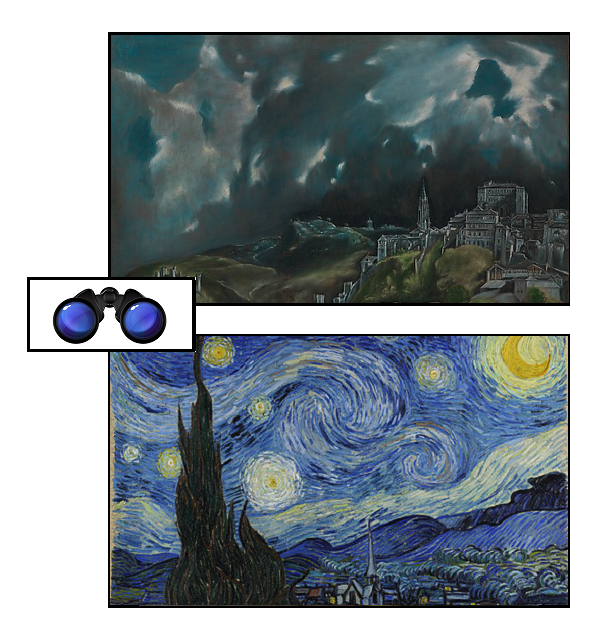
    I’ve also featured that particular van Gogh painting in another DQ, this one showing the sky as painted by El Greco and Van Gogh:

    SPEC DQ greco gogh

    El Greco was first among my loves in painting, and I’ve long thought that the differences between how El Greco sees the sky and how Van Gogh sees it could stand in for the differences between religions — you don’t see Van Gokkites attacking El Grekkites in museums on account of the different visions of their preferred painters, and if we could view religions as visionary rather than prescriptive, taking from them what a poetic, metaphoric, non-literal, non-fundamentalist, non-reductionist reading would approve, we might be a little farther on our way towards interfaith harmony, and away from religiously-sanctionable violence.

    I’m thinking here of St Francis‘ meeting with the Sultan Malik al-Kamil, and more recently Thomas Merton‘s meetings with Buddhist contemplatives, Sufis and the like..

    **

    Here’s the Von Kármán / Van Gogh DQ, which I value in light of Hermann Hesse‘s Glass Bead Game as a clear bridge between one of the crucial dualities of recent centuries — the needless and fruitless schism between the arts and sciences, which has given rise not only the rantings of Christopher Hitchens and his less elegant disciple Bill Maher, but to such other matters as the Papal condemnation and “forgiveness” 359 years later of Galileo Galilei, Charles Babbage‘s Ninth Bridgewater Treatise, Andrew White‘s A History of the Warfare of Science With Theology in ChristendomW, and CP Snow‘s The Two Cultures:

    karman gogh

    **

    And finally, here’s an ugraded version of the other DQ of mine that seeks to bridge the arts and sciences — featuring Hokusai‘s celebrated woodblock print, The Great Wave off Kanagawa (upper panel, below) and Jakob aka nikozy92‘s fractal wave, which I’ve flipped horizontally to make its parallel with the Hokusai clearer (lower panel) — Jakob‘s is a much improved version of a fractal wave compared with the one I’d been using until today:

    SPEC-DQ-Hokusai-fractal v 2.0 minikozy92

    Sunday surprise: Bach BWV 998

    Sunday, July 17th, 2016

    [ by Charles Cameron — with a ramble via his peerless peer, Shakespeare ]
    .

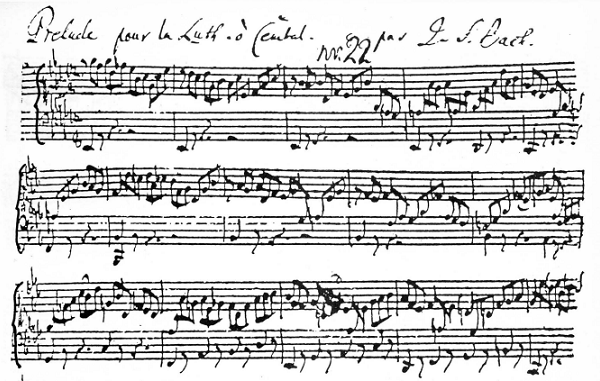
    What’s a piece of music worth, on paper?

    BWV 998 MS image

    **

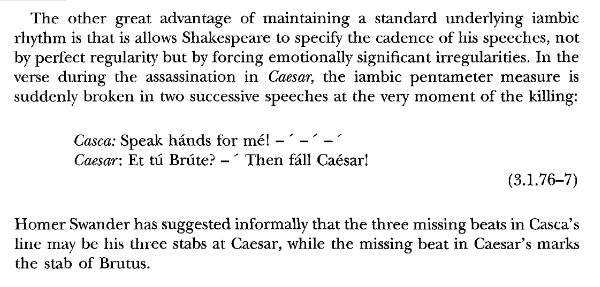
    I had the good fortune some decades ago to be invited to attent Dr Homer Swander‘s seminar at the Oregon Shakespeare Festival in Ashland. Dr Swander is notable among Shakespearean scholars for his insistence that the texts we have of the plays are not themselves works of art, but serve the same function with respect to actual performances that an anrchitect’s blueprints serve with respect to a house, or a musical score to the performance of a work of music. Dr Swander dedicated much of his life to Shakespeare‘s plays, so we should not imagine that he thought little of the First Folio — or indeed of the First Quarto of Hamlet with its truncated soliloqy beginning:

    To be or not to be, ay there’s the point,
    To die, to sleep, is that all? Ay all:

    [for the original spelling, see this facsimile ©The British Library]

    — it’s simply that he saw them as prelimiaries, not the thing itself. This in turn allowed him to “see” aspects of the plays from a director’s standpoint, with intriguing results:

    Swander Caesar
    Hugh Macrae Richmond, Shakespeare’s Theatre: A Dictionary of His Stage Context

    You should have seen Dr Swander stab that point home!

    But to return to Johann Sebastian Bach.. Similarly, we may ask ourselves, what’s the manuscript score of a great work of music worth?

    **

    Christie’s auction house in London has one answer for us in ther case of Bach’s Prelude, Fugue, and Allegro in E-flat major, BWV 998 — $3.3 million:

    Valuable Bach manuscript goes under the hammer

    The manuscript’s value was originally estimated at between 1.5 and 2.5 million pounds (between 2 and 3.3 million dollars). At the auction on Wednesday (13.07.2016) in London, the final bid came in at the high end of expectations.

    Likely written between 1740 and 1745, the Prelude, Fugue and Allegro in E-flat Major (BWV 998) is a favorite among both harpsichords and lutenists. Like many works by Johann Sebastian Bach (1685-1750), it can be played on different instruments, which is expressly indicated on this score in the composer’s handwriting: “Prelude pour la Luth ò Cembal” (for lute or keyboard).

    That’s its current cash value as judged by the market.

    **

    But what’s it worth — to you, to me, to life?

    Nicholas Harnoncourt
    explains:

    **

    I am grateful as always to my friend Michael Robinson of Ornamental Peasant for pointing me to the sale at Christie’s — and to this remarkable piece.


    Switch to our mobile site