zenpundit.com » 2016

Archive for 2016

Rumi One: the poet and his poems

Sunday, June 12th, 2016

[ by Charles Cameron — first of four posts on the poet Jalal al-Din Rumi, hugely popular, perhaps soon to be the pivot of a blockbuster movie ]
.

Rumi has been in the news recently and in Rumi Three I’ll say a bit about why. But first, in this post, Rumi One, I’ll say something about the poet and his poems — leaving his ineffable spiritual attainments ineffable, since if they’re anything, they’re ineffable — and in Rumi Two I’ll consider a current attack on Rumi and “Rumism” in Turkey, little observed in the western press, which may be of interest to the poet’s many followers here. Rumi Four will contain some recommended readings.

**

Let’s start with some praise of Rumi from Will McCants:

It’s a powerful poet who turns a scholar to the study of his language, the better to read him.

**

I’ve been reading Rumi at least since the first Arberry translations of his Mystical Poems came out in 1968, and in the mid-eighties between then and now had the delight and privilege of doing a joint poetry reading with his more recent translator / popularizer, Coleman Barks, at Lake Tahoe.

I’m in no way surprised — but yes, delighted — that a scholar of McCants’ stature should appreciate Rumi so warmly, and envious of his ability to read the Divan, the Masnavi, the Discourses in the original. Did not the great poet Jami write of Rumi’s Masnavi that it is “the Qur’an in the Persian tongue”?

**

Here’s the poem with which Chicago University Press introduces Arberry’s Mystical Poems of Rumi:

My verse resembles the bread of Egypt—night passes over it, and you cannot eat it any more.
Devour it the moment it is fresh, before the dust settles upon it.
Its place is the warm climate of the heart; in this world it dies of cold.
Like a fish it quivered for an instant on dry land, another moment and you see it is cold.
Even if you eat it imagining it is fresh, it is necessary to conjure up many images.
What you drink is really your own imagination; it is no old tale, my good man.

Set beside this, another comment of Rumi’s, considering his poetry:

I am affectionate to such a degree that when these friends come to me, for fear that they may be wearied I speak poetry so that they may be occupied with that. Otherwise, what have I to do with poetry? By Allah, I care nothing for poetry, and there is nothing worse in my eyes than that. It has become incumbent upon me, as when a man plunges his hands into tripe and washes it out for the sake of a guest’s appetite, because the guest’s appetite is for tripe.

The secular mind may think of that second quote as something of a pose, imagining the poetry of a great poet to be the poet’s own primary concern — but the poems of Rumi themselves, like the poems of St John of the Cross, speak of a love of the divine of which the poetry itself can be but an offshoot, a byproduct.

**

There are none so happy, I would suggest, as those who keep company with the lovers of the divine beloved, and it is that companionship that I see depicted in the poem of Rumi’s I most treasure:

Little by little the drunkards congregate, little by little the wine-worshippers arrive.
The heart-cherishers coquettishly come along the way, the rosy-cheeked ones are arriving from the garden.
Little by little from the world of being and not-being the not-beings have departed and the beings are arriving.
All with skirts full of gold as a mine are arriving for the sake of the destitute.
The lean and sick from the pasturage of love are arriving fat and hale.
The souls of the pure ones like the rays of the sun are arriving from such a height to the lowly ones.
Blessed is that garden, where, for the sake of the Mary’s, new fruits are arriving even in winter.
Their origin is grace, and their return is grace; even from the garden to the garden they are coming.

Indeed, that grace, that garden is woven throughout Rumi’s poetry:

The springtide of lovers has come, that this dust bowl may become a garden; the proclamation of heaven has come, that the bird of the soul may rise in flight.

And where is that garden, when is that springtide of lovers?

Alfred North Whitehead was thinking of education as a stepped-down version of that same garden when he wrote:

The present contains all that there is. It is holy ground; for it is the past, and it is the future. … The communion of saints is a great and inspiring assemblage, but it has only one possible hall of meeting, and that is, the present, and the mere lapse of time through which any particular group of saints must travel to reach that meeting-place, makes very little difference.

Of sundry musicians and their moon walks

Sunday, June 12th, 2016

[ by Charles Cameron — a jeu d’esprit, really, because i already have my sunday surprise for this week lined up, and this was too much fun to miss ]
.

I ran across this tweet this morning from Husain Haqqani, former ambassador of Pakistan to the United States and author of Pakistan: Between Mosque and Military and Magnificent Delusions: Pakistan, the United States, and an Epic History of Misunderstanding, currently with the Hudson Institute:

Neil Armstrong? Heard the Islamic Call to Prayer? On the moon?

**

Poets love the moon, almost by definition — the Chinese poet Li Po supposedly drowned while attempting (under the influence) to kiss her face in the Yellow River — so this alleged, though dubious, story was definitely too rich in possibilities for me to ignored. And the Islamic Call to Prayer? According to Nicholas Kristof in the NYT:

Mr. Obama described the call to prayer as “one of the prettiest sounds on Earth at sunset.”

You may or may not agree, but if you want to hear the Call and judge for yourself, you could try listening to one of these videos:

  • https://www.youtube.com/watch?v=mUHDYlJHaOQ
  • https://www.youtube.com/watch?v=otdgbR3yso0
  • https://www.youtube.com/watch?v=T8o6WKTQpMc
  • **

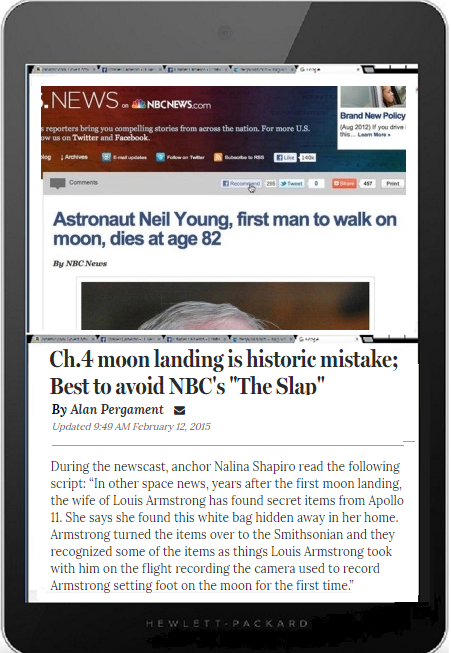
    That’s what led me to my second discovery –one which might be excused by blaming autocorrect, twice, for suggesting that Neil Young — he of the voice, upper panel below — and Louis Arnmstrong — he of the trumpet, lower panel — were each the first man to land on the moon, per (in both cases) NBC.

    Tablet DQ 600 at 75 blank Musicians on Moon

    In all fairness, it’s worth noting that other candidates for moon walks include Buzz Lightyear, Lance Armstrong, and Michael Jackson.

    **

    Sources:

  • Mix 104.1, Twitter Confuses Neil Armstrong With Lance and Louis
  • Buffalo News, Ch.4 moon landing is historic mistake; Best to avoid NBC’s “The Slap”
  • **

    None of these mistakes are critical, however, if you believe the late Srila Prabhupada, who introduced Krishna Consciousness to the United States. As someone fascinated by different cosmologies and theologies, I remember reading of Prabhupada’s claim that the moon landing was faked in a California film studio in his magazine some time in the 1970s. No longer having access to the magazine, and looking for confirmation of that memory, I found this page, Srila Prabhupadas statements about the moon landing, of considerable interest:

    Srila Prabhuapda himself said different things at different times. Sometimes he directly said they didn’t go and it was some kind of hoax. And at other times he said they didn’t go to the moon because they didn’t experience the higher dimensional nature of the moon planet, which is a rational way to harmonize the Vedic perspective with the idea of three dimensional space travel. At other times he just said the whole idea was foolish and a waste of money. He saw material space travel as a foolish attempt to reach higher dimensions which can only be reached by yogic practice.

    Bear in mind too that both Joseph Smith and L Ron Hubbard also taught their followers about significant planets that do not form part of the standard astronomical account of deep space — or the heavens, in other words.

    And Charles Williams — the brilliant Dante scholar, Arthurian poet, novelist, theologian of Romantic Love, and friend of JRR Tolkien and CS Lewis — offers a striking near-contemporary Christian example of the genre in the opening paragraph of his book, The Descent of the Dove: A Short History of the Holy Spirit in the Church.

    The beginning of Christendom, is, strictly, at a point out of time. A metphysical trigonometry finds it among the spiritual Secrets, at the meeting of two heavenward lines, one drawn from Bethany along the Ascent of the Messias, the other from Jerusalem against the Descent of the Paraclete. That measurement, the measurement of eternity in operation, of the bright cloud and the rushing wind, is, in effect, theology.

    See also my post, A metaphysical trigonometry.

    Given my propensity for seeing conflicts in sectarian terms

    Sunday, June 12th, 2016

    [ by Charles Cameron — delicious irony in the twitter stream as a teaching tool re middle east ]
    .

    Given my propensity for seeing conflicts in sectarian terms, it’s a breath of fresh air / splash of wet water for me to read Hayder al-Khoei, scion of the eminent al-Khoei family and Chatham House Fellow, tweeting on the subject of the English football hooliganism in Marseille over the last three days, which has included both bottle-throwing against French riot police and a running battle with a pack of Russian supporters brandishing knives:

    **

    **

    **

    **

    **

    **

    **

    **

    **

    **

    **

    **

    **

    **

    Al-Khoei‘s observations offer us a brilliant parody of the way western analysts, myself included, all too often write about events in the Middle East, and I admire his skill in delivering his reproof — but it’s also worth remarking that England as I understand it seems less and less interested in attendance at its established Protestant church, while France is notable for it’s official laïcité. Indeed, of the three nations involved in this circus, only the Russians appear to be experiencing quite a resurgence of Orthodoxy, coming after decades of official atheism.

    Enfin:

    The England v Russia match was a 1-1 draw. Game theorists would presumably call the event a zero-sum game, since the two sides do seem to have cancelled each other out — but in the larger context of sectarian rivalry, the entire three days have surely been lose-lose, while al-Khoei‘s wit is a win for us all.

    The curious case of the Ominous Share

    Thursday, June 9th, 2016

    [ by Charles Cameron — a side-note on web practice — American Lands Council vs BLM ]
    .

    JJ McNabb is a Fellow with the Program on Extremism at George Washington University, and author of the book The Seditionists, Inside the Explosive World of Anti-Government Extremism in America. Today she posted two linked tweets.

    This first one shows what you can find on the American Lands Council site:

    while the second shows what you will be sending if you hit the “share” button at the bottom of the same page.

    As McNabb points out, you are “sharing” something quite different from what you might have expected to share — although you do get to see it ahead of time, and can thus decide not to share it after all.

    McNabb makes a neat use of the rhetorical device I call the DoubleTweet — revealing the squirrely nature of the ALC’s “share” button.

    **

    FWIW, the text under the new and menacing image is the vision statement of the American Lands Council:

    To advance prosperity and self-reliance, improve the health of public lands, and provide increased funding for public education by securing and defending local control of land access, land use and land ownership of public and private lands.

    and can be found on the group’s About page.

    Considering Viv, Wolfram Language, Syntience, and the GBG

    Wednesday, June 8th, 2016

    [ by Charles Cameron — expanding the computable to include qualitative ideation ]
    .

    Let’s start with Viv. It looks pretty phenomenal:

    That video is almost exactly a month old, and it’s pitched at “the universe of things” with a marked tilt towards e-commerce. Fair enough.

    **

    It’s instructive to compare it with Wolfram Language, although here I’ve had to go with a video that’s a couple of years old:

    Stephen Wolfram, the creator of both Mathematica and Wolfram Alpha, is focused on the world of numbers — and incidentally, that includes graphs of the sort I’ve been discussing in my series here On the felicities of graph-based game-board design, as you can see in the video above.

    It will be interesting to see how the two of them — Viv and Wolfram — interact over time. After all, one of the purposes of these lines of development is to dissolve the “walled gardens” which serve as procrustean beds for current thinking about the nature and possibilities of the web. Do these two gardens open to each other? If so, why? If not, why not?

    **

    I’ve talked enough for my purposes about AlphaGo and it’s narrowly focused though impressive recent triumph, and the wider picture behind it, as expressed by Monica Anderson — and tying the two together, we have this video from Monica’s timeline, Bob Hearn: AlphaGo and the New Era of Artificial Intelligence:

    Bob Hearn: AlphaGo and the New Era of Artificial Intelligence from Monica Anderson on Vimeo.

    Monica’s Syntience, it seems to be, is a remarkable probing of the possibilities before us.

    **

    But I’m left asking — because Hermann Hesse in his Nobel-winning novel The Glass Bead Game prompts me to ask — what about the universe of concepts — and in particular for my personal tastes, the universe of musical, philosophical, religious and poetic concepts. What of the computational mapping of the imagination?

    My question might well have large financial implications, but I’m asking it in a non-commercially and not only quantitative way. I believe it stands in relationship to these other endeavors, in fact, as pure mathematics stands in relation to physics, and hence also to chemistry, biology and more. And perhaps music stands in that relationship to mathematics? — but I digress.

    If I’m right about the universe of concepts / Glass Bead Game project, it will be the most intellectually demanding, the least commercially obvious, and finally the most revelatory of these grand-sweep ideas..

    From my POV, it’s also the one that can give the most value-add to human thinking in human minds, and to CT analysts, strategists, journos, educators, therapists, bright and playful kids — you name them all!

    Seeing it in terms of counterpoint, as Hesse did — it’s the virtual music of ideas.


    Switch to our mobile site
