Fidei Defensor — Henry VIII, Defender of the Faith
Wednesday, February 10th, 2016[ by Charles Cameron — Catholic Vespers at Hampton Court, February 2016 ]
.
**
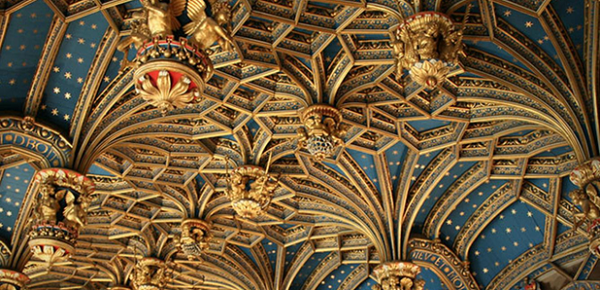
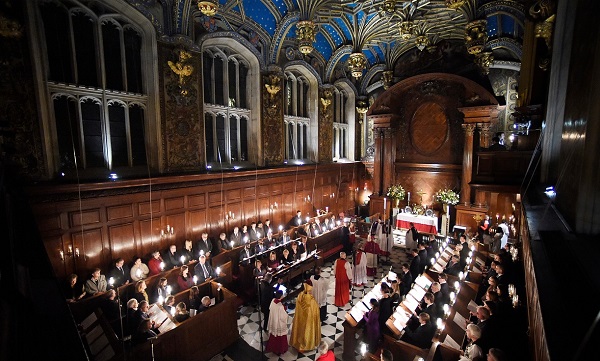
Yesterday, February 9th 2016, the (Cathlic) Cardinal Nichols celebrated the beautiful Vespers liturgy in Henry VIII‘s old chapel at Hampton Court Palace in London, with the (Anglican) Bishop of London and Dean of Her Majesty’s Chapels Royal, Dr Richard Chartres, delivering the sermon:
As the Guardian reported:
Almost half a millennium after the Act of Supremacy, which declared the Tudor king as the supreme head of the Church of England and formalised the break with Rome, England’s most senior Catholic cleric celebrated Vespers in the palace’s Chapel Royal on Tuesday evening.
The scent of incense filled the air beneath the chapel’s magnificent blue and gold ceiling as a small procession made its way towards the altar. Vincent Nichols, the Catholic archbishop of Westminster, in a gold mitre and brocade robe, walked a few steps behind Richard Chartres, the Anglican bishop of London and dean of the royal chapels, in a symbolic gesture of reconciliation.
The first Catholic service in the chapel for more than 450 years was hailed as “one for the history books” by John Studzinski of the Genesis Foundation, which jointly organised the event with the Choral Foundation. “Dialogue between faiths is much needed and welcomed in these turbulent times. We need to recognise that we have more in common than not.”
And Vatican Radio:
World renowned ensemble ‘The Sixteen’ which specializes in early English polyphonic music, will perform works from the Reformation period, highlighting how – in the cardinal’s words – “music can help us rediscover our roots and shared heritage” [ .. ]
Cardinal Nichols notes that the music has been chosen to fit the history of the Chapel Royal, featuring composers like Thomas Tallis who “lived through all the turbulence of the Reformation of 1535” and the subsequent decades during which, he says, the situation in England was “quite porous and quite subtle”. Tallis and others wrote both Catholic and Anglican music and in many ways, the Cardinal says, “the Chapel Royal captures the fluidity and ambiguity of the age”.
**
So — two senior clerics belonging to rival churches managed to join in prayer — is that such a big thing?
If religion is a semi-cultish fad or superstition, nah. If religion is a major aspect of culture, maybe. If the divisions in Christianity are an offence against the God of Love and a voluntarily imposed obstacle to the workings of Love in the world, then yes, and this is a step in the right ecumenical direction.
From a secular British perspective, leaders of two rival versions of the same superstitions managed to agree with one another long enough to hold a joint press conference and a concert. The concert was first rate, the setting historic, the seating limited – tickets were allotted by ballot – and the whole event worth maybe a human interest column in the day’s news, well behind the bombing of some city in Syria.
Let’s call that the perspective from the ground up.
**
But hold it. The secular mind works from the facts, the “material world” as Madonna put it, with priority given to survival, food, shelter, and other needs – but to the sacred mindset, it is the spiritual world, the world of inspiration and joy that takes priority. Myth, ritual, dream, poetry, romance – these are the elements in human culture which must deeply touch our hearts, our souls — and from that perspective, the event yesterday at Hampton Court was anything but unimportant.
Let’s call this the perspective sub specie aeternitatis — from above. Rene Daumal describes its benefits in his brilliant mountain-climbing novel, Mount Analogue:
What is above knows what is below, but what is below does not know what is above. One climbs, one sees. One descends, one sees no longer, but one has seen. There is an art of conducting oneself in the lower regions by the memory of what one saw higher up. When one can no longer see, one can at least still know.
Monarchy, like religion, is a matter of myth, ritual, dream, poetry, and romance. The stories of the kings and queens of England are replete with myth and legend – King Arthur, Guinevere, Sir Launcelot, the Holy Grail, Glastonbury. The royal year is shot through with ritual – the great Royal weddings, Trooping the Colour and Changing of the Guards, the opening of Parliament, the races at Royal Ascot, the tagging of swans during Swan Upping, and towering about them all, the successive Coronations of sovereigns down the ages.
In sum, the monarchy embodies, for those who see it, the dreams and poetry of the nation, its traditions and its aspirations. And pageantry is at the heart of those dreams, its richest expression, just as liturgy – the performance of the rites and services of the church — is at the heart of the church’s dream, each being the enactment, with all solemnity and symbolic force, of a great ordering and binding principle.
Where the prayerful and celestial liturgy of the church and the grand traditions of the monarchy come together, the spirituality, the pageantry, the music, the gorgeous robing, the sacred architecture and yes, nobility, come together to stir the deep national memory, elevating us to that double sense of identity conveyed in the great hymn, I Vow to Thee, My Country, with words by Sir Cecil Spring-Rice and music by Gustav Holst. This hymn rang out in a multitude of voices at the wedding of Prince William and Kate Middleton, at the Festival of Remembrance, at the funerals of Princess Diana, of Baroness Thatcher and Sir Winston Churchill, and it articulates the sense of a double world – “my country” and “another country”, the material and spiritual worlds in harmonious continuity – which is buried deep in the British consciousness.
I vow to thee, my country, all earthly things above,
Entire and whole and perfect, the service of my love;
The love that asks no question, the love that stands the test,
That lays upon the altar the dearest and the best;
The love that never falters, the love that pays the price,
The love that makes undaunted the final sacrifice.And there’s another country, I’ve heard of long ago,
Most dear to them that love her, most great to them that know;
We may not count her armies, we may not see her King;
Her fortress is a faithful heart, her pride is suffering;
And soul by soul and silently her shining bounds increase,
And her ways are ways of gentleness, and all her paths are peace.
That “other country” calls to mind Blake’s Albion, the sleeping Britain — the Britain of a possibility that transcends the Gross National Product, and lies at the heart of Britain’s reluctance to give over its sovereignty to the bureaucrats of Brussels.
All this is evoked by the grand ceremonial of Catholic Vespers accompanied by the prayers, incense and choral voices raised in prayer to the gilded rafters of Henry VIII’s Chapel Royal at Hampton Court Palace, where Catholic worship last took place in the reign of “Bloody” Mary Tudor (1553-58). It is, if you will, a foretaste – in high British ceremonial style — of paradise.
And so yes, from a ceremonial, symbolic and mythic perspective, it was and is a big deal. It is a moment rich in the tapestry which interweaves heaven and earth, the sacred and secular realms – not to mention two great rival religious traditions. For yes, it was Catholic against Protestant that warred in Europe and gave us, finally, the Treaty of Westphalia, and the concept of the nation state, Catholic against Protestant that echoed from the Battle of the Boyne to the Belfast Troubles, Catholic against Protestant that sent Guido Fawkes plotting to blow up the Houses of Parliament in an earlier era of sectarian hatred and religious terror…
**
King Henry VIII was granted the title of Defensor Fidei or Defender of the Faith by a grateful Pope Leo X in 1521, in recognition of a treatise, Defense of the Seven Sacraments, which he had written attacking the “reformed” teachings of Martin Luther. In 1530, however, Henry broke from the Papacy and Catholic Church to establish the Church of England under his own royal authority, and was excommunicated and the title papally withdrawn. No matter, the British parliament confirmed Henry in the title soon after in its new sense, as Defender of the Faith of the Church of England – a title which continues to be held by British monarchs to this day.
During the coronation ceremony, the monarch swears an oath to govern the far-flung territories of the Commonwealth “according to their respective laws and customs”, “to cause Law and Justice, in Mercy, to be executed” in all the monarch’s judgments; and to protect the Church of England, of which the monarch is Supreme Governor. At the most recent British coronation, that of Queen Elizabeth II, the Archbishop of Canterbury asked:
Will you to the utmost of your power maintain the Laws of God and the true profession of the Gospel? Will you to the utmost of your power maintain in the United Kingdom the Protestant Reformed Religion established by law? Will you maintain and preserve inviolably the settlement of the Church of England, and the doctrine, worship, discipline, and government thereof, as by law established in England? And will you preserve unto the Bishops and Clergy of England, and to the Churches there committed to their charge, all such rights and privileges, as by law do or shall appertain to them or any of them?
— to which Her Majesty responded:
All this I promise to do. The things which I have here before promised, I will perform and keep. So help me God.
It is the Coronation Oath too, along with the twin sectarian meanings of the title Defensor Fidei, which is in play as we approach afresh the meanings of church and state, constitutional monarchy, in times both ecumenical and sectarian, secular and sacred, traditional, vitally present, and forward looking. The Catholic liturgy of Vespers, celebrated yesterday with all dignity and ceremonial in Henry VIII’s own chapel at Hampton Court is a reminder and a promise of the high spiritual, ritual and cultural possibilities to which our British traditions invite us.
**

**
A video of yesterday’s ceremonial is not yet available, but I imagine this was the Magnificat that Harry Christophers and his choir sang…
I could live my life out under the shelter of such Magnificats.