zenpundit.com » 2017

Archive for 2017

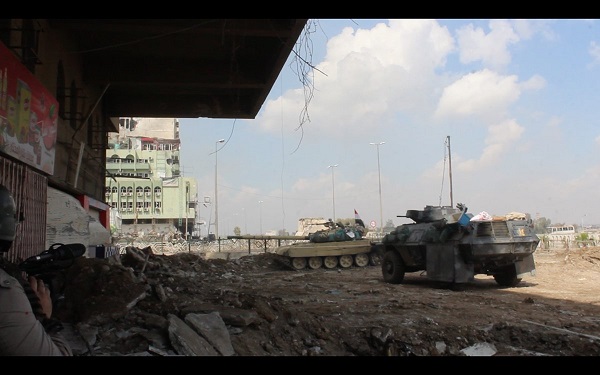
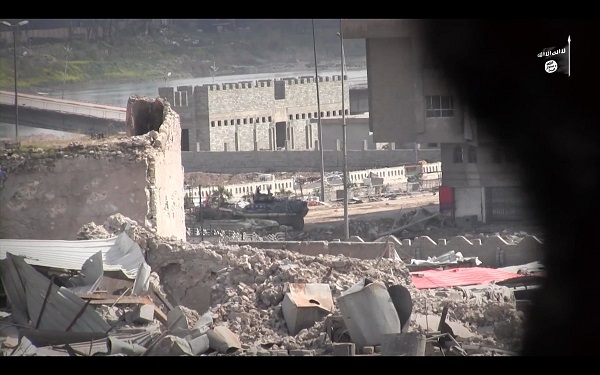
Binocular (camera) vision, Mosul

Sunday, March 19th, 2017

[ by Charles Cameron — ISIS vs journo, fighter vs reporter ]
.

An intriguing use of DoubleQuote thinking — from opposite sides of a conflict moment:

**

These images are even more striking when seen in full:

ISIS pov:

Raineri pov:

Kudos, Daniele Raineri.

Rwanda cognition – and a *key* question

Sunday, March 19th, 2017

[ by Charles Cameron –the key question arises from the final quote ]
.


[source page unavailable ]

**

Mark Gilchrist, the Australian serving officer who brought us Why Thucydides Still Matters, has a new post — the first of three — up at Strategy Bridge in which he explores The Twilight Between Knowing and Not Knowing — an appropriately liminal title — specifically, the difficulties involved in recognizing genocide. It’s a fascinating if harrowing article, and I’m going to cherry-pick some quotes for your attention..

**

the world’s diplomats were accustomed to dealing with wars – they were not, and did not try to become, accustomed to the requirements of dealing with genocide.

So, between politics and (its continuation) war, at least ne liminal condiciton: genocide.

You’ve got to sow the seeds of hysteria in the population, and that takes time…

How far back can we date the current wave of hysteria in the population — from a liberal and from a conservative perspective, or other?

Dallaire deployed without knowledge of the history and culture of Rwanda or relevant intelligence about the stakeholders, agendas or general situation on the ground. This inhibited his ability to understand the massacres that occurred

Ooh, anthropology, and — dare we say it — (dark) religion.

it failed to recognise the importance of the rise in anti-Tutsi rhetoric in the Rwandan media, which was instrumental in furthering the extremists’ genocidal aims through the psychological preparation of the Hutu population.

Are we monitoring the rise of anti-x rhetoric (foreign and domestic)? How’s it going?

**

Here’s the stunning cognitive takeaway!!

The scale of the barbarity was almost incomprehensible to Western observers – UNAMIR troops included – which resulted in eyewitnesses often finding themselves in denial about what was unfolding around them. The troops made themselves believe that high-pitched screams were gusts of wind, that the rabid packs of dogs were feeding on animal remains and not human carcasses, that the smells enveloping them emanated from spoiled food and not decomposing bodies. Barnett argues that this fantasy is reminiscent of Primo Levi’s observation about the Holocaust that ‘things whose existence is not morally comprehensible cannot exist.’ This is particularly so for Western troops who are trained to think and act within the bounds of a moral and ethical behavioural framework that can obscure their ability to recognise the evil that others may be capable of.

Blindness, denial. The grand question raised by this article and by the Rwandan experience goes way beyon Rwanda to our cognitive incapacities and their potentially disastrous repercussions in general.

No worries, ma — it’s only a gust of wind.
Sunday surprise — literal rainfall ancient and modern

Sunday, March 19th, 2017

[ by Charles Cameron — a DoubleQuote in the arts ]
.

Guillaume Apollinaire:

**

Il pleut

Il pleut des voix de femmes comme si elles étaient mortes même dans le souvenir
c’est vous aussi qu’il pleut merveilleuses rencontres de ma vie ô gouttelettes
et ces nuages cabrés se prennent à hennir tout un univers de villes auriculaires
écoute s’il pleut tandis que le regret et le dédain pleurent une ancienne musique
écoute tomber les liens qui te retiennent en haut et en bas.

Roger Shattuck, brilliant author of The Banquet Years: The Origins of the Avant-Garde in France) translates:

It’s Raining

It’s raining women’s voices as if they had died even in memory
And it’s raining you as well marvellous encounters of my life O little drops
Those rearing clouds begin to neigh a whole universe of auricular cities
Listen if it rains while regret and disdain weep to an ancient music
Listen to the bonds fall off which hold you above and below

As Edward Hirsch comments at Poetry Foundation:

The slanting lines of Apollinaire’s poem create the sensation of rain running downward across a windowpane. Graphic form and verbal music come together as each long vertical line becomes a rhythmic unit of meaning

— which is itself a verbal / visual DoubleQuote!

**

Code running downward..

**

This was brought to mind by the magnificent title sequence of the Le Carré thriller The Night Manager:

essentially completing a second DoubleQuote with those falling droplets. those rising bubbles — and there are several filmic equivalents of DoubleQuotes graphic matches aka match cuts — in the sequence itself: bomb cloud > martini, tea cups >machine gun, contrails > pearls..

I’m always happy to see more Le Carré on film..

Pincers on Aung San Suu Kyi

Wednesday, March 15th, 2017

[ by Charles Cameron — is her non-intervening stance now squeezed between Islamist warriors and peaceable Buddhists? ]
.

**

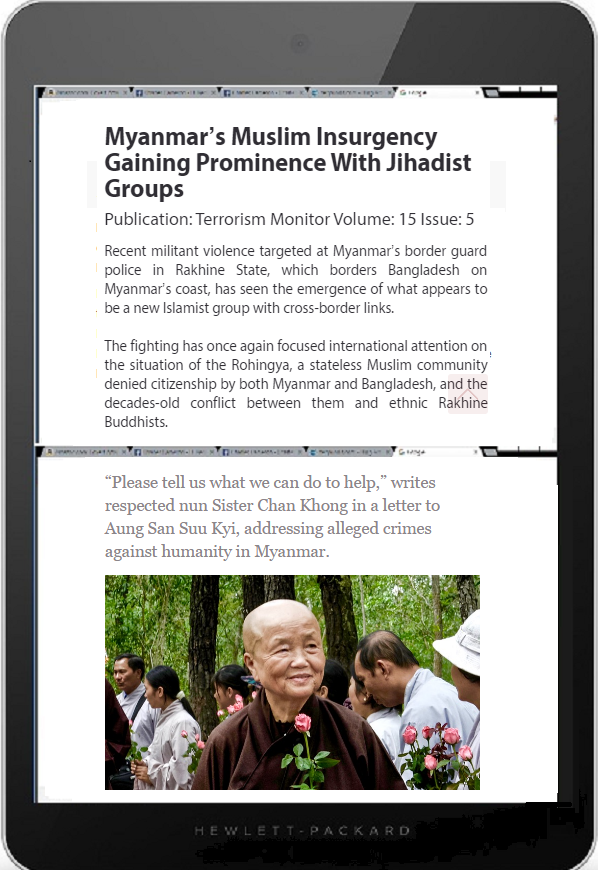
Aung San Suu Kyi has been mute on the persecution of Rohingya Muslims in Rakhine State, Myanmar, see eg A new wave of atrocities is being committed against Muslims in Burma’s Rakhine state, but I imagine the pressure on her is growing — not just from the military or the bulk of the Buddhist population and many monks — but on the one hand from iolent Islamist jihadists and on the other from peaceable Buddhists elsewhere — exemplified here by Thich Nhat Hanh‘s close disciple Chan Khong..

Peaceable Buddhists — what other kind should there, could there be?

**

Sources:

  • Jamestown, Myanmar’s Muslim Insurgency Gaining Prominence With Jihadist Groups
  • Lion’s Roar, Sister Chan Khong implores Aung San Suu Kyi to accept help
  • Talmud for today?

    Wednesday, March 15th, 2017

    [ by Charles Cameron — two brief surface readings in Talmud, with a request for deeper understanding ]
    .

    As someone brought up with more of a focus on the Beatitudes than the Torah (I know, a huge question with many potential shades of answer opens up when I say that), I was not familiar with this Talmudic aphorism until the drone strikes that killed Anwar al-Awlaki and shortly thereafter his son Abdulrahman brought it to my attention:

    Ha-Ba le-Horgekha Hashkem le-Horgo is a teaching of increasing popularity among Israelis. Taken from the Babylonian Talmud, Sanhedrin 72:1, its most precise translation is: ‘If someone comes to kill you, get up early to kill him first.’

    I imagine it also has relevance to the (presumed) Israeli targeted killing of (eg) Imad Mughniyah..

    **

    Yesterday I came across a second such Talmudic phrase, based on Genesis 50:

    The sages derived a principle from this text. Mutar le-shanot mipnei ha-shalom: “It is permitted to tell an untruth (literally, “to change” the facts) for the sake of peace.” A white lie is permitted in Jewish law.

    This aphorism may be of interest to bear in mind in the context of Israeli peace negotiations — but more directly (and literally) “it is permitted to change the facts” carries a sidelong resemblance to the concepts of alt-facts & faux news currently infesting our politicians and media…

    Sources:

  • Jewish Quarterly, Kill him first
  • Rabbi Sacks, When is it Permitted to Tell a Lie?
  • ^^

    Knowing the Talmud to be deeper and richer than my own understanding by many orders of magnitude, I’d like to invite commentary on these or other aspects of Talmudic thought that may play, directly or indirectly, into national security issues.


    Switch to our mobile site