[ by Charles Cameron — on imbalances in public interest, reporting, just one example ]
,
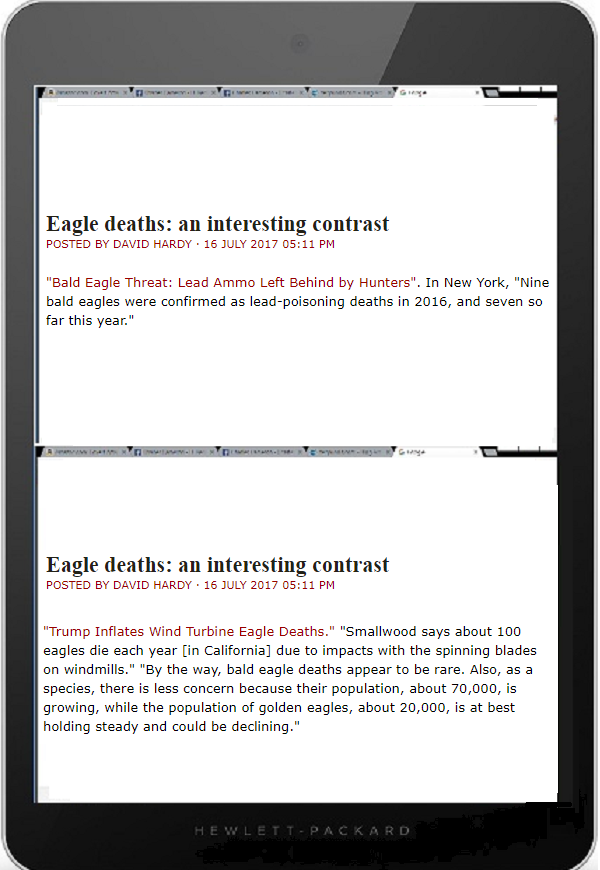
David Hardy at Of Guns and the Law posted Eagle deaths: an interesting contrast today, Jonathan at ChicagoBoyz picked up on it, and when I looked at it myself, I saw the first two of Hardy’s three paragraphs as a DoubleQuote — making two points in counterpoint, as a musician might say, Hardy’s phrase “interesting contrast” meaning much the same thing. I like to use my DoubleQuote graphic formulations for such juxtapositions, as I’ve done here with Hardy’s “DoubleQuote in the wild”:
Hardy’s third and final paragraph reads thus:
When worked at Interior, a quarter century ago, I was told that bird deaths due to wind farms were massive, but orders were to do and say nothing, because wind power was fashionable. Hmmmm..
Ouch.
**
If you took all the world’s potential “compare and contrast” pairs, and tried to balance them all equably, so that no comparisons ever had the kind of imbalance Hardy exposes here, there would be too many subjective factors for everyone to agree on, and worse thasn that, all too frequently balancing one pair of issues would almost certainly imbalance others..
So we’d always have room to complain that something or other wasn’t fair.. Sort of like a Gödel’s incompleteness theorem for idealists?
Are the thoughts that I am thinking as I look at this solid lump of fatty protein covered in blood vessels really made out of the same stuff? And the answer always comes back–they are–and the thought itself is too crazy, too incomprehensible, and I get on with the operation.
The purpose of the historian, to Coleridge, is the same as that of the poet : to convert a series of events, which constitute the straight-line of real or imagined history, into a whole, so that the series shall assume to our understanding “a circular motion — the snake with its tail in its mouth.”
Here’s one more:
Apparently, Donald Trump Jr’s version of the Prisoner’s Dilemma involves defecting from yourself.
[ by Charles Cameron — some non-Islamic (archetypal) context for a jihadist’s bride receiving a suicide belt as a wedding gift ]
.
Asia Ahmed Mohamed, 26 (left), was given a suicide belt as dowry by her jihadi husband Mohammed Hamdouch – Daily Mail
**
The unfortunate King Admetus, who had shown great hospitality to Apollo when the latter was banished from Olympus for nine years, was gifted by the spinners of fates with an extended lifespan — provided a substitute was found at the time death came to claim him.
Death came for Admetus, and in the great poem that Rainer Maria Rilke wrote, after his father, mother and closest friend have each refused the chance to save Admetus’ life at cost of their own — Admetus’ loving wife Alcestis steps forward to offer herself..
No one can be his ransom: only I can.
I am his ransom. For no one else has finished
with life as I have. What is left for me
of everything I once was? Just my dying.
Didn’t she tell you when she sent you down here
that the bed waiting inside belongs to death?
For I have taken leave. No one dying
takes more than that. I left so that all this,
buried beneath the man who is now my husband,
might fade and vanish–. Come, lead me away,
already I have begun to die, for him.
**
The young, free, wild woman, the Artemis in every young bride, loses not just her father’s name but her identity, her life even, at the moment of marriage: the more sober, adult, bound woman, the wife, succeeds toi her flesh and days.
This theme, in which the (presumably white) bridal veil is seen to imply the (presumably black) burial veil, is a central strand in Greek tragedy, not just in Euripides ALcestist, from which Rilke drew his narrative, but in all three great tragedians, as Rush Rehm shows in his book, Marriage to Death: The Conflation of Marriage and Funeral Rituals in Greek Tragedy:
The link between weddings and death — as found in dramas ranging from Romeo and Juliet to Lorca’s Blood Wedding–plays a central role in the action of many Greek tragedies. Female characters such as Kassandra, Antigone, and Helen enact and refer to significant parts of wedding and funeral rites, but often in a twisted fashion. Over time the pressure of dramatic events causes the distinctions between weddings and funerals to disappear. In this book, Rush Rehm considers how and why the conflation of the two ceremonies comes to theatrical life in the tragedies of Aeschylus, Sophocles, and Euripedes.
Although condemned by mainstream churches, this folk saint’s supernatural powers appeal to millions of Latin Americans and immigrants in the U.S. Devotees believe the Bony Lady (as she is affectionately called) to be the fastest and most effective miracle worker, and as such, her statuettes and paraphernalia now outsell those of the Virgin of Guadalupe and Saint Judetwo other giants of Mexican religiosity. In particular, the book shows Santa Muerte has become the patron saint of drug traffickers, playing an important role as protector of peddlers of crystal meth and marijuana; DEA agents and Mexican police often find her altars in the safe houses of drug smugglers. Yet Saint Death plays other important roles: she is a supernatural healer, love doctor, money-maker, lawyer, and angel of death. She has become without doubt one of the most popular and powerful saints on both the Mexican and American religious landscapes.
In Santa Muerte we see the conflation of wedding and funeral alive and well in 21st century Mexico — and rippling out into the wider world.
[ by Charles Cameron — what fire can spark forth when a great actor reads a great poet ]
.
First, Clapton performing Dylan:
It’s the speeding beauty (grace, flight, blues brutality) of Clapton’s guitar riffs that I’d draw your attention to — how can the human voice, in language hope to compare?
It’s a question that has driven me any times to despair, listening to Clapton.
**
And then there’s this poem. Let me give you the words first, so you can follow them. Gerard Manley Hopkins is the poet:
The Leaden Echo and The Golden Echo
(Maidens’ song from St. Winefred’s Well)_
THE LEADEN ECHO
How to keep — is there any any, is there none such, nowhere known some, bow or brooch or braid or brace, lace, latch or catch or key to keep
Back beauty, keep it, beauty, beauty, beauty…. from vanishing away?
O is there no frowning of these wrinkles, ranked wrinkles deep,
Down? no waving off of these most mournful messengers, still messengers, sad and stealing messengers of grey?
No there’s none, there’s none, O no there’s none,
Nor can you long be, what you now are, called fair,
Do what you may do, what, do what you may,
And wisdom is early to despair:
Be beginning; since, no, nothing can be done
To keep at bay
Age and age’s evils, hoar hair,
Ruck and wrinkle, drooping, dying, death’s worst, winding sheets, tombs and worms and tumbling to decay;
So be beginning, be beginning to despair.
O there’s none; no no no there’s none:
Be beginning to despair, to despair,
Despair, despair, despair, despair.
THE GOLDEN ECHO
Spare!
There is one, yes I have one (Hush there!);
Only not within seeing of the sun,
Not within the singeing of the strong sun,
Tall sun’s tingeing, or treacherous the tainting of the earth’s air.
Somewhere elsewhere there is ah well where! one,
One. Yes I can tell such a key, I do know such a place,
Where whatever’s prized and passes of us, everything that’s fresh and fast flying of us, seems to us sweet of us and swiftly away with, done away with, undone,
Undone, done with, soon done with, and yet dearly and dangerously sweet
Of us, the wimpled-water-dimpled, not-by-morning-matched face,
The flower of beauty, fleece of beauty, too too apt to, ah! to fleet,
Never fleets more, fastened with the tenderest truth
To its own best being and its loveliness of youth: it is an ever-lastingness of, O it is an all youth!
Come then, your ways and airs and looks, locks, maiden gear, gallantry and gaiety and grace,
Winning ways, airs innocent, maiden manners, sweet looks, loose locks, long locks, lovelocks, gaygear, going gallant, girlgrace —
Resign them, sign them, seal them, send them, motion them with breath,
And with sighs soaring, soaring sighs deliver
Them; beauty-in-the-ghost, deliver it, early now, long before death
Give beauty back, beauty, beauty, beauty, back to God, beauty’s self and beauty’s giver.
See; not a hair is, not an eyelash, not the least lash lost; every hair
Is, hair of the head, numbered.
Nay, what we had lighthanded left in surly the mere mould
Will have waked and have waxed and have walked with the wind what while we slept,
This side, that side hurling a heavyheaded hundredfold
What while we, while we slumbered.
O then, weary then why should we tread? O why are we so haggard at the heart, so care-coiled, care-killed, so fagged, so fashed, so cogged, so cumbered,
When the thing we freely forfeit is kept with fonder a care,
Fonder a care kept than we could have kept it, kept
Far with fonder a care (and we, we should have lost it) finer, fonder
A care kept. Where kept? Do but tell us where kept, where. —
Yonder. — What high as that! We follow, now we follow. —
Yonder, yes yonder, yonder,
Yonder.
Richard Burton, unbelievably, recites this poem:
Burton performing Hopkins.
Let that wash over you once. Or twice — or as they say, binge-listen.
One of the commentators on the Clapton video calls it “a guitar tutorial on what it means to truly master the art of music” — ditto say I for Burton performing Hopkins.
we could get into the magnificent rage of Clapton & Dylan later (from a quasi-pacifist position over here).
[ by Charles Cameron — another “life imitates art” and a Trumpian ouroboros ]
.
In my view, humility shaves ckoser than Occam’s Razor — Occam tends not to shave our assumptions, while humility invites us to consider even our thoughts, even our certainties, as uncertain, as open to question.
During a lightning round of a debate, Republican frontrunner Donald Trump picked a potential Secret Service code name that was truly coded: HUMBLE. When the braggadocious billionaire starts to receive actual Secret Service protection Wednesday morning, agents plan to call him something a bit more fitting: MOGUL.
Okay. Mebbe that’s a bit more modest.
Hm. MOGUL as in magnate, tycoon? Or MOGUL as in speed-bump on the ski slopes?
Zenpundit is a blog dedicated to exploring the intersections of foreign policy, history, military theory, national security,strategic thinking, futurism, cognition and a number of other esoteric pursuits.