I thought I’d back-track a little, and drag in two blog posts that I made elsewhere back in March of 2008, which may help to explain my basic outlook on the sorts of issues that analysts face.
.
I. The version of the idea as poetry:
I am Charles
.
My concern is the human mind in service
to an open heart, and my problem
is that the heart picks issues rich in ambiguity
and multiplicity of voices, tensions
and torsions tugging not one way but
in many directions, even dimensions, as does
a spider’s web weighed down with dew –
to clarify which a mind’s abacus is required
.
equal in subtlety to subtlety itself, while
in all our thinking and talking, one
effect follows one cause from question
to conclusion down one sentence or white
paper — whereas in counterpoint,
Bach’s fugal voices contain their dissonance.
.
II. The same idea presented in prose — as I say, a few years back — with graphical illustration:
Spiders and dewdrops
Spiders and dewdrops do a pretty convincing job of portraying a certain level of complexity in this node-and-edge diagram of the global situation.
When, say, Castro hands over power to his brother, or Musharraf has to give up control of the Pakistani army, it’s like snipping a couple of threads in that spiders web — and the droplets fall this way and that, carom into one another, the fine threads they’re on swing down and around until a new equilibrium is reached…
But try thinking that through in terms of Cuba and Pakistan before breakfast one morning if you’re Secretary of State, with a linear Cold War mind, Russia going through its own changes, and al-Qaida and associates training and recruiting in the background…
Well, those two instances have been and gone, and the new configurations are now the tired old same old configurations we believe we’ve figured out — until another dewdrop slips, and a thread breaks, and all things are once again new…
It’s the web of tensions that constitutes the “complexity” that must somehow be grasped by the analyst, the writer, the historian…
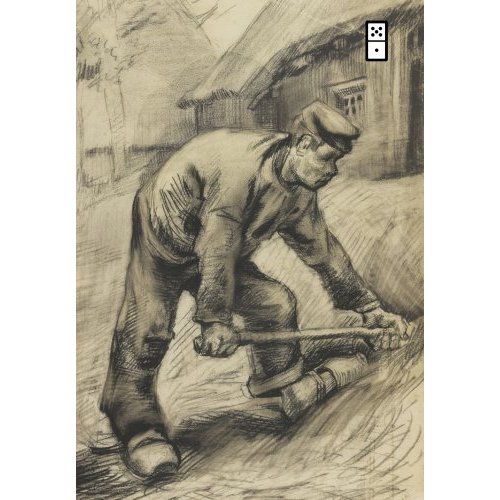
And Hokusai, watching across the years how grasses bend in the winds, reach for sunlight, bow under the weight of dew — and spring back when released — may finally have a mind that’s attuned to that kind of complexity — to a degree that linear thinking will never reach…
The Warlord is Colonel John Collins, who has over a half century of national service as a military officer and analyst and now is the proprietor of the national security listserv, The Warlord Loop. His tips fit in well with my review of Do the Work.
Research Techniques
*Peruse a broad spectrum of opinion with an open mind. Never reach conclusions first, then prepare a paper to support them. You will often find that initial impressions were poorly founded.
*Take nothing for granted. Challenge conventional wisdom to see if it is sound, regardless of the source.
*Document important ideas with footnotes, so readers can pursue selected topics in greater depth, if they so desire
For the contrast between Mr. Ryan last week and Mr. Obama on Wednesday wasn’t just about visions of society. There was also a difference in visions of how the world works.
Indeed there were and I found them visions that varied from mistaken to delusional to demagogic. But it likely explains why the 2011 budget was so late: there are conflicting and irreconcilable visions of how the world works and all parties finally came together on the single point they could agree on (getting re-elected).
Dave, with trademark evenhandedness, gives each plan a fisking and finds them all wanting.
….Understand that Washington had wanted Germany to pick up a big share of the tab for funding the Nabucco nightmare, which, when Wikipedia last checked, still hasn’t found funding.2. U.S. and British machinations in Ukraine, which egged on Ukraine’s President Viktor Yushchenko to escalate his cold war with Putin. This included holding Europeans who were dependent on Russia natual gas hostage to the prospect of freezing in the winter, and which threatened to crash a good chunk of the EU economy. And which by 2008 also had something to do with a cold war between the Kremlin and the British foreign office over a joint oil deal involving British Petroleum — er, “BP.”3. The very same war in Georgia that Herr Schockenhoff delicately alluded to. You remember that war, right? The one where presidents Bush and Putin had to learn while sitting next to each other at China’s Olympics that Georgia’s president — the necktie-chewing Mikheil Sakaashvili, installed as Georgia’s President in a U.S.-orchestrated putsch (“The Rose Revolution”) — was trying to start World War Three?Yeah. That war.There are surely additional reasons not specifically related to the United States — the economic crisis for one, which brought home to Germans that they couldn’t continue bankrolling the expansion of the European Union at the rate they’d done in the past.
And there was simply the fact that a shaking out in alliances was inevitable when it became clear to West Europeans that continuing with the policy of using former Soviet republics to create an ever-expanding front against Russia was threatening to create the very instability on the Continent that had driven European fear of Russian hegemony. The Georgia war was the starkest demonstration that there had to be a realignment of priorities for Europe, even if this caused a major rift with the United States
Every nation has historic policies that are cherished and repeatedly get dusted off. The Russo-German partnership goes back to Bismarck….unless we want to count the brief period of Tsar Peter II’s Germanomaniac worship of Frederick the Great
BLOGFRIENDS UNITE! The eponymous Adam Elkusand Great Satan’s Girlfriend, Courtney Messerschmidt, the gamine of COIN, have joined forces to seize control of Wings Over Iraq! Or….maybe….Starbuck just went on vacation or something.
Where earlier attempts have fired ungainly missiles that tumbled end-over-end through the air like “hypersonic bricks,” this one uses a sabot round, which flies straight and smoothly for a distance of seven kilometers, AFTER punching through a solid steel plate
I read the GeorgeR.R. Martin series which is heavy on swords, political intrigue, war, sex and a 4GW-like collapse of a great and venerable feudal realm and lighter on sorcery. More like Machiavelli than Tolkien, at least in the earlier books ( the series is not finished). Looks quite good and true to the story, from the trailer and the preview. The first episode aired last night.
Steven Pressfield has gone Zen on us with this little tome dedicated to the triumph of the creative spirit over the self-defeating power of “Resistance”. Do the Work is both a distillation and a complementary addition to his previous and longer non-fiction examination of becoming “a professional” in a creative field, The War of Art, which I recommend highly.
Here’s my favorite passage in Do the Work:
I was thirty years old before I had an actual thought. Everything up till then was either what the Buddhists call “monkey mind” chatter or reflexive regurgitation of whatever my parents or teachers said, or whatever I saw on the news or read in a book, or heard somebody rap about, hanging around the street corner.
In this book, when I say “Don’t Think”, what I mean is: don’t listen to the chatter. Pay no attention to the rambling, disjointed images and notions that drift across the movie screen of your mind.
Those are not your thoughts.
They are chatter.
They are Resistance.
Something I try to impart in my students is the practice of metacognition. Not that I expect them to execute a precision analysis of their thought process the first time through, or even the fiftieth. Instead, I am trying to break them of habitually moving on mental autopilot, running “tapes” in their head recorded by cultural osmosis, to stop and ask themselves, what do I really think here? With skepticism and active, focused, attention. For more than a few, it is the first time in their lives experiencing what it is like to be intellectually awake and in control of their own thinking.
Reading Do the Work is a little like reading the Mao’s Little Red Book or Marcus Aurelius’Meditations of writing. The sections are short vignettes of certitude that add up to a philosophical whole, in the case of Pressfield, a prescription for a personal creativity jihad based on in the moment creative action followed by reflection and refinement. It is meant for the person who can but doesn’t and doesn’t know why. Pressfield explains why and then, essentially, tells the reader to get off of the dime….NOW!
For the creative procrastinator ( like yours truly) or aspiring writer, Do the Work is a book that reads like an ass-kicking.
You don’t have to be a Christian to see the force of this pair of quotes… you just have to love words.
I ran across the Milton quote somewhere today: I thought grievous wolves was a great example of the power of poetry, and when I checked to make sure I had the right attribution, found St Paul had used the phrase first — at least in the King James version — so it’s also an instance of the power of sanctity — or at least, sanctity in translation.
And the idea transcends a particular faith, too. Students of Max Weber will recognize in it the routinization of charisma, readers of Simone Weil the workings of gravity against grace… and those whose devotion is to the Book of Nature, the pattern by which a stream that flows from a fresh-water spring gets progressively more polluted as it proceeds past villages and towns towards the port city and the sea…
You can draw an infinite number of lessons from the process by which the soft and flexible coagulates and hardens, yet the moral is simple and always the same: it pays to return to the source.
Colin Gray is one of the four or five go-to strategic thinkers around today. Joseph Nye, the father of the soft power concept, is a seminal figure in Political Science and International Relations.
….Unfortunately, although the concept of American soft power is true gold in theory, in practice it is not so valuable. Ironically, the empirical truth behind the attractive concept is just sufficient to mislead policymakers and grand strategists. Not only do Americans want to believe that the soft power of their civilization and culture is truly potent, we are all but programmed by our enculturation to assume that the American story and its values do and should have what amounts to missionary merit that ought to be universal. American culture is so powerful a programmer that it can be difficult for Americans to empathize with, or even understand, the somewhat different values and their implications held deeply abroad. The idea is popular, even possibly authoritative, among Americans that ours is not just an “ordinary country,” but instead is a country both exceptionally blessed (by divine intent) and, as a consequence, exceptionally obliged to lead Mankind. When national exceptionalism is not merely a proposition, but is more akin to an iconic item of faith, it is difficult for usually balanced American minds to consider the potential of their soft power without rose-tinted spectacles. And the problem is that they are somewhat correct. American values, broadly speaking “the American way,” to hazard a large project in reductionism, are indeed attractive beyond America’s frontiers and have some utility for U.S. policy. But there are serious limitations to the worth of the concept of soft power, especially as it might be thought of as an instrument of policy. To date, the idea of soft power has not been subjected to a sufficiently critical forensic examination. In particular, the relation of the soft power of attraction and persuasion to the hard power of coercion urgently requires more rigorous examination than it has received thus far.
….In 2007, Richard Armitage and I co-chaired a bipartisan Smart Power Commission of members of Congress, former ambassadors, retired military officers, and heads of non-profit organizations at the Center for Strategic and International Studies in Washington. We concluded that America’s image and influence had declined in recent years and that the United States had to move from exporting fear to inspiring optimism and hope.
The Smart Power Commission was not alone in this conclusion. Even when he was in the George W. Bush administration, Defense Secretary Robert Gates called on Congress to commit more money and effort to soft-power tools including diplomacy, economic assistance, and communications because the military alone cannot defend America’s interests around the world. He pointed out that military spending then totaled nearly half a trillion dollars annually, compared with a State Department budget of just $36 billion. In his words, “I am here to make the case for strengthening our capacity to use soft power and for better integrating it with hard power.” He acknowledged that for the secretary of defense to plead for more resources for the State Department was as odd as a man biting a dog, but these are not normal times. Since then, the ratio of the budgets has become even more unbalanced.
One of the ironies here, is that the United States, through the private sector production of goods, services and intellectual property, has since WWII been overwhelming successful in exporting our “soft power” into foreign cultures to an extent seldom matched in history. However, the ability of the USG to capitalize on this latent-passive global acculturation through public diplomacy has ranged from minimal to excruciatingly counterproductive when our words, deeds and image are in serious disharmony.
Zenpundit is a blog dedicated to exploring the intersections of foreign policy, history, military theory, national security,strategic thinking, futurism, cognition and a number of other esoteric pursuits.

 and active, focused, attention. For more than a few, it is the first time in their lives experiencing what it is like to be intellectually awake and in control of their own thinking.


