zenpundit.com » Uncategorized

Archive for the ‘Uncategorized’ Category

Moral Equivalence

Wednesday, August 9th, 2017

[ by Charles Cameron — in which a sunni sheikh protects a yazidi family ]
.

Yad Vashem:

**

I seldom make comparisons that strike me as demonstrating moral equivalence as such — mostly I intend the juxtapositions I present to illustrate some parallelism or opposition that’s worthy of note as one aspect of a bigger picture, but by no means the whole. Often such an aspect will add nuance to the broader picture, sometime by contrasting with the overall impression. I relish those opportunities to see more that the first glance would tell me, to begin probing, digging deeper into a particular situation or issue.

Here though, I think I may have stumbled onto a juxtaposition that does reveal a moral equivalence — in this case, a Sunni tribal leader standing in the same relation to the Yezidis he saved as one or another of the Righteous Among the Nations does to a Jewish person, family, or group they saved.

The details of tribal anthropology in the Sunni-Yazidi case — which would be of interest no doubt to our friend David Ronfeldt — are fascinating in themselves:

Fadel was a wealthy Sunni, and a tribal leader from the Shammar tribe, one of the world’s largest and most influential Arab tribes. He was also a close friend of the family.

When Fadel found out where the family was, he rushed to the IS headquarters in Kocho, where he negotiated with the local militant leaders. “Please, let me take them with me,” he told them. “They belong with me.”

While thousands of other Yazidi women and children were transferred to other places in Iraq and Syria – and most of the Yazidi men were killed on the spot – Nadine and her children, along with dozens of their relatives, were taken to the tribal leader’s house in Ba’aj, a small town in Nineveh governorate.

Immediately, the family buried their mobile phones and Yazidi clothing. It was the beginning of a long period in hiding.

But why would the local sheikh go to such lengths to protect this Yazidi family? The families go way back and have a long history together, explained Nadine. He was their ‘krive‘ – a kind of godfather or patron. “And he had promised to protect us,” Nadine said.

Just like Muslims, Yazidis circumcise their young boys. During the ceremony, the man who holds the boy on their lap is considered his godfather, or “blood brother” – or krive.

Before 2003, the krive was often historically selected from among religious families or even influential Muslim families. Yazidis believe that this creates a special bond between two clans; they have to respect and protect each other whenever needed.

Sadly:

But the ritual shared between the two religious groups declined amid Iraq’s sectarian violence, and after the Yazidi genocide in 2014, it completely disappeared.

**

Note here the role of circumcision, adding nuance to the parallel with Judaism. Ritual here is not some form of “dry as dust” repetition, but the instrument of deep, indeed life-saving human bonding.

As so often, I wish I knew more — and in the meantime, I am grateful to those such as Oscar Schindler, Fadel of the Shammar, and so many others — the righteous protectors.

Nadine Naif and family, your story brings me hope. Fadel, I salute you.
David Ronfeldt: Readings on tribes & tribalism

Tuesday, August 8th, 2017

[ by Charles Cameron — a catch-up post ]
.

Despite his modest comments to the contrary, David Ronfeldt has in fact been posting up a storm on his Materials for Two Theories blog, bringing us up to date with his readings on tribalism as the key aspect of his TIMN (tribes, hierarchical institutions, markets, and networks) theory.

Just as I keep harping on the significance of — and our tendency to overlook — religious and particularly apocalyptic drivers across a range of problematic issues, so David relentlessly points to the significance of — and our tendency to overlook — tribalism as a key form in understanding many of those same issues.

**

Most recent:

David’s two most recent posts are of particular interest.

#14: Richard Landes’s “How Thinking Right Can Save the Left” (2015)

Richard Landes, in addition to his encyclopedic work on apocalyptic matters, is the proponent of a game theoretical approach to the Israeli-Pakestinian question with considerable overlap with David’s focus on tribalism — regarding the core issue as that of a clash between zero-sum and win-win players, in which concessions made by the win-win player, in expectation of reciprocal concessions, are taken as victories, requiring no re ciprocation, by the zero-sum player.

I hope I got that right, albeit in very simplified / condensed form

#15: Mark Weiner’s “The call of the clan: why ancient kinship and tribal affiliation still matter in a world of global geopolitics” (2013)

Mark Weiner‘s entry is the one which comes closest to David’s TIMN work, and David accordingly uses parallels as a means of outside confirmation of certain of his own insights.

**

The full monte:

Here, for your convenience, are David’s recent tribalism posts — some items deal specifically with America, one with Britain, and others are more general, but I have grouped them all together in the order of posting since David issued them as a numbered series:

  • Intro and #1: Sabrina Tavernise, “One country, two tribes” (2017)
  • #2: David Roberts, “Donald Trump and the rise of tribal epistemology” (2017
  • #3: Daniel Shapiro, “Modern tribes – the new lines of loyalty” (2008)
  • #4: Charlie Sykes, “Where the Right Went Wrong” (2016)
  • #5: Ben Shapiro, “The Revenge of Tribalism” (2016)
  • #6: Robert Reich, “The New Tribalism and the Decline of the Nation State” (2014)
  • #7: Glenn Harlan Reynolds, “Politicians benefit from American tribal warfare” (2014)
  • #8: Jonathan Haidt & Ravi Iyer, “How to Get Beyond Our Tribal Politics” (2016)
  • #9: Deepak Chopra, “After Trump, What Will It Take To Heal?” (2016)
  • #10: Jalaja Bonheim, “Why We Love Trump” (2016)
  • #11: NeoTribes, “NeoTribal Emergence” (2016)
  • #12: Ross Douthat, “The Myth of Cosmopolitanism” (2016)
  • #13: Kenan Malik, “Britain’s Dangerous New Tribalism” (2015)
  • #14: Richard Landes’s “How Thinking Right Can Save the Left” (2015)
  • #15: Mark Weiner’s “The call of the clan: why ancient kinship and tribal affiliation still matter in a world of global geopolitics” (2013)
  • Quietly now, a possibility

    Monday, August 7th, 2017

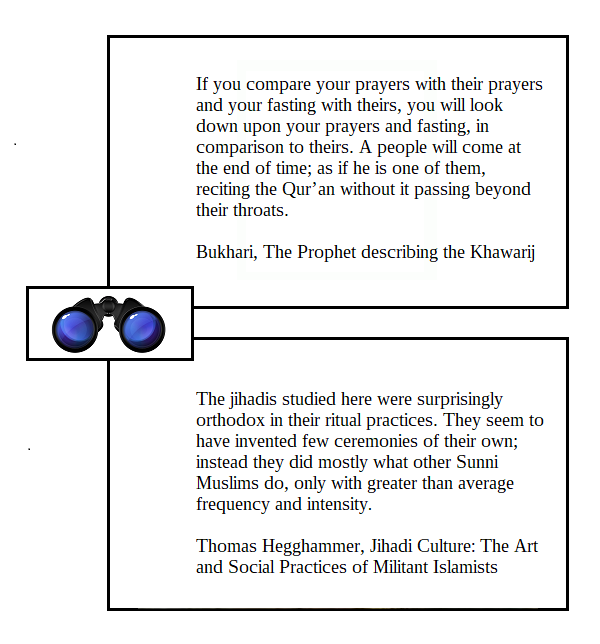
    [ by Charles Cameron — a comment by Hegghammer, possibly echoing Bukhari re the Khawarij ]
    .

    Ritual practice with greater intensity..

    Very much a book to read..

  • Thomas Hegghammer, Jihadi Culture: The Art and Social Practices of Militant Islamists
  • Transfiguration, Tabernacles, and Yom Kippur

    Sunday, August 6th, 2017

    [ By Charles Cameron — responding to Scott, Jewish & Christian holy days ]
    .

    J Scott Shipman today sent some Zenpundit friends a post concerning The Feast of Tabernacles (Sukkot), viewed through a “Messianic Jewish” (ie Judaism-observant Christian) lens:

    As the last feast on the Sabbatical calendar, representing the final ingathering of the great harvest and the joyful celebration that will follow, the number seven is imprinted in this feast. The feast was in the seventh month, lasted for seven days, and the number of sacrifices, of which there were more than for any other festival, were divisible by seven. Little wonder that it was also called the “Feast of the Lord”.

    Following closely after Yom Kippur (the Day of Atonement), it was a particularly joyous celebration, representing the joy of those who have been reconciled to God through the forgiveness of sin. One of the names applied to this feast was “the season of our joy.”

    According to Jewish tradition the pillar of cloud and the pillar of fire which was given to guide the Israelites day and night first appeared to Israel on the 15th of Tishri, the first day of the feast. Moreover, Moses is said to have come down from the mountain and announced to the people that the tabernacle of God would be pitched in the midst of their tabernacles on this same day.

    **

    By way of response, I’d like to offer Scott and company the following post, The Transfiguration and Jewish feast days, from a liturgically traditionalist Catholic site:

    I thought it might be helpful to look at today’s feast day in the light of two Jewish feasts. Many years ago, I was bowled over by Fr Jean Galot’s observation concerning St Peter’s profession of faith. He argued that if, as many scholars accepted, the transfiguration occurred during the feast of tabernacles, then the “after six days” of Matthew 17.1 would mean that the profession of faith of St Peter in Matthew 16.16 would have taken place on the Day of Atonement. This is highly significant because the Day of Atonement was the one day in the year on which the high priest solemnly pronounced the holy name YHWH in the holy of holies in the Temple. St Peter, by his confession of faith fulfils the work of the high priests, and Our Lord in His own person is the living presence the Most High.

    There’s more at each site, naturally, and both Jewish and Christian traditions have their symbolisms as well as their festivals.

    Greetings to all.

    Sunday surprise, from dogs & muffins to Stop! & 45mph limit

    Sunday, August 6th, 2017

    [ by Charles Cameron — better eat a muffin than a dog, stop at a stop sign than blow through it at 45, oh well ]
    .

    **

    It’s cute, sorta, that AIs can’t easily distinguish dogs from muffins:

    But STOP!

    **

    What’s not so funny is that the AI in many autonomous vehicles misreads a treated STOP sign —

    — as a sign for a 45 mph speed limit. As Ivan Evtimov and colleagues indicate in Robust Physical-World Attacks on Machine Learning Models, “Physically realizing such an attack for road signs can raise concern in human observers.”

    I’ll say.

    Grab the wheel, conscious entity!

    **

    Readings:

  • Becoming Human: AI, Why are Marketers All Talking about AI Now?
  • Wired, Simple Pictures that State-of-the-Art AI Still Can’t Recognize
  • Car & Driver, Researchers Find a Malicious Way to Meddle with Autonomous Cars
  • Arxiv, Robust Physical-World Attacks on Machine Learning Models

  • Switch to our mobile site