zenpundit.com » Uncategorized

Archive for the ‘Uncategorized’ Category

Firefights, breath, & meditation

Monday, June 20th, 2016

[ by Charles Cameron — remembering my father, Capt Orford Gordon Cameron, DSC, RN ]
.

I came across two pieces with overlapping descriptions of what happens to the body, perceptions, and thought, in a firefight. As is my habit, I’ve picked some of the essential text and accompanying illustration in each case, and offer them to you in my DoubleQuote format:
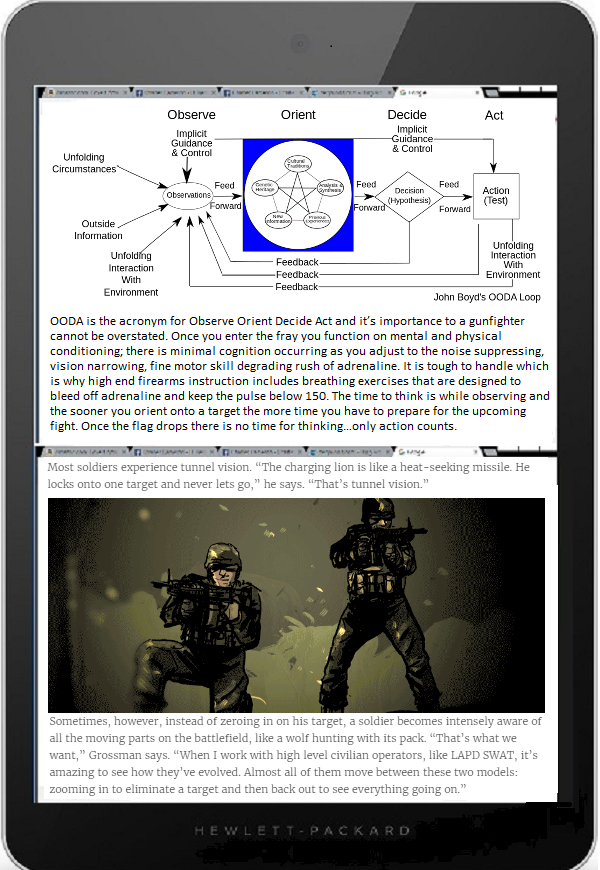
DQ Breath and time dilation

**

The first quote, with the Boyd OODA Loop diagram heading it, comes from Tim Lynch‘s Fourth Generation War Comes To America: What Are You Going To Do About It?, which Michael Yon linked to.

Lynch’s piece is his response to the Orlando shooting, its thrust being that the event went on way too long, and that we need more people to identify (and prepare) themselves as sheepdogs:

Human Sheepdogs are, by nature, not a threat to their fellow citizens but are death dealing fighting machines when they, their loved ones or the sheep (other citizens) are in peril.

In particular, Lynch delivers a mini-seminar on the essential contents of two books:

  • LTC Dave Grossman, On Killing
  • Gavin de Becker, The Gift of Fear
  • The second comes from Adam Linehan‘s This Is Your Brain On War at Task & Purpose. Again, the topic centers around Grossman’s work, but in this case the framing has to do with the tranfer of psychological insight from sports medicine to the military profession.

    There’s more in Linehan’s piece that’s relevant to my posting here than I’ve been able to quote in my “tablet” DQ format, so here’s some additional detail:

    The moment an engagement kicks off, the body initiates a dramatic response, beginning with the circulatory system, which immediately shunts blood away from the body surface. This, Grossman explains, is the body preparing to suck up damage.

    Preparing to absorb damage, the circulatory system moves blood away from the body’s surface to its core.

    “It’s called vasoconstriction. Just before the capillaries, there’s a mechanical shutdown of the blood flow, and now the arteries and the body core are holding up to twice as much blood. That’s why the face goes white.”

    There are two primary reasons for this. One, it helps prevent bruising, which is what happens when the capillaries and veins burst from blunt force trauma. If there’s no blood, they remain intact. But more importantly, the redirected blood flow helps keep the person alive long enough to finish the fight. [ .. ]

    Blood drains from the brain’s rational control center (the forebrain), leaving the midbrain in full control, at which point, you will do what you’ve been trained to do.

    That’s because, at its most extreme, vasoconstriction affects the brain, too. “As the blood drains from the face, blood drains from the forebrain, and there’s no rational thought,” Grossman explains. “I call that ‘condition black.’ And at condition black, the midbrain is in charge, and you’ll do what you’ve been trained to do — no more, no less. You will do what you’ve been programmed to do — no more, no less.”

    Thus, if a soldier reaches condition black and lacks adequate training, there’s a good chance he or she will freeze up. A well-trained soldier, on the other hand, will likely take action to neutralize the threat. “Given a clear and present danger, with today’s training almost everyone will shoot,” Grossman says.

    There are specific impacts on perception, too:

    Many soldiers report barely being able to hear the blast of their own rifles during combat.

    “The lion’s roar is a deafening, stunning event,” says Grossman. “But the lion doesn’t hear his roar, just like the dog doesn’t hear his bark. Their ears shut down, and so do ours. Gunpowder is our roar.”

    Under high stress, the nerve connecting the inner ear and the brain shuts down, resulting in temporary hearing loss, or “auditory exclusion.”

    This phenomenon is called “auditory exclusion,” and it’s a result of the nerve that connects the inner ear and the brain shutting down in the heat of battle. According to Grossman, 90% of combat soldiers report having experienced auditory exclusion. “You get caught by surprise in an ambush. Boom. Boom. Boom. The shots are loud and overwhelming. You return fire, boom. The shots get quiet, but you’re still getting hearing damage.”

    A soldier’s vision can also be affected by combat, and Grossman uses two different so-called predator models — the “charging lion” and the “wolf-pack dynamic” — to explain this.

    This is where the quote I selected about two types of vision — one in tight focus, one diffusely aware of everything going on around you — kicks in.

    And one more thing: there’s time-dilation.

    A number of soldiers and law enforcement officers whom Grossman has interviewed reported being able track incoming rounds with their eyes.

    There is another phenomenon involving vision that is widely disputed, but which Grossman insists is real, and that’s the experience of what he calls “slow-motion time.”

    “I have had hundreds of people tell me they can see the bullet in combat,” he says. “Many have been able to later point to where the bullet hit, and they could not have done that without tracking the bullet with their eyes. Not like the matrix. It’s like a paintball, where the bullet is slow enough you can track it with your eyes.”

    **

    I’m not much of a gun person — though this is Father’s Day, and I do recall going on exercises aboard my father‘s command (Royal Navy) when I was nine, and firing the Oerlikon and Bofors guns. Why, then, am I interested enough in these two articles to recap them together here?

    It’s because I’m a meditator, and concerned with breath and matters of cognition — so “high end firearms instruction includes breathing exercises that are designed to bleed off adrenaline and keep the pulse below 150” speaks to my daily practice — not because I’m in firefights, but because I want to enter a state of peace, and remain peaceable even when not meditating.

    And that, my friends, means there’s some common ground between warfare and peacefare right here, in the breath. Which is something I think should be of keen interest to all of us.

    Linehan’s article goes into more detail regarding cognition under fire, but two points particularly strike me. The first is that he mentions two states, often in rapid alternation, one involving tightly focused awareness, and the other a wide-angled awareness of 360 degrees around you, not to mention above and below..

    That interests me because there are two major strands of meditative practice, one using a tight focus (eg on the breath, a mantra, etc), and the other picking up on whatever crosses the threshold of consciousness, not only from all around your external environment, but also from the various streams of bodily sensations, emotions, and thoughts. Mantra meditation is of one kind, zen sitting an example of the other.

    Don’t take my word for it, though, I’m probably missing some important subtleties, and practice under the watchful eye of a teacher will give you a far better sense of the distinction and its niceties than I can.

    The last thing? Time dilation.

    It’s my experience — sometimes in meditation, but perhaps most noticeably when I was in a car rolling over and over in the Nevada desert — that time as perceived can both slow down and speed up. There can be all the time in the world to notice every last detail of what’s happening — and it can all be over in a flash, a split-second.

    Words really don’t do such experiences justice, so I’ll leave it at that. But the similarities and commonalities between military experience under fire and meditative experience in the cool of the day are striking enough to warrant in-depth study — or as the meditation community might out it, further contemplation.

    Don’t hide your money in a hortus conclusus

    Monday, June 20th, 2016

    [ by Charles Cameron — a criminal twist in Argentinian politics amid lofty considerations of convents, the Virgin Mary, and unicorns ]
    .

    The King James Version of the Bible, Song of Solomon 4:12, reads:

    A garden inclosed is my sister, my spouse; a spring shut up, a fountain sealed.

    In the Latin Vulgate, the phrase “a garden enclosed” is rendered “hortus conclusus” — and as the context makes clear, it refers both to a garden, literally, and metaphorically to a woman. In the Christian Middle Ages, the phrase was often used to indicate the Virgin Mary, often enclosed within a literal garden, as in this Hortus Conclusus from Cologne, ca 1430:

    600 Hortus Conclusus from Cologne, 1430

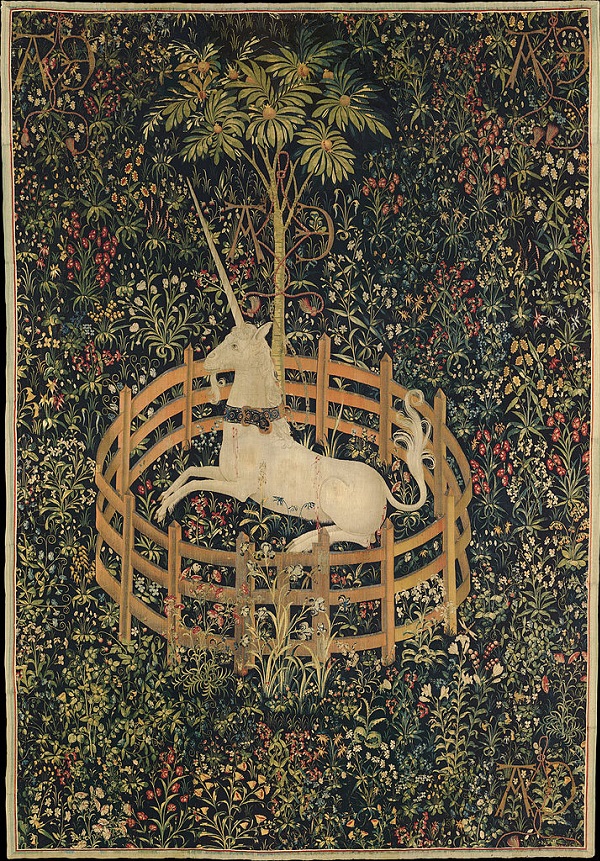
    Parhaps unsurprisingly, the hortus conclusus is also the place where the unicorn — only ever tamed by a pure virgin — ends up, as in this example from the Cloisters Unicorn Tapestries:

    600 Unicorn in Captivity

    So much art history, so much beauty, so much virginity — and all so that I can make a couple of points about Jose Lopez, an Argentinean MP who was arrested earlier in the week.

    **

    The unfortunate Lopez made the error of tossing some bags of money, or moneybags as they are sometimes called, over a hedge into a convent garden…

    A convent, as we’ll easily understand, is a terrific example of the hortus conclusus — and since nuns are typically sworn to poverty as well as chastity and obedience, it is altogether contrary to the intended purpose of a convent’s hortus conclusus to use it as a stash for ill-gotten gains, especially of a monetary kind — to the estimated tune of US$5-8 million.

    So that’s my point number one: that Lopez was acting in direct opposition to the contemplative and unworldly intent of the convent garden. Worse, indeed, he was also carrying some form of Sig Sauer rifle along with his “160 bundles of cash, 108 of dollars, and some of them still thermo-sealed with the stamps from China’s central bank.”

    Ouch.

    **

    But what I like best from the report is the sting in the end of this first paragraph:

    The ex-Kirchnerite official, considered the right/hand man of ex Federal Planning minister Julio De Vido was caught by the police after neighbors and a nun of the Fatima monastery warned authorities about the presence of a man throwing bags over a dividing line of bushes.

    It’s that bit about “throwing bags over a dividing line” that gets me.

    I’ve discussed the concept of liminality before, both lightheartedly, as in Liminality I: the kitsch part [note: NSFW], and more seriously, in Liminality II: the serious part — where I discussed the behavior of the USS Topeka at the Equator as the Second Millennium CE turned in to the Third, and the curious tale of the demonic king Hiranyakasipu and his death at the hands of Narasimha, an avatar of Vishnu.

    A limen or threshold is always a “special place” set apart, and thus sacred and powerful in its own right — and the limen around a convent’s perimeter even more so. We’ve seen the extraordinary effort ISIS made very early on in their campaign to erase the limen between Iraq and Syria established no less determinedly by Sykes-Picot. And we know, too, that the central rite-of-passage by which a woman becomes a nun is a liminal rite (van Gennep, Victor Turner).

    Beware, be very aware of the liminal! Enjoy the security a hortus conclusus provides the pure in heart — but don’t abuse it!

    **

    Sources:

  • Wikipedia, hortus conclusus
  • Wikipedia, Narasimha
  • MercoPress, An Argentine ex-Kirchnerite official caught red-handed trying to hide bags of cash in a monastery
  • Sunday surprise: three entangled faiths

    Monday, June 20th, 2016

    [ by Charles Cameron — two exhibits linking the Abrahamic faiths ]
    .

    For disciplinary as well as doctrinal purposes, the three Abrahamic faiths — Judaism, Christianity, Islam — are generally thought of separately — a separation which the two exhibitions this post revolves around are intended to bring into question.

    **

    One: Of gods and men: how Egypt was a crucible for multiple faiths

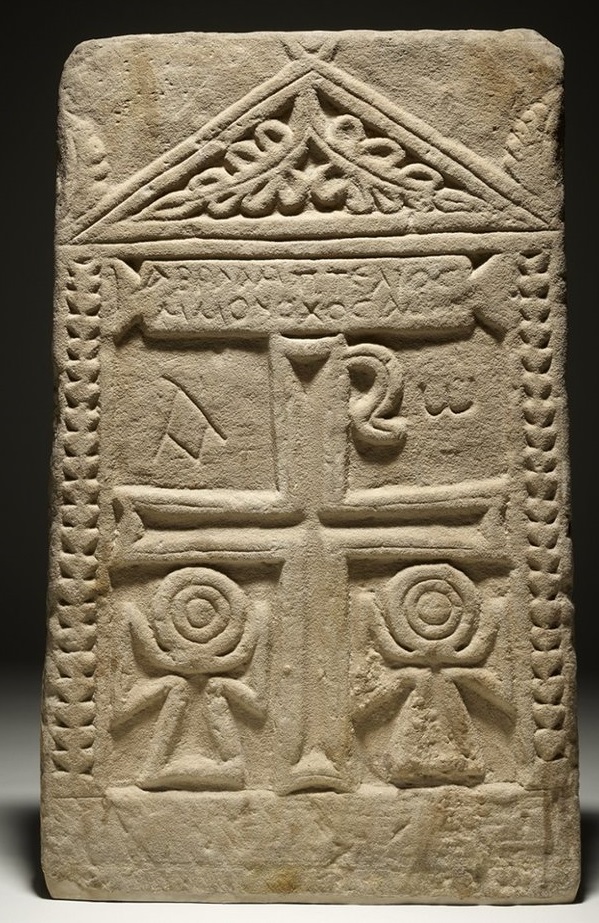
    For instance, there’s a “stele of Abraham” in the British Museum show from last autumn that is worth pondering:

    stele of Abraham

    The accompanying text tells us:

    On public display for the first time will be a gravestone, or stele, for a man called Abraham. “It commemorates someone with a Jewish name and yet it bears Christian symbols inside a classical frame next to the ankh symbol, the ancient Egyptian sign of life,” said O’Connell. “What is more, the engraving on it says he was ‘the perfected monk’ and is written in Coptic Egyptian.”

    More about the show:

    Curators at the London museum will use a series of items, many never put on public display before, to demonstrate the level of “entanglement” of religious symbols and rituals; with Egyptian emblems regularly appearing in classical Greek designs, depicting Jewish stories that were decorated with Christian crosses and Roman wreaths.

    “Over the last 10 or 15 years in scholarship, there has been growing interest across the disciplines in looking at the way religions interacted, rather than just in isolation,” said Elisabeth O’Connell, a keeper in the museum’s Department of Ancient Egypt and the Sudan and a co-curator of the exhibition. “It is becoming clear that a lot of religious history has been founded on our modern distinctions simply being projected back.”

    Note in the next paragraph the use of the terms ” troublesome” and subversive”:

    Two hundred of these troublesome objects, many deliberately ignored by scholars in the past, have been gathered together to challenge the conventions of religious history. From architectural fragments, jewellery, paintings, gravestones and toys, to the paraphernalia of religious worship, they are all subversive evidence that faiths were once amalgamated in a way that was accepted by the ordinary people of Egypt, regardless of their birth-race or family’s religion.

    Those are the Guardian writer’s words — Vanessa Thorpe‘s — not the words of the curators, but it seems the exhibit is intended to emphasize the “melting pot” side of Egyptian religion across the millennium after the fall of the Pharaohs rather than the separations:

    “If you only take the work we have from Dioscorus of Aphrodito, it blows apart these distinctions,” said O’Connell. “He was a lawyer and poet, who lived in Egypt and wrote in Greek, although he was a Christian Copt.

    “He is a great example of what was going on widely, because he used biblical sources and also wrote Homeric verse, one of them dedicated to a man with a Christian name, Matthew.”

    **

    Much the same impulse appears to have been behind a British Library exhibit in 2007:

    Two: Sacred texts that reveal a common heritage

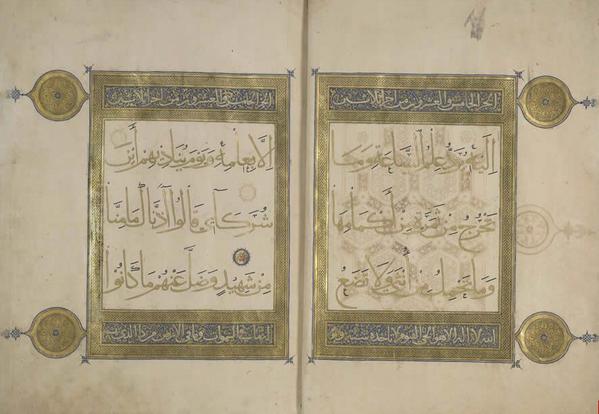
    For the first time, the oldest and most precious surviving texts of the Jewish, Christian and Islamic faiths have gone on display side by side at the British Library. They include a tattered scrap of a Dead Sea Scroll and a Qur’an commissioned for a 14th-century Mongol ruler of modern Iran who was born a shaman, baptised a Christian, and converted first to Buddhism, then Sunni and finally Shia Islam.

    Here’s a two-page spread of that “Mosul Qur’an“:

    quran
    reduced image via the British Library

    The Guardian article continues:

    The exhibition also has some exotic private loans, including an embroidered 19th-century curtain which once covered the door of the Ka’bah, the shrine which is at the core of the hajj pilgrimage to Mecca, a hand embroidered Jewish bridal canopy – and a gold shalwar kameez worn by Jemima Goldsmith in 1995, when she married the former Pakistan cricket captain Imran Khan.

    Phew, pop-cultural enthusiasts will at least have had the shalwar kameez to give them comfort!

    More:

    Graham Shaw, the lead curator, said: “We were determined not to create faith zones, but to show these wonderful manuscripts side by side, and demonstrate how much we share – not least that these are three faiths founded on sacred texts, books of revelation.” Many exhibits are among the oldest of their kind, including a Qur’an made in Arabia within a century of Muhammad’s lifetime.

    The exhibition also shows how calligraphers and manuscript illuminators shared influences and styles. The microscopically detailed decorated capital letters of the Lindisfarne Gospels are echoed in Islamic and Jewish manuscripts, while Christian and Jewish texts borrowed Islamic-inspired decoration, so that a 14th century Qur’an and a translation of the gospels into Arabic are indistinguishable at a glance, and two 13th-century French texts, one Christian, one Jewish, use virtually identical images of King David.

    And this part tickled my fancy, and will surely find a place in my book on Coronation and Monarchy if it ever finds a publisher:

    A later psalter owned by Henry VIII outrageously uses his portrait as the great Jewish king – accompanied by Henry’s court jester, William Somer, beside a text which translates as “the fool says in his heart ‘there is no God'”.

    The wise fool Will Somer or Sommers wasn’t quite a member of Henry VIII’s Royal Family, but stands nearby, in the arch far right, in this detail from a family portrait of 1545 or thereabouts:

    detail Will Sommers Family_of_Henry_VIII_c_1545

    Michael Wilson

    Monday, June 20th, 2016

    [ by Charles Cameron — quick update on Cameron’s Recomended Reading: Michael Wilson from 2008 ]
    .

    Back in 2008, Zen wrote of Michael Wilson‘s papers:

    I’ve only just begun to look at these and I’m posting them here for those readers whose interests gravitate toward issues of intel analysis and futurism.

    I checked recently, and most if not all of Michael’s papers are still available via the Internet Archive:

  • 7Pillars, Papers by Michael Wilson
  • Decision Support Systems, DSSi Publications
  • **

    A quick quote that caught my eye from Al-Qaida’s Endgame? A Strategic Scenario Analysis:

    Osama bin Laden has a number of viable ‘role models’ from the history of the Middle East, including Saladin and the Assassins. For example, Saladin (the enormously successful commander during the Crusades) wrote in a letter to the Caliph in Baghdad that “European merchants supply the best weaponry, contributing to their own defeat.” This is similar to Lenin’s famous comment that “the Capitalists will sell us the rope with which we will hang them.”

    Now there’s a DoubleQuote!

    **

    Here’s something I hadn’t seen before — a video of Michael speaking at DefCon 9, a couple of years after we met:

    **

    And here’s the .pdf vesion of the course I took with him, first online and then in person — if you read one piece of his, this should be the one:

  • Michael Wilson, Continual and Complete Intelligence: a 21st Century Approach
  • Dune, Islam, Jihad, and the perennially missing Mahdi

    Friday, June 17th, 2016

    [ by Charles Cameron — on the proleptic brilliance of Frank Herbert’s 1965 novel, Dune ]
    .

    who's your mahdi
    image via Ian Rountree

    **

    In Arabic and Islamic themes in Frank Herbert’s “Dune”, the writer Khalid admits “I did not read the original novels. I have watched and enjoyed the movie and the mini-series, and read summaries of the novels” — but he’s an Arabic speaker, and offers us an annotated list of Arabic bterms and phrases he encountered in his necessarily limited exposure to the Dune novels. One term which he does annotate is “Mahdi” — about which he has this to say:

    In the Fremen messianic legend, ‘The One Who Will Lead Us to Paradise.’ Paul Atreides, the central figure in the Dune novel is the son of the murdered Duke, he is exiled with his mother, manages to escape, and after a confrontation with the Fremen, gains their respect, and becomes their leader in their struggle against the evil Harkonen. He is called the Mahdi. In Islam, the Mahdi (“The Rightly Guided One”) is an all human Messianic figure, who comes to “fill the world with justice” after much of the opposite. The views of Sunni Islam differ quite a bit from Shia Islam on this, but they both at least agree on this part. Mahdi si a much more central figure in Shia Islam than it is in Sunni Islam, where the concept is often denied and attributed to legends and myths.

    And that’s it.

    **

    lya Somin‘s Volokh Conspiracy piece, Radical Islamism and Frank Herbert’s Dune doesn’t mention Mahdism. Wikia’s Muad’Dib’s Jihad doesn’t either — but Wikia is a fan outlet, and fandom can be excused if it is only occasionally scholarly, it’s a form of devotion, and worthy in its own right. There’s no mention of the Mahdi in Liel LeibovitzTablet review of Jodorowsky’s failed but fascinating attempt to film Dune, What science fiction tried to teach us about Jihad, and why no one listened.

    Oy: my own equivalent would be titled What science fiction tried to teach us about Mahdism, and why no one listened!

    Indeed, one might hope that Ashley Andrews Learn PhD, in her Jihad: Comparing the Fremen Revolt to Contemporary Islamic State, would at least briefly mention the Mahdi, given that IS refers to the Mahdi by name in their magazine Dabiq issue 3:

    And he [the Prophet] (sallallahu ‘alayhi wa sallam) linked this blessed land with many of the events related to al-Masih, al-Mahdi, and the Dajjal.

    and featured a hadith expressly about the Mahdi, though it does not name him, on the final page of issue #5:

    Ibn Mas’ud (radiyallahu ‘anh) narrated that Rasulullah (sallallahu ‘alayhi wa sallam) said, “If there were not left except a day from the dunya, Allah would lengthen that day to send forth on it a man from my family whose name matches my name [Muhammad] and whose father’s name matches my father’s name [‘Abdullah]. He will fill the Earth with justice and fairness as it was filled with oppression and tyranny.” [Sahih: Reported by Abu Dawud]

    But no.

    **

    Why do we so often miss the Mahdi?

    There’s space available for a serious look at Dune in light of today’s jihadism and Mahdism, and I’d fill it if I could find the time. I thought space-time was supposed to be a single continuum, though — how come there’s space but no time?

    You’ll seldom find time with no space, except when attempting to park a car..


    Switch to our mobile site