zenpundit.com » state building

Archive for the ‘state building’ Category

Pushtunistan Rising?

Tuesday, May 19th, 2009


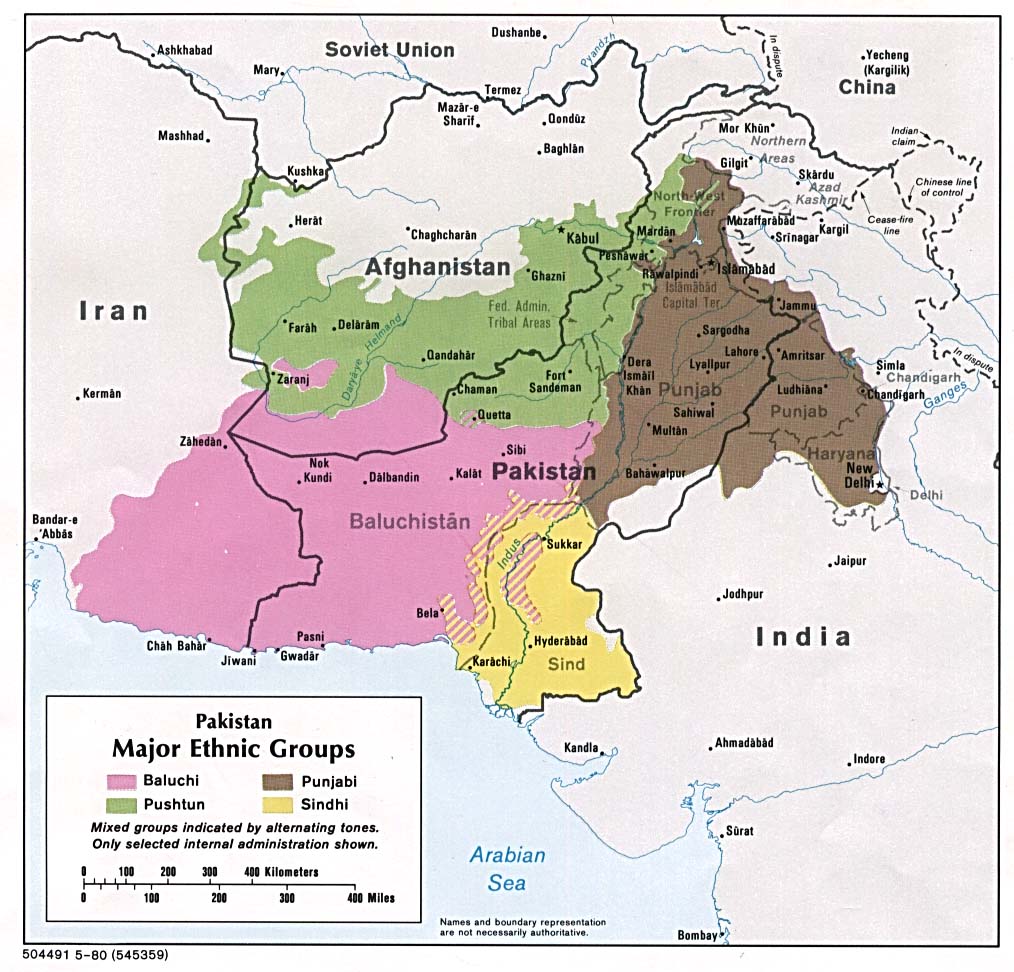
Steve Hynd at Newshoggers made the intriguing suggestion of an independent Pushtun state as a solution to the strategic problems of the Afghanistan-Pakistan region. The Pushtuns, like the Kurds are one of the world’s largest ethnic groups without a state:

The Punjabi and Sindh populations have always regarded the Pashtun as mountain wild men, bandits and reivers. The Pashtun have always regarded their neighbours as prey for their raids. It’s been that way since before the British arrived and shows no sign of abating anytime soon. The Pashtun were only forced at gunpoint into accepting the splitting of their traditional tribal ranges by the Durand Line in 1893. The situation is entirely analogous to the old border reiver clans of the English/Scottish border – another bunch of inter-related hill country wildmen who raided their neighbours irrespective of nationality for over 300 years before finally calming down and accepting imposed nationality. That territorial stramash was only solved by exiling the worst offenders to the American colonies.

….More, with the Pashtun in their own homeland free from outside overlords their reason for supporting the Taliban politically would disappear and the incompatibility between the Taliban’s extreme form of Islam and the Pashtun’s own traditional religious forms would put the two at odds more often than not.

Rather than insisting on fighting the Pashtun, the amswer in Af/Pak may lie in giving them back the independence they once had.

Read the rest here

Sort of like Ralph Peters famous re-drawing of the Mideast map a few years ago, Steve’s suggestion is provocative.The Kurds took decades to get beyond the Talabani-Barzani rivalry and seize the de facto independence that the U.S. invasion of Iraq made possible and “frontier agents”, whether British or from the ISI , have always succeeded in playing off one Pushtun group against another with only the Soviet invasion of Afghanistan in 1979 creating even semi-unity among Pushtuns – and then temporarily. This is the stuff of Pakistani nightmares but a latent sense of Pushtun nationalism lurks in the shadows, with Afghanistan being thought of as a “Greater Pushtunistan”.

Is A Weak or “Hollow” State Worse than a Failed State?

Thursday, April 2nd, 2009

Galrahn, writing at USNI Blog about my recent post on Mexico, raised an important question: “Are Weak States a worse outcome from the perspective of U.S. national security than a Failed State?”. Galrahn comes down squarely against the “muddling through” of a weak state:

Failed States Are Worse Than Weak States

….My point would be this: there is no value in the cartels overthrowing the Mexican government because its existence helps them more than its absence helps them.

But this is my larger point. There are currently zero, none, nada 4GW/COIN/Whatever military solutions for failed states; our emerging 4GW/COIN/Whatever doctrines, strategies, and theories only apply for weak states that have legitimate governments that can be supported. Failed states are problems that can be handled, even in an ugly way, by conventional military forces. The danger to US strategic interests is not failed states, as is often claimed, rather the real danger to US strategic interests always comes from weak states.

The ugly truth is, failed states allow for freedom of action by military forces without consequence; weak states do not allow such freedom of military action. Afghanistan before 9/11 was a weak state, not a failed state, thus Al Qaeda operated under the state governance of the Taliban and had top cover to carry out its evil agenda. In Somalia, pirates operate in a failed state, and as a failed state the west has taken military action, including cruise missiles, hostage rescue attempts with special forces, and other military activities without consequence against targets as they have been identified. The danger Somalia poses in the future to US strategic interests is not that Somalia continues as a failed state, rather if it were to become a weak state with a recognized legitimate government strong enough to say, eliminate the pirate threat while still being too weak to prevent the training and development of terrorist cells.

….but because it is a weak state, we face serious and complex diplomatic obsticles in taking freedom of action, even along our own national border. In a failed state, we could do what needed to be done to take out the bad guys. As a weak state, we are far more limited in options, and must account for the legitimate governments perspective a lot more than we would if Mexico was a failed state.

Zenpundit may or may not be right regarding the threat posed by Mexico, but if he believes Mexico as a failed state is more dangerous than a Mexico as a weak state, he is mistaken.

Read the whole post here.

I found Galrahn’s argument to be very intriguing. There’s the issue of Mexico specifically in his post and then Weak States being worse than Failed States as a general rule. First, Mexico:

The thought experiment I penned previously aside, Mexico is not yet a Failed State and I hope it does not become one – though I would not wager a mortgage payment on it staying away from catastrophic failure. Mexico is definitely, in my view, already a Weak State suddenly resisting the process of being “hollowed out”, slowly, by vicious drug cartels. I wish President Calderon well in his efforts to crush the narco networks, but just as America cannot avoid admitting that our drug laws are impacting Mexico severely, let’s not let the fact that Mexico’s ruling oligarchy has also brought this disaster on themselves with their self-aggrandizingly corrupt political economy escape comment.

The crony-capitalist-politico ruling class in Mexico ruthlessly squeezes their poor but ambitious countrymen to emigrate and is too greedy to even invest properly in the very security services that keeps their own state apparatus afloat. Mexico is not a poor country, their GDP is in the same league as that of Australia, India or the Netherlands. Mexico can afford to pay for a professional police, a functioning judiciary and a larger Army at a minimum. On a more reasonable level, Mexico can also afford basic public education and core public services for it’s citizens and could liberalize it’s economy further to stimulate entrepreneurship. They choose not to do so. An elite that stubbornly refuses to reform, even in the interest of self-preservation, is not a group likely to make statesmanlike decisions in the Cartel War.

If Mexico fails, really fails on the order of Lebanon in the 1980’s or Somalia since the 1990’s, Galrahn is correct that the U.S. military would, in the last analysis, have a free hand to do things in Mexico that could not be remotely contemplated today. However the  second and third order effects of a Failed State Mexico are calamitous enough that I’d prefer to skip enjoying that kind of “free hand”. Unless Mexicans have something in their DNA that makes them different from Iraqis, Afghans, Cambodians or Kosovar Albanians, extreme levels of violence in one area will cause them to move to areas of relative safety in another place. Internal displacement will precede external displacement. Elite flight will precede the flight of the masses.

That brings us to the general question of, is a Failed State better or worse than a Weak State whose tattered shreds of international legitimacy prevent robust foreign intervention? I am going to “punt” by inclining toward judging on a case-by-case basis. “Failed State Botswana” is not likely to impact the world very much nor is “Functional State Congo” going to look very good next to anything except Congo as the Failed State that it is. Now “Failed State China” or “Failed State Russia”, that has consequences that are the stuff of nightmares.

What do you say? Which is worse: Weak State or Failed State?

ADDENDUM:

SWJ Blog links to a Washington Post series on the Cartel War
POINT-COUNTERPOINT on Mexico

Tuesday, March 31st, 2009

My previous post stirred some interest in the blogosphere on the issue of Mexico being in danger of becoming a “Failed State” and prompted others to respond with Mexico related analysis of their own. Here are some that caught my eye:

           POINT – Mexico is a Failed State or at least in some danger of becoming so:

Threatswatch.org (Fraser) Los Zetas and the Denial of Mexico’s Failed State Status

The softening of words and the aversion to stating the obvious by the Administration simply obliterates the reality that President Felipe Calderón of Mexico “leads” a country dominated by the cartels and not governed by the federal government. The transparent denial of the recent Joint Operating Environment report is troubling at best.

To better understand just how close to the precipice he is, it might be worthwhile to take another look at the organization (and movement) of Los Zetas. As a reminder, Los Zetas are a paramilitary group tied to the Gulf Cartel. Their origins and their evolution from being deserters from the Mexican special forces to a criminal organization is chronicled in a report from International Relations and Security Network

….With each of the original members training at least another ten, they grew to over 300 strong by 2003. In just the first quarter of 2009, Los Zetas (the organization) has been linked to a death threat against the president of Guatemala, the hand grenade tossed in Pharr, Texas and various other criminal acts. The ranks of Los Zetas has grown, and strikingly, they have broken ranks with the Gulf Cartel. Over time however, and with the deaths of some of the original Zetas, they have morphed into an organization. This is a very important distinction to note.

RBO Are Afghanistan, Pakistan, Mexico ‘failed states’? If so, then what?

….In particular there is recent debate as to whether Mexico is/is not a failed state. If it is, then we ask whether its “failed” status is on a par with such other failed states as Pakistan and Afghanistan? – Even though there are those who do not subscribe to the notion that either of them is a failed state.

As always, let’s start at the beginning. What is a failed state?

In the simplest of definitions, a failed state is one that has a “shattered social and political structure.”

Writing December 1999 for the International Review of the Red Cross, Daniel Thürer, J.D. (right), Professor of International Law, European Law, Constitutional Law and Administrative Law at the University of Zurich, said

    Failing States are invariably the product of a collapse of the power structures providing political support for law and order, a process generally triggered and accompanied by “anarchic” forms of internal violence.

Dr. Thürer wrote that former Secretary-General of the United Nations, Boutros Boutros-Ghali, described this situation in the following way (emphasis added):

    A feature of such conflicts is the collapse of state institutions, especially the police and judiciary, with resulting paralysis of governance, a breakdown of law and order, and general banditry and chaos. Not only are the functions of government suspended, but its assets are destroyed or looted and experienced officials are killed or flee the country. This is rarely the case in inter-state wars. It means that international intervention must extend beyond military and humanitarian tasks and must include the promotion of international reconciliation and the re-establishment of effective government. States in which institutions and law and order have totally or partially collapsed under the pressure and amidst the confusion of erupting violence, yet which subsist as a ghostly presence on the world map, are now commonly referred to as “failed States” or “Etats sans gouvernement”.

Jay Fraser, who has been watching developments in Mexico for some time, drills down on the most violent and fastest evolving faction among the cartel groups in Mexico. Procrustes concentrates on the “Failed State” concept and examines how conditions in Mexico compare to academic yardsticks and the case studies of Afghanistan and Pakistan, two countries that inevitably crop up in discussions of failed and failing states.

          COUNTERPOINT – Mexico is not a failing state or has greater resilience than experts are acknowledging:

Apropos Two Theories – Why Mexico may NOT fall apart – and a way to think about it

I’ve never seen so many American analysts and journalists sounding alarms about Mexico – most for good reasons, others for their own agendas. And it’s true, parts of Mexico have turned awfully violent, barely governable. Government controls have weakened, and security trends are adverse. Domestic terrorism and insurgency are not presently the problem; it’s the extreme crime and corruption, driven by the drug cartels and other criminal gangs.

….Yet, I’m struck that long-time American experts who specialize on Mexico are not providing counter-arguments. A few Mexicans are, lately Enrique Krauze. But no Americans I know of (though I’ve not searched exhaustively).Shouldn’t analysts and journalists who specialize on Mexico be doing a better job of wondering whether and why the growing alarmism may be wrong – again?When I worked as a specialist on Mexico, I experienced three or four periods when Mexico seemed to be on the verge of instability, in particular:

  • In 1968, at the time of the student uprising and its military suppression (I was then a graduate student studying in Mexico City).
  • During 1984-8, when a few U.S. government analysts claimed that Mexico was about to collapse due to multiple economic, political, and other crises.
  • In 1994-5, when the Zapatista uprising raised new specters of widespread insurgency, if not terrorism.

Each time Mexico remained stable and recovered. And it did so mostly for reasons that American analysts had not understood or anticipated well at the time – including American experts on Mexico who did not buy into the alarmism.In these three instances, the key stabilizing factor turned out to be some kind of social or organizational network that American analysts were barely aware of:

  • In 1968, it was intra-elite networking that revolved around the mysterious camarilla system (or so I think, though I was just a grad student then).
  • In the mid 1980s, it was familial and other social networks that cushioned the effects of unemployment and other economic displacements.
  • In 1994, it was the roles played by newly-formed networks of human-rights and other activist NGOs, first in calming the Zapatista scene, later in monitoring the 1994 presidential election campaign.

Conditions in Mexico look worse than ever this time around – much worse, not just along the U.S. border, but everywhere that the drug cartels are powerful. So I’m not suggesting optimism, but rather a search for additional factors that may moderate the equations of gloom.What might keep Mexico from disintegrating this time? My guesstimate is that networks will be the decisive factor again. And the networks that will matter most this time are:

  1. Informal intra-elite social networks that reflects what’s left of the old camarilla dynamic.
  2. Cross-border organizational networks for U.S.-Mexico security (military, police, intel) cooperation

David Ronfeldt, for new readers here, is a major “edge” thinker in the national security field at RAND and is a co-author (with John Arquilla) of the influential “classic”,  Networks and Netwars: The Future of Terror, Crime, and Militancy , which sits on my shelf about two feet from me as I type this. As it happens, Ronfeldt also specialized in Mexican and Latin American security as an analyst during the Cold War which gives means that his caveats are worth careful consideration. Frankly, we are all better off if Ronfeldt is correct and the “alarmists” are wrong, though I think the grim state of affairs south of the Rio Grande is deterring most Mexico experts  from going out on a limb to make positive predictions.

How About an Assistant SecDef for Irregular Warfare ?

Saturday, December 20th, 2008

Real change requires budgets, bureaucratic platforms and visionary leaders who can be both champion and evangelist. Having successfully lobbied for the retention of Secretary Gates, the small wars/COIN/military reform/strategic security community should capitalize on the logical political momentum and not be afraid to ask for the moon. This and many other things.

The United States and the world are at the kind of crystallizing flux point – where paradigm shifts have been recognized but the policy responses have not been decided – that comes once in a half century or more. Many things are fluid right now in different domains that were once regarded as certainties. Time to push while doors and minds are open.

People, like Secretary Gates, who “get it” need to be put in critical positions ASAP. Broadly speaking, what gets decided in the next 6 months may impact all of us for the next 60 years.

When 4GW Forces Weigh Becoming a State

Thursday, June 26th, 2008

At the most excellent site Jihadica, I found this obscure gem:

Interview with Umarov, North Caucasus Amir

More interesting is Kavkaz Center’s newly-released interview with Dokka Umarov, the amir of the North Caucasus Emirate that he declared at the end of 2007. Here’s what stands out:

  • The decision to declare an emirate was not taken lightly and occurred after much debate.
  • Umarov acknowledges that he has taken a lot of heat from fellow travelers for aligning himself ideologically with al-Qaeda and declaring war on the world.
  • The mujahids do control some territory, but their control is not absolute. Therefore, he does not want his supporters rushing to form a state.

The two translations, Arabic and English, diverge over what sort of state Umarov is talking about. In Arabic, he says he doesn’t want his supporters rushing to form an “actual state” (dawla fi`liyya). In English, he says he doesn’t want them rushing to form a “virtual state.” The difference is significant and if anyone can download the video and make out the right translation, I’d appreciate it

Almost two years ago, William Lind, musing on the prospects of the much more militarily and politically formidible HAMAS terrorist group, pointed to the question for 4GW entities “To Be or Not to Be a State”:

Normally, that captured Israeli would be a Hamas asset. But now that Hamas is a state, it has discovered Cpl. Gilad Shalit is a major liability. Israel is refusing all deals for his return. If Hamas returns him without a deal, it will be humiliated. If it continues to hold him, Israel will up the military pressure; it is already destroying PA targets such as government offices and arresting PA cabinet members. If it kills him, the Israeli public will back whatever revenge strikes the Israeli military wants. Hamas is now far more targetable than it was as a non-state entity, but is no better able to defend itself or Palestine than it was as a Fourth Generation force. 4GW forces are generally unable to defend territory or fixed targets against state armed forces, but they have no reason to do so. Now, as a quasi-state, Hamas must do so or appear to be defeated.

….Hamas faces what may be a defining moment, not only for itself but for Fourth Generation entities elsewhere. Does it want the trappings of a state so much that it will render itself targetable as a state, or can it see through the glitter of being “cabinet ministers” and the like and go instead for substance by retaining non-state status? To be or not to be a state, that is the question – for Hamas and soon enough for other 4GW entities as well.

Statehood appears to be a risky tipping point for an irregular movement to cross.  A strong insurgency only makes for a vulnerable state and a targetable, semi-disciplined, conventional force unless the new state can devote years and resources to consolidating it’s fragile position. For that reason, in the era of State vs. State warfare, guerilla armies were careful to create separate civilian political wings or, better yet, “governments-in-exile” that could safely operate in some remote capitol, playing the diplomatic game of winning legitimacy under the protection of a foreign power. This is not an option for 4GW movements because being an overt pawn of foreign powers conflicts with the ability of the 4GW entity to compete on the moral level of warfare with the regime.

What about “virtual statehood” ?

This is easier to manage, being mostly free of the responsibilities of governance of fixed territory. A virtuual state is still targetable, being composed of social and economic networks but it is a highly elusive target, very adaptive, quickly evolving and with a propensity toward symbiotic behavior, grafting itself onto a host nation-state, willing or unwilling, such as Pakistan in the case of al Qaida ( and before Pakistan, Afghanistan. And prior to that, Sudan).

Wielding sophisticated information networks, the virtual state can cultivate primary loyalties anywhere on Earth that is within range of an ISP or area of mobile phone reception.


Switch to our mobile site
