Archive for the ‘counterinsurgency’ Category
Thursday, December 25th, 2014
[by Mark Safranski, a.k.a. “zen“]
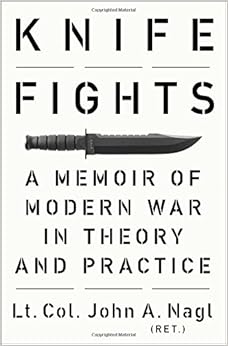

Knife Fights by John Nagl
Jon and Pete of The Break it Down Show interview arch-COINdinista and former CNAS president turned educator, Dr. John Nagl. Pete, who is a deep believer in (and practitioner of) village-district level, F2F partnership with locals in stability ops, counterinsurgency, aid and development projects and host country transition was definitely pleased to have Colonel Nagl as a guest.
Listen to the show here –Knife Fights – with John Nagl
Good drill down after the half-hour mark on the complexity of trying to do COIN with units rotating in and out and the need to avoid imposing American solutions on local forces that may not be able to sustain them ( or need them in the first place, having more urgent problems).
Related Break it Down Show interview with Johnny Walker here..
Posted in Break it Down Show, COIN, counterinsurgency, insurgency, intellectuals, Interview | 1 Comment »
Tuesday, January 7th, 2014
[by Mark Safranski, a.k.a. “zen“]
Yale organizational behaviorist Rodrigo Canales has an interesting talk on the Narco-insurgency in Mexico ( which he correctly sees as having been as lethal as Syria’s civil war). While this won’t be news to close students of Mexico’s cartel wars, Canales explains how Los Zeta, La Familia, Knights Templar and Sinaloa cartel violence is neither random nor strictly criminal on criminal violence but is used as part of organizational strategies to create distinctive “franchise brands”, amplify political messaging, reinforce effects of social service investment in the communities they control and maximize market efficiency of narcotics sales and other contraband. COIN, 4GW and irregular warfare folks will all see familiar elements in Canales management theory driven perspective.
A useful short tutorial considering the cartels are operating inside the United States and their hyper-violent tactics are eventually going to follow.
Posted in 21st century, 3 gen gangs, 4GW, Adaptability, COIN, counterinsurgency, counterterrorism, criminals, dystopia, gangs, government, insurgency, Latin America, law enforcement, Mexico, military, narcoterror, national security, non-state actors, organizations, state failure, strategy, Tactics, terrorism, theory, war | 5 Comments »
Tuesday, November 26th, 2013
[by Mark Safranski, a.k.a. “zen“]

Octavian Manea, the interviewer par excellence of Small Wars Journal, steps up with an interview with COIN guru and former USG senior adviser Dr. David Kilcullen:
[….]
SWJ: Should we expect that when we see all these clustered elements conflict is more likely, the societal environment more conflict prone?
David Kilcullen: There are two different ways to look at this set of relations. If we look at this from the standpoint of the military or law-enforcement, then it is pretty clear that we really need to get comfortable with operating in a very littoral, very urban and very highly networked environment because that is where the bulk of the people on the planet are going to live in the next generation. If you are not comfortable operating in such an environment you are not going to be effective. But this doesn’t mean that the solution to this problem is a military one. Seen from the perspective of the city in itself, it is pretty clear that the solution is not to bring the hawk cops in, and apply hard power tools to stabilize the environment. This is often a recipe for disaster. The paradox is that, on the one hand, there are no military solutions, but at the same time there are no solutions at all without security. Someone will provide that security and it is better for it to be the locals, but if the locals cannot do it, then history suggests that we will be drawn into this kind of conflict with about the same frequency as in the past.
SWJ: You emphasized in your book, and also at the New America Foundation launching event that in the future we will face operational continuity and environmental discontinuity. What if the environmental discontinuity can in itself be a variable able to change the operational continuity?
David Kilcullen: That’s possible, to the extent that we have data — information based on historical patterns. On one hand, it seems that there is a lot of unwillingness on behalf of the American politicians to contemplate future engagements like Afghanistan and Iraq. Congress has no appetite as we’ve seen in the case of Syria for further military activity overseas. The military leadership is very reluctant to recommend that kind of operation. But going back to the 19th century we see a cyclical pattern in American military history where we repeatedly have leaders coming out with this kind of statement and yet we end up doing these kinds of operations anyway, on about the same frequency. There are deep structures about the way the US is connected to the international community that lead to this kind of behavior. It is possible that we won’t do this in the future, but it is not the way to bet. If you are going to bet on what is likely to happen, the pattern suggests that we are going to see a specific “conflict climate” (shaped by population growth, urbanization, littoralization and connectedness) within which wars will arise.
Read the rest here.
Posted in COIN, counterinsurgency, insurgency, intellectuals, kilcullen, military, small wars journal, strategist, strategy, Strategy and War, Tactics, theory, war | 1 Comment »
Monday, September 9th, 2013
[ by Charles Cameron — a popular catch-phrase fumbled ]
.

**
TE Lawrence was an original. The “second senior official” either has a poor memory for quotations, or wishes he were an original, sad in either case.
Hat-tip to the Small Wars Journal editors, who noted the combo — they referenced John Nagl, who borrowed his book title from Lawrence, while I prefer to attribute the spoon to Lawrence directly, but no matter.
What comes next? Chewing Qat with a spork?
Posted in Charles Cameron, counterinsurgency, humor, john nagl, war | 7 Comments »
Monday, September 2nd, 2013

[by Mark Safranski a.k.a. “zen“]
Octavian Manea has had an excellent series of COIN interviews at SWJ and this is one of the more important ones:
Reflections on the “Counterinsurgency Decade”: Small Wars Journal Interview with General David H. Petraeus
SWJ: In his recent op-ed published in the New York Times, “The Pipe Dream of Easy War”, General H.R. McMaster warned against the fantasy of “a new era of war”, and especially about the dangers in the blind faith in the transformative effects that technology promises to have on war. He argued that over the past counterinsurgency (COIN) decade we relearned a few lessons that we really should keep in mind as we head into the future: “American forces must cope with the political and human dynamics of war in complex, uncertain environments”. His warning reminds me of an article you wrote in 1986 with General John Galvin about “uncomfortable wars”. You warned to take into consideration “the societal dimension of warfare”. To what extent do you see that prophecy still holding true post Iraq and post Afghanistan?
General Petraeus: I think the essence of the article back in 1986 with General Galvin was frankly the importance of the human terrain in each particular situation, and the importance of understanding the terrain, having a very nuanced, detailed feel for the context of each situation, not just nationally, but sub-nationally and literally all the way down to each valley and each village. That kind of knowledge was achieved in Iraq and helped us enormously during the Surge. We had a greater understanding there, earlier than we did in Afghanistan, just because we had so many more forces on the ground, 165,000 American military alone at the height of the surge. In Afghanistan at the height of our deployment, we had 100,000 US troopers and about 50,000 coalitional forces, and we maintained that level for a relatively brief period of time. As I noted on a number of occasions, we never really got the inputs close to right in Afghanistan until late 2010.
So, noting the importance of human terrain, I believe, is a fundamental aspect of crafting a counterinsurgency campaign. In fact, it was the biggest of the big ideas when we launched the Surge in Iraq, and we knew that since the human terrain was the decisive terrain, we would had to secure it as our principal focus – and to do so by living with the people, locating forward operating bases/joint security stations in the neighborhoods and villages, and specifically right on the sectarian fault-lines across which the heaviest fighting was ongoing in the capital. We ultimately established 77 additional locations just in the Baghdad area of operations alone, and many dozens more elsewhere throughout the country. There were other big ideas to be sure: e.g., that you can’t kill or capture your way out of an industrial strength insurgency, such as we faced, therefore you need to reconcile with as many of the insurgents as was possible, seeking to maximize the number of the reconcilables; correspondingly, we also needed to intensify our campaign of targeted operations against the irreconcilables. But I think, fundamentally, it comes back to this issue, that it is all about people, counterinsurgency operations are wars in, among, and, in essence, for the people. And the first task of any counterinsurgency campaign has to be to secure those people.
Read the rest here.
Posted in Afghanistan, COIN, counterinsurgency, counterterrorism, insurgency, intellectuals, Interview, iraq, mideast, military, military history, military training & education, national security, petraeus, small wars journal, state building, state failure, strategist, strategy, Strategy and War, swj blog, Tactics, terrorism, theory, tribes, veterans, war, warriors | 4 Comments »


