zenpundit.com » theory

Archive for the ‘theory’ Category

Foreword

Friday, September 26th, 2008

Tom Barnett posted up on his foreword to  The John Boyd Roundtable: Debating Science, Strategy, and War:

…To truly think in grand strategic terms is hard because, in order to communicate concepts to the universe of relevant players, one needs a sort of “middleware” language able to traverse domains far and beyond the most obvious one of warfare. As America heads deeper into this age of globalization-a global order fundamentally of our creating-our need for such bridging lexicons skyrockets. In a networked age, everything connects to everything else, so most of what constitutes strategic thinking nowadays is really just the arbitraging of solid thinking regarding the dynamics of competition, leveraging the surplus of conceptual understanding in one realm to raise such understanding in others….

Read the rest here.

Barnett and Boyd shared a teaching modality, “the brief”. Here’s a head to head comparison:

Colonel John Boyd:

Dr. Thomas P.M. Barnett:

CTLab Symposium – On the Hamdan Tribunal

Thursday, September 25th, 2008

As I mentioned previously, CTLab is featuring a symposium this week on the Hamdan Tribunal with Professor Brian Glyn Williams  who testified as an expert witness, and an invited panel of legal scholars and academics ( including blogfriend/SWC member Dr. Marc Tyrell). This week begins with a five-part series on the tribunal itself by Dr. Williams. His posts, so far:

Defending Hamdan: The Capture and Defense of Bin Laden’s Driver

Defending Hamdan: On Ruffling Establishment Feathers

Defending Hamdan: Letter and Spirit of the Law

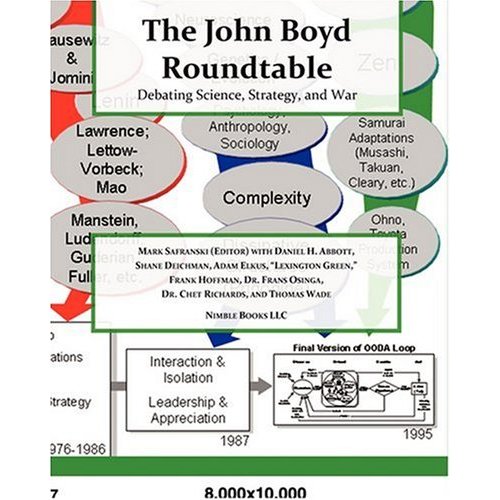
NEW BOOK – The John Boyd Roundtable: Debating Science, Strategy and War

Monday, September 22nd, 2008

boydbook2.jpg

        The John Boyd Roundtable: Debating Science, Strategy, and War

This post has been a long time coming.

A while back, we had a a symposium at Chicago Boyz to discuss and debate the superb book Science, Strategy and War: The Strategic Theory of John Boyd by Colonel Frans Osinga ( Softcover edition available here). It was a great discussion from which I learned far more about  the ideas of the iconoclastic military theorist John Boyd than I had ever previously considered. Not everyone involved was an admirer of John Boyd, a few were initially skeptical and we had one certified critic ( though I had tried to recruit several more). Overall, it was the kind of exchange that makes the blogosphere special as a medium when it is at it’s intellectual best.

Shortly thereafter, via Dan of tdaxp I was approached by the publisher of Nimble Books, W.F. Zimmerman, who happened to be a military history buff and who was interested in working our loose online discussion of Dr. Osinga’s prodigious tome into a book. Initially, I was somewhat dubious but I warmed to the project at the urging of tdaxp and Lexington Green, and agreed to serve as the Editor and “herder of cats” in a project that would involve a large number of contributors with very different backgrounds and some fairly dense and esoteric material on strategic theory to digest and make comprehensible to a general reader.

A wonderful experience.

We had an excellent roster of contributors for The John Boyd Roundtable: Debating Science, Strategy, and WarDr. Chet Richards, Daniel Abbott, Shane Deichman, Frank Hoffman, Adam Elkus, Lexington Green, Thomas Wade and Dr. Frans Osinga, who contributed several essays. Dr. Thomas Barnett sets the intellectual tone in the foreword after which the authors brought a wide range of professional perspectives to bear – cognitive psychology, military history, physics, strategy, journalism and, of course, blogging – in a series of articles that tried to explain the essence and dimensions of John Boyd’s contribution to strategic thought.  Hopefully, we succeeded in creating an interesting and useful primer but the readers will be the ultimate judges, free to dispute our conclusions and offer contending arguments of their own.

I’d like to think that Colonel Boyd would have wanted it that way.

Online Symposium at CTLab

Tuesday, September 16th, 2008

Next week CTLab in it’s slick, officially rolled-out, version kicks off it’s new iteration by hosting an online symposium on the Hamdan trial ( note, this is not the SCOTUS decision in Hamdan v. Rumsfeld – though I’m certain that case is also fair game for discussion –  but instead Hamdan’s subsequent trial by military tribunal).

Social Science In War / Online Symposium

“CTlab member Brian Glyn Williams, PhD, Assistant Professor of History at the University of Massachusetts, Dartmouth, recently testified as an expert witness for the defence in the trial of Salim Ahmed Hamdan, “Bin Laden’s Driver”, in the first US military tribunal since World War II…

…On 22 September 2008, CTlab will launch an online symposium on the scholarly and substantive implications of the Hamdan trial. Dr. Williams has drafted an original, narrative account of his experience, and is making it available for discussion through the CTlab weblog. It will be released for public consumption, followed by comments and observations from a panel of invited legal scholars and social scientists based in the United States, the United Kingdom, Canada, Australia, and New Zealand.”

I’ll put in my two cents regarding the symposium and Hamdan after the conclusion.

Battles of Military Doctrine

Sunday, September 7th, 2008

 I am behind the news curve on this one but here’s a good article from InsideDefense.com ( Hat tip Chris Castelli) on the controversey over the call by USMC General James Mattis to banish “EBO” (Effects-Based Operations) and “Systems” terminology from military doctrine. Unsurprisingly, the U.S. Air Force is less than pleased:

Mattis Sparks Vigorous Debate

….How Mattis’ guidance will be implemented remains unclear, but the memo signals a sea change in the way JFCOM will address EBO.

By declaring that JFCOM will no longer use, sponsor or export the terms and concepts related to EBO, ONA and SoSA in its training, doctrine development and support of military education, Mattis tees up a major opportunity for EBO critics to curtail the use of these terms and ideas in American military discourse. Some EBO proponents see this as a threat, while other EBO advocates see an opportunity to hone the concept and discard unhelpful baggage.

Mattis explicitly calls for refining two joint doctrine publications that dictate how military officials use effects in joint operations in terms of desired outcomes.

….Before Deptula provided comments on the missive to ITP, Air Force headquarters referred questions on the topic to retired officers like McInerney, who unloaded heaps of criticism.

“Even though I am no longer on active duty I am embarrassed for a combatant commander to publish such a document,” McInerney says. “I am a fan of Mattis but this is too much.”

McInerney even encouraged combatant commanders to “ignore” what he sees as a shocking memo.In an e-mail to ITP, McInerney calls JFCOM’s missive the “most parochial, un-joint, biased, one-sided document launched against a concept that was key in the transformation of warfare — and proven in the most successful U.S. military conflicts of the past 20 years (Desert Storm and Allied Force).”

He belittles the two-page memo as a “tantrum” and the accompanying five-page guidance as “puerile” and “totally unbecoming” of a JFCOM commander.Mattis should be “encouraging multiple perspectives for the enhancement of joint operations — not trashing them,” McInerney asserts. The JFCOM memo is “intellectually bankrupt” and the policy’s conclusions are “profoundly out of touch with reality,” he adds.”The rationale ignores any notion of strategic art much less operational art, and instead relies on centuries’ old, discredited ‘commander’s intuition’ to design, plan and execute campaigns rather than offering a demonstrated better alternative,” he insists.

All strategic theories as they percolate through a massive bureaucracy tend to become distorted, misunderstood, inflated, stretched to cover pre-existing agendas, get advanced in tandem with career interests and be misapplied to situations for which they were never intended. EBO is no exception but “banning” concepts wholesale from discussion is less healthy for the long term intellectual good of an organization than is simply subjecting them to warranted criticism.

Those interested in a USAF practitioner’s counterpoint might look at a series from the now defunct FX-Based blog where Sonny was responding to an op-ed by  Ralph Peters, one of the more colorful EBO critics:

In Defense of EBO

In Defense of EBO, Part II.

In Defense of EBO, Part III.

In Defense of EBO, Part IV.

Extensive discussion of the Mattis pronunciamento can be found ( and engaged in) at The Small Wars Council.


Switch to our mobile site