zenpundit.com » book

Archive for the ‘book’ Category

Book Review: The Authentic Swing by Steven Pressfield

Wednesday, September 25th, 2013

[by Mark Safranski a.k.a “zen”]


The Authentic Swing by Steven Pressfield 

Callie was kind enough to send me a review copy of Steven Pressfield’s new non-fiction book, The Authentic Swing. Much like the title implies, it is a book with an arc.

The Authentic Swing continues a theme Pressfield began with his excellent The War of Art, continued with Do the Work and Turning Pro of helping struggling writers, artists and others conquer their resistance and acquire the mature habits of mind to become creative, productive professionals. While the previous books were advice, The Authentic Swing is a demonstration. Pressfield breaks down for the reader the gestation and evolution of his first successful novel, The Legend of Bagger Vance and applies a granular eye to the creative process but does so without tipping his hand or writing a “cookbook”. Steve is employing all his gifts as a storyteller to lead and nudge the reader into understanding.

There are many parts in the book that I like, but the following is in my view the most important, despite being less colorful and more straightforward than others:

When Robert McKee was a young writer/director in New York, he got the chance to interview Paddy Chayefsky, the only person to have one two Academy Awards for original Screenplay (Marty and Network) Chayefsky shared this priceless nugget:

As soon as I figure out the theme of my play, I type it out in one line and scotch tape it to the front of my typewriter After that, nothing goes into the play that isn’t on-theme.

If  there is a single more powerful piece of wisdom for any writer, artist or entrepreneur, I don’t know what it is.

Theme.

Theme is everything.

Once we know the theme we know the climax, we know the protagonist, we know the antagonist, we know the supporting characters, we know the opening, we know the throughline.

I said before that I have a file in my computer titled NEW IDEAS. I have another THEME.  for each new project, I open a new file and title it THEME. I go back to this file over and over. I pile paragraph on paragraph, trying to answer the question, “What the hell is this book about?”

It’s hard.

Theme not only drives art, it drives a coherent life. It makes the disparate connected and gives actions unity. We see theme in great innovative companies, in the curriculum of our best university programs, at the core of great religions, in revolutionary political movements and a nation’s grand strategy. Charles Hill, drew on themes of classical literature to teach that very point about foreign policy. This advice is worth the price of the book alone.

The theme here is authenticity and allowing yourself to express it. Pressfield demonstrates this frequently by parable and metaphor, moving the reader toward the process of discovering authenticity without making the fact that it is a process confuse the reader with the expectation that it will be linear or easy, only natural. I don’t want to give away too much because it is fun to see how the vignettes unfold on build upon one another, obviously golf and the cultural context the sport provided for Bagger Vance is a large part of the book but that will not be a surprise. I will say that The Authentic Swing is a very elegant method of teaching.

Steve’s best non-fiction book since The War of Art.

Ronfeldt’s In-Depth Review of America 3.0

Monday, September 23rd, 2013


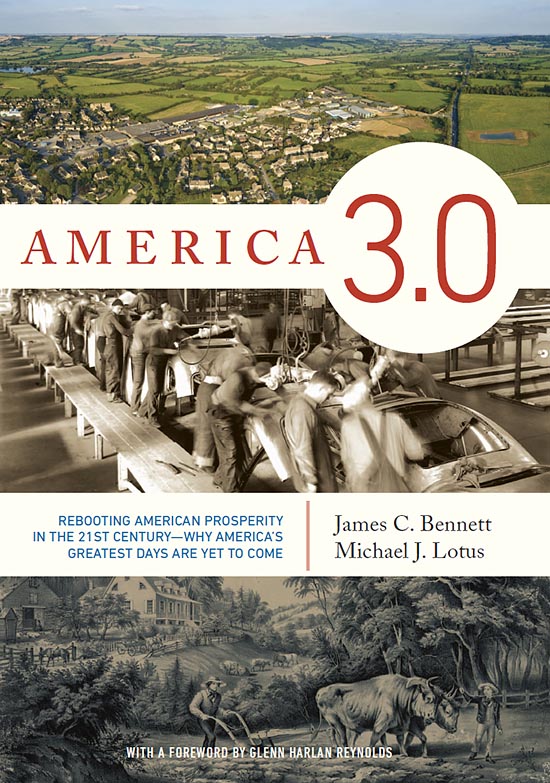
 David Ronfeldt, RAND strategist and theorist has done a deep two-part  review of America 3.0 over at his Visions from Two Theories blog. Ronfeldt has been spending the last few years developing his TIMN analytic framework (Tribes, Institutions [hierarchical], Markets and Networks) which you can get a taste from here  and here or a full reading with this RAND paper.

David regards the familial structure thesis put forward by James Bennett and Michael Lotus in America 3.0 as “captivating”  and “compelling” for  “illuminating the importance of the nuclear family for America’s evolution in ways that, in my view, help validate and reinforce TIMN”. Both reviews are detailed and should be read in their entirety, but I will have some excerpts below:

America 3.0 illuminates significance of nuclear families — in line with TIMN (Part 1 of 2) 

….Bennett and Lotus show at length (Chapter 2, pp. 29-45) that the nuclear family explains a lot about our distinctive culture and society:

“It has caused Americans to have a uniquely strong concept of each person as an individual self, with an identity that is not bound by family or tribal or social ties. … Our distinctive type [of] American nuclear family has made us what we are.” (p. 29)And “what we are” as a result is individualistic, liberty-loving, nonegalitarian (without being inegalitarian), competitive, enterprising, mobile, and voluntaristic. In addition, Americans tend to have middle-class values, an instrumental view of government, and a preference for suburban lifestyles. 

As the authors carefully note, these are generally positive traits, but they have both bright and dark sides, noticeable for example in the ways they make America a “high-risk, high-return culture” (p. 38) — much to the bane of some individuals. The traits also interact in interesting ways, such that Americans tend to be loners as individuals and families, but also joiners “who form an incomprehensibly dense network of voluntary associations” — much to the benefit of civil society (p. 39). 

In sum, the American-style nuclear family is the major cause of “American exceptionalism” — the basis of our freedom and prosperity, our “amazing powers of assimilation” (p. 53), and our unique institutions:

“It was the deepest basis for the development of freedom and prosperity in England, and then in America. Further, the underlying Anglo-American family type was the foundation for all of the institutions, laws, and cultural practices that gave rise to our freedom and prosperity over the centuries.” (p. 52)The authors go on to show this for America 1.0 and 2.0 in detail. They also reiterate that Americans have long taken the nuclear family for granted. Yet, very different marriage and family practices are the norm in most societies around the world. And the difference is profoundly significant for the kinds of cultural, social, economic, and political evolution that ensue. Indeed, the pull of the nuclear model in the American context is so strong that it has a liberating effect on immigrants who come from societies that are organized around extended families and clans (p. 55) — an important point, since America is a land of immigrants from all over, not just from Anglo-Saxon nuclear-family cultures.

….As for foreign policy, the authors commend “an emerging phenomenon we call “Network Commonwealth,” which is an alignment of nations … who share common ties that may include language, culture and common legal systems.” (p. 260) Above all, they’d like to see the “Anglosphere” take shape. And as the world coalesces into various “global networks of affinity” engaged in shifting coalitions (p. 265), America 3.0 would cease emphasizing democracy-promotion abroad, and “reorient its national strategy to a primary emphasis on maintaining the freedom of the global commons of air, sea, and space.” (p. 263) [UPDATE: For more about the Network Commonwealth and Anglosphere concepts, see Bennett’s 2007 paper here.]

Read the whole thing here.

America 3.0 illuminates significance of nuclear families — in line with TIMN (Part 2 of 2)  

….Overlaps with TIMN themes and propositions

Part 1 discussed America 3.0’s key overlap with TIMN: the prevalence and significance of the nuclear family in the American case. This leads to questions about family matters elsewhere. Furthermore, it should be pointed out that there is more to TIMN’s tribal form than the nature of the family. I also spotted several additional thematic overlaps between America 3.0 and TIMN, and I want to highlight those as well. Thus, in outline form, this post addresses:

  • Seeking a fuller understanding of family matters beyond the American case.
  • Gaining a fuller understanding of the tribal/T form.
  • Anticipating the rise of the network/+N form.
  • Recognizing that every form has bright and dark sides.
  • Recognizing the importance of separation among the forms/realms.
  • Recognizing that balance among them is important too.
  • Cautioning against the exportability of the American model.

After these points, the post ends by summarily noting that America 3.0 is more triformist than quadriformist in conception — but a worthy kind of triformist plus, well worth reading.

My discussion emphasizes the T and +N forms. Bennett and Lotus also have lots to say about +I and +M matters — government and business — and I’ll squeeze in a few remarks along the way. But this post mostly skips +I and +M matters. For I’m more interested in how America 3.0 focuses on T (quite sharply) and +N (too diffusely). 

By the way, America 3.0 contains lots of interesting observations that I do not discuss — e.g., that treating land as a commodity was a feature of nuclear-family society (p. 105), and so was creating trusts (p. 112). Readers are advised to harvest the book’s contents for themselves.

….Caution about the exportability of the American model: TIMN sharpens — at least it is supposed to sharpen — our understanding that how societies work depends on how they use four cardinal forms of organization. This simplification leaves room for great complexity, for it is open to great variation in how those forms may be applied in particular societies. Analysts, strategists, and policymakers should be careful about assuming that what works in one society can be made to work in another. 

….In retrospect it seems I pulled my punch there. I left out what might/should have come next: TIMN-based counsel to be wary about assuming that the American model, especially its liberal democracy, can be exported into dramatically different cultures. I recall thinking that at the time; but I was also trying to shape a study of just the tribal form, without getting into more sweeping matters. So I must have pulled that punch, and I can’t find anywhere else I used it. Even so, my view of TIMN is that it does indeed caution against presuming that the American model is exportable, or that foreign societies can be forced into becoming liberal democracies of their own design.

Meanwhile, America 3.0 clearly insists that Americans should be wary of trying to export the American model of democracy. Since so much about the American model depends on the nature of the nuclear family, policies that work well in the United States may not work well in other societies with different cultures — and vice-versa. Accordingly, the authors warn,

“American politicians are likely to be wrong when they tell us that we can successfully export democracy, or make other countries look and act more like the United States.” (p. 24)

“A foreign-policy based primarily on “democracy-promotion” and “nation-building” is one that will fail more times than not, … .” (p. 254)TIMN is not a framework about foreign policy. But as a framework about social evolution, it may have foreign-policy implications that overlap with those of America 3.0. In my nascent view (notably herehere, and here), the two winningest systems of the last half-century or so are liberal democracy and patrimonial corporatism. The former is prominent among the more-advanced societies, the latter among the less-developed (e.g., see here). As Bennett and Lotus point out, liberal democracy is most suitable where nuclear families hold sway. And as I’ve pointed out, patrimonial corporatism is more attractive in societies where clannish tribalism holds sway. 

Read the rest here.

This discussion about America 3.0 and TIMN seems particularly appropriate in light of the need to process, digest and distill the lessons of more than a decade of COIN and counter-terrorism warfare in Iraq, Afghanistan, Pakistan, Yemen and – increasingly- Africa. One of the more difficult aspects of COIN operations has been for American military and diplomatic to decipher the layered relationships and interplay of family honor, tribe, political institution, emerging market and networks in a nation shattered by dictatorship and war like Iraq or to import modern institutions and  a democratic political system in Afghanistan where they had never existed.

Many of these aspects were opaque and were understood only through hard-won experience (frequently lost with new unit rotation) or still remain elusive to Americans even after ten years of fighting among alien cultures which were also permeated by the sectarian nuances and conflicts of Islam. A religion to which relatively few Americans adhere or know sufficiently about, yet is a critical psychological driver for many of our adversaries as well as our allies.

Arguably, the eye-opening response of people to America 3.0 indicates we do not even understand ourselves, much less others

American Caesar — a reread after 30 years

Wednesday, September 4th, 2013

[by J. Scott Shipman]

American Caesar, Douglas MacArthur 188-1964, by William Manchester

Often on weekends my wife allows me to tag along as she takes in area estate sales. She’s interested in vintage furniture, and I hope for a decent collection of books. A sale we visited a couple months ago had very few books, but of those few was a hardback copy of American Caesar. I purchased the copy for $1 and mentioned to my wife, “I’ll get to this again someday…” as I’d first read Manchester’s classic biography of General Douglas MacArthur in the early 1980’s while stationed on my first submarine. “Someday” started on the car ride home (she was driving), and I must admit: American Caesar was even better thirty years later. Manchester is a masterful biographer, and equal to the task of such a larger-than-life subject.

MacArthur still evokes passion among admirers and detractors. One take-away from the second reading was just how well-read MacArthur and his father were. When MacArthur the elder died, he left over 4,000 books in his library—both seemed to possess an encyclopedic knowledge of history and warfare. Highly recommended.

PS: I visited the MacArthur Memorial, in Norfolk, Virginia, recently while in town for business and would recommend as well.

Adding to the Book Pile

Tuesday, September 3rd, 2013


[by Mark Safranski a.k.a. “zen“]

Some “new” used books I picked up from Half-Price Books this holiday weekend….

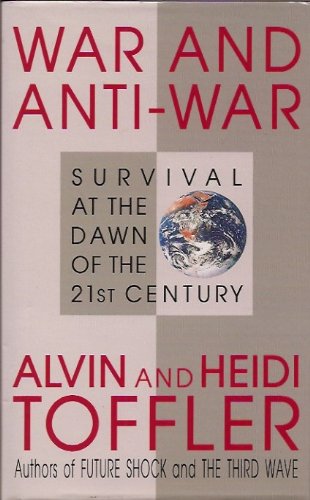
War and Anti-War by Alvin and Heidi Toffler 

The Tofflers were among the most influential and prescient of the pop futurists of the 1970’s and in War and Anti-War they took a stab at how revolutions in information and science fields were going to change warfare and peace making. Or as Alvin Toffler said:

The thesis is very simple. The way you make war is the way you make wealth. If you change the way you make wealth, you inevitably change the way you make war. And if you change the way you make war, you ought to be thinking about changing the way you make peace.

War was initiated by the agrarian revolution, or in our terminology “the first wave of change.” With the coming of the industrial revolution, particularly the French Revolution and Napoleon, you begin to get mass production, you begin to get mass conscription. You begin to get machine guns for the machine society. With mass production, you get mass destruction – industrialized warfare. And if we are now in the process of transforming the way we create wealth, from the industrial to the informational, or call it whatever you wish, there is a parallel change taking place with warfare, of which the Gulf War gives only the palest, palest little hint. The transition actually started back in the late-1970s, early-1980s, to a new form of warfare based on information superiority. It mirrors the way the economy has become information-dependent.

An important part of this will be what we call “knowledge strategies” – social knowledge strategies, national knowledge strategies, and so on. In military terms there will be attempts to coordinate all the knowledge- intensive activities of the military from education and training to high- precision weaponry to espionage to everything that involves the mind – propaganda – into coherent strategies.

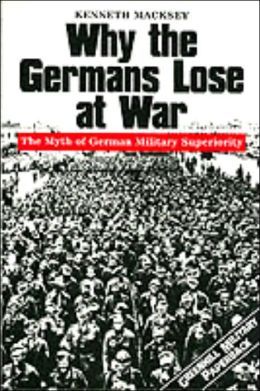
Why the Germans Lose at War: The Myth of German Military Superiority by Kenneth Macksey

The book is short and focused primarily upon the 20th century German grab for European hegemony and world power and, I expect, somewhat polemical as a counterweight to Germanomania common among military history buffs. Most of the Amazon reviewers panned it.

Hitlerland: American Eyewitnesses to the Nazi Rise to Power by Andrew Nagorski 

An account of American perceptions – reporters, diplomats, scholars and businessmen living in the Reich – of the Nazi movement and it’s coming to power and totalitarian rule over Germany. Useful in showing intelligent and well-informed people operating without benefit of hindsight as they attempted to assess the early stages of National Socialist Germany at a time when Fascism and Communism were popularly believed among Western intellectuals to represent the wave of the future.

Mike Royko: A Life in Print by Richard Ciccone

I grew up reading Mike Royko and the earlier part of my childhood was spent in the kind of gritty Chicago neighborhood of aspiring middle-class bungalows, dingy corner taverns and 16 inch softball leagues in Ed Kelly-run parks of the people who frequently populated Royko’s columns. I have read Boss several times and it is a classic tale of the world of big city Democratic Machine rough and tumble politics as much as  The Last Hurrah.

The Chicago Tribune, is a mere shadow of the great and independent newspaper that hired Mike Royko as a columnist after his career at the long defunct Chicago Daily News and The Chicago Sun-Times, which Royko quit the day it was purchased by Rupert Murdoch. Had Royko lived to see the Trib purchased by the exceedingly nasty Sam Zell, he’d have quit there as well.

NatSec Lit

Wednesday, August 7th, 2013

[ by Charles Cameron — books, Gitmo and Snowden — signing off with a great clip from Three Days of the Condor exhibiting the benefits of reading ]
.

I’m not entirely sure that Fifty Shades of Grey qualifies as Literature, but I think it can squeeze by as Lit — just as I’m not sure the topic of this post has much to do with National Security, but NatSec seems to fit.
.


.

Seriously, though — Carole Rosenberg at the Miami Herald is the go to person for all news Gitmo, and her recent piece, Congressman: ‘Fifty Shades’ popularity shows Guantánamo prisoners are ‘phonies’, is well worth your attention. I’ve selected the choicest cuts for your reading pleasure — and will also recommend John Schwartz‘ NYT piece, Russia for Beginners: A Literary Course for Edward Snowden, further down. Together, they make a feast.

And hang in there — there’s a clip from Condor at the very end…
**

From Gitmo, then:

A member of Congress said Tuesday he disclosed the popularity of the erotic sometimes sadomasochistic series Fifty Shades of Grey among Guantánamo’s most prized prisoners not to titillate but to set straight for their global followers that they were not devout holy warriors passing their Ramadan reading the Quran.

“It demystifies them. It exposes them for who they actually are,” said Rep. Jim Moran, D-Va., in a telephone interview that sought to set straight that the captives in the secretive Camp 7 complex are “not exactly holy warriors. Just the opposite. These people are phonies.” [ … ]

What made the disclosure so odd is that, during media visits to the trailers that house the prison camp’s collection of about 18,000 books, many of them religious, the Defense Department contractor in charge, Milton, says he systematically forbids the circulation of books and videos that are either lascivious or exceptionally violent..

The Herald contacted Moran on vacation after a prison camps spokeswoman, Army Capt. Andi Hahn, checked with the Army officer in charge of the detention center library and replied that the Fifty Shades of Grey series is a “prohibited” book. [ … ]

Moran said he has long favored exposing the Pentagon prisoners to great works of Western literature, and had asked the same questions in the less secretive prisons containing the 150 or so other prisoners, 84 of them approved for release or transfer in 2010. In those prison, the troops responded more generically that detainees who broke the rules get to keep just two library books in their cells while cooperative, communal captives get to borrow eight at a time.  [ … ]

In February, military spokesman said they were forbidden to elaborate on war court testimony that showed Camp 7’s troops seized as banned a previously approved book by ex-FBI Agent Ali Soufan called Black Banners. [ … ]

Another attorney, Carlos Warner, said while his Camp 7 client, Muhammed Rahim, was interested in American popular culture he couldn’t imagine him reading the Fifty Shades of Grey series sometimes referred to as “mommy porn.”

In March, Warner said, he handed Rahim the bestseller fantasy novel American Gods, about a freed prisoner, now being serialized for HBO — and was fully engaged in it.

Because of his enthusiasm, Warner got a card for Rahim from the book’s author, Neil Gaiman. “I hope you enjoy American Gods. It was written before Guantánamo and all this current madness,” the British novelist wrote Rahim in June at Warner’s behest. The lawyer said he plans to show it to Rahim at their next meeting.

American Gods is not an approved book at the detention center library, the prison spokeswoman, Hahn, said in response to a question Tuesday.

**

Meanwhile, regarding Edward Snowden

Edward J. Snowden has the time, and now he has the classics. [ … ]

His Russian lawyer earlier this week left him a shopping bag with books by Dostoyevsky, Chekhov and Nikolai Karamzin to help him learn about Russian reality.

According to news accounts, the lawyer, Anatoly Kucherena, gave his client Dostoyevsky’s “Crime and Punishment,” the tale of law, order and redemption, telling him, “You should know who Raskolnikov was.” He added that the Chekhov was “for dessert,” and also provided him with the writings of Karamzin, a historian, for background on the nation’s development.

One has to ask: Is Dostoevsky really the best choice? Raskolnikov could hardly be expected to cheer up Mr. Snowden. Sonia, the girl whose love saves Raskolnikov’s soul, may remind him of Lindsay Mills, the pole-dancing, exhibitionist girlfriend he left behind. [ … ]

Are there better Russian books to help Mr. Snowden get to know the Russian soul? One could do worse than to read Gogol, whose absurdist short story “The Nose” could help Mr. Snowden understand that living in Russia might not make any more sense than living in the United States. And Tolstoy – well, no matter how much time Mr. Snowden has, he may not have enough time for Tolstoy. [ … ]

Why should Mr. Snowden confine himself to the literature of Russia? After all, Edward Everett Hale wrote a book that must absolutely resonate with Mr. Snowden and his plight: “The Man Without a Country,” whose main figure is tried for treason and cries out before the judge, “I wish I may never hear of the United States again!” Walter Kirn’s “Up in the Air” would continue the travel theme. John le Carré’s George Smiley offers glimpses into Russian life that ring with gloomy authenticity.

The French, who gave us the word ennui and sharpened the concept of existentialism, produced the works that may most help Mr. Snowden adjust to his new life, especially those of Jean-Paul Sartre. What masterpiece better describes his situation than “No Exit”?

**

Reading. It helps:


Switch to our mobile site