zenpundit.com » book

Archive for the ‘book’ Category

Punch counter punch

Sunday, November 25th, 2018

[ by Charles Cameron — a perfect two-snake pattern from the WaPo headline writers ]
.

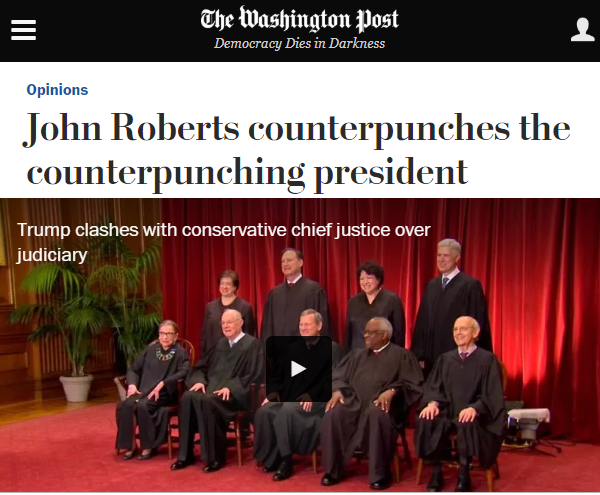
As patterns go, this one is hard to beat:

Source:

  • Washington Post, John Roberts counterpunches the counterpunching president
  • **

    As you may have gathered, the human propensity for patterning is an enduring interest of mine, and my collecting of such things as ouroboroi, parallelisms, paradoxes, moebius formats and mirrorings is effectively a small pattern language study after the example of Christopher Alexander‘s Pattern Language. Mine, drawing its materials from verbal and visual exemplars rather than architectural ones, perhaps reveals more about the workings of the human mind, aka consciousness.

    The “outer world” has yet to catch up with the significance of these studies..

    **

    At a time when my worldly goods in book form consisted of fifty or so over-thumbed, used science fiction paperbacks and one hardback — I no longer recall what it was — I won a minor poetry prize of $50 and decided it was better to splurge it on one thing I’d really treasure than to dribble it away, a coffee here, a sandwich there.. much though I like my coffees.

    Henbce, for about $45, I aacquired my copy of Alexander’s book — hardback #2!

    An I Ching for the West! Nobel-worthy! A Master’s Masterpiece!

    Decapitation — Variations on a theme by Vollmann

    Monday, September 24th, 2018

    [ by Charles Cameron — preliminary to a rave review, i suspect, with Helena Bonham Carter as Red Queen thrown in ]
    .

    **

    There’s an old English saying, presumably about the martyred King Charles I:

    The King walked and talked half an hour after his head was cut off..

    Young boys, getting acquainted with rules and grammar, and somewhat literal minded as a result, find this statement a paradox, which, however, can easily be resolved by the addition of a comma or perhaps better, a semicolon:

    The King walked and talked; half an hour after his head was cut off..

    Older boys quickly learn the (semicolon) reason of the riddle, and eagerly apply the first version to younger boys, the better to perplex and torment them. And thus both versions, the beauty of the paradox, the ease of its resolution, and the cruelty thus made available are transmitted across the generations..

    **

    I have written this because the beheading of a king clearly marked my young soul, as I was yesterday reminded by three passages from an Atlantic review of Vollmann‘s latest Opus — Magnum III at least [I, II, and let us not forget, gods I would love to read this, Kissing the Mask: Beauty, Understatement and Femininity in Japanese Noh Theater]..

    Summits chopped off:

  • In West Virginia, mountains do not have their summits chopped off but are granted “removal of overburden.”
  • Decapitation:

  • His insatiable appetite for detail yields both irrelevant trivia (“Embarking on the Super Limited Hitachi Express, which was also known as the Super Hitachi 23 Limited Express”) and magisterial portraits of landscapes befouled by poking and prodding and, in the case of West Virginia’s mountains, decapitating.
  • Headless:

  • Vollmann breathes a cool wind “whose degree of particulate contamination was of course unknown,” hears on a silent street at night the grunting of a radioactive wild boar, and walks on broken glass through an abandoned clothing store advertising a 50 percent–off sale and peopled by headless mannequins.
  • Headless mannequins and radioactive wild boars — vivid metaphors, no? — we the humans have been brain-dead, and in all likelihood will continue so.

    **

    We’re all too familiar with images of ISIS executioners with their orange jump-suited prisoners, just prior to and after solo and group beheadings — as a corrective to the “it’s all Islam” narrative, here’s a para from an article titled Inside the Minds of Cartel Hitmen: Hannibal Lecters for Hire (which includes an interview with Robert Bunker that I will be taking a more extended look at now my review of JM Berger‘s new book. Extremism, is in):

    And the tactics employed in all that killing have become more and more gruesome over time. Maybe the rush felt by some murderers is like a drug itself, and they are junkies needing ever greater doses to get the same high. But how is it that ordinary people get hooked on activities like beheading, acid baths, and cannibalism?

    **

    Quoth the Red Queen: Off with their heads!

    JM Berger’s Extremism, from MIT Press. Brilliant.

    Monday, September 24th, 2018

    [ by Charles Cameron — my third JM Berger review, following reviews of Jihad Joe and ISIS: State of Terror ]
    .

    **

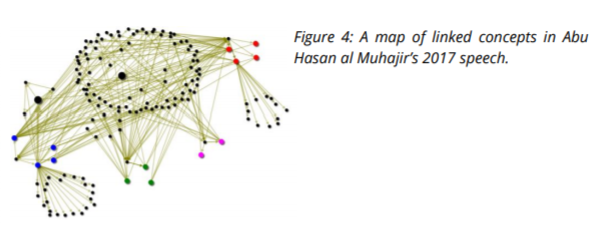
    I ordered a copy of JM Berger‘s Extremism months early from Amazon, having followed many of the posts in which he was formulating the insights that led to the book, and expecting a volume full of the very detailed diagrams and network analyses they contained:

    Image sources:

  • ICCT, Countering Islamic State Messaging Through “Linkage-Based” Analysis
  • Intelwire, EXTREMIST CONSTRUCTION OF IDENTITY
  • **

    These diagrams, and the research that underlies them — the work of JM and his colleague, Haroro J Ingram — attest to JM’s skill at the detailed drill-down level, the equivalent of rock-face drilling in a mine. The book couldn’t be further from my expectations: it attests to an entirely different set of skills, those of simplicity, grace, and a superb command of language.

    JM has the ability to communicate directly with a lay audience at their (our) level. He neither shies away from nuance nor adds needless complications — either of which would be a form of condescension to the reader.

    JM’s writing is direct and clean:

  • Terrorism is a tactic, whereas extremism is a belief system.
  • Extremism is a spectrum of beliefs, not necessarily a simple destination.
  • Group radicalization precedes individual radicalization
  • **

    Above are three of the pull-quotes, extracted from the book’s text, that state some of JM’s basic propositions on lucid, large-print, white on black pages, scattered as needed across the book’s 167 short pages (plus glossary, notes, bibliography, further reading, index)..

  • What extremism is, how extremist ideologies are constructed, and why extremism can escalate into violence
  • That’s the core proposition of the whole work, buttressed as it is with a wealth of detailed research and analysis. And radical…

    JM’s approach is already radical in its (his) refusal to treat only one ideological or religious frame for extremism. Studying both ISIS and home grown Identity groups, those who promote violence and those who arguably foreshadow it, led JM to see extremism itself as the most fruitful category to study — not terrorism, nor Islam, not the Citizen Sovereignty movement nor alt-right, but extremism tout court.

    That broadening of the frame allows Berger a set of analytic insights that were obscured by detail in earlier, more limited studies, and his book is the elegant formulation of those insights, simply, and with a forest of scholarship in support.

    **

    JM lists Impurity, Conspiracy, Dystopia, Existential threat, and Apocalypse as central “crisis narratives” utilized by in-groups as they view out-groups — but it is the in-group-out-group distinction which is central to his thinking, its wrongness characterized by the in-group’s paranoid conspiracist suspicions of the out-group’s impurity, dystopic being the nature of the world now ruled by the out-group, and to be abhorred or saved by the in-, with existential threat and apocalypse providing the sense of time-crunch, urgency.

    All this, I say, with a simplicity and elegance which belies the originality and scholarship that undergirds it.

    Above highly recommended.

    John McCain for whom the bell now tolls, RIP

    Sunday, August 26th, 2018

    [ by Charles Cameron — a small but necessary personal tribute, along with corroborating witnesses for the details and more ]
    .

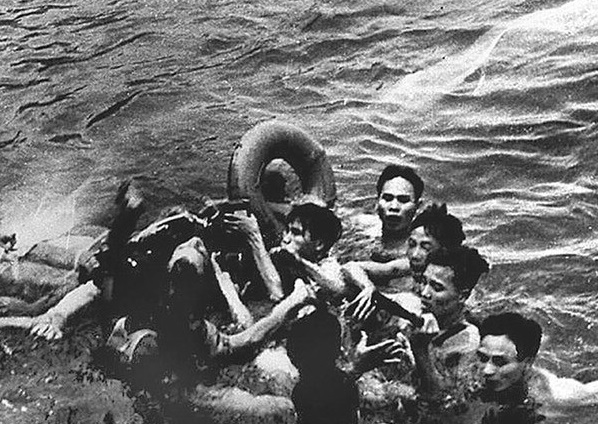
    McCain limps home, from Hanoi to freedom:

    **

    I want to say a quick word about John McCain, may his echoes remain long among us, before culling some significant images and quotes from other sources. I came late to my knowledge of the man, but when I arrived there, the two matters that most impressed me were:

    First, that when after a couple of years of imprisonment and torture at the hands of the North Vietnamese he was offered release, he refused it and opted consciously for years more of the same unless his fellow POWs were also released, in accord with Article III of the Military Code of Conduct to “accept neither parole nor special favors from the enemy.” That was an act of almost unbelievable courage ..

    **

    In more detail, from elsewhere:

    The protagonist of Ernest Hemingway’s novel “For Whom the Bell Tolls” is Robert Jordan, a young American who left his job to fight with the Republican side, against the Nazi-supported Nationalists, in the Spanish Civil War. He never loses sight of his objective — the demolition of a bridge — despite doubts about whether the mission is necessary or even possible. He hates fascism and feels a profound sense of duty to oppose it.

    John McCain, who died Saturday in Arizona after a 14-month fight against brain cancer, always said this 1940 novel about guerrilla warfare was his favorite and that its hero was a source of inspiration throughout his life — even as a prisoner of war in Vietnam.

  • Yahoo, The bell tolls for John McCain: How Hemingway’s antifascist hero shaped the man
  • The crew on the carrier Forrestal put out a fire that killed 134 men in the worst noncombat incident in American naval history. Mr. McCain was seriously injured. Credit: U.S. Navy, via Associated Press

    *

    Promoted to lieutenant commander in early 1967, Mr. McCain requested combat duty and was assigned to the carrier Forrestal, operating in the Gulf of Tonkin. Its A-4E Skyhawk warplanes were bombing North Vietnam in the campaign known as Operation Rolling Thunder. He flew five missions.

    Then, on July 29, 1967, he had just strapped himself into his cockpit on a deck crowded with planes when a missile fired accidentally from another jet struck his 200-gallon exterior fuel tank, and it exploded in flames. He scrambled out, crawled onto the plane’s nose, dived onto a deck seething with burning fuel and rolled away until he cleared the flames.

    As he stood up, other aircraft and bomb loads exploded on deck. He was hit in the legs and chest by burning shrapnel. At one point, the Forrestal skipper considered abandoning ship. When the fire was finally brought under control, 134 men had been killed in the worst noncombat incident in American naval history.

  • New York Times, John McCain, War Hero, Senator, Presidential Contender, Dies at 81
  • Those who escape unscathed from such close calls are marked for life.

    And then there’s so much more..

    Mr. McCain, center, after he ejected from his fighter plane in 1967 and fell into a lake. The Vietnamese imprisoned and tortured him for more than five years. Credit: Library of Congress

    *

    Mr. McCain was stripped to his skivvies, kicked and spat upon, then bayoneted in the left ankle and groin. A North Vietnamese soldier struck him with his rifle butt, breaking a shoulder. A woman tried to give him a cup of tea as a photographer snapped pictures. Carried to a truck, Mr. McCain was driven to Hoa Lo, the prison compound its American inmates had labeled the Hanoi Hilton.

  • New York Times, John McCain, War Hero, Senator, Presidential Contender, Dies at 81
  • McCain’s conduct during nearly six years in a North Vietnamese prison, the infamous Hanoi Hilton, had become the stuff of legend. In 1968, less than a year after his Navy bomber was shot down, the imprisoned McCain was abruptly offered unconditional release by the North Vietnamese, perhaps because his father had just been named the commander of U.S. forces in the Pacific. McCain was still badly crippled from his crash and the poor medical treatment that followed, yet he adhered to the P.O.W. code of honor and refused to be repatriated ahead of American prisoners who had been in captivity longer than he. His refusal was adamant. His guard told him, “Now, McCain, it will be very bad for you.” He was tortured for his defiance, and ultimately spent more than two years in solitary confinement.

  • New Yorker, The True Nature of John McCain’s Heroism
  • Years later, as McCain reflected on this period, he said he held no ill will toward his captors. “I don’t blame them. We’re in a war,” McCain said in a separate interview with C-SPAN in 2017. “I didn’t like it, but at the same time when you are in a war and you are captured by the enemy, you can’t expect to have tea,” McCain said.

  • NPR, From A POW Prison, John McCain Emerged A ‘Maverick’
  • Honestly, the fact that he’s spent so much time in Trump’s crosshairs should arguably serve as a clue that the guy’s integrity might be above average on Capitol Hill whether you happen to agree with his positions or not.

  • Paste, HBO’s Valedictory John McCain: For Whom the Bell Tolls Is Not a Puff Piece
  • **

    Second, that he continued his opposition to the torture of others throughout his life ..

    Others may speak of McCain from close personal acquaintance, or with a deeper historical awareness of his life and service, but what little I can say, I can say with deep sincerity and respect:

    The man had guts — courage — nobility. Here was a man of whom the Senate and all America can and should be justifiably proud.

    Journal — Illuminatus! trilogy, QAnon!! and more..

    Monday, August 20th, 2018

    [ by Charles Cameron — a dayalong cabinet of curiosities, really — the essence of creativity, paradox, and America, via conspiracies this way and that, contrasts between clearances, and key Rwanda para from the NYorker ]
    .

    Here’s a Diary — a miscellaneous catch-all for today :

    **

    **

    Robert Anton Wilson, The Illuminatus saga stumbles along:

    Wilson and Shea derived much of the odder material from letters sent to Playboy magazine while they worked as the editors of its Forum.[19] The books mixed true information with imaginative fiction to engage the reader in what Wilson called “guerrilla ontology”, which he apparently referred to as “Operation Mindfuck” in Illuminatus!

    Wilson and Shea mashed up the ten thousand conspiracies and facts of their times to create one fact-spattered fiction, the Illuminatus! trilogy — one from many, e pluribus unum ahem! — whereas in our own day the inventors of QAnon invoked a massive outpouring of different conspiracies within conspiracies:

    In November 2017, a small-time YouTube video creator and two moderators of the 4chan website, one of the most extreme message boards on the internet, banded together and plucked out of obscurity an anonymous and cryptic post from the many conspiracy theories that populated the website’s message board.

    Over the next several months, they would create videos, a Reddit community, a business and an entire mythology based off the 4chan posts of “Q,” the pseudonym of a person claiming to be a high-ranking military officer. The theory they espoused would become Qanon, and it would eventually make its way from those message boards to national media stories and the rallies of President Donald Trump.

    From many, one, and from one, many — Pythagorean sacred mathematics, America, expansive and synthetic thinkjing, the origins of paradox, essence of creativity — between one and many, it’s all there..

    **

    Quick thought:’

    We’ve seen Jared Kushner having his clearance restored, and John Brennan having his clearance withdrawn, but just fr the record, they bear considering in tandem, DoubleQuote style.. Right here I’m making the connection.

    **

    Rwanda:

    Key NYorker para on Rwandan warning to Kofi Annan, upon whom be the peace, requiescat in pace, a reminder:

    Annan then wrote, “We do not recall any specific reports from Kigali to this effect.” A review of the peacekeeping files, he wrote, had turned up only four cables from Kigali in the months preceding the genocide that mentioned “ethnic tensions as being possibly related—or not related—to specific incidents of violence.”

    But, in reality, one of the four cables Annan listed consisted of an alarmingly specific report of preparations for the genocide, sent by his force commander in Kigali, the Canadian General Romeo Dallaire, in January of 1994. Dallaire had heard from a trusted informant on the payroll of Rwanda’s ruling party, who described plans to “provoke a civil war,” and to kill Belgian peacekeepers in order to scuttle the U.N. mission. The informant himself said he was involved in drawing up lists of Tutsis in Kigali, and Dallaire wrote, “He suspects it is for their extermination. Example he gave was that in twenty minutes his personnel could kill up to a thousand Tutsis.” Dallaire asked for permission to act on this information by raiding and seizing illegal arms caches. Annan’s office replied at once, in a cable under his name, and signed by his deputy, telling Dallaire not to act but, rather, to follow diplomatic protocol and share his information with Rwanda’s President—the head of the party that Dallaire wanted to act against. Three months later, in April of 1994, everything that Dallaire described in his warning took place, and in the course of a hundred days around a million Tutsis were massacred.

    **

    Ordinary:

    Lovely prose, extraordinary normalcy in the New Yorker, Hearing Aretha Franklin’s “I Say a Little Prayer” in the Soviet Union

    I was gazing ahead, out the half-shaded window, sitting in the diffuse circle of warm light from a tall floor lamp to the left of me, with my elbows propped on the table and my head resting in the palms of my hands, in front of a half-empty bottle of an acrid, half-dry Bulgarian red called The Evening Bells and a white faience teacup with a chipped rim. In the boreal darkness outside, there was nothing for me to perceive but an irregular checkered pattern of blue- and yellow-lit windows in the apartment building across the way.

    Beyond those windows, perfectly and naturally unaware of my existence, ordinary Soviet citizens like me silently lived their ordinary human lives: hugging or ignoring one another, standing still in their kitchens in tank tops and nightgowns and saying something silently to someone unseen, flinging angry words at one another, gesticulating broadly and opening and closing their mouths, drinking tea, eating something greasy from an aluminum pan on the stove, or just staring into the night’s emptiness with unseeing eyes, their foreheads pressed against the windowpane, a slow-burning cigarette squeezed between their pressed lips.

    It is into such lives, among so many, that Aretha’s voice penetrates. Whenever we consider any of this world’s painful pasts, dire future threats, and potent presents, we should quickly run them up against all those audiences, normal and overwhelmingly influential, who may be affected.

    **

    I’m reminded..

    Okay, I saw that New Yorker piece today on the penetration of Aretha‘s voice into a bloc of Soviet flats in Leningrad, Hearing Aretha Franklin’s “I Say a Little Prayer” in the Soviet Union, and reading it, I’m reminded of the Japanese cult Aum Shinrikyo and its interest in nuclear, biological and chemical weapons.

    You’ll remember they attained world notoriety after attacking the Tokyo subway system with sarin gas.. Specifically:

    Aum dabbled in many different biological agents. They cultured and experimented with botulin toxin, anthrax, cholera, and Q fever. In 1993, Ashahara led a group of 16 cult doctors and nurses to Zaire, on a supposed medical mission. The actual purpose of the trip to Central Africa was to learn as much as possible about and, ideally, to bring back samples of Ebola virus. In early 1994, cult doctors were quoted on Russian radio as discussing the possibility of using Ebola as a biological weapon.

    So, here’s my take:

    Some journo sending an early report on the Ebola outbreak was read by someone involved in the Aum Shinrikyo chemical weapons team, who thereupon suggested a trip to Africa to Aum’s guru, Shoko Asahara. I’m sure the journo concerned wasn’t thinking that some member of a a relatively obscure Japanese cult would read their report! — but news ripples out to obscure corners of the world, Aretha‘s voice reaches Leningrad, news of an outbreak in Africa reaches Tokyo, more generally the world is porous, and these things have consequences…

    **

    The world is porous, and there are causes and consequences…

    Switch to our mobile site