zenpundit.com » media

Archive for the ‘media’ Category

For the record: al-Raymi’s Message to the American People

Tuesday, June 4th, 2013

[ by Charles Cameron — a quick, minor note ]
.

You may of course already know this, but in case you don’t…

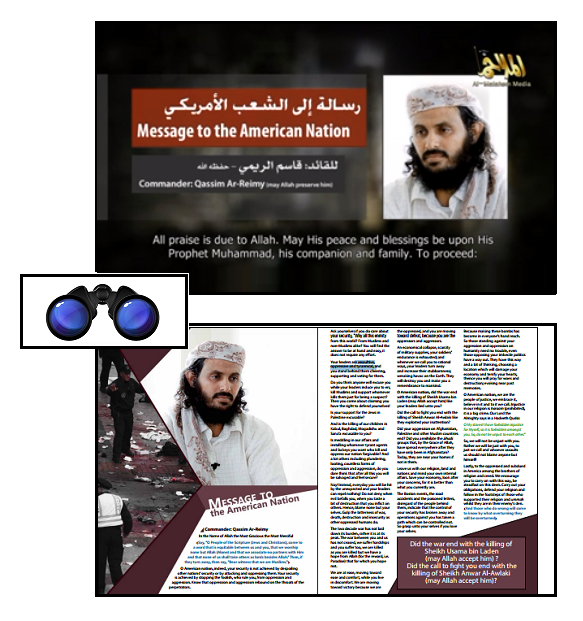
May eye was caught by the words “Your leaders are assaultive, oppressive and tyrannical” in the English subtitles to Qasim al-Raymi‘s “Message to the American People” video (upper panel, below)…

I guess it was the word “assaultive” that really caught my eye… I wasn’t looking forward to transcribing the entire video, so I went to the net to see if anyone else had done the job — which was when I realized I’d seen that same phrase before, in the latest issue, #11, of Inspire magazine (lower panel, above).

So this is just a quick note to say if you want to quote al-Raymi, there’s no need to transcribe the video, he says what he says in Inspire #11 pp. 8-9.

**

I suspect we could glean quite a bit if we listened with careful ears to the phrasings used by jihadist sources when writing or speaking in English or translating into it. There are some interesting characteristic turns of phrase — I haven’t been making notes as yet, but “to proceed” is one that is often used to end the scriptural prelims and turn to the message of the day… And there was that curious phrasing in the Khorasanist video Tamerlan Tsarnaev favorited, “The word Taliqan not just mentions the Taliqan region of today only, but…”

There are many interesting ways to read a text, and reading for tone and phrasing is one of them…

**

Sources, h/t to Aaron Zelin at Jihadology:

  • Al-Raymi, al-Malahim video
  • Al Raymi, al-Malahim Inspire magazine
  • A feast of form in my twitter-stream today

    Sunday, June 2nd, 2013

    [ by Charles Cameron — forms & patterns, pattern recognition & creative leaps, creative leaps & connecting dots, connecting dots & node-and-edge mapping — node-and-edge mapping, link charts and Sembl-HipBone games ]
    .
    .

    There’s no “actionable intelligence” in that tweet, but it recognizes a pattern, it makes a fine creative leap. And given the chance, that’s something bright minds do naturally, and enjoy doing, and is away more important than we think.

    Yestedrday I was watching Manhunt pretty closely for an upcoming Zenpundit review, and noticed that some of the most significant quotes in the film were absent from CNN’s transcript. One gap I noticed had to do with the descriptions of the analytic process, and in particular some of the things Cindy Storer said. I’ll quote this one, which goes to the heart of the matter, but there’s plenty more left for me to chew over with you later. Here she goes:

    Even in the analytical community there’s a relatively smaller percentage of people who are really good at making sense of information that doesn’t appear to be connected. So that’s what we call pattern analysis, trying to figure out what things look like. And those people, you really need those people to work on an issue like terrorism, counternarcotic, international arms trafficking, because you’ve got bits and pieces of scattered information from all over the place, and you have to try to make some sense of it. … That takes this talent, which is also a skill, and people would refer to it as magic — not the analysts doing it, but other people who didn’t have that talent referred to it as magic.

    That’s a pretty exact description of what the Sembl game will eventually teach people, once it comes out of the museum prototype and onto the web — but let’s back it up with a quick quote from Wittgenstein:

    A surveyable representation produces precisely that kind of understanding which consists in ‘seeing connections’ [Zusammenhänge sehen]. Hence the importance of finding and inventing connecting links. Hence the importance of finding and inventing intermediate links.

    That’s from Philosophical Investigations, 122, and it’s a higher altitude / more abstract view — but it’s also the very heart of network thinking, seeing processes not just in terms of isolated nodes but of the connections between them.

    **

    Seeing connections — connecting the dots — happens in lines and leaps. That is to say, it can happen according to the usual linear way of thinking, the dogged 99% of perspiration that people talk about — or according to the far less common lateral move or creative leap, which moves by analogy, which is to say by pattern recognition, by the perception of similarities of form.

    That’s the 1% we call inspiration. That’s the magic.

    **

    So a whole lot of patterning was going on in my twitter-stream today, and I thought I’d show you.

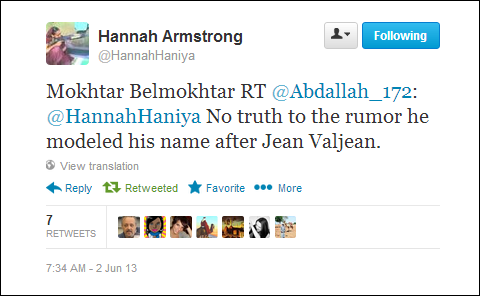
    First, there was the parallel between the names Mokhtar Belmokhtar and Jean Valjean (above). If you’re hunting either fellow, the parallelism isn’t going to yield a useful clue — but the mode of recognition is what matters, and the reason its such a rare mode is precisely because it’s playful. It plays with forms — in this case, the forms of the two names — without regard for practicality.

    And yet this playful spirit is what brought us Weil‘s conjecture and Pierre Deligne‘s Abel Prize, and the Taniyama-Shimura conjecture and Wiles‘ proof of Fermat’s Last Theorem.

    Serious playfulness is key… to serious, magical breakthroughs. In any and all domains.

    *

    With that in mind, here are the rest of the patterns I recognized in todays feed.

    Let’s start with self-reference, which can hardly get more succinct than the hackers hacked:

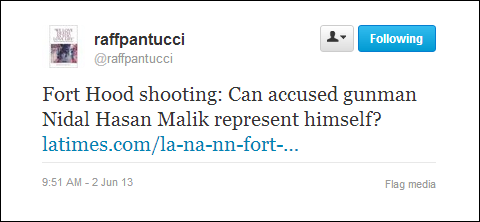
    There’s also a self-referential paradox at work in the question of a defendant appearing in his own defense — something that gives judges pause, because they see how tightly the serpent is chasing its own tail. Defendant defends self, From Raff Pantucci:
    The saddest self-reference of the morning’s tweets was this one, which could be encapsulated as storm-chaser chased by storm:
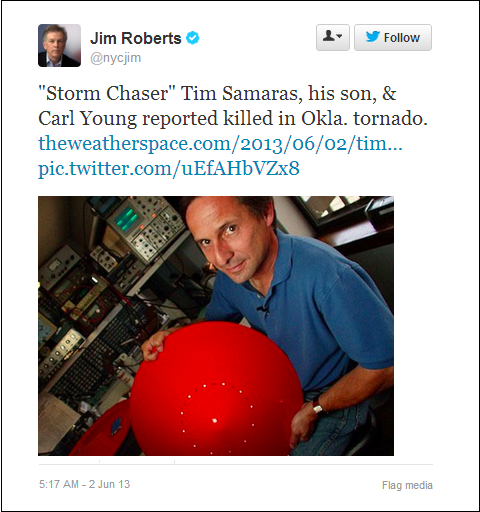
    Even tragedy can take self-referential form.

    **

    But lets move on to Turkey, which provided a rich dividend:

    There was this problem:
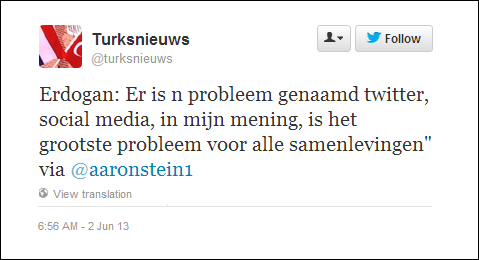
    Turkish I couldn’t read, Dutch I can more or less make out — but for an English tweet making the same point let’s go to Zeynep Tufekci, who has expertise in both matters Turkish and matters Internet, and tweets about Erdogan disapproving of tweeting:

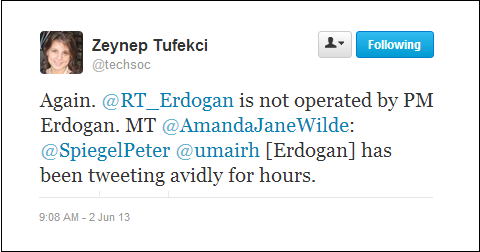
    Tufekci again, this time catching an even neater self-reference which doesn’t quite pan out — because, as she says, PM Erdogan is not the same as @RT_Erdogan:
    **

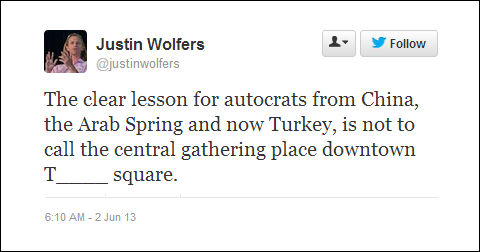
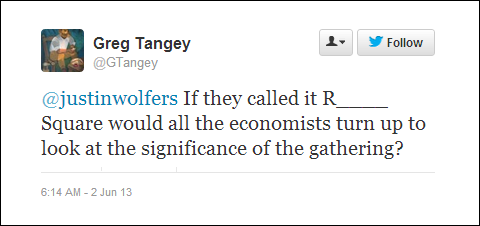
    While we’re on Turkey, this tweet about Tienanmen, Tahrir and Taksim Squares gave us another example of a bright mind catching a hint of pattern…
    And what a neat rejoinder!
    All of the above is quite useless, entirely playful — and of deep interest if creativity and insight matter

    **

    Finally, I’d like to go someplace quiet and bathe in peace. This tweet, featuring a poem by a Korean zen master, does the trick nicely:
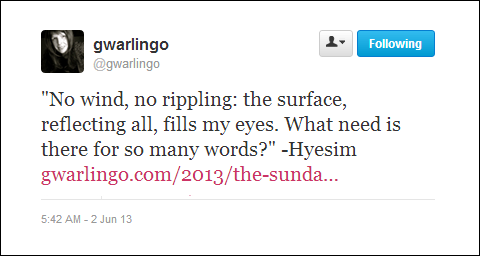
    AN appreciative bow to Gwarlingo for that one…
    Various body parts for various body parts

    Friday, May 31st, 2013

    [ by Charles Cameron — mostly about a fascinating quote from Martin Luther King ]
    .


    .

    Let’s start with the Code of Hammurabi, 196-97:

    If a man put out the eye of another man, his eye shall be put out. If he break another man’s bone, his bone shall be broken.

    A few days ago, I found I was feeling mildly exercised by one Dan Hodges writing in the Telegraph:

    Indeed, “An eye for an eye, a tooth for a tooth,” quoted by one of Lee Rigby’s suspected killers, comes from the Bible, not the Koran.

    Hodges was quoting Michael Adebolajo, who had said on camera:

    The only reason we have killed this man today is because Muslims are dying daily by British soldiers. And this British soldier is one. It is an eye for an eye and a tooth for a tooth. By Allah, we swear by the almighty Allah we will never stop fighting you until you leave us alone.

    **

    It is true that Deuteronomy 19.21 reads:

    And thine eye shall not pity; but life shall go for life, eye for eye, tooth for tooth, hand for hand, foot for foot.

    and Exodus 21.23-25:

    And if any mischief follow, then thou shalt give life for life, Eye for eye, tooth for tooth, hand for hand, foot for foot, Burning for burning, wound for wound, stripe for stripe.

    — but its is clear that Adebolajo — who was brought up devoutly Christian in Nigeria, converted (“reverted”) to Islam, and now references suras of the Qur’an using their Arabic names — would also be aware of Sura Al-Ma’ida (5) 45:

    And therein We prescribed for them: ‘A life for a life, an eye for an eye, a nose for a nose, an ear for an ear, a tooth for a tooth, and for wounds retaliation’; but whosoever forgoes it as a freewill offering, that shall be for him an expiation.

    **

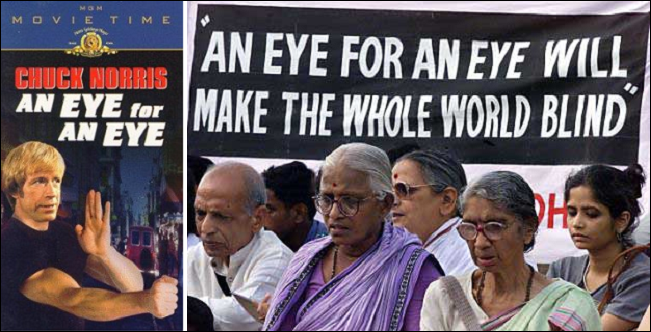
    The quote “An eye for an eye makes the whole world blind” is often attributed to Mohandas Gandhi, but I checked with Quote Investigator and found it was originally used by one Louis Fischer to paraphrase Gandhi’s teaching, although the Gandhi family apparently think it sounds authentic. But what interested me most was that a form of the same phrase can safely be attributed to Martin Luther King, who is quote in Stride Toward Freedom: The Montgomery Story, p 208, as saying:

    Violence as a way of achieving racial justice is both impractical and immoral. It is impractical because it is a descending spiral ending in destruction of all. The law of an eye for an eye leaves everyone blind. It is immoral because it seeks to annihilate the opponent rather than win his understanding; it seeks to annihilate rather than to convert. Violence is immoral because it thrives on hatred rather than love. It destroys community and makes brotherhood impossible. It leaves society in monologue rather than dialogue. Violence ends by defeating itself. It creates bitterness in the survivors and brutality in the destroyers.

    That’s quite a paragraph.

    **

    Of note, besides the parallel structure with which King addresses violence as both impractical and immoral, are two matters I have often pointed to here on Zenpundit:

    Self-reference:

    Violence ends by defeating itself.

    and polyphony:

    It leaves society in monologue rather than dialogue.

    **

    Gandhi’s position seems to come close to that presented in Matthew 5. 38-48 — in which Christ clearly countermands the lex talionis as promulgated in Exodus and Deuteronomy:

    Ye have heard that it hath been said, An eye for an eye, and a tooth for a tooth: But I say unto you, That ye resist not evil: but whosoever shall smite thee on thy right cheek, turn to him the other also. And if any man will sue thee at the law, and take away thy coat, let him have thy cloke also. And whosoever shall compel thee to go a mile, go with him twain. Give to him that asketh thee, and from him that would borrow of thee turn not thou away.

    Ye have heard that it hath been said, Thou shalt love thy neighbour, and hate thine enemy. But I say unto you, Love your enemies, bless them that curse you, do good to them that hate you, and pray for them which despitefully use you, and persecute you; That ye may be the children of your Father which is in heaven: for he maketh his sun to rise on the evil and on the good, and sendeth rain on the just and on the unjust. For if ye love them which love you, what reward have ye? do not even the publicans the same? And if ye salute your brethren only, what do ye more than others? do not even the publicans so? Be ye therefore perfect, even as your Father which is in heaven is perfect.

    And. for that matter, to The Richmond Declaration of Faith of 1887, as quoted today by my friend, Friend Marshall Massey:

    We feel bound explicitly to avow our unshaken persuasion that all war is utterly incompatible with the plain precepts of our divine Lord and Law-giver, and the whole spirit of His Gospel, and that no plea of necessity or policy, however urgent or peculiar, can avail to release either individuals or nations from the paramount allegiance which they owe to Him who hath said, ‘Love your enemies.’ (Matt 5:44, Luke 6:27)

    **

    How — without denigrating those who are of either the Deuteronomic or the Gandhian persuasion — does one nudge the world-system gently away from justice and towards mercy, away from revenge and towards reconciliation, away from war and towards peace? Towards a new and more viable homeostasis?

    Sisyphus on the treadmill of memes

    Thursday, May 9th, 2013

    [ by Charles Cameron — Khorasan, black banners, the Ghazwa-e-Hind — when will the updating ever stop? ]
    .

    **

    It looks as though I first realized that “the black banners of Khorasan” was a meme I should be “eyes out” for was in July 2007, when John Robb pointed us to a piece by Syed Saleem Shahzad on events at the Red Mosque

    For the al-Qaeda leadership sitting in the tribal areas, the situation is fast evolving into the promised battle of Khorasan. This includes parts of Iran, Pakistan, Afghanistan and Tajikistan from where the Prophet Mohammed promised the “end of time” battle would start.

    That reference to Khorasan in turn led me back to a slightly earlier Washington Post piece where the Khorasan / black banners motif was clearly set forth, along with a pointed comment from Andrew Black, co-founder of Thistle Intelligence Group:

    The battles today, like those against the Soviet occupiers, are also fought with religious verve. The Taliban and al-Qaida fight under a black flag connoting the participation of Islam’s prophet in their battle for Khorasan, the ancient name for the region centered around Afghanistan.

    Khorasan increasingly features in the militants’ videos and the name was taped to the leg of a suicide bomber who killed 24 people in Pakistan’s Northwest Province this spring.

    “One should not underestimate the theological importance of Khorasan to aspiring mujahedeen; particularly those who are only able to initially view the conflict through the Internet,” said Black.

    Hamid Gul was in Shahzad’s piece too, talking about the Red Mosque and the Red Fort — and here, too, I likely made my first acquaintance with the motif of the Ghazwa-e-Hind, symbolized by the wish to plant Pakistan’s flag on Delhi’s Red Fort:

    It is a pity that our army was preparing youths to seize Lal Qala [the Red Fort of Delhi] and they ended up seizing the Lal Masjid,” Gul said.

    Both these memes have been around longer than I have, but back then they didn’t seem to be attracting much attention in the west.

    Now they’re cropping up all over — and I’m (to switch metaphors in mid-stream) paddling hard to keep up.

    **

    The black flags are alive and well this week, as shown in this video of the graduation of a new batch of the Free Army fighters in Syria:

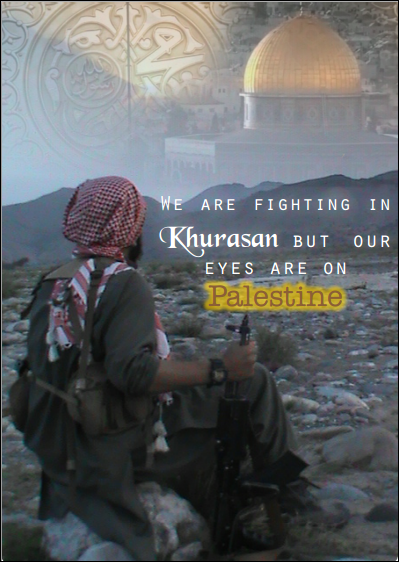
    Khorasan too, as seen in the image from the new magazine Azan at the top of this post — but where does Azan itself come from?

    B Raman writes:

    It is not yet clear who has started “Azan”. One suspect is the Tehrik-e-Taliban Pakistan (TTP), which is the Pakistani Taliban. The other suspect is Al Qaeda headquarters in the South Waziristan area of Pakistan.

    I’m interested in this question, because Azan had an overview of the various fronts of contemporary jihad, and an image that invokes both Khorasan and Jerusalem isn’t exactly “local” in focus. And that brings me to that other meme of interest here — the Ghazwa-e-Hind — which as I pointed out recently ius also mentioned in Azan, though not a huge focus there.

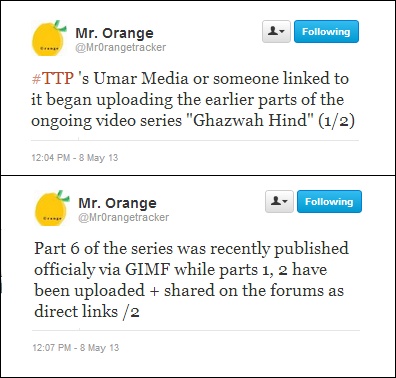
    But if Azan is indeed a TTP product, then this info from Mr Orange:

    would indicate they find the Ghazwa of more than passing interest…

    Religions 101

    Wednesday, May 8th, 2013

    [ by Charles Cameron — prone to be wrong himself, for that matter ]
    .

    The media seems having a hard time of it. Journalists are neither all scholars of religion, nor necessarily religiously inclined, so it’s only too easy for the New York Times to get Easter wrong:

    or for AP to manage the same sort of trick with Islam.

    **

    The New York Times has had time to repent of its sins, and has published a retraction that comes close enough to accuracy for my taste:

    An earlier version of this article mischaracterized the Christian holiday of Easter. It is the celebration of Jesus’s resurrection from the dead, not his resurrection into heaven.

    The AP needs to make a similar confession. The Hajj is not a pilgrimage directed to Muhammad’s place of birth, but to the Ka’aba — which is indeed in the city where the Prophet was born, but is believed to have been a site of pilgrimage since the time of Abraham, and to have been cleansed of idols by Muhammad and restored to its original purpose as a shrine to the one God.

    And BTW, the honorific would be “Hajji” not “Hajii” — FWIW.

    **

    This is Islam 101, just as the Resurrection is Christianity 101. I’ve forgotten what the numbering system is for remedial classes, but we need them.

    Guess I’d best get back to reading Zen Mind, Beginner’s Mind.


    Switch to our mobile site