zenpundit.com » media

Archive for the ‘media’ Category

Plus ça change I

Wednesday, July 20th, 2011

[ by Charles Cameron — backstory of Google+ ]

.

dq-circles.jpg

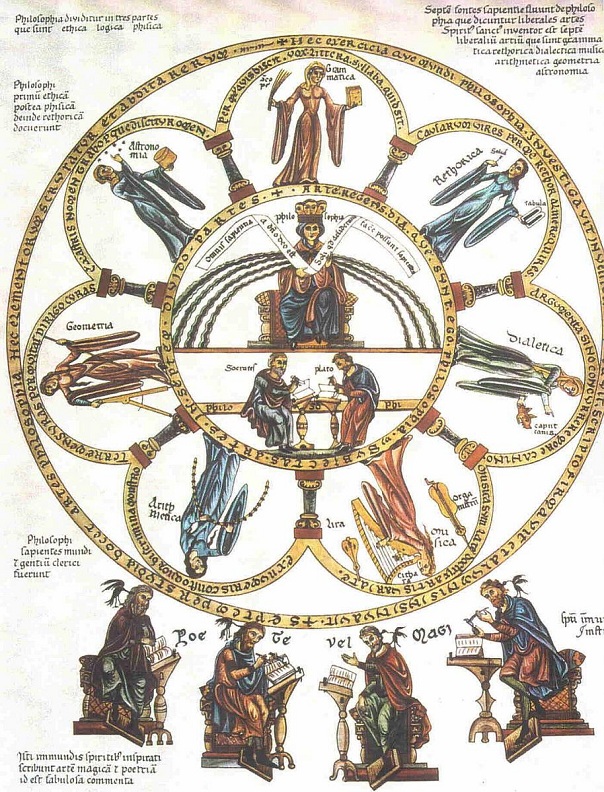
Herrad von Landsberg seems to have corralled seven of his best friends — the Septem Artes Liberales— into his “Hortus deliciarum” on Google+ back in 1180.

Here’s a larger version, for your viewing convenience:liberal-arts-med.jpg

Outrage Over News Corp: A Tale of Two Standards

Monday, July 18th, 2011

As a rule, I eschew political news here but I think this one merits an exception.

The big story of the moment for political junkies is the illegal hacking of cell phones allegedly carried out by employees of one of Rupert Murdoch’s British tabloid newspapers. Not just any phones either, the cell phones of British VIPs, political bigwigs, celebrities and perhaps, some 9/11 victims. All of the details have not been revealed, but there are police investigations, one of News Corp’s top employees has been arrested, parliamentary inquiries and demands by Murdochs political enemies there to have the British government “dismantle his empire“.

Rupert Murdoch is not, it must be said, a cuddly public figure. He is a press baron throwback to the era of Joseph Pulitizer and William Randolph Hearst and has a reputation for ruthlessness in business and overweening ambition in politics to gain personal influence for promoting his conservative views. He is a hate figure to Democratic and liberal partisans of the intolerant kind who see political disagreement as evidence of evil and would like FOXnews, one of Murdoch’s most influential and profitable properties, to be suppressed by the FCC (though Murdoch’s right-wing views did not preclude him from trying to cozy up to China’s communist leadership). These folks are naturally celebrating Murdoch’s dilemma and hoping for a collapse – and Murdoch and his son James are in genuine jeopardy, possibly legal, certainly political and commercial.

Much indignant outrage is being heaped on Murdoch’s head now by the enlightened; I have no love for phone hacking and I definitely agree that and violating people’s privacy is a crime that ought to be punished by sending those responsible to prison. I am curious though, how this position is squared morally with the fact that the two liberal news outlets most triumphant about the News Corp scandal, The New York Times and The Guardian, themselves recently were knowing accessories to the much more serious crime of espionage.

Actually calling these papers criminal accessories is not a full picture of their behavior during the Wikileaks document dump; it is more accurate to say that they reaped corporate financial benefit from facilitating espionage, grand theft and treason, for which their editors have not faced any legal consequences. 

Yes, treason. Look up the definition.

Much unlike the nobody Army private and patsy, Bradley Manning, who is likely to face a sentence of life in prison. Good thing for  Manning that he only outed a vast array of US intelligence and diplomatic secrets and exposed ordinary, unimportant, unprotected Afghans and Iraqis to murderous retribution by Islamist degenerates. If Manning had phonehacked a Labor MP or a wealthy, airhead celebrity – you know, really important and beautiful people – the NYT and the Guardian would be calling for a death sentence. It is a most curious scale of values.

Go back and look at which partisan blowhards with columns and bylines and talking head opinion shapers thought Wikileaks was just great and defended Julian Assange and what their opinion is on phonehacking today and see if any – any at all – evidence some consistency. Or awareness of the relative magnitude of each crime – and crime is the right word, neither of these scandals are mere pranks, but one is important to national security and the other, so far, is only interesting.

There’s something amiss here in the way that partisan politics and a seamy, not too subtle, undercurrent of class entitlement have warped the perspective and sense of proportion of some people who are smart enough to know better.

Our lives are touched

Wednesday, June 1st, 2011

[ by Charles Cameron – on death of journalist Syed Saleem Shahzad ]

.

Our lives are touched by those who inform us: just a short while ago it was Tim Hetherington, today it is Syed Saleem Shahzad.

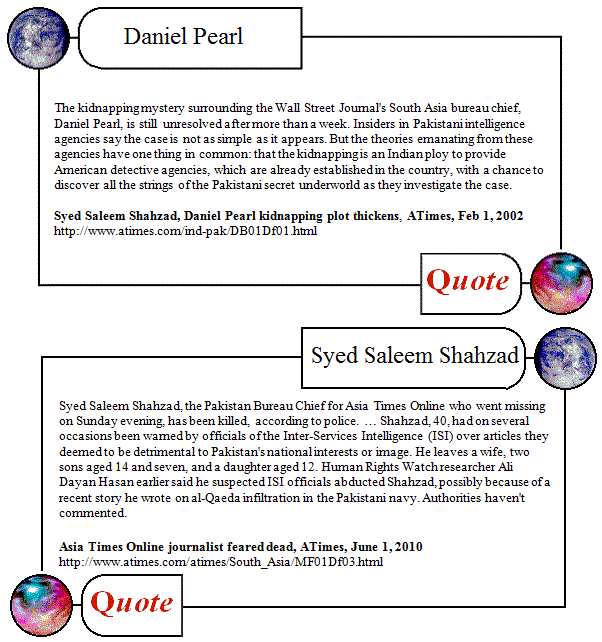
I must have been reading Saleem Shahzad for almost as long as he was reporting for Asia Times online – the first piece of his I could find on my hard drive is, ironically enough, a piece he wrote on the disappearance of Daniel Pearl:

quo-pearl-shahzad.gif

And now Shahzad too is dead.

According to today’s ATimes report of his death, “Shahzad, who has been writing for Hong Kong-based Asia Times Online for nearly 10 years, failed to show up for a scheduled appearance on a television talk show in the capital Islamabad”…

So the Shahzad piece on Daniel Pearl must have been one of his earlier reports for ATimes, and here we are almost ten years later, with Shahzad himself in the role of the disappeared journalist.

*

Shahzad had interviewed the likes of Sirajuddin Haqqani and Ilyas Kashmiri on the jihadist side of things, and been recently interviewed himself by Rear Admiral Adnan Nazir and Commodore Khalid Pervaiz

Joshua Foust sums up our reasons to regret his passing on Registan:

This is a serious loss—not just for his family, which must mourn a senseless death, but for people trying to understand the inexplicable militancy in Pakistan. He often had incredible sources, embedding with the insurgency inside Pakistan and Afghanistan and bringing to light narratives, perspectives, and stories no one could even hope to touch. Shahzad also seemed to have close ties to the ISI, and he performed an invaluable service reflecting those views to the outside world.

Shahzad, in other words, helped us start to understand why things happen in Pakistan and Afghanistan. Beyond his value as a human being—which means already that he couldn’t ever deserve to be abducted off the road and tortured to death—Syed Saleem Shahzad lived his life reporting things no one else would or could. And for that, we should celebrate what he accomplished.

Huma Imtiaz writes, in an AfPak Channel post aptly — if again ironically — titled Angels of death:

In the 1990s, journalists in Pakistan used to refer to members of the ISI as farishtas, which in English means “angels.” “The angels are at work,” they used to remark, when election results were delayed, a reference to the ISI rigging the polls to achieve a desired result. For journalists, reporting on these angels increasingly means exposing yourself to great danger, and the ever-present threat of disappearing in the middle of the night, perhaps never to be seen again.

*

Requiescat in pace.

Syed Saleem Shahzad’s book, Inside Al-Qaeda and the Taliban: Beyond Bin Laden and 9/11 was released two weeks ago.

AQ Merch

Monday, May 23rd, 2011

[ by Charles Cameron — AQ tech savvy, impact of visuals ]
.
.
Jarret Brachman told us a while back:

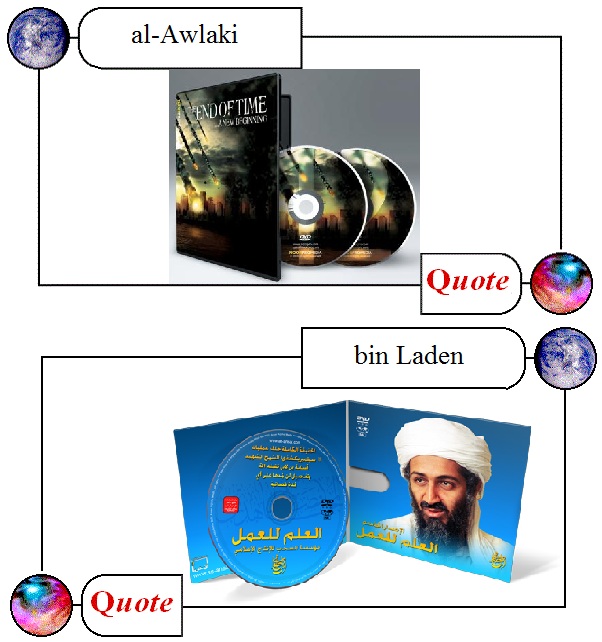
Jihadi movement participants, he [al-Awlaki] argues, should also use computers, CD-ROMs, and DVDs to circulate large quantities of jihadi information—in the form of books, essays, brochures, photographs, and videos—in a highly compressed fashion.

I know that in theory, it doesn’t surprise me too much — but visuals like these bring it home to me in a way that reading words never will:

quo-aa-and-obl-merch.jpg

*

Merchandise — CDs and DVDs, the coin of the info-realm.

BTW, that Brachman article, High-Tech Terror: Al-Qaeda’s Use of New Technology, will be familiar to many who read here, but is worth reading if you don’t already know it.

Rapturous times, neh?

Saturday, May 21st, 2011

[ By Charles Cameron — apocalyptic movements, best readings, budget shortfalls, lack of support for scholarship in crucial natsec areas — and with a h/t to Dan from Madison at ChicagoBoyz for the video that triggered this post ]
.
.
What with rapture parties breaking out all over, billboards in Dubai proclaiming The End and thousands of Hmong tribespeople in Vietnam among the believers, this whole sorry business of Harold Camping‘s latest end times prediction is catching plenty of attention. I thought it might be helpful to recommend some of the more interesting and knowledgeable commentary on Camping’s failed prophecy.

*

First, three friends and colleagues of mine from the Center for Millennial Studies at Boston University, about which I will have a further paragraph later:

Richard Landes of BU has a text interview here, and a TV interview here. His forthcoming book, Heaven on Earth, is a monumental [554 pp.] treatment of millenarian movements ranging “from ancient Egypt to modern-day UFO cults and global Jihad” with a focus on “ten widely different case studies, none of which come from Judaism or Christianity” — and “shows that many events typically regarded as secular–including the French Revolution, Marxism, Bolshevism, Nazism-not only contain key millennialist elements, but follow the apocalyptic curve of enthusiastic launch, disappointment and (often catastrophic) re-entry into ‘normal time'”.

Stephen O’Leary of USC wrote up the Harold Camping prediction a couple of days ago on the WSJ “Speakeasy” blog. He’s the rhetorician and communications scholar who co-wrote the first article on religion on the internet, and his specialty as it applies to apocalyptic thinking is doubly relevant: the timing of the end — and the timing of the announcement of the end. His book, Arguing the Apocalypse, is the classic treatment.

Damian Thompson of the Daily Telegraph is a wicked and witty blogger on all things Catholic and much else beside — the normally staid Church Times (UK) once called him a “blood-crazed ferret” and he wears the quote with pride on his blog, where you can also find his comments on Camping. Damian’s book, Waiting for Antichrist, is a masterful treatment of one “expecting” church in London, and has a lot to tell us about the distance between the orthodoxies of its clergy and the various levels of enthusiasm and eclectic beliefs of their congregants.

Three experts, three highly recommended books.

*

Two quick notes for those whose motto is “follow the money” (I prefer “cherchez la femme” myself, but chacun a son gout):

The LA Times has a piece that examines the “worldwide $100-million campaign of caravans and billboards, financed by the sale and swap of TV and radio stations” behind Camping’s more recent prediction (the 1994 version was less widely known).

Well worth reading.

And for those who suspect the man of living “high on the hog” — this quote from the same piece might cause you to rethink the possibility that the man’s sincere (one can be misguided with one’s integrity intact, I’d suggest):

Though his organization has large financial holdings, he drives a 1993 Camry and lives in a modest house.

*

Now back to the Center for Millennial Studies.

While it existed, it was quite simply the world center of apocalyptic, messianic and millenarian studies. CMS conferences brought together a wide range of scholars of different eras and areas, who could together begin to fathom the commonalities and differences — anthropological, theological, psychological, political, local, global, historical, and contemporary — of movements such as the Essenes, the Falun Gong, the Quakers, Nazism, the Muenster Anabaptists, al-Qaida, the Taiping Rebellion, Branch Davidians, the Y2K scare, classic Marxism, Aum Shinrikyo and Heaven’s Gate.

And then the year 2000 came and went, and those who hadn’t followed the work of the CMS and its associates thought it’s all over, no more millennial expectation, we’ve entered the new millennium with barely a hiccup.

Well, guess what. It was at the CMS that David Cook presented early insights from his definitive work on contemporary millennial movements in Islam — and now we have millennial stirrings both on the Shia side (President Ahmadinejad et al) and among the Sunni (AQ theorist Abu Mus’ab Al-Suri devotes the last hundred pages of his treatise on jihad to “signs of the end times”)…

Apocalyptic expectation continues. But Richard Landes’ and Stephen O’Leary’s fine project, the CMS, is no longer with us to bring scholars together to discuss what remains one of the key topics of our times. When Richard’s book comes out, buy it and read it — and see if you don’t see what I mean.

Or read Jean-Pierre Filiu‘s Apocalypse in Islam.  Please. Or Tim Furnish‘s recent paper.

*

And while it may not see Judgment Day or the beginning of the end of the world as predicted, what this week has seen is the end of funding of Fulbright scholarships for doctoral dissertation research abroad.  But then as Abu Muqawama points out:

hey, it’s probably safe to cut funding for these languages. It’s hard to see Iran, Afghanistan, Pakistan or anywhere in the Arabic-speaking world causing issues in terms of U.S. national security interests anytime soon.

Right?

So the CMS isn’t the only significant scholarly venue we’ve lost to terminal lack of vision.


Switch to our mobile site