zenpundit.com » china

Archive for the ‘china’ Category

Hermit Kingdom of Darkness

Sunday, April 7th, 2013

North Korea’s shopworn game of bluster, threaten, bully, violate international norms and eventually be rewarded with concessions and bribes has stopped working, which is why there now is a crisis. With the suckers (ROK, USA and Japan) refusing to play three card monty and with even  Pyongyang’s confederate China wearying of the scam when they have their own fish to fry, Kim Jong Eunhas few options to save face except to double down on painting himself into a smaller and tighter corner. There are some who would like to play the game of appeasement for a temporary respite but both Seoul and Washington are taking a harder line on North Korean antics.

One gets the impression that -unofficially, mind you – Beijing would not mind “Fatty the Third” getting a comeuppance that could push him from power and lead to the ascension of a more mature, more reasonable, more seasoned and more Sinicized leader of the Kim dynasty.

Here is a round up of more intelligently thought out (or at least interesting) articles and posts about the Nut of the North and possible war with North Korea:

Colonel Dave Maxwell– north Korean Leadership Assessment and The Realist Prism: North Korea Gambles on Strategic Assumptions and U.S. would seek regime change in North Korea if attack occurs

Colonel Maxwell is an area specialist on the DPRK, these are the “must read” pieces

Robert Baer –Viewpoint: North Korea’s Gaddafi Nightmare 

Gordon Chang –Is Kim Jong Un’s Bluster Really a Prelude to Reform?

Thomas PM Barnett –The Tricky Thing about Kim Jon Eun 

Patrick Cronin – Tell me How this Starts

IHT –Detecting Shift, U.S. Makes Case to China on North Korea 

Let me try my hand at reading the tea leaves. I don’t know that much, relatively speaking, about the “sovietology” of analyzing North Korean nuances which I will leave for experts like Colonel Maxwell to concentrate on other angles. Some points i no particular order:

  • First, any hope of an internal coup against Eun is probably nonexistent. Not only for the the consistent ruthlessness and lavish bribery which the Kim Family regime has treated it’s military, but the fact that coups of this nature have a poor track record in Communist states, even weird ones like the DPRK. From the inception of Communist power in the USSR, Soviet leaders fretted about “Bonapartism” by counterrevolutionary generals on white horses from Kornilov to Tukhachevskii to Zhukov. That these plots were mostly imaginary did not matter and Communist rulers neutralized this threat by binding the military leadership into the Party leadership at a level subordinate to the Politburo and periodically shooting likely upstarts. The political space for successful military coups do not exist in Communist regimes even for the key insiders, just ask Lin Bao. The North Korean military does not have the will to do this except in conjunction with massive Chinese intervention. Perhaps not even then.
  • For all the talk of irrationality, North Korea has been been playing this game as a survival strategy for sixty years and only miscalculated once, with the original invasion of South Korea in 1950 – which only happened, after Kim Il-Sung received the blessing of Stalin and promise of massive support from Mao ZeDong – and it was an unmitigated disaster for North Korea and China. Pointedly, the North has not initiated a war since and their subsequent violent provocations, while infuriating, have been quixotic and weird rather than existential threats that would guarantee a crushing military response.
  • The “win” for the US and ROK here is in frustrating the regime’s grasp for status, however self-deluded, in extorting more material concessions by acting like the international community’s equivalent of a crazy, menacing, homeless person ranting on a street corner. We need to make this charade appear to be a diplomatic sure-fire loser this time in the eyes of Pyongyang’s elite with an endgame where the North emerges empty handed and Eun feels that pressing further risks a greater loss of face. We do this by making moves where the spillover costs of North Korean intransigence and public lunacy drift in China’s direction; a tightly constrained North Korea out of diplomatic and economic options is really Beijing’s problem.
  • The strategic equation for “victory” from the North’s perspective depends heavily upon the reaction of the US and ROK governments to get drawn into tiresome negotiations before the North ceases it’s behavior, something they ultimately cannot control. Washington and Seoul cold hold firm or even (conceivably) take a harder line. If frustrated in their quest for concessions, the regime could exercise several options a) shift gears to a different propaganda campaign to distract internal audience b) engage in an act of terrorism elsewhere in the world, such as against a ROK embassy c) engage in a military demonstration that while provocative, like ballistic missile test, is not a casus belli d) all of the above e) undertake a military strike under the mistaken impression the ROK will not retaliate.

Comments welcomed.

Honor, Shame, Scandal and Integrity

Friday, March 8th, 2013

[ by Charles Cameron — reflecting on the anthropology of honor – shame, its relevance to cover ups of many kinds, and its potential for impact in our search for a more peaceable modus vivendi ]
.

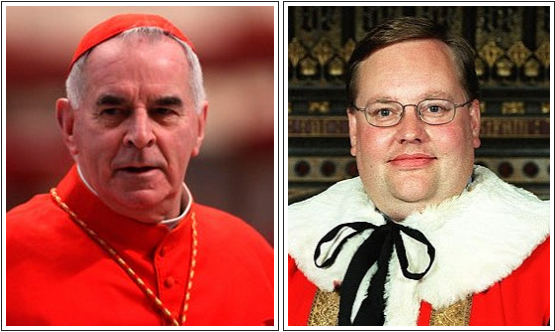
Cardinal O'Brien & Lord Lennard, their images as juxtaposed on the Cranmer blog


**

Recent political news in the United Kingdom, from The Telegraph:

Liberal Democrat leader Nick Clegg has been forced to admit that his office knew for years of claims that a senior party figure might be sexually molesting volunteers and staff.

The Deputy Prime Minister changed tack in a statement on Sunday evening over the sex scandal which is engulfing his party.

He broke into the end of his holiday to admit for the first time that his office had been aware of the allegations surrounding his former chief executive Lord Rennard since 2008. But he said he was personally unaware of the claims.

Nick Clegg admits his office knew of Lord Rennard rumours for five years

**

In today’s Wired, concerning a cover-up in the US Air Force:

A military jury found Lt. Col. James Wilkerson guilty of groping a sleeping woman’s breasts and vagina. But the Air Force wasn’t done with the “superstar” F-16 pilot. It reinstated Wilkerson to active duty and wiped away his conviction — but, to save face, is pledging not to promote him to full colonel.

[ … ]

Now the embarrassed Air Force is looking for a face saving way out of its institutional mess. Its answer thus far, reports Stars & Stripes, is to remove Wilkerson’s name from its promotions list. There’s an opportunity for Wilkerson to appeal the decision.

Air Force Accountability for Sexual Assault: Not Promoting Convicted Officer

**

And concerning Lockheed and China, a short while back from emptywheel:

I’m just wondering out loud here: what if China did more than just steal data on the F-35 when it hacked various contractors, and instead sabotaged the program, inserting engineering flaws into the plane in the same way we inserted flaws in Iran’s centrifuge development via StuxNet?

[ … ]

I don’t know that we would ever know if this clusterfuck was caused with the assistance of China. It’s not like Lockheed would publicize such information, just as it asked for another $100 billion. And I don’t want to underestimate the defense industry’s ability to screw up all by themselves.

What if China Not Just Hacked — But Sabotaged — the F-35?

**

I think one of the least appreciated parts of our human make-up is what anthros call the honor-shame system. It considers the honor of a larger group — the family, the regiment, the city, the nation, the corporation, the church — as of overriding importance, with personal considerations clearly secondary. And by honor I mean the respect with which the rest of society views it.

That’s the system that gives us “honor killings” in a swathe of countries, and in modified western form it’s also at the root of every cover-up, every attempt by hacks and flacks to put a good face on things — and it’s very much something that investigative journalism exists to uncover, just as PR attempts to cover it up.

To my mind, this is one of the big battlefronts in the world today, comparable perhaps to the battle post-Descartes between “enlightenment” and “superstition”. And when there’s murky business to cover up or admit to, corporations are often slower than individuals to ‘fess up — if only because the stock market favors appearances rather than realities. Until the bubble bursts.

And much the same is true for politicians and the electoral market, and for churches and the market in faith.

**

My mentor Richard Landes believes honor-shame is a large part of the battlefront between “the Israelis” and “the Arab world” — he quotes these two definitions:

Politeness is not saying certain things lest there be violence; civility is being able to say those certain things and there won’t be violence.

and writes:

In an honour culture, it is legitimate, expected, even required to shed blood for the sake of honour, to save face, to redeem the dishonoured face. Public criticism is an assault on the very “face” of the person criticised. Thus, people in such cultures are careful to be “polite”; and a genuinely free press is impossible, no matter what the laws proclaim.

Modernity, however, is based on a free public discussion, on civility rather than politeness, but the benefits of this public self-criticism – sharp learning curves, advances in science and technology, economic development, democracy – make that pain worthwhile.

Leaving aside their applicability to the Israeli-Arab issue, are those fair distinctions between two modes of being? How much of the battle between those forces can be found in the world around us, in our politics, our economics situation, and so on?

How much impact did the differences between honor cultures and modernity have, in the wars in Iraq and Afghanistan? Where else might this kind of conflict of values confront our leaders and ourselves?

How can we best handle interfaces between these two ways of experiencing, evaluating and acting in our shared world?

Sherlock Holmes, Hannibal Lector and Simonides

Sunday, March 3rd, 2013

[ by Charles Cameron — the art of memory, with a sidelong glance at swans, typhoid and theodicy ]
.

Thomas Harris (and by extension Hannibal Lector) has been interested in memory palaces for a long time. We can begin to infer this this because Lector describes his hobby in Red Dragon (1981) and again in Silence of the Lambs (1988):

So — church collapses?

**

As you can tell from that last comment in the Silence of the Lambs quote — to my mind the most brilliant presentation of the problem of theodicy for our day — if there’s a God worth defending, it has to be a God who allows sparrows to fall, typhoid to accompany swans in the vast ecology of existence, churches to collapse on worshipers, and “bad things to happen to good people” from time to time.

And such things, specifically including collapses of religious buildings atop worshipers, do indeed happen in fact as well as fiction.

And they don’t only happen to Christians, either… Bon is the shamanistic religious tradition of Tibet, prior to — and later, somewhat assimilated by — Buddhism

**

The thing is, when I read that Hannibal Lector collected church collapses, it not only made me start to take note of them myself, it also made me think of Simonides. As Frances Yates tells us in her book, The Art of Memory:

At a banquet given by a nobleman of Thessaly named Scopas, the poet Simonides of Ceos chanted a lyric poem in honour of his host but including a passage in praise of Castor and Pollux. Scopas meanly told the poet that he would only pay him halfthe sum agreed upon for the panegyric and that he must obtain the balance from the twin gods to whom he had devoted half the poem. A little later, a message was brought in to Simonides that two young men were waiting outside who wished to see him. He rose from the banquet and went out but could find no one. During his absence the roof of the banqueting hall fell in, crushing Scopas and all the guests to death beneath the ruins; the corpses were so mangled that the relatives who came to take them away for burial were unable to identify them. But Simonides remembered the places at which they had been sitting at the table and was therefore able to indicate to the relatives which were their dead. The invisible callers, Castor and Pollux, had handsomely paid for their share in the panegyric by drawing Simonides away from the banquet just before the crash. And this experience suggested to the poet the principles of the art of memory of which he is said to have been the inventor. Noting that it was through his memory of the places at which the guests had been sitting that he had been able to identify the bodies, he realised that orderly arrangement is essential for good memory.

And by way of reinforcing my Lector-Simonides conjecture, Lector certainly had a remarkable interest in memory, as we learn from his dialogue with Clarice Starling:

“Did you do the drawings on your walls, Doctor?”
“Do you think I called in a decorator?”
“The one over the sink is a European city?”
“It’s Florence. That’s the Palazzo Vecchio and the Duomo, seen from the Belvedere.”
“Did you do it from memory, all the detail?”
“Memory, Officer Starling, is what I have instead of a view.”

A belvedere, from the Italian, is “a structure (as a cupola or a summerhouse) designed to command a view” — and a beautiful view at that. Belvedere is also, ironically, the name of the town in Ohio where Buffalo Bill, Lector’s serial killer ex-patient, lives…

**

So it didn’t surprise me to discover that in Hannibal (1999), the book that follows Silence, this brilliant man who as we have seen collects church collapses and has an exquisite memory in place of a view, is revealed as a practitioner of Simonides’ art:

The memory palace was a mnemonic system well known to ancient scholars and much information was preserved in them through the Dark Ages while Vandals burned the books. Like scholars before him, Dr. Lecter stores an enormous amount of information keyed to objects in his thousand rooms, but unlike the ancients, Dr.Lecter has a second purpose for his palace; sometimes he lives there. He has passed years among its exquisite collections, while his body lay bound on a violent ward with screams buzzing the steel bars like hell’s own harp.

Hannibal Lecter’s palace is vast, even by medieval standards. Translated to the tangible world it would rival the Topkapi Palace in Istanbul for size and complexity.

We catch up to him as the swift slippers of his mind pass from the foyer into the Great Hall of the Seasons. The palace is built according to the rules discovered by Simonides of Ceos and elaborated by Cicero four hundred years later; it is airy, high-ceilinged, furnished with objects and tableaux that are vivid, striking, sometimes shocking and absurd, and often beautiful. The displays are well spaced and well lighted like those of a great museum. But the walls are not the neutral colors of museum walls. Like Giotto, Dr. Lecter has frescoed the walls of his mind.

Brilliant. And a delight, years later, to have my hunch connecting the church collapses and prison cell with only memory for a view with Simonides and the Art of Memory confirmed by the third book and film in the series…

You’ll note, btw, that the Lector (caveat lector) of the first two books has now become Lecter in alignment with the films starring Anthony Hopkins.

**

I love symmetries, so let’s move from the most monstrous criminal mind in literature, to the greatest detective…

Sherlock Holmes — in his latest television incarnation — builds memory palaces of a sort, though I’m not sure Simonides would recognize them.

I’m posting the clip from the series here to honor my son Emlyn, with whom I have been watching the series…

**

And then there’s the Jesuit whose use of the Art is explored in Jonathan Spence‘s The Memory Palace of Matteo Ricci:

In 1596 Matteo Ricci taught the Chinese how to build a memory palace. He told them that the size of the palace would depend on how much they wanted to remember: the most ambitious construction would consist of several hundred buildings of all shapes and sizes, “the more there are the better it will be,” said Ricci, thought he added that one did not have to build on a gradiose scale right away. One coul create modest palaces, or one could build less dramatic structures such as a temple compound, a cluster of government offices, a public hostel, or a merchants’s meeting lodge. If one wished to begin on a still smaller scale, then one could erect a simple reception hall, a pavilion, or a studio. And if one wanted an intimate space one could use just the corner of a pavilion, or an altar in a temple, or even such a homely object as a wardrobe or a divan.

You’ll note that in this early example of virtual reality as an pedagogical technology, Ricci doesn’t start with the easy stuff, the single wardrobe or divan — he begins with “the most ambitious construction”…

Enough for now. When I want to talk about in a follow up post is detail… the crucial importance of detail.

The Oscars, the Conclave and the Chinese

Monday, February 25th, 2013

[ by Charles Cameron — more on the upcoming papal election from a “comparative” perspective ]
.

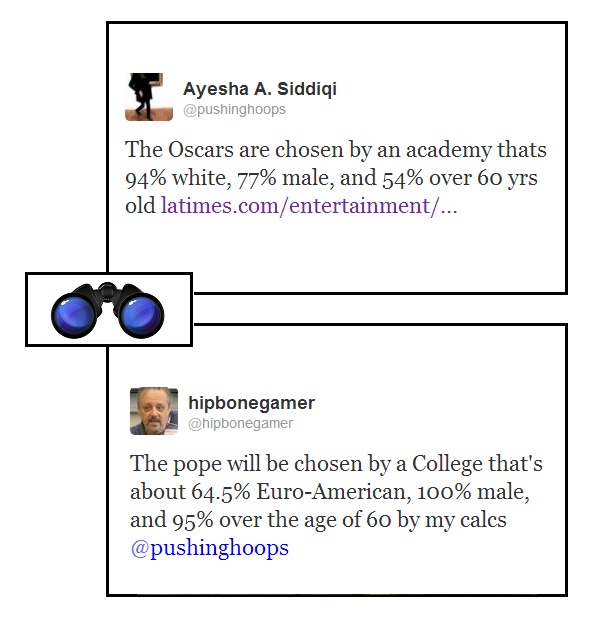
As you know, I noodle around with parallelisms and oppositions quite a bit. Here are two recent pairings that caught my attenion — one of them just in time for the Oscars:

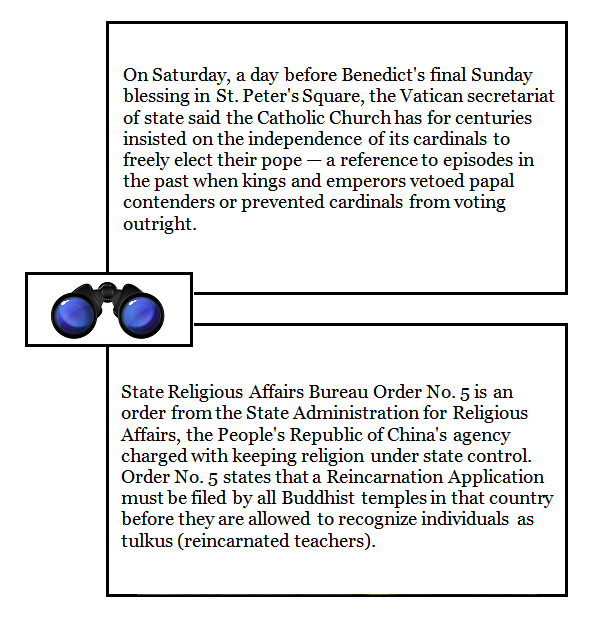
The other concerns political influence on spiritual appointments…

I had the good fortune to meet and befriend a “tulku” while I was at Oxford, so the whole business of the identification and recognition of reincarnated Tibetan lamas has long been an interest of mine.

“The Galula Doctrine”

Wednesday, January 23rd, 2013

Small Wars Journal has published another edition of the excellent COIN interview series conducted by Octavian Manea. Here he interviews A.A. Cohen, author of Galula: The Life and Writings of the French Officer who Defined the Art of Counterinsurgency 

The Galula Doctrine: An Interview with Galula’s Biographer A.A. Cohen

OM: Which were the role of Mao and the exposure to Chinese civil war in Galula’s story? It seems to be his decisive formative lab experience like Russia was for George Kennan.

AAC: Unquestionably, of all the influences exerted on Galula’s treatise, Mao and the Chinese Civil were the greatest. Galula had a strong intellectual admiration for Maoist revolutionaries, despite being very opposed to what they stood for. Before the Chinese Civil War, Galula had no interest in insurgency or counterinsurgency. He had not fought as a Partisan during WW2; he had no experience or interest in these fields until he was exposed to China as of late 1945, in the thick of its civil war. There, his analytical penchant led him to see himself as the decipherer of Mao, intent on getting to the bottom of what the revolutionaries were fundamentally about. Galula cut through the egalitarian propaganda and all that surrounding the People’s revolution. Above all, he wanted to understand why these guys were gaining momentum as they were despite the unfavorable odds. When he figured it out, he reverse-engineered their methods to arrive at a counter-process to revolution and insurgency. His embrace of Chinese dialectics, and with these, the notion of unity of opposites or yin and yang, was helpful in achieving this.

Is counterinsurgency to Galula more of a strategy or  more of a technique and a methodology?

What Galula offers, first and foremost, is a doctrine – not a strategy. His doctrine is underpinned by an important theory about people and what motivates them to take up arms, or to side with those who do. The theory goes that in times of danger (war), the majority of people will be motivated primarily by a fundamental need for security. Galula is adamant about this. But he also recognizes that there will be a minority of people – the instigators at the core of a movement – that will be ideologically, or even fanatically motivated. These are the true believers. He makes no qualms about prescribing that this is the group that the counterinsurgent or counterterrorist will need to find and neutralize, while protecting the rest of the population that aspires to a normal, if not better life. If you buy into this theory, Galula’s doctrine offers a multi-step framework for operations; in other words, a method to counterinsurgency. His famous eight steps are there to provide some logical linearity to what is otherwise a very nonlinear form of warfare. Within that framework, you have the flexibility to formulate your strategy and to conduct your operations to achieve your objectives.

Read the rest here.

I agree that Galula was not offering a strategy. Even more strongly, I think Cohen is correct about the historical importance of China’s long period of disorder, from the overthrow of the Q’ing dynasty to Mao ZeDong’s declaration of the People’s Republic, for Galula. However, not just for him but for anyone interested in questions of war and statecraft where insurgency, warlordism, state failure, state-building, foreign intervention, balance-of-power politics, ideological mass-movements, 4GW, revolution and total war coexisted and co-evolved.

The best comparison in our lifetime to China in this period would have been Lebanon  in the 1980’s, except that China’s polycentric conflict was even more complex and on an epic scale.


Switch to our mobile site