zenpundit.com » geopolitics

Archive for the ‘geopolitics’ Category

The Strategic Dilemma of Bitter-Enders

Sunday, April 8th, 2012

Berlin 1945

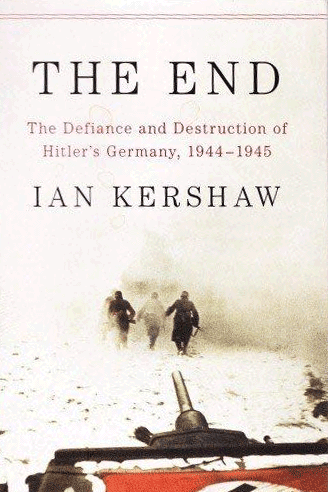
I have been reading The End by Ian Kershaw and it struck me that the story therein of Hitler’s Reich going down to total destruction is really a recurrent phenomena.

It is interesting that Kershaw, who began his earlier 2 volume biography of Adolf Hitler with the hypothesis that the Fuhrer was more the opportunistic vehicle of grand historical forces, in this study of the Nazi Gotterdammerung has accepted that the pull of Hitler’s inexorable authority over  Nazi and traditional German elites was charismatic, personalized and beyond challenge, even when Hitler was encircled by Soviet forces in his subterranean bunker and hours from suicide. Kershaw details how Hitler and his die-hard Gauleiter apparatchiks repeatedly demanded not only the militarily impossible, but the nonsensically insane, from the Wehrmacht, the Waffen-SS and the German people themselves. Virtually everyone struggled to comply.

This story is far from unique.

The Imperial Japanese, it must be said, surpassed even their Nazi allies in stubborn refusal to accept empirical reality and determination to fight to uttermost ruin. After the destruction of their Navy, loss of 100,000 men in Okinawa (their entire army there, minus a handful, fought to the death), the ruin of their cities, approaching famine, exhaustion of aviation fuel and gasoline stocks, the declaration of war on Japan by the Soviet Union and the atomic bombing of Hiroshima – Imperial Japan’s war cabinet deadlocked on a vote to surrender. The Kamikaze enthusiasts among the flag officers proposed a battle plan for their home islands to the war cabinet picturesquely titled “Honorable Death of 100 Million”, with gruesome implications for Japan’s civilian population.

Emperor Hirohito inspects Hiroshima after the atomic bombing

Many years later, Prime Minister Nakasone, who had been conscripted as a mere boy to meet invading American soldiers and Marines on the beach with a sharpened bamboo stake, credited the two atomic bombs with having saved his life. Without them, Japan’s warlords, with the tacit approval of their Emperor, would have coerced the Japanese nation into a gloriously genocidal defeat. A policy that while irrational,  faithfully followed the cultural spirit of Bushido and Japan’s mythic 47 Ronin.

Then there was the ancient example of Masada, the defiance of Titus by the Jewish Sicarii in 73 AD, as described by Josephus:

…. Miserable men indeed were they, whose distress forced them to slay their own wives and children with their own hands, as the lightest of those evils that were before them.  So they being not able to bear the grief they were under for what they had done any longer, and esteeming it an injury to those they had slain to live even the shortest space of time after them,-they presently laid all they had in a heap, and set fire to it.  They then chose ten men by lot out of them, to slay all the rest; every one of whom laid himself down by his wife and children on the ground, and threw his arms about them, and they offered their necks to the stroke of those who by lot executed that melancholy office;  and when these ten had, without fear, slain them all, they made the same rule for casting lots for themselves, that he whose lot it was should first kill the other nine, and after all, should kill himself. Accordingly, all these had courage sufficient to be no way behind one another in doing or suffering;  so, for a conclusion, the nine offered their necks to the executioner, and he who was the last of all took a view of all the other bodies, lest perchance some or other among so many that were slain should want his assistance to be quite dispatched; and when he perceived that they were all slain, he set fire to the palace, and with the great force of his hands ran his sword entirely through himself, and fell down dead near to his own relations. So these people died with this intention, that they would leave not so much as one soul among them all alive to be subject to the Romans.

….Now for the Romans, they expected that they should be fought in the morning, when accordingly they put on their armor, and laid bridges of planks upon their ladders from their banks, to make an assault upon the fortress, which they did,  but saw nobody as an enemy, but a terrible solitude on every side, with a fire within the place as well as a perfect silence So they were at a loss to guess at what had happened. At length they made a shout, as if it had been at a blow given by the battering-ram, to try whether they could bring anyone out that was within;  the women heard this noise, and came out of their underground cavern, and informed the Romans what had been done, as it was done, and the second of them clearly described all both what was said and what was done, and the manner of it:  yet they did not easily give their attention to such a desperate undertaking, and did not believe it could be as they said; they also attempted to put the fire out, and quickly cutting themselves a way through it, they came within the palace,  and so met with the multitude of the slain, but could take no pleasure in the fact, though it were done to their enemies. Nor could they do other than wonder at the courage of their resolution and the immovable contempt of death, which so great a number of them had shown, when they went through with such an action as that was.

What does the phenomenon of bitter-end political leadership mean in terms of strategy?

To the extent that war is a contest of wills or a form of bargaining between two political communities, the fanaticism of bitter-enders simplifies strategy while often complicating the warfare necessary to execute it.  Strategy is simplified because, to borrow a term from labor relations, the “last, best offer” has been refused. No bargaining is taking place – one or more sides refuses peace at any price short of total victory (“unconditional surrender”) or complete defeat. This represents movement away from a limited war for limited ends closer toward Clausewitz ‘s theoretical “Absolute War” by becoming, for the losing party, an existential conflict. The implicit threat to fight to the bitter end in any war – assuming the resources and will to make good on the threat exist – is really a primitive form of psychological deterrence; most states seeking limited objectives will avoid getting trapped in this dynamic.

This means the strategic calculus is altered by such a stance. The war itself and the driving need to wage it to it’s ultimate conclusion may have come to outweigh the value of the original “End” over which the conflict began; perhaps a policy concession or bit of territory or admission by a state’s rulers of a subordinate place in the diplomatic pecking order. While adopting a “bitter-end” position logically seems disadvantageous to the weaker party, it presents the enemy with a new set of problems. The “Means” or costs required to wage a war of conquest and lengthy occupation may be economically or attritionally prohibitive, or even physically impossible. Israel has a fine military and nuclear weapons but the Jewish state is too small to subdue and rule over the Arab states; Imperial Japan, for all it’s martial ferocity and cruelty, could not swallow the vastness of China, divided by civil war and fighting without allies, even before Pearl Harbor. Reach can exceed grasp.

Likewise, the moral burden and diplomatic friction of waging war not only against the opposing army, but the enemy population as well – of bombing or blockading into starvation women, children and the elderly – may be more than a political community or it’s leadership are able to bear and remain unified. As callous and narcissistic leaders of great countries usually are, few of them (fortunately) aspire to follow in the footsteps of Hitler, Stalin or Mao and openly spill an ocean of blood.  The impressive firepower of the bombing campaigns of Lyndon Johnson and Richard Nixon did not break Hanoi’s will to fight the Vietnam War, they broke the Eastern Establishment’s will to pursue anticommunist Containment by force in Vietnam or elsewhere. The brutal counterinsurgency tactics of the French Army in the Algerian War destroyed the Algerian rebels militarily, but it shattered the Fourth Republic politically.

Insurgency, the “war of the weak”, is powerful because it inherently contains elements of bitter-endism. To rise up against one’s own society usually is an act of politically burning your boats and wearing, so far as the state is concerned, the mantle of treason and all that it entails. A desperate act by desperate men and conversely,  many of the leaders of states, being tyrants, are in no better position. Tyrants are widely despised; the Gaddafis or Mussolinis know that their power is their only guarantee of safety and their fate, if they fall into the hands of their people, would be terrible, so any rebellion must be crushed immediately, lest it gain traction. The Shah by contrast, was a congenital coward but a realist. He knew what might happen if he and his family fell into the hands of his political opponents, so the Pahlavi dynasty preemptively fled at the first sign of trouble (twice).

Finally, a word must be said about the position of a people under the leadership of  bitter-ender rulers in a war. Caught between a rock and a hard place, they essentially have three choices, none of them attractive:

1. Make a supreme effort to win the war.

2. Make a supreme effort to overthrow the government and sue for peace.

3.  Desert the cause as quietly as they can on an individual basis and hope for the best.

The best almost never happens. Kershaw’s history of the fate of the Germans in 1945 would have been well understood by Thucydides, even if the Melians were as blameless as the Germans were deserving of their fate:

….About the same time the Melians again took another part of the Athenian lines which were but feebly garrisoned. Reinforcements afterwards arriving from Athens in consequence, under the command of Philocrates, son of Demeas, the siege was now pressed vigorously; and some treachery taking place inside, the Melians surrendered at discretion to the Athenians, who put to death all the grown men whom they took, and sold the women and children for slaves, and subsequently sent out five hundred colonists and inhabited the place themselves.

If you want the bitter end, be prepared to drink the last drop.

Perception and Strategy Part I.

Tuesday, March 20th, 2012

Jason Fritz at Inkspots had a thoughtful post about Afghanistan in light of recent events and made some points regarding strategy well worth further consideration. I suggest that you read his post in full, but I will comment on excerpts of his remarks below in a short series of posts. Here’s the first:

Delicate strategic balancing: perception’s role in formulating strategy

…..That all said, incidents in Afghanistan these past few months have caused me to question the validity of strategies that hinge upon the perspectives of foreign audiences*. This is not to negate the fact that foreign perspectives affect nearly every intervention in some way – there has been plenty of writing on this and believe it to be true. I firmly believe that reminding soldiers of this fact was possibly the only redeeming value of the counterinsurgency manual. To say nothing of this excellent work. But strategies that hinge upon the perspectives of foreign populations are another matter altogether. 

I think Jason is correct to be cautious about either making perception the pivot of strategy or throwing it overboard altogether. The value of perception in strategy is likely to be relative to the “Ends” pursued and the geographic scale, situational variables and longitudinal frame with which the strategist must work. The more extreme, narrow and immediate the circumstances the more marginal the concern about perception. Being perceived favorably does not help if you are dead. Being hated for being the victor (survivor) of an existential war is an acceptable price to pay.

Most geopolitical scenarios involving force or coercion though, fall far short of Ludendorf’s total war or cases of apocalyptic genocide. Normally, (a Clausewitzian would say “always”) wars and other violent conflict consist of an actor using force to pursue an aim of policy that is more focused politically and limited than national or group survival; which means that the war or conflict occurs within and is balanced against a greater framework of diverse political and diplomatic concerns of varying importance.  What is a good rule of thumb for incorporating perception into strategy?

According to Dr. Chet Richards, the advice offered by John Boyd:

….Boyd suggested a three part approach:

  • With respect to ourselves, live up to our ideals: eliminate those flaws in our system that create mistrust and discord while emphasizing those cultural traditions, experiences, and unfolding events that build-up harmony and trust.  [That is, war is a time to fix these problems, not to delay or ignore them. As an open, democratic society, the United States should have enormous advantages in this area.]
  • With respect to adversaries, we should publicize their harsh statements and threats to highlight that our survival is always at risk; reveal mismatches between the adversary’s professed ideals and how their government actually acts; and acquaint the adversary’s population with our philosophy and way of life to show that the mismatches of their government do not accord with any social value based on either the value and dignity of the individual or on the security and well being of society as a whole.  [This is not just propaganda, but must be based on evidence that our population as well as those of the uncommitted and real/potential adversaries will find credible.]
  • With respect to the uncommitted and potential adversaries, show that we respect their culture, bear them no harm, and will reward harmony with our cause, yet, demonstrate that we will not tolerate nor support those ideas and interactions that work against our culture and fitness to cope. [A “carrot and stick” approach.  The “uncommitted” have the option to remain that way—so long as they do not aid our adversaries or break their isolation—and we hope that we can entice them to join our side. Note that we “demonstrate” the penalties for aiding the enemy, not just threaten them.]

I would observe that in public diplomacy, IO  and demonstrations of force, the United States more often than not in the past decade, pursued actions in Afghanistan and Iraq that are exactly the opposite of what Boyd recommended. We alienated potential allies, regularly ignored enemy depredations of the most hideous character, debased our core values, crippled our analysis and decision-making with political correctness and lavishly rewarded treachery against us while abandoning those who sacrificed at great risk on our behalf . We are still doing these things.

Most of our efforts and expenditures at shaping perception seem to be designed by our officials to fool only themselves.

The End and Ends

Tuesday, March 13th, 2012

The End by Sir Ian Kershaw

I am currently reading The End, about the last year of the Third Reich and the Nazi death spiral toward Germany’s absolute destruction. It is a fascinating, mass suicidal, political dynamic that was mirrored to an even greater degree of fanaticism by Nazi Germany’s Axis partner, the Imperial Japanese. Facing the prospect of certain defeat, the Germans with very few exceptions, collectively refused every opportunity to shorten the agony or lighten the consequences of defeat and stubbornly followed their Fuhrer to the uttermost doom. It made no sense then and still does not now, seven decades later.

Adolf Hitler’s personal authority over the life and death of every soul in Germany did not end until his last breath. When surrounded by Soviet armies, trapped in his Fuhrerbunker in the ruin of Berlin, all it took for Hitler to depose his most powerful paladins, Hermann Goering and Heinrich Himmler was a word. They still commanded vast military and paramilitary security forces – Himmler had been put in charge of the Home Army as well as the SS, Gestapo and German police – but when Hitler withdrew his support and condemned them, their power crumbled. Goering, the glittering Nazi Reichsmarchal and second man in the state, was ignominiously arrested.

Even in Gotterdammerung, the Germans remained spellbound, like a man in a trance placing a noose around his own neck.

Currently, the chattering classes of the United States are uneasily working their way toward a possible war with Iran, or at least a confrontation with Teheran over their illegal nuclear weapons program (some people will object that, technically, we are not certain that Iran has a weapons program. This is true. It is also irrelevant to the diplomatic dynamic created by Iran’s nuclear activities which the regime uses to signal regularly to all observers that they could have one).  There is much debate over the rationality of Iran’s rulers and the likely consequences if Iran is permitted to become a nuclear weapons state. There is danger and risk in any potential course of action and predictions are being made, in my humble opinion, far too breezily.

In the run-up to war or negotiation, in dealing with the Iranians and making our strategic calculations, it might be useful to recall the behavior of the Germans.

Of diversity in Islam

Wednesday, March 7th, 2012

[ by Charles Cameron — against either / or thinking — a graphic reminder? ]
.

Islam is “a mosaic, not a monolith”.

Vartan Gregorian, president of the Carnegie Corporation, offered us a 177-page exposition of that theme in a book of that title published by the Brookings Institution (2003), expanding on an earlier and shorter essay of the same title. Of the book-length version, he writes:

Presenting such a wide-angle view in a relatively small space requires the free use of generalizations, summaries, and categorizations that must leave out many nuances of history.

1.

There’s no doubt that some currents within Islam preach a continuing war against “Crusaders and Zionists” — and make no mistake about it, this is a religious movement, claiming its sanction in scripture and its path as submission to the will of God, as indicated by David Martin Jones and MLR Smith in Whose Hearts and Whose Minds? The Curious Case of Global Counter-Insurgency [see Zen’s comments here]:

The process of radicalisation is obviously a complex one. Certainly, the passage to the act of terrorism cannot be reduced solely to religion. Nevertheless, it is somewhat naive, if not perverse, to dismiss it completely. The bombings of the Madrid and London transport systems in March 2004 and July 2005 respectively, and even the 9/11 assaults, are, whatever else, Islamist acts in a Western setting. The view that religion is at best a secondary motive defies the evidence. All the groups that have undertaken high-profile terrorist acts dating from 9/11 and stretching from Bali to Madrid, London and Mumbai have acted in the name of a militant understanding of Islam. Such a pattern of worldwide attacks, exhibiting a profound devotion to a politically religious cause intimates, if nothing else, a religious dimension to jihadism. In fact, to reduce jihadism to individual social pathology attempts to explain away political religion as a social fact. Rather worryingly, it assumes that when a highly motivated jihadist claims to undertake an operation to advance a doctrine, he does not really mean it.

This might seem so obvious as to require no comment — yet Jones and Smith follow this paragraph with a question:

we need to resolve this paradox: why do counterinsurgency theorists exhibit this reluctance to confront the ideological or politically religious dimension of modern insurgency?

— and there are no doubt other segments of the media, intelligence and policy communities of which the same question might be asked.

One aspect of the answer, I believe, lies in the general tendency of post-enlightenment thinkers to “push religion into the background of their story” (Richard Landes‘ words, which I quoted here in a different context a week ago).

2.

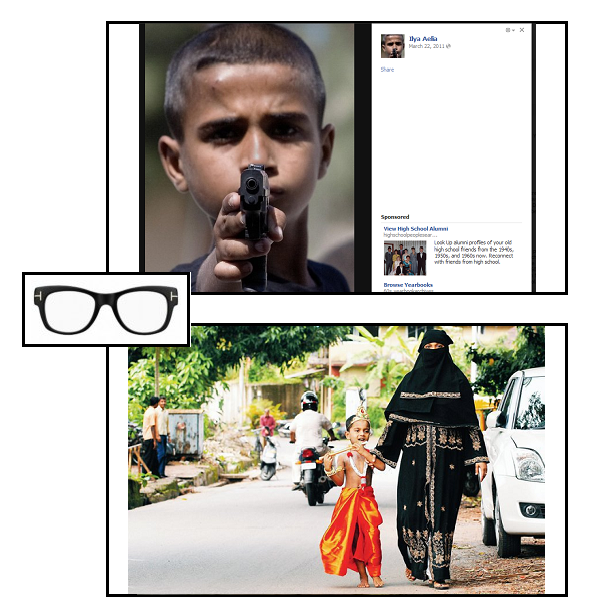
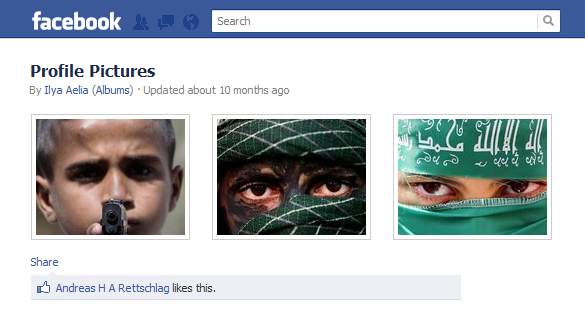
The young man pointing a gun at the viewer on a Facebook page (h/t Internet Hagganah) is the avatar of a net-salafi in Germany whose sequence of avatars looks like this:

Quintan Wiktorowicz defines a salafi thus:

The term “salafi” is used to denote those who follow the example of the companions (salaf) of the Prophet Mohammed. Salafis believe that because the companions learned about Islam directly from the Prophet, they commanded a pure understanding of the faith.

As he notes in another article:

The Salafi movement (often referred to as the Wahhabis)1 represents a diverse community. All Salafis share a puritanical approach to the religion intended to eschew religious innovation by strictly replicating the model of the Prophet Muhammad. Yet the community is broad enough to include such diverse figures as Osama bin Laden and the Mufti of Saudi Arabia. Individuals and groups within the community reflect varied positions on such important topics as jihad, apostasy, and the priorities of activism. In many cases, scholars claiming the Salafi mantel formulate antipodal juristic positions, leading one to question whether they can even be considered part of the same religious tradition.

The avatar-salafi depicted above sums up his own existence and “aim in life” by pointing a gun at you.

3.

Not so the lady leading a child by the hand in the lower of the two images, from a photo taken in India.

She offers us, in fact, a vividly contrasting picture of Islam to that of the salafi. She, a woman who is clearly observant of the demure dress code given in Qur’an 33.59 and wearing a niqab, is leading by the hand a joyful child arrayed in the finery of Krishna — beloved flute-playing avatar of Vishnu (avatar in its original sense) among her Hindu neighbors.

You might consider the pair of them together as monotheism hand-in-hand with polytheism. But then again, you might see them as peace and delight together, walking hand-in-hand.

You might see them as expressive of the Quranic proclamation (49.13 ):

O people, We have created you from a male and a female and made you into races and tribes so that you may know each other. Surely the most honored of you in the sight of God is the one who is the most righteous of you.

4.

To bring this back to contemporary politics, we may have our views about Islamist politics, and in the context of the changing scene across the Arab world it is worth pondering this recent quote from Rachid Ghannouchi, founder of the Ennahda Party in Tunisia, indicating another significant aspect of the contemporary evolution of Islamist thought:

Freedom is a fundamental principle in Islam, religion can not be forced on believers … Religion is not meant to give us guidance in all areas of industrial management, agricultural innovation, and governance, those subjects require human reason. Religion, however, gives us a code of values and principles.

Islam is not merely diverse, it is self-renewing.

5.

In light of all this, we need a far richer awareness of the mosaic that is Islam that our tendency towards black and white, war or peace, either / or thinking easily allows.

Consider these Quranic verses (35.27-28):

See you not that Allah sends down rain from the sky? With it We then bring out produce of various colors. And in the mountains are tracts white and red, of various shades of color, and black intense in hue. And so amongst men and crawling creatures and cattle, are they of various colors.

Again, the delight in diversity!

Now take another, closer look at those two folks from India:

Beautiful.

Some unknown calculus

Thursday, March 1st, 2012

[ by Charles Cameron — thinking inside and outside the pack, Robert Wright, John Robb, Iran, outliers ]
.

1.

Robert Wright just closed his Atlantic piece on Why Bombing Iran Would Mean Invading Iran with an exchange from a couple of years back between Gen. James Cartwright, then Vice-Chairman of the Joint Chiefs, and Sen. Jack Reed:

Senator Reed: I presume that [a bombing campaign] would not be 100 percent effective in terms of knocking them out. It would probably delay them, but that if they’re persistent enough they could at some point succeed. Is that a fair judgment from your position?

General Cartwright: That’s a fair judgment.

Senator Reed: So that the only absolutely dispositive way to end any potential would be to physically occupy their country and to disestablish their nuclear facilities. Is that a fair, logical conclusion?

General Cartwright: Absent some other unknown calculus that would go on, it’s a fair conclusion.

2.

Look, I’m way outside my zone of focus here, but that phrase “some unknown calculus” intrigues me.

Maybe Robert Wright should read John Robb. Maybe that “unknown calculus” is in Robb’s post, Israel, Iran and the Poor Man’s Cruise Missile:

One of the Stratfor research “findings” (culled from the Wikileaks stockpile) is that Israel claimed its upcoming strike on Iran would be “catastrophic enough” to cause a regime change. This claim was made both to dissuade Iran from going forward with its program, physically eliminating their ability to move forward with the program, and persuade the US to act instead of Israel.

Running through all of the potential scenarios, only one emerges that makes sense.

A strike on Iranian oil facilities. A strike so devastating that it disrupts all of its oil production, currently at 4 million barrels a day.

How to do that? Drones.

Look, Robb’s piece came out yesterday, Wright’s piece came out today — and who knows how long the editorial process might have taken. So I don’t blame Wright.

3.

The point is, Robb doesn’t think with the pack. And that means he comes up with ideas the pack is blind to.

Outliers.


Switch to our mobile site