zenpundit.com » geopolitics

Archive for the ‘geopolitics’ Category

Pundita on Mexican Insurgency and Hollowing Out America

Wednesday, June 15th, 2011

Blogfriend Pundita turns an eye to Mexico, which is currently entering free fall despite official US policy that the cartels are not an insurgency, and has extensive comments on how the transnationally oriented, strategically inept, elite mismanaging US foreign policy no longer think in terms of a “US foreign policy”. Or perhaps, a “US”:

“Hollowed out” Mexico and hollowed-out USA

….I hate to be the one to break this news to Mark but there can no longer be an American policy on Mexico because there is no longer a United States of America. He doesn’t know this because he doesn’t watch much television news, but a few weeks of watching CNN will clue him that the USA is no more. In its place is a country called The Whole World (aka RIC – Republic of International Community), which for reasons known only to the rascals who run CNN excludes every world region where CNN is not in hot competition with al Jazeera.I myself speak of the “country” of the USA, which I think is what seems to be a box of cookies or a milk carton in the foreground of the above satellite photo of the RIC, only as a matter of convention.

As for FNC (Fox News Channel): currently too busy taking pot-shots at other TV news outlets for initially covering up the Weiner story and otherwise too busy trying to find a Republican who can win the White House to notice that a U.S. government is a memory.

(Memo to FNC: The other TV media were initially quiet about Weiner’s texting problem not because he’s a Leftist but because his wife is Hillary Clinton’s closest aide and they didn’t want to have to tell the American public that the person closest to the U.S. Secretary of State is an American Muslim of Indian-Pakistani heritage who was raised in Saudi Arabia, you nitwits.)So before we try to upgrade U.S. policy on the hollowed-out state of Mexico, as the Narcos book terms it, I say let’s examine how the U.S. got hollowed out.

One more point before I cede the floor to Mark: His summary doesn’t indicate whether the book addresses racism and apartheid in Mexico. I know that Mark is aware of the subject so I think he would have mentioned it, if any of the monographs dealt specifically with racism; frankly I’d be surprised if any did because the topics of Mexican racism and apartheid are taboo in both the USA and Mexico.

Later this week or the next I’ll try to rip myself away from the Afghan War long enough to return to those issues, which I touched on in an earlier post. For now, I’ll just say that I think Mexico’s type of racism is the true “virus” that Dr Bunker talks about….

Good question regarding the effects of racism in Mexico on the evolution of the cartel wars. An important point. I know why employees of USG entities do not raise it; for the same reason they will not use the “i” word – Mexican officials would go ape.

Dr. Bunker reads ZP from time to time and he’s best placed to explain why none of the authors delved into that aspect of narcocultas folk religion or Mexican elite behavior. My recollection is that most of the contributors to Narcos Over the Border were security specialists rather than social historians or sociologists.  Maybe David Ronfeldt, who also has a specialty in Mexican affairs, can also weigh in on this important point.

Hollowing out of the US requires a post of it’s own to consider.

Grand Strategy Competition Rolls at Wikistrat

Tuesday, June 14th, 2011

From Thomas P.M. Barnett:

Wikistrat’s Grand Strategy Competition – Week One

Greetings from the Wikistrat team!

In the last 7 days we’ve had 44,097 actions within the wiki with new information being added at an average rate of once every 10 minutes.

The Week 1 Challenge

Competitors, organized into 38 teams by school or institution, have been assigned either one of 13 possible actors. They were tasked with writing position papers on the following five issues:

  • Global Energy Security;
  • Global Economic “Rebalancing” Process;
  • Salafi Jihadist Terrorism;
  • “Chimerica” – China-US Relationship; and
  • Southwest Asia Nuclear Proliferation.

The standard of work has been outstanding and Dr. Barnett and the judging panel are hard at work preparing feedback and scores. We’ll announce some of those next time

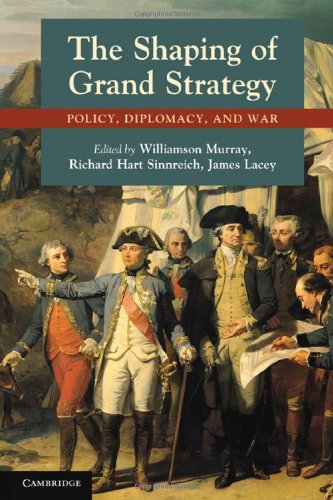
Book Review: The Shaping of Grand Strategy

Tuesday, May 24th, 2011

The Shaping of Grand Strategy: Policy, Diplomacy, and War by Williamson Murray, Richard Hart Sinnreich and James Lacey (Ed.)

As readers of this blog know, grand strategy is an important and timely subject that speaks directly to the difficulty American leaders have had in navigating the ship of state in the waters of the international arena. The Shaping of Grand Strategy: Policy, Diplomacy, and War by Williamson Murray, Richard Hart Sinnreich and James Lacey (Ed.) and contributing authors Colin S. Gray, Marcus Jones, Jeremy Black and John A. Lynn III postulates what grand strategy is and explain from historical case studies how statesmen struggled to fashion one in peace and war.

The Shaping of Grand Strategy has a number of strengths to recommend it to the serious student of history or strategic practitioner:

Focus: The case studies are all anchored in the Westphalian state system starting with the early modern period of European absolutism and apex of “national” monarchies and transitions through a Bismarckian 19th century to finish with the West’s cataclysmic 20th century battle with totalitarianism. This gives the chapters by different scholars a sense of cohesion and chronological succession.

Balance: The Shaping of Grand Strategy gives scholarly treatment from both the theoretical, strategic studies perspective as well as the historical case study. I learned some things about Louis XIV’s Europe and the Great Britain of the Pitts and the Hanoverian dynasty of which I was unaware. Theory bookends history in this tome.

Nuance: Each scholar gives his subject an adult treatment. Controversial points are interesting rather than shrill and each author engages an impressive synthesis of historiographic material as they cover a broad ground in investigating grand strategy. Each chapter is sound and engaging.

Limitations, such as they are, to be considered:

Absent: Powerful non-Western case studies. The ancient world.  Revolutionary war (French, Soviet or Islamist insurgent) as a grand strategy. Geoeconomics asnd political economy as a foundation for grand strategy. 

Weak: Insufficient treatment of the impact of nuclear weapons and deterrence on grand strategy, which frankly deserved a chapter of it’s own.

If you are composing a syllabus for a class on grand strategy or strategy, The Shaping of Grand Strategy would serve as an excellent generalist core for the course, supplemented by cognate, specialist or subtopical readings.

Some things that struck me while reading The Shaping of Grand Strategy:

  • Colin Gray’s distillation of the strategic dilemmas faced by Truman and an almost Boydian implicit explanation of what grand strategy is and why it needs a compelling moral power:

High policy does not emerge in a vacuum, though it can be invented in a hurry without much forethought when necessity presses. Policy requires a North Star for guidance that can inspire, yielding to would-be leaders the fuel they require to recruit and satisfy their followers

  • James Lacey’s realistic and granular treatment of the relationship between military strategy and grand strategy in the WWII Anglo-American Alliance and his generally admiring assessment of FDR as a strategist vs. a critical treatment of George Marshall.
  • Marcus Jones’ emphasis of the importance of the strategist himself and the uncertainty of decision making in his chapter on Otto von Bismarck.
  • The drawing of historical parallels with today  by John Lynn and Richard Sinnreich as well as the investigation of the reasons for grand strategic failure of British appeasement by Williamson Murray.

The Shaping of Grand Strategy is a tight, concise and focused academic book that furthers the discussion of grand strategy by providing coherent and detailed examples as well as a readable an interesting analysis from which both the professional or the the student can profit.

Strongly recommended.

Anglosphere Rising? The New Joint National Security Strategy Board

Tuesday, May 24th, 2011

Aaron Ellis of Egremont alerted me to this story today in The Guardian:

Barack Obama agrees to form joint national security body with UK

Barack Obama will announce during his first state visit to Britain this week that the White House is to open up its highly secretive national security council to Downing Street in a move that appears to show the US still values the transatlantic “special relationship”.

A joint National Security Strategy Board will be established to ensure that senior officials on both sides of the Atlantic confront long-term challenges rather than just hold emergency talks from the “situation room” in the White House and the Cobra room in the Cabinet Office.

….Britain believes that co-operation between the British and US national security councils marks a significant step. One British government source said: “The US and UK already work closely together on many national security issues. The new board will allow us to look ahead and develop a shared view of emerging challenges, how we should deal with them, and how our current policy can adapt to longer-term developments.”

The new board is a rare step by the White House, which guards the secrecy of the national security council. Founded in 1947 by Harry Truman, the NSC was in 1949 placed in the executive office of the president, who chairs its meetings.

Cameron tried to replicate the council when he established a body with the same name on his first full day as prime minister. It is chaired by the prime minister and designed to co-ordinate the work of the three Whitehall departments responsible for foreign affairs – the Foreign Office, the Ministry of Defence and the Department for International Development.

One government source said that Ricketts and Donilon would have to tread with care. “There is a little bit of disconnect between the two. The US national security adviser is a political appointment, whereas Sir Peter Ricketts is a civil servant. But this does make sense. We have a highly developed relationship with the USA where our military and intelligence officials work closely together. This is a useful move…

It is a start and I am heartened by the decision to formally include “strategy” as the body’s brief, that and the transatlantic nature coupled with bureaucratic differences may lead the new board to concentrate to a greater degree on looking at isues a strategic perspective rather than the S.O.P of wading into granular bureaucratic minutia. Given that I recently floated the idea of a Grand Strategy Board here ( along with Aaron), I can only be pleased to see a trend in that general direction from the Obama administration and our British allies.

Aaron was first on this story at Egremont, but he expresses some deep skepticism:

The Special Relationship lacks a purpose for the 21st century

….What immediately came to mind was the Combined Chiefs of Staff which, had it continued, might have become such a board. The engine to drive the Special Relationship forward. However, unless the UK is willing to throw away 40 years of foreign policy, the National Security Board (NSB) could be nothing more than a fair weather institution. The shared strategic interests that kept the alliance alive in the 20th century disappeared at the end of the Cold War. Other countries may prove more useful partners this century.

The given rationale for a NSB is to keep senior officials in touch with the broader challenges that face the two countries. Unfortunately, there are reasons why it might not succeed.

As global power shifts eastwards and emerging Asian states challenge US hegemony, Washington will be increasingly concerned with security and stability in the western Pacific. This is their broader challenge and President Obama is pursuing the correct policies in that region. The UK does not have a similar strategic clarity. If we want to enjoy the kind of relationship we enjoyed last century then our defence and foreign policies must expand east of Suez. Professor Michael Clarke, the head of the RUSI, has written that such a radical move “would represent the most judicious, and audacious, use of the hard/soft power combination yet seen in contemporary politics”. So far, however, the Government has shown no sign that it plans to make as big a shift as this in its ‘Big Picture’ thinking. Yet without it the NSB may prove fit only for fair weather.

….Nor do I see how the NSB can solve the institutional problems that I outlined last month. The board is supposed to move beyond crisis management, with senior officials from each side of the Atlantic focusing on the bigger picture. Given both countries’ bureaucracies have been promoting problem solvers at the expense of strategists, it isn’t evident that thinking will suddenly become more long-term. The same people will be shaping things, just this time sharing hats with Anglo-Saxon cousins. As with the Grand Strategy Board, the NSB’s utility also depends on the extent to which it taken seriously by our leaders. “You can organise government all you like, but strategy is an essentially political process that comes from the top,” Julian Lindley-French told MPs last September.

I think Aaron is spot on with the last paragraph.

Strategy is the crystallization of a kind of thinking process that needs to be present in the room or what you will have in the NSSB is a “coordination council” rearranging the deck chairs instead of charting the course. The British Cabinet and the Obama administration should strongly consider adding a few mutually acceptable wise men who do not have to juggle the supremely hectic schedules of a Foreign Secretary or a National Security Adviser, or at least some executive staffers recommended for the excellence of their strategic thinking.  It will help lean against the relentless and universal gravitational pull of bureaucratic and political culture toward the short term time horizon and the tactical details.

The Glenn Beck, Mahdism & Antichrist series

Wednesday, April 27th, 2011

[ by Charles Cameron ]

.

Glenn Beck has a new documentary coming out tonight on Mahdism and the Antichrist.

He calls it “the documentary that you will not see on mainstream television” and to get to see it, you have to be a subscriber to Beck’s Insider Extreme channel on the web. But then that fits with Beck’s emphasis right now — he doesn’t mind crying shame on the media for not carrying the documentary, but he doesn’t want unbelievers to see it either — he told his radio audience today:

Make sure you see it tonight at nine o’clock. And if I may recommend that you watch it with some friends. Invite some friends over, some like-minded people, don’t try to get any converts in. Pull up the nets, man, pull up the nets.

So okay — it won’t be on “mainstream television” but it will be seen in a million “like-minded” homes, and it will influence them, it will influence their perspective on Islam, and on the Middle East.

Here’s a description of what they can expect, drawn from Joel Rosenberg‘s blog today. Joel is the author of the apocalyptic thriller The Twelfth Imam, has seen the rough cut and will be appearing on the video, along with those he lists here:

Tonight on his website, Glenn Beck will premiere his new documentary film, “Rumors of War — Part Two.” As with Part One, I was interviewed for the film…

The documentary examines current events and trends in the Middle East and the Islamic world from various vantage points — Biblical End Times theology, Jewish End Times theology, and Islamic End Times theology. It discusses the latest threats from the Radical Islamic world to Israel, the West and our allies. It features a wide range of Jewish, Muslim and evangelical Christian authors and commentators in a balanced yet provocative and fascinating way. Among them:

  • Dore Gold, former Israeli ambassador to the U.N.
  • Reza Kahlili, former CIA agent inside Iran and author of A Time To Betray
  • Tim LaHaye, author of the Left Behind novel series
  • Brigitte Gabriel, author of They Must Be Stopped: Why We Must Defeat Radical Islam and How We Can Do It
  • Joel Richardson, author of The Islamic Antichrist
  • Dr. Zudi Jasser, president of American Islamic Forum for Democracy

*

The thing is, Beck doesn’t know a whole lot about these things, and his advisers get things wrong — sometimes flat out wrong, sometimes just out of proportion — too.

I aim to review Beck’s documentary along with its predecessor, and the books of Joel Richardson and Joel Rosenberg, and also take a look at some other books and articles that cover the same materials with greater scholarship and less religious special interest — notably the works of David Cook, J-P Filiu and Timothy Furnish — clear up some of this issues in which definitive corrections are in order, suggest areas where the preponderance of evidence and informed commentary leans away from Beck’s position, and raise again those urgent questions which remain.

Because from where I sit, Glenn Beck has hit on one of our blind spots — and is giving us a dangerously distorted mirror in which to view it.

*

Here’s Beck talking about the upcoming documentary this morning on his radio show:

Tonight, you don’t want to miss, on Insider Extreme, something that we have been trying to tell the story for quite some time, and I have told it to you many times before, the story of the Twelfth Imam, well this is not the full story of the Twelfth Imam, this is what people Middle East believe about the Twelfth Imam, or the Mahdi as the… Sunnis? Sunnis are in Egypt, Shias are in, ah, is it Shias in Iran or is it the other way around? I think it’s S.. Shias are in Iran. One believes in the Twelfth Imam, the others believe in the Mahdi, same guy, it is the… the… you would know it as the Antichrist. It is the, it has every earmarking of the Antichrist, every single one, I mean, he makes a peace for seven years with Egypt, he viol… — I mean with Israel, he violates it, he marks people with a number, he beheads people if they don’t submit, I mean it’s all there. It’s all there. And Ahmadinejad says that he is alive and well and orchestrating the things in the Middle East.

Did you get that? He’s not sure: “is it Shias in Iran or is it the other way around?”

If Beck has been working on this documentary for a year now, let’s hope he does in fact know the difference between Sunni and Shi’a, and that he’s using the popular gag technique of pretending not to know, so his audience — who haven’t all been working on a documentary and may well not know — can feel all the more strongly “he’s one of us”. And besides, Sunni, Shia, it’s all the same, Mahdi, Twelfth Imam, no difference at all, right?

So that’s the level of required accuracy that’s tolerated here. Which side was it wanted to keep slavery? I forget now, I think it may have been the South. Belfast — now is that Catholic, or Protestant?

*

And one last quick note from the same post on Joel Rosenberg’s blog:

As far as I can tell, Glenn Beck is leaving the Fox News Channel in part because Fox is opposed to him devoting so much time on his program to End Times issues, Bible prophecy, Iran’s eschatology, and the linkage of these things to left wing efforts to sow seeds of revolution and chaos. It’s too bad, really.

That’s an interesting data point.

*

There will be plenty to talk about, anyway:

the new documentary, Joel Rosenberg’s thriller, which I enjoyed, Joel Richardson, with whom I correspond and whom I like, the new Mahdist video in Iran which is causing quite a stir, and may or may not be an “official” Iranian production, the vexed question — vexed in all three Abrahamic faiths — of whether you can hasten the coming of the Awaited One and if so, how, and the implications of all this both in the United States and in the Middle East, the Iranian nuclear program…

The Glenn Beck, Mahdism & Antichrist blog series, coming up.


Switch to our mobile site