zenpundit.com » war

Archive for the ‘war’ Category

My Asynchronous COIN Debate with Dr. Bernard Finel

Friday, January 7th, 2011

Actually, we are probably not that far apart, really.

Originally, in a past year, Dr. Finel wrote this.

I am not wholly convinced as a matter of ontology that there exists a coherent phenomena that can be termed “insurgency.” My sense, instead, is that there are various sub-state armed threats that exists to states, several of which we usually lump in together under the rubric of insurgency, but which have very different causes and consequences, and hence require different strategic approaches.  I am not just referring, by the way, to the various motivations for “insurgency” – i.e. religious vs. leftist vs. ethnic – but also that there are at least some groups that have strategic orientations quite at odds from the image of an organized group with ambitions to replace the existing government.

My curiousity piqued, I responded here:

Why are submaximum strategic goals (i.e. something < regime change) an indicator of “non-insurgency” ? I think this standard would eliminate most of the popular uprisings in recorded history – for every Taiping Rebellion or Emelian Pugachev, there’s a dozen smaller, hopeless, desperate, peasant revolts.

Why the implicit use of the Maoist model as the defining characteristic of “insurgency”? That is, to the extent Bernard considers insurgency to exist

Dr. Finel replied yesterday with this ( I will intersperse my comments to make it easier on the readers):

I guess I should have been clearer.  I have no interest in debates over semantics. My interest is in ensuring that terms we use actually have a useful and coherent meaning and analytical utility.  You want to call the “Maoist model” a “war of national liberation” rather than insurgency, go ahead.  You want to call narcoviolence, “insurgency,” fine go ahead.  But don’t call a Maoist model and narcoviolence by the same name because if you, you confuse the issue.  I really don’t care what terms is applied to the various phenemena under consideration, but I do care that before we lump things together we make sure the analytic containers are, in fact, meaningful.

I am all for analytical clarity. Narco-cartels in Mexico were originally engaged in purely economically motivated violence, mostly against each other and corrupt officials in their pay. That is in my view, criminal activity. When the narcos changed their goal to encompass establishing TAZs that supplant the political authority of the Mexican state and engaged in systematic campaigns of assassination, intimidation and infiltration of local, state and Federal Mexican goverment entities they evolved from organized criminals into an insurgency.

Is there a calculated political challenge to state power by non-state actors manifested in organized violence? If so, that to my mind is an insurgency, regardless of whether they seek to topple the state or carve out some sort of niche where they can dominate.

Why is this relevant? Because, as a practical matter there are actually insurgencies that grow out of legitimacy gaps and that are best fought – perhaps – by population-centric counter-insurgency measures designed to provide good governance. But not all forms of sub-state violence are that sort of insurgency, and as a result, not all forms of sub-state violence require (or are even usefully addressed) by the sort of clear-hold-build model of integrated military operations and development initiatives.

We are facing a world with a great deal of sub-state disorder. The mistake is assuming that all of this reflects a unified dynamic (e.g. insurgency) that can be addressed with a single response (e.g. population-centric counter-insurgency).

Tend to agree with Bernard here, but with a more generous inclination to Pop-centric COIN. It isn’t a silver bullet but it has some uses. Frankly, if a regime lacks all moral scruples, democidal assault against probable supporters of insurgents (i.e.  death squads, reigns of terror) is often successful in short order. Not always. Rwanda’s genocide of the Tutsi contributed to the overthrow of the radical Hutu government by Tutsi rebels but it worked in Guatemala in the 1970’s, in French Indochina and El Salvador in the 1930’s.

Or there is a middle ground. El Salvador in the 1980’s fought a brutal war against the Communist FMLN with a focus on kinetics and extrajudicial murder but the government abandoned an oligarchical military junta for a representative democracy, addressing concerns about legitimacy. Colombia in the 1990’s combined unleashing vicious loyalist paramilitaries with an aggressive effort to establish competent governance, in order to push back against the marxist rebels of  FARC and the ELN. At a minimum, if counterinsurgents want better intelligence, they need to win the trust of locals, at least some of them, most of the time.

This is not just a theoretical critique. The situation in Iraq was not an “insurgency” in the classic meaning of the term.  Indeed, much of what we considered insurgency was actually little more than a terror campaign aimed at maximizing political leverage.  Other parts involved contestation for power between various Shi’a factions.  And a third, was a simple, and straight-forward sectarian conflict over a relatively small slice of contested territory. None of those conflicts required a comprehensive COIN/Development strategy to manage.

The classic insurgency, the “Maoist model”, should probably have ceased being regarded as definitive twenty years ago. Decentralized, quasi-anarchic “open source insurgency” as conceptualized by John Robb, are more probable in multicultural, weak states with artificial borders drawn by long dead colonialists.

Just to be clear. I am not, as a matter of analytical commitments, always a “splitter.” It is not my desire to disaggregate these domestic conflicts simply for the sake of disaggregating them. Personally, coming out of a mainstream political science orientation, I actually prefer to be a “lumper.” Lumping is how you get the most powerful and parsimonious theories.  But in this case, we’re lumping too many dissimilar concepts together into the basket of insurgency and it is hurting both the academic study of the phenemenon as well as leading to inappropriate policy recommendations.

Insurgency, like terrorism, is both a tactic and a categorical classification. Some movements will combine insurgency with terrorism, peaceful political activities and economic development. Or with criminal enterprises. But does the violence in sum have a political objective? Is it directed against the state?

These are the key questions.
Doc Madhu on “Sweet Strategery of Strategic Depth”

Thursday, January 6th, 2011

Onparkstreet, a.k.a. Dr. Madhu has a post I rather liked on Pakistan’s maniacal quest for “strategic depth” in Afghanistan, over at Chicago Boyz:

The Super Sweet Strategery of Strategic Depth

Pakistan’s beliefs in the value of seeking strategic depth in Afghanistan were influenced by two factors. The support it received from the U.S. in waging an armed response against the Soviet occupation triggered the belief. The success of that endeavour with no apparent costs to itself, gave Islamabad the illusion of being able to play a major role in the geo-politics of Central Asia. This more than anything else led to the belief that Afghanistan provided the strategic leverage Pakistan had long been seeking. The energy-rich Muslim states of Central Asia beckoned both Pakistan and the energy-seeking multi-nationals. Iran’s standing up to western pressures was proving an obstacle to long-term plans for energy extraction from the region. Afghanistan offered both shorter energy routing and political control through Pakistan.

V. R. Raghavan (The Hindu, 2001)

Pakistan’s intelligence agency, the ISI, “wants a reliable proxy that has territorial control of the P2K area,” Mr. Dressler adds. This desire is the result of Pakistan’s historic conflict with India. “If India comes across the border, Pakistan can fall back into Afghanistan and drive them out. It’s about strategic depth vis-à-vis India. As long as that continues to be a driving concern, Pakistan’s support for the Haqqani network will continue.”

The Christian Science Monitor (via Small Wars Journal)

A highly plausible future scenario indeed (regarding the second quoted item). In the event that the Indians decide on a massive ground invasion into Pakistan and march sturdily through the landscape of jihadi-networks and scattering Pakistani troops – with nary a nuke in sight and the US sitting idly by – it sounds like a winner of strategy. The supply lines to the Indians will, of course, be Bollywood unicorns pooping ammunition and some sort of MREs.

On the other hand, serious people seem to take Pakistani strategic depth worries seriously. The Indians are forever being told that they must take Pakistani fears of regional encroachment into account so that the United States (ISAF) may have a negotiated settlement in Afghanistan that is stable. Although….

Read the rest here.

The key to understanding Pakistan is that it does not really function like a state in the Westphalian sense, nor do it’s rulers want it to do so, the state merely being a vehicle for their own personal and class aggrandizement. Nor are the official borders of Pakistan the same as the borders that exist in elite Pakistani imaginations. Nor is Pakistan an ally of the United States in any sense that most normal people would use the term “alliance”, as allies are rarely the epicenter of one’s enemies in a shooting war. It is as if in 1944, as we jointly prepared for Operation Overlord, the British were raising volunteer Scottish Waffen SS divisions to kill American troops on the beaches of Normandy.

Strategy works within the confines of reality, strategy does not confine reality. We give Pakistan billions of dollars in military aid annually, and they use some of it to fund and train Taliban who have killed Americans, every year, for the last ten years, and continue to do so while their leadership is safely ensconced in Peshwar, Quetta and Rawalpindi.

Every year.

Think about that as you sign your 1040.

If we our leaders can’t recognize admit in public who America’s enemies really are, how can we win a war?

Our relationship with Pakistan is strategically toxic.

At the turn of another year

Saturday, January 1st, 2011

[ by Charles Cameron ]

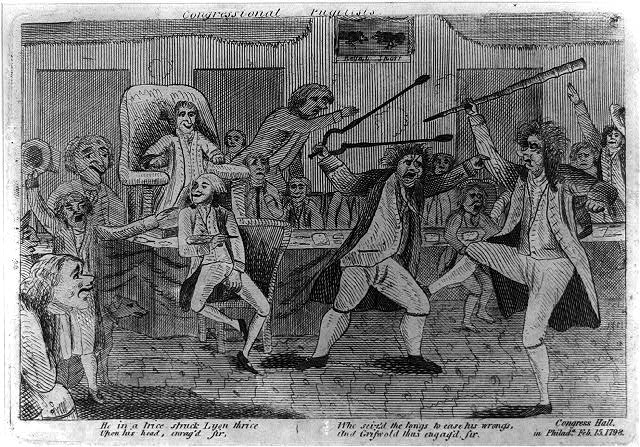
Lyon-Griswold brawl

Reps. Roger Griswold of Connecticut and Matthew Lyon of Vermont practice politics by means of hickory stick and tongs in Congress Hall, 1798

It’s always interesting to watch the way one thing morphs into another, and von Clausewitz’ formulation that war is “a mere continuation of politics by other means” is instructively illustrated in the gallery of a dozen photos on the CBS News site titled Best Parliamentary Brawls of 2010.

Ukraine, Indonesia, Italy, S Korea, Nigeria, Taiwan, Turkey… that’s a pretty fair slice of gepopolitics!

Happy New Year!

image above from the Prints and Photographs Division, Library of Congress.

North Korea, Juche and “sacred war”

Monday, December 27th, 2010

[ by Charles Cameron ]

Okay, I am now clear that the correct translation of the Korean phrase that has sometimes been rendered “holy war” in recent news reports is in fact “sacred war”.

I’d been wondering just what an atheist state was doing threatening “holy” or “sacred” war…

*

Juche is the state philosophy of North Korea, and is considered to be the 10th largest religion in the world by the Adherents.com portal, ranking above Judaism, Baha’i, Jainism and Shinto. It developed out of Marxist-Leninism and has more recently incorporated Confucian elements.

Sunny Lee, writing in a 2007 article in Asia Times titled God forbid, religion in North Korea?, quotes Han Sung-joo, a former South Korean foreign minister, as saying “There is a deification and a religious emotional element [in juche] in the North. The twinned photos of Kim Il-sung and Kim Jong-il are everywhere. Every speech says Kim Il-sung is still alive. I think if I stayed another two weeks, I might even see Kim Il-sung. The country worships someone who is deceased, as if he were alive.”

One Christian site goes so far as to call Juche a “counterfeit Christianity:

Recognizing the power of Christianity, Kim wanted it to be directed at himself. So he took Christianity, removed God the Father, Jesus Christ and the Holy Spirit, set up himself, his wife and son as the new trinity, and called it Juche. At its core, Juche is a counterfeit Christianity that is deathly afraid of true version, and rightfully so.

I suppose a close comparison here would be with the cult which Robert Jay Lifton described in Revolutionary immortality: Mao Tse-tung and the Chinese cultural revolution.

*

In On Junche in Our Revolution, vol II (published in English, 1977), Kim Il Sung writes:

No military threat of the US imperialists, however, can frighten the Korean people. If, in the end, the US Imperialists and their stooges unleash a new war against the DPRK, in defiance of our people’s patient efforts to prevent a war and maintain peace and the unanimous condemnation of the peace-loving people of the world, the Korean people will rise as one in a sacred war to safeguard their beloved country and the revolutionary gains. They will completely annihilate the aggressors.

So the “sacred war” phrasing has been around for a while.

I hope to learn more — these in the meantime are some clues to be going on with…

Now Reading Luttwak

Thursday, December 23rd, 2010

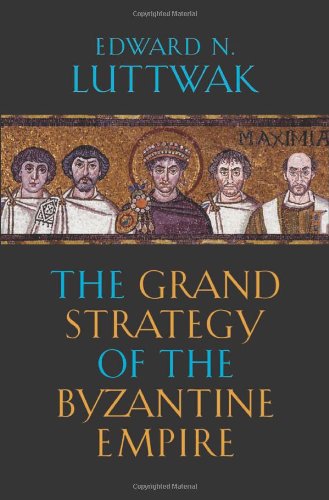
The Grand Strategy of the Byzantine Empire by Edward Luttwak

Just starting reading this magnum opus by eminent strategist Edward Luttwak and I am thoroughly enjoying it; particularly, the context-building historical digressions that enrich the text.  Highly recommended.


Switch to our mobile site