zenpundit.com » recommended reading

Archive for the ‘recommended reading’ Category

GMTA: Temple Grandin

Friday, May 24th, 2013

[ by Charles Cameron — here’s today’s windfall apple from the tree of creative delight ]
.

On March 31st, 2012 (or very likely the evening of the day before, because the clock this blog runs on is always way ahead of me) I posted a graphic here:

The upper image illustrates Theodore von Kármán‘s mathematics of turbulent flow, the lower image Vincent van Gogh‘s view of the night sky, and I juxtaposed them using my “DoubleQuotes” format to illustrate the underlying unity of the arts and sciences, and the breathtaking beauty and insight we can derive when we recognize a “semblance” — a rich commonality that transcends our usual division of concepts into separate and un-mutually-communicative “disciplines” and “silos”.

Apparently, this kind of cognition — the basis of every DoubleQuote, and of every move in one of the Hipbone / Sembl games — has now been termed “pattern thinking”.

**

According to Amazon, Temple Grandin and Richard Panek‘s book The Autistic Brain: Thinking Across the Spectrum was released April 30, 2013 although books are often available a couple of weeks ahead of release date, and galleys and proofs earlier still).

I read about it for the first time today, in Grandin & Panek’s piece, How an Entirely New, Autistic Way of Thinking Powers Silicon Valley in Wired. That article begins with a pull-quote from Grandin’s book:

I’ve given a great deal of thought to the topic of different ways of thinking. In fact, my pursuit of this topic has led me to propose a new category of thinker in addition to the traditional visual and verbal: pattern thinkers.

Obviously, that’s something i’d want to find out more about, so I read on into the article, expecting good things. Imagine my surprise when I read this paragraph, though:

Vincent van Gogh’s later paintings had all sorts of swirling, churning patterns in the sky — clouds and stars that he painted as if they were whirlpools of air and light. And, it turns out, that’s what they were! In 2006, physicists compared van Gogh’s patterns of turbulence with the mathematical formula for turbulence in liquids. The paintings date to the 1880s. The mathematical formula dates to the 1930s. Yet van Gogh’s turbulence in the sky provided an almost identical match for turbulence in liquid.

Boom!

**

Okay, I just received my review copy of Hofstadter and Sander, Surfaces and Essences: Analogy as the Fuel and Fire of Thinking — I guess I’ll have to review Grandin and Panke here, too.

Two Readings, and If You Read It, Why Not Review It?

Thursday, May 23rd, 2013

[by J. Scott Shipman]
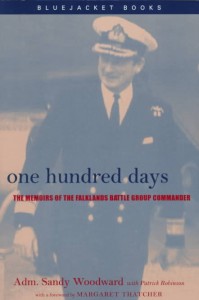
One Hundred Days, The Memoirs of the Falklands Battle Group Commander, Admiral Sandy Woodward

For professional reasons, many trusted colleagues have recommended One Hundred Days, and I finally finished it a few weeks ago. They reminded me the Falklands War “was the first modern anti-access/area-denial (A2/AD) war, pitting a joint expeditionary force against a regional power with modern land, air, and sea capabilities.” [sourced from Proceedings magazine, May 2012, by Commander Jim Griffin, U.S. Navy—strongly recommended] In other words, the scrap in the South Atlantic in 1982 was the last time a “modern” expeditionary force faced a credible adversary with modern capabilities. 

Admiral Woodward reminds that no one expected Argentina to invade the Falklands, and even if they did, no one expected the UK to respond with force (even the Royal Navy (RN) was surprised, and many had to find the islands on a map). Woodward departed with the two remaining UK carriers, the Hermes and Invincible which were already on the chopping block due to budget problems (sound familiar?). Fighting was such a distant memory for the RN, having not engaged in significant action since WWII, and Woodward recounts that many of his men had difficulty making the transition from “a sea-going job” to fighting, and possibly dying. I wondered as I read if the U.S. Navy has prepared/is prepared for this transition; and truly both officer and rates proved susceptible. The personal nature of Woodward’s account was bit of a surprise, but provides valued insight into the challenges and frequent frustrations faced by naval leaders.

Commander Griffin’s account in Proceedings referenced above has a very good list of lessons learned, and a few observations and questions are added for consideration:

  1. Naval warfare is war of attrition. Attrition can occur as a result of sinking or disabling an opponent. In the case of the Brits, many of their ships sustained non-fatal hits that, for practical purposes, removed the ship from any offensive or defensive action. Many of our enemies, while not sophisticated, understand and plan accordingly. As a result numbers are important; numbers of ships and weapons.
  2. In the age of the missile, response times were/are measured in seconds, so ships and aircraft will be lost…often, quickly.
  3. Are our systems susceptible to electro-magnetic interference (EMI)? 
  4. Could our ships navigate or fight without GPS or other satellite-dependent technologies?
  5. Can sailors onboard fix systems when they break (and they will break, see #6 below)? One RN ship had a contractor embarked who made the difference, which was blind luck. Over the last 20 years, the USN has tended towards “operators” over technicians.
  6. “Murphy” is alive and well. When things can fail (including technologies), they will, at the worst possible time.
  7. Is the theater commander in command? In the Falklands, Woodward had command of ships, but not submarines—which hampered the effectiveness of his battle group.
  8. Ship preservation (preventive maintenance) is often paid for in battle. At least two RN ships were unable to use weapons because of salt corrosion rendering missile hatches inoperable. This is engineering problem, too, to be sure, but also an example of how preventive maintenance can pay-off when it counts.
  9. Damage control training for all-hands; rigorous and often. RN sailors did a masterful job of saving several of their wounded ships.
  10. Anti-missile capabilities on logistic/support ships.
  11. Homefront politics and posturing provides fog in war as does the enemy. One curse of modern communications; having the White House Situation Room second-guessing/micromanaging the war.
  12. The press is often not your friend. On a couple of occasions, the BBC broadcast orders of battle and goals, and the Argentineans planned and acted accordingly.
  13. The motto of Captain John Coward, RN, of HMS Brilliant, “The essence of war is violence. Moderation in war is imbecility.”

Woodward’s book is the clearest account we have of naval warfare in the missile age. If it is not already, One Hundred Days should be required reading for every naval officer. Strongest recommendation.
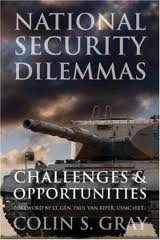
National Security Dilemmas, Challenges & Opportunities, Colin S. Gray

Colin Gray is no stranger to the readers of Zenpundit. I read this title over the Christmas break, and have returned to review with some frequency. In fact, my copy is so littered with underlining and marginalia, these periodic “reviews” can take a couple of hours. As the title suggests, Gray outlines the challenges and opportunities facing policymakers, and in so doing provides an accurate glimpse of our current state of political-military affairs. He encourages policymakers to reacquaint themselves with the importance of the concept of victory, and on how to successfully navigate a transition of our military from our previous focus of regular warfare to the realities introduced by enemies using irregular methods. Gray discusses “revolutions in military affairs (RMA)” and deterrence and the implications of both in our thinking and planning. Gray’s concluding section on preemption and preventative war is exceptionally well-presented.

For example, Gray’s section on Achieving Decisive Victory includes:

  1. Better armies tend to win.
  2. No magic formula for victory.
  3. Technology is not a panacea.
  4. The complexity of strategy and war is the mother of invention.
  5. Know your enemies.

This book is imminently quotable, so I’ll share a few with my highest recommendation.

The idea that strategy has an essence is deeply attractive. Strategy sounds incredibly rare and valuable, like something that could be bottled and sold. Unfortunately, American understanding of and sound practice in strategy is desperately rare. Strategic thinking and behavior are endangered activities in the United States. This is hardly a stunningly original insight. However, familiar though the criticism should be, it loses none of its bite for reason of longevity. Much as the U.S. defense community periodically is prodded by irregularist anxiety to worry about insurgency and terrorism, so from time to time it remembers the value of strategy. Though American defense professionals do not know what strategy is or how it works, they know that it is a matter of grave importance. The pattern has been one wherein a politician or a senior official with a personal interest has lit the fire of genuinely strategic discussion. The fire briefly flare brightly but then dies away for want of fuel. The fire is not fed, because there is not much demand for the heat and light of truly strategic argument in the United States. Although America is not quite a strategy-free environment, such a characterization would err in the right direction. (page 169 of paperback edition)

Since, inter alia, warfare is a competition in learning between imperfect military machines, fortunately one need only be good enough. (page 178; this is a personal favorite of mine)

There needs to be a continuous, albeit “unequal,” dialogue between civilian and soldier. War and warfare are permeated with political meaning, and consequences. A competent supreme command knows this and behaves accordingly. However, this relationship carries implications for civilian participation in military decisions in wartime that run contrary to the traditional American way in civil-military relations. If the strict instrumentality of force is not to be neglected, there has to be a constant dialogue between policymaker and soldier. Policy is a nonsense if the troops cannot perform “in the field,” while the troops may be so effective in action that policy is left gasping far behind unexpected opportunities by events. (page 179, emphasis added)

Gray’s National Security Dilemmas is a must read for policymakers and practitioners. [btw: it has been my custom to provide selected referenced works in book reviews. Gray’s bibliography is so excellent and comprehensive, I could not make a list that would do it justice.]

That said, I’ll close with more questions, and an apology: Does anyone read anymore? I’m rereading Manchester’s classic American Caesar after an absence of 30+ years, and I’d forgotten how much time both MacArthur the Elder and MacArthur the Younger (Douglas) spent reading. That said, how often do we see military leaders review the books they recommend? A reading list is one thing, explaining why the book made the cut another. With blogs, the internet, and social media, there are no barriers to entry. Recommendation to senior officers, including the General Officers and Flag Officers who post required reading lists: let your folks know why, write it down, explain it—the exercise will do you good, and give your subordinates insights into your thinking.

Now for the apology: there are four of us here at Zenpundit, but I’ve been the anchor man. This is my first post in too long, and I apologize to my colleagues and you, the reader. I’ve been on a tear reading naval stuff, mostly associated with my business endeavors. That said, I’ll endeavor to eat my own cooking and review what I read/have read with greater frequency.

Recommended Reading

Wednesday, May 22nd, 2013

Top Billing! WSJ Captain Lindsay Rodman, USMC – The Pentagon’s Bad Math on Sexual Assault 

….It is disheartening to me, as a female officer in the Marine Corps and a judge advocate devoted to the professional practice of law in the military, to see Defense Department leaders and members of Congress deal with this emotionally charged issue without the benefit of solid, verifiable data. The 26,000 estimate is based on the 2012 Workplace and Gender Relations Survey of Active Duty Military. The WGRA survey was fielded throughout all branches of the military in September and November 2012. As the report indicates, “Completed surveys were received from 22,792 eligible respondents,” while “the total sample consisted of 108,478 individuals.” In other words, one in five of the active-duty military personnel to whom the survey was sent responded.

I am one of those who responded to the survey after receiving an email with an online link. None of the males in my office received the email, though nearly every other female did. We have no way of knowing the exact number of male or female respondents to the 2012 WGRA survey because that information wasn’t released.

The term “sexual assault” was not used in the WGRA survey. Instead, the survey refers to “unwanted sexual contact,” which includes touching the buttocks and attempted touching. All of that behavior is wrongful, but it doesn’t comport with the conventional definition of sexual assault or with the legal definition of sexual assault in the Uniform Code of Military Justice, as enacted by Congress.

SWJ (Dave Maxwell) –Is the War on Terrorism Over? Long Live Unconventional Warfare 

….Even the most cursory analysis reveals that Al Qaeda has all the hallmarks of an organization conducting unconventional warfare through enabling various resistance organizations (such as Al Qaeda affiliates but also “lone wolf” operatives) to at least coerce and disrupt the US and in some cases by clearly trying to overthrow friends, partners, and allies of the US.  Most importantly it is conducting a concerted campaign that includes subversion to achieve each of the strategic objectives outlined above. It of course executes this campaign through an underground that is the traditional subversive arm of any resistance organization. An underground is nothing more than a network that has been popularized in today’s counterterrorism terminology with such phrases as it “takes a network to defeat a network.” In actuality it takes a deep understanding of unconventional warfare by intelligence agencies, law enforcement and specific elements of the military to defeat an underground conducting subversion against the United States or its allies.

One of the most important aspects of unconventional warfare is that by nature it is both political and psychological. It can be summarized this way: “The intent of UW operations is to exploit a hostile power’s political, military, economic, and psychological vulnerabilities by advising, assisting, and sustaining resistance forces.” It is designed to achieve political effects and one of the ways it does so is through extensive psychological warfare efforts. One of the most concrete examples of this is Al Qaeda’s focus on radicalization throughout its target areas on virtually every continent of the world to include North America. In the case of the perpetrators of the Boston Marathon bombing whether they were indirectly self radicalized and acted on their own or were radicalized directly through contact with Al Qaeda or affiliates matters little because either situation shows the effects of Al Qaeda’s psychological warfare campaign.

Abu Muqawama (Adam Elkus) – I Got 200 Million Problems, But Multicollinearity Ain’t One 

When even David Brooks, Herodotus of the Bobos, is waxing lyrical about data and empiricism you know that data science has become mainstream. Drew Conway is right that the phrase is rather clumsy, but so are many other things in social science. If the mad awesome/state of the art work Conway does is the data equivalent of the mouth-watering Chinese restaurants I go to during my summer jaunts back to LA, the now de rigueur pretty-looking bloggy data visualization is the bland but dependable PF Chang’s. Both are great, but only King Hua is going to get you that great dim sum. 1

Look past my questionable Chinese food analogy and the nature of the problem becomes apparent. Pretty pictures that answer big questions are becoming hotter than Hairless Cats That Look Like Putin. In some ways, this is a good thing. It means less listicles/GIFs, less argument by analogy, and more evidence. And we certainly need more of that. I’ve spent the last week trying and failing to write a follow-up post to my Benghazi piece here from last December due to the sheer amount of derp on that subject, to say nothing of “Syria is Vietnam/Rwanda/Iraq/Sudatenland” analogy Mad-Libs

Ah, “Herodotus of the Bobos“….I wish I had written that one. Bravo, Elkus!

Grand Blog Tarkin (Matt Ford) –Paradise Regained…..Star Trek Into Darkness

Roddenberry’s dream lives on.

This might come as a surprise to many; it certainly came as a surprise to me. I wrote in my first post on BlogTarkin some months ago that Star Trek: Deep Space Nine, with its grim but brilliant take on Roddenberry’s utopia, nevertheless eroded the Federation’s moral edifice with “the slow poison of necessity.” J.J. Abrams’ first foray into the franchise in 2009, with only an oblique reference to Starfleet as a “humanitarian and peacekeeping armada,” seemingly abandoned Star Trek’s vaunted position as the moral high ground of popular science fiction.

Did Star Trek Into Darkness bring the franchise back to its roots? It depends on what those roots are. Much of Star Trek’s enduring popularity comes from the chemistry between its diverse crew. Chris Pine, Zachary Quinto, and their shipmates met even the wildest expectations in building this camaraderie. At the same time, Star Trek has always represented a moral and social paradigm to which we could aspire. That utopian vision, however, is often presented fully-formed to the audience without any perspective on the work that went into building it. Into Darkness tackles this weakness.

Campaign Reboot –Ongoing oligarchy and Reading at a professional level 

Not the Singularity (Steve Hynd) – Does the US Really Want To Pick A Side In A Sunni/Shia War?

Kings of War – Dirty wars, knives and hands  

Gene Expression – Why race as a biological construct matters and The Kings of Minos were not Pharoahs

AeonThe Neanderthal Mind and There is No Alternative

The GuardianDaniel Dennett’s seven tools for thinking 

The Weekly StandardThomas Perez Makes a Deal 

That’s it.

History doesn’t rhyme — it swears

Friday, May 10th, 2013

[ by Charles Cameron — finding both rhyme and obscenity here, to be honest — San Salvador then, Mexico today ]
.

**

I once had the privilege of hearing Carolyn Forché read her poems.

You can read and hear her reading the prose poem from which that excerpt is taken here — for richer background on her experiences in El Salvador, see her extraordinary essay El Salvador: An Aide-Mémoire in Granta, or find a copy of The American Poetry Review for July/August 1981, pp. 3-7.

Sources:

  • Carolyn Forché, The Country Between Us
  • Sunil S, El Narco and the Jihad in Pragati, illus credit: El cartel de San Luis
  • **

    I know, in the title of this post I’m conflating a quote attributed to Mark Twain, “History doesn’t repeat itself, but it rhymes”, with Bob Dylan‘s “Money doesn’t talk, it swears”. So be it.

    As Dylan also once said: “I said that.”

    Jottings 7: Two for the iconography of terror

    Tuesday, May 7th, 2013

    [ by Charles Cameron — taking a break from my pressing writerly duties ]
    .

    I wouldn’t have noticed these two offerings quite so clearly if I hadn’t been pointed to each of them in the last couple of days. Both look to be of considerable interest:

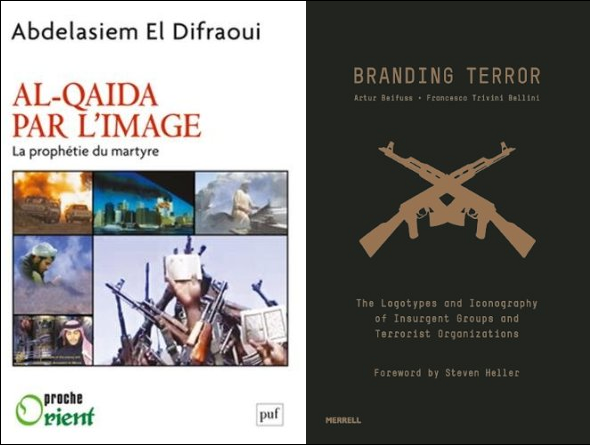
    Artur Beifuss & Francesco Trivini Bellini, Branding Terror: The Logotypes and Iconography of Insurgent Groups and Terrorist Organizations
    Asiem El Difraoui, The Jihad of Images

    Hat-tip Nico Prucha at Jihadica, and who or whatever pointed me to HuffPo — idenitfy yourselves and be saluted!

    **

    The first image in the HuffPo slideshow for Branding Terror (lower image, below, AQIM) really hit me square between the eyes, because when I was in Mashhad, Iran, in the early seventies, I snarfed up a postcard with a very similar design — Shi’ite rather than Sunni, and not so distinctly violent (upper image):

    Some things just don’t seem to change.


    Switch to our mobile site