zenpundit.com » recommended reading

Archive for the ‘recommended reading’ Category

Mini-Recommended Reading

Monday, December 19th, 2011

Top billing goes to a very tough post by Pundita:

Pundita –Would the U.S. pay Pakistan’s military to help murder American troops if the U.S. had military conscription? 

Through it all — throughout all the deceptions, denials, evasions, rationalizations and insultingly useless advice given over the years by Americans in civilian government, the military and academia — there is one question relating to U.S. tolerance for Pakistan’s proxy war against NATO and Afghanistan that towers above all others. And yet it’s the one question that has never been asked of a public figure. So in the title of this post I’ve put the question to the public.

I’d say the answer to the question is “Very unlikely.”

By this I don’t mean to shift blame to Americans at large, nor am I arguing to restore conscription. I’m simply pointing out that if service in the U.S. military was compulsory, there would have been such a large number of Americans personally involved in the outcome of the Afghan War that there would have been no ‘dark’ or ‘lost’ years in the war while the U.S. was fighting in Iraq. 

Combine this with the instant era in global communications, and I think the outcome would have been that factions in Washington that managed for the better part of a decade to hide Pakistan’s proxy war from the American public would have found their machinations quickly overwhelmed by the volume of complaints from conscripted Americans and their parents — many of those parents veterans of the Vietnam War, I might add.

This would have forced the U.S. news media to dig deeper and faster into the conditions that kept Pakistanis pouring across the Afghan-Pakistan border to kill Afghans and Americans and troops from other NATO countries. This would have quickly destroyed the rationalizations voiced by factions in Washington and Brussels that wanted to hand off Afghanistan to Pakistan’s junta, or which preferred to see American troops die as a tradeoff for what they term “geostrategic” reasons; e.g., keeping Russia off balance, placating Saudi Arabia, etc.

Again, I’m not arguing for conscription but I am asking whether it’s possible for the United States to field an all-volunteer fighting force that’s not treated as a mercenary army. The question needs to be answered. Unless you want to subscribe to the thesis I floated several weeks ago, which is that card-carrying fiends attached themselves to the U.S.-NATO prosecution of the Afghan War. By the way, my thesis does carry some weight. Let’s face it: even history’s most sadistic tyrants wouldn’t have paid a military to murder and maim the tyrant’s own troops.  Even Vlad the Impaler wouldn’t have thought of that one. ….

Whoa.

Militaries come in several forms, historically speaking. There are military castes like the Samurai, Spartans or the Janissaries; there are armies of citizen volunteers as with ancient Athens, ancient Rome or Washington’s Continental Army; there are armies built by conscription and finally there are professional mercenaries. Each kind of military has a different relationship with the political community from which it emerged and when a political community changes it’s form of military, this signals a change in the political community.

The Roman legions annihilated at Cannae by Hannibal were of a different character than the Roman legions lost by Emperor Valens under the hooves of Gothic heavy cavalry at Adrianople ( note which set of Romans had the systemic capability to recover and win). Richard Nixon is the father of our AVF and he initiated the transformation at the time for shrewd, self-interested, political reasons. One of those reasons was that a republican (small “r”) military composed of conscripts representing the broad population of American citizens was a politically difficult army to employ ruthlessly for reasons of state compared to a military with the ethos of professional soldiers.

Herein lies the root of the much remarked distance between the American public and the small fraction who are soldiers, sailors airmen and marines fighting wars on our behalf.

Milpub (seydlitz89) – The Death of COIN, or the Death of Strategic (“C”) Thought? 

….First, tactics has become the sole focus for the simple fact that the government has been loath to define what the actual political purposes/policy goals of the wars conducted were/are. This was particularly true for Iraq. The military was essentially given a list of propaganda themes (WMDs, overthrow a terrible dictator, inflict punishment for 9/11, ensure our security) and told that they were the political goals, when in reality the actual goals were the overthrow of the Iraqi government and the establishment of a US client state, bases for US force projection throughout the area, domination of Iraq’s national resources and economy. That US economic interests/corporate players botched the last two goals should come as no surprise. They were too busy chasing the no-risk war $$$ .

….Second and very much related to this was/is the assumption by US policy makers that force and violence were/are the preferred means of attaining their strategic (political) goals, and with the level of force and violence the US was/is able to wield, there was/is no question of failure. I include the present tense here to indicate that this dubious assumption is still very strong in spite of the obvious reality to the contrary. It is in fact driving our current policy in regards to Iran…..

Lexington Green –Vaclav Havel, 1936-2011


The Cold War didn’t have to end the way it did. The Communists could have won. Or it could have ended with a lot of big explosions. Instead it ended when a lot of people who had lived under Communist lies, oppression, stupidity, waste, pollution, hypocrisy, squalor and corruption stood up, risked getting their heads kicked in by the cops, and pushed the whole stinking pile of junk onto the ash heap of history.

Vaclav Havel was one of the guys who did the pushing.

Velvet Revolution, where as few people get killed as possible, is a great achievement.

Havel is one of the guys who made that happen.

1989 and the Fall of Communism in Eastern Europe already seems like something from ancient history to many people.

To me it seems like last week.

An entire disgraceful and brutal episode in our past is being sanitized and tossed down the memory hole.

Please do not forget the Soviet Union, do not forget the Cold War, do not forget Communism, do not forget the people who suffered under it, do not forget the people who opposed it, do not forget the people who wanted to give in to it, and who lied about it, do not forget the people who brought it all to an end.

Vaclav Havel, rest in peace.

Ribbonfarm– How the World Works: Part II 

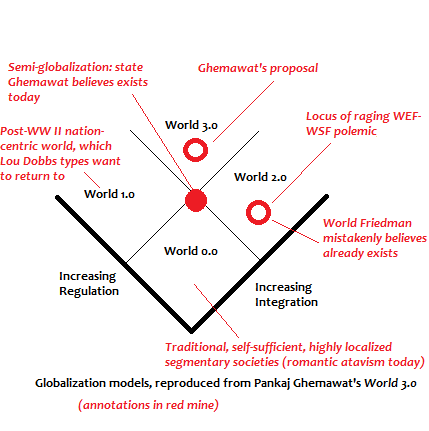
….Let’s tackle World 3.0 next.

Ghemawat’s book is a tour de force of quantitative synthesis. Let’s start with an annotated version of the 2×2 that anchors World 3.0 (cleverly rotated by 45 degrees; I don’t know why other 2×2 inventors don’t do this)

This 2×2 is almost the only major piece of conceptual scaffolding in a book that is otherwise an empiricist’s delight. Everything is argued with numbers, and what cannot be argued with numbers is mostly not argued at all. It makes for a book with a lot of narrative potholes wherever the data gods to not smile, but where there is data, the book is extremely solid. It’s a refreshing change for me to read something that stays away from data-free speculation.
That’s it.


Odierno’s Reading List

Tuesday, December 6th, 2011

General Ray Odierno, Chief of Staff of the US Army has a pretty good prospective professional reading list in the works with many titles of general interest to people in national security and foreign policy fields. He’s asking for feedback too.

Minus the Mustache of Understanding, whose inclusion seems to be required on lists of these kind, there are titles here that I would strongly recommend including McPherson’s Battle Cry of Freedom,  The Landmark Thucydides, Luttwak’s Grand Strategy of the Byzantine Empire and the best of military historians and strategists like Paret, Keegan, van Creveld and Parker.

I would recommend adding Acheson’s memoir Present at the Creation, for an understanding of policy and national strategy and Alan Schom’s critical and monumental biography, Napoleon Bonaparte: A Life, for a comprehensive understanding of Napoleon’s campaigns in context with his psychology and political leadership.

But what seems to really be missing from the General’s list is a good book on intelligence history and tradecraft.

Since the list is intended for military officers, it would not have to be a technical critique along the lines of Roberta Wohlstetter’s Warning and Decision (though that would not hurt) but something that gave a good overview, spymaster biography or history, would help.

I can think of many, but I’d like to see what the readership would nominate in the comment section. Have at it!

Hat tip to Lucien.

Recommended Reading

Sunday, December 4th, 2011

Top Billing! Dr. David Ucko and Carl Prine’s  Point -COINterpoint debate:

PRISM Counterinsurgency After Afghanistan: A Concept in Crisis (Ucko)

LoD Ucko is Wrong (Mostly)  (Prine)

KoW Prine is Wrong (Mostly): A Reply to a Critic (Ucko)

LoD Ucko Attacks! (Prine)

KoWPrine Attacks! (Again) (Ucko)

Can’t really summarize this much prose, so a short quote from each gentleman:

PRINE: Ucko’s obvious intelligence can’t compensate for a Prism essay that lacks a rudimentary understanding of recent Iraqi history, a grasp on guerrilla strategies employed there during the occupation and the political realignments that followed in the wake of the rebellions.  It devolves into the same sort of scholarship about counter-insurgency ginned up five decades ago during an age of nationalist and communist revolt throughout the Third World, which surprised me because Ucko is an exceptionally well-read analyst….

UCKO: My crime, apparently, is writing a book on counterinsurgency that included a two-page foreword written by arch-nemesis John Nagl. This is sufficient for Prine to misinterpret the rest of my work as surge propaganda, even when my position is not so far removed from his own. For example, Prine seems to concede that local factors along with US inputs accounted for the decline in Iraqi casualties in 2006-2008, but when I say the same, he reads it as ‘COIN porn’. 

CTOvision.comCarrier IQ invades privacy ( Bryan Halfpap)

The application collects the following data:

  • Phone Keypad Presses
  • Website URLS (regardless of https encryption)
  • Home/Properties/Back/Search button presses
  • Battery State Changes
  • Location

And requests access to many hardware and system resources in Android, including “services that cost you money” and “personal information”.

Admittedly, the collection of location on its own may not be a big deal to many people, but the fact that it is collecting URLs which should be encrypted is a problem. This could expose sensitive user credentials. Collecting phone call key presses is even worse because it can easily collect banking PINs, credit card numbers, passwords, and more. The application even has access to sound and recording functionalities, which means it could be turned into an all-in-one surveillance device.

There is absolutely no reason for a diagnostic application to collect the amount of data it is collecting. There is no reason for a diagnostic application to record key-presses or any other user action when crash reports are readily available from the phones operating system. This should not have happened.

SWJ – Toward a Gentler, Kinder German Reich (Dr. Tony Corn)

Corn on the emerging play by Berlin for an economic Festung Europa.

In the past two years, German elites have taken up the Rahm Emanuel doctrine (“never let a serious crisis go to waste”) all the more eagerly that Washington, in the process of rebalancing away from the Greater Middle East to the Asia-Pacific region, is less interested than ever in following intra-EU affairs.

For the third time in less than twenty years, Germany is trying to force down the throat of Europe a federal “political union” which, in the eyes of too many European observers, eerily resembles a gentler, kinder Anschluss.  While Europeans were able to push back against the first two attempts, the two-year long financial crisis has created within Europe a “German unipolar moment” and provided the kind of leverage that had eluded Germany earlier. With the German Chancellor as a de facto “EU Chancellor,” German elites are leveraging the crisis by playing a game of chicken in order to make their federal vision prevail.

Maggie’s Farm – Jews confront the Gentlemen’s agreement on campuses  (Bruce Kesler)

Kesler looks at the de facto alliance between tenured leftists and pro-Palestinian student extremists on university campuses to promote antisemitic activities and even violence and the response of Jewish student organizations:

….In March 2011, the US Office of Civil Rights finally opened an investigation into Rossman-Benjamin’s Title VI complaint. There’s also a pending legal complaint against UC Berkeley for allowing harassment of Jewish students, and a weak court sentence, later further reduced, was levied against UC Irvine and UC Riverside students who illegally disrupted Israel Ambassador Oren’s speech at UC Irvine. Other legal challenges to colleges in other states allowing across-the-line infringements on laws and academic freedom are in process or development. Fear of threats and violent or illegal actions by pro-Palestinian activists on campuses continue to silence many pro-Israel speakers from being allowed a peaceful campus stage. Freedom of speech is being violated, in contradiction to tenets of academic freedom. 

SLATE – “Narco Economics” (Ray Fisman) 

“It’s not personal, Sonny. It’s strictly business.” Al Pacino’s classic line from The Godfathernicely sums up the economics profession’s basic view of human enterprise, criminal and otherwise: Human beings make decisions based on rational cost-benefit calculations, not passion or emotion. And it captures the approach employed by MIT Ph.D. student Melissa Dell in her recent work, which strips the seemingly senseless violence of the Mexican Drug War to its cold, rational essentials. Viewing Mexico’s drug cartels as calculating, profit-maximizing business operations, Dell’s model provides a framework for understanding how traffickers have adjusted their operations in response to President Felipe Calderón’s war on the drug trade. According to Dell, the cartels have behaved like textbook economic actors, shifting their trafficking routes in predictable ways to circumvent towns where the government has cracked down and raiding towns where competing cartels have been weakened by government efforts. By providing a basis for analyzing how traffickers react to government efforts, Dell’s work might help Calderón’s administration design a better strategy for defeating Mexico’s drug lords.

Hat tip to Feral Jundi

Dr. VonGaming in Education 

….For example, the most prominent conclusion of this body of evidence is that teachers are very important, that there’s a big difference between effective and ineffective teachers, and that whatever is responsible for all this variation is very difficult to measure (see hereherehere and here). These analyses use test scores not as judge and jury, but as a reasonable substitute for “real learning,” with which one might draw inferences about the overall distribution of “real teacher effects.”

And then there are all the peripheral contributions to understanding that this line of work has made, including (but not limited to):

Prior to the proliferation of growth models, most of these conclusions were already known to teachers and to education researchers, but research in this field has helped to validate and elaborate on them. That’s what good social science is supposed to do.

Conversely, however, what this body of research does not show is that it’s a good idea to use value-added and other growth model estimates as heavily-weighted components in teacher evaluations or other personnel-related systems. There is, to my knowledge, not a shred of evidence that doing so will improve either teaching or learning, and anyone who says otherwise is misinformed. It’s an open question.*

That’s it.

Recommended Reading

Monday, November 21st, 2011

Top Billing! Mike FewBlood Done Signed My Name

Major Mike Few takes leave of editorial duties at SWJ for a guest post at Carl Prine’s Line of Departure:

….Duke professor Timothy B. Tyson’s Blood Done Signed My Name: A True Story describes the 1970 murder of Henry “Dickie” Marrow, a 23-year-old black man who once served as a paratrooper in Fort Bragg.  The memoir them limns the acquittal of his three white killers, and what the aftermath of that injustice wrought on the tiny town of Oxford, N.C.

So, you ask, what does this have to do with small wars?  Well, I could start by reminding you that U.S. Marine Corps Gen. James Mattis recommends that we study the works of Martin Luther King as if they were texts about strategy, and Blood Done Signed My Name certainly is a tale about the civil rights movement.

But if we agree that Mattis is right, then don’t we have to look at how King’s strategy played out at the micro-level of villages and neighborhoods, towns like Oxford?  And isn’t that perhaps what an entire generation of soldiers and Marines already has done overseas, albeit when prosecuting quite a different strategy to very different ends?

When I was conducting recon in Iraq, I found it helpful to think of a town as an eco-system.  Once I understood how the caste, theological, ideological, linguistic and kinship relationships entangled the village in violence, my job became the commander who tried to untie them, or the pacification process wouldn’t work.

Various types of counter-insurgency theory were important, but it was always vital to keep an independent mind about them while I explored the hard realities of life and death in these Iraqi villages.   Experience with violence caused me to rethink a lot of those theories, just as Blood Done Signed My Name has made me reassess the role violence played in the larger civil rights movement.

Global Guerrillas – OCCUPY NOTE 11/20/11: The HIDDEN logic of the Occupy Movement

….Using John Boyd’s framework as a guide, this media disruption did have an effect across all three vectors:

  • Physical.  No isolation was achieved.  The physical connections of police forces remained intact.  However, these incidents provided confirmation to protesters that physical filming/imaging of the protests is valuable.  Given how compelling this media is, it will radically increase the professional media’s coverage of events AND increase the number of protesters recording incidents.
  • Mental.  These incidents will cause confusion within police forces.  If leaders (Mayors and college administrators)  back down or vacillate over these tactics due to media pressure, it will confuse policemen in the field.  In short, it will create uncertainty and doubt over what the rules of engagement actually are.  IN contrast, these media events have clarified how to turn police violence into useful tools for Occupy protesters. 
  • Moral.  This is the area of connection that was damaged the most.  Most people watching these videos feel that this violence is both a) illegitimate and b) excessive.  Watch this video UC Davis Chancellor Katehi walking from her building after the incident.  The silence is eerie.

The Chronicle – The Kennan Industry

A less laudatory view of George F. Kennan than Henry Kissinger gave us, from David Engerman:

….In other cases, Kennan went far beyond handwritten reminders. Soon after he authorized Princeton to open his personal papers to researchers in 1970, Kennan was, apparently, shocked that a young historian, C. Ben Wright, would focus so closely on a 1930s draft essay called “The Prerequisites.” It called for “an authoritarian state” that denied suffrage to those unable to wield it properly-that is, to immigrants, women, and blacks. Wright, who greatly admired Kennan, quoted extensively from “The Prerequisites” in his dissertation. Wright also had the temerity to suggest that Kennan’s version of containment might have a military component after all, using Kennan’s letters and speech drafts from the 1940s to support his interpretation. Kennan flew into a rage, trying to strike the offending quotations from Wright’s work and-in Gaddis’s telling-ultimately driving Wright out of the profession. The offending documents (if that is the right description) were removed from Kennan’s papers, and photocopying from the remainder of the collection was forbidden.

Hat tip to Lexington Green.

Chicago Boyz (Bruno Behrend) –A must read for every Conservative/Libertarian

Mother JonesInside the Corporate Plan to Occupy the Pentagon

AFJ Polyglot Dragon

Foreign AffairsThe Problem Is Palestinian Rejectionism

Recommended Viewing:

Hat tip to longtime ZP reader Morgan:


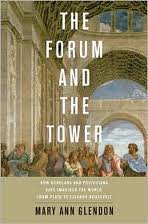
The Forum and The Tower, a review

Sunday, November 20th, 2011

[by J. Scott Shipman]

the-forum-and-the-tower.jpeg

The Forum and The Tower by Mary Ann Glendon

“The relationship between politics and the academy has been marked by mutual fascination and wariness since the time of Plato.”

The first sentence on the flap of the dust jacket of this very good and informative small book. Professor Glendon, who is the Learned Hand Professor of Law at Harvard Law school, set out to write a book for her students that would answer ageless questions such as:

“Is politics such a dirty business, or are conditions so unfavorable, that couldn’t make a difference? What kinds of compromises can one make for the sake of getting and keeping a position from which one might be able to have influence on the course of events? What kinds of compromises can one make for the sake of achieving a higher political goal? When does prudent accommodation become pandering? When should one speak truth to power no matter what the risk, and when is it acceptable, as Burke put it, to speak the truth with measure that one may speak it longer? When does one reach the point at which one concludes, as Plato finally did, that circumstances are so unfavorable that only the reasonable course of action is to “keep quiet and offer up prayers for one’s own welfare and for that of one’s country”?”

Professor Glendon answers these questions and more through brief examinations of the lives and works of some of history’s most important figures:

Plato

Cicero

Justinian, Tribonian, and Irnerius

Machiavelli

Thomas Hobbs and Edward Coke

John Locke

Jean-Jacques Rousseau

Edmund Burke

Tocqueville

Max Weber

Oliver Wendell Holmes

Eleanor Roosevelt and Charles Malik

All in all, I believe Professor Glendon has provided a uniquely valuable book to help her students and other readers to answers those questions. In short but focused chapters of about 20 pages each, she provides mini-biographies of the subjects above and how they answered the some of the questions both in their lives and in their philosophy. Some of her subjects were thinkers lacking the abilities for the public square, Plato, for instance, but were enormously influential just the same. Rare were those like Cicero and Burke who were equally comfortable in the political arena or the academy.

My favorite chapters were on Plato, Cicero, Machiavelli, and Burke—mostly because I’ve read a respectable amount of their work. That said, I have not read Plato’s The Laws—and Professor Glendon suggests it is much better than The Republic—which I have read and did not much enjoy. Not surprisingly, The Laws will be on my list for this winter.

The inclusion of Eleanor Roosevelt and Charles Malik was something of a surprise, but Professor Glendon is weaving a sub-story through each chapter and illustrating how Roosevelt and Malik’s work on the Universal Declaration of Human Rights was something of culmination and extension of over 2,000 years of thinking and political action—not in the context of human progress towards a utopia of sorts, which she wisely rejects,  but rather a reflection the common threads of political thought throughout history.

While this is not criticism, I would have liked to have seen a chapter on John Adams and Thomas Jefferson, and a chapter on Karl Marx, whom she frequently mentions.

This is a book that is approachable and readable, and in our tumultuous domestic and global political climate, important.

She closes with this illuminating sentence:

“If one message emerges from the stories collected here, it is that just because one does not see the results of one’s best efforts in one’s own lifetime does not mean those efforts were in vain.”

Professor Glendon is to be commended for a job “well done!”

The book comes with my highest recommendation and may be the best book I’ve read this calendar year. Add this book to your must read list.

.
Referenced works you may find of interest (some of these works are out of print and expensive—for simplicity I’ve used Amazon links): 

The Laws of Plato, translated by Thomas Pangle

Cicero: The Life and Times of Rome’s Greatest Politician, by Anthony Everitt

Cicero, A Portrait, by Elizabeth Rawson (Glendon praised this book.)

A Panorama of the World’s Legal Systems, John Henry Wigmore

The Life of Nicolo Machiavelli, Roberto Ridolfi

The Prince, translated by Harvy Mansfield

Machiavelli, by Quentin Skinner

The Lion and the Throne, Catherine Drinker Bowen

The Spirit of Modern Republicanism, by Thomas Pangle

Statesmanship and Party Government, by Harvy Mansfield

The Great Melody, A Thematic biography of Edmund Burke, by Conor Cruise O’Brien (I read this wonderful book in 1992 when it was released: highly recommended.)


Switch to our mobile site