zenpundit.com » anthropology

Archive for the ‘anthropology’ Category

Steven Pinker on Analogy

Thursday, December 6th, 2012

[ by Charles Cameron — importance of analogy as an under-developed cognitive skill ]
.

There was a interview with five prominent “science writers” in the Guardian a few days back, titled Science writing: how do you make complex issues accessible and readable? and one of the writers, Steven Pinker, makes two highly interesting observations:

**

There are a couple of things going on here that I’d like to note. One is that without intending to do so specifically, he is in essence formulating a view about a possible, central difference between scientific and religious thinking, since what he says about the humanities in general applies with great specificity to religion and the arts: in both religion and art, the expansive nature of “symbolism” is a key to the experience.

And that in turn prompts me to suggest that perhaps both the arts and religion are geared towards provoking, evoking or invoking an experience — whereas the sciences are geared towards obtaining an understanding.

I’ll have to think about that, and come to some sort of understanding of my own — perhaps expressed via symbolic means.

**

My second point of interest is that there’s an analogy to be made between Pinker’s two remarks: each of them has a form I could portray thus in terms of cause :: effect

science : humanities :: simplicity : complexity

Nobody present — the interviewer, Pinker himself, and four other very bright science writers — picked up on the close correspondence between those two statements at the time. And I find that very interesting.

I find it very interesting because the six of them were more interested in seeing what they could say (of what they already thought) than in saying what they could see (in light of the ongoing, immediate conversation).

I think we all tend to do that — which is why David Bohm‘s approach to dialogue is so important: if brings us to speak more into the moment as it surrounds us, not quite so much from the past as it has informed us.

**

Then there’s the interesting fact that Pinker’s sense of the difference between modes of thought in the humanities and the sciences as expressed in the top quote translates so directly to the difference between uses of analogy in the second — and his fairly emphatic statement:

one could argue that we understand everything except for the physical world of falling objects by analogy.

Analogy is the central device in our mental toolkit, and yet we know far more about trains of logic than we do about analogical leaps. We know so little, in fact, that distinguishing between “literary metaphor” and “scientific analogy” (both of which are based in the recognition of resemblance) on the basis of one looking for multiple, rich connectivity and the other for a single tight connection is something noteworthy enough for Pinker to bother to point it out. It is indeed a provocative and perhaps essential insight. But it is also pretty basic — dividing a field up into significant chunks, the way anthropology got divided into “cultural”, “archaeological”, “linguistic” and “physical anthropology”…

It’s time we learned to understand and use analogic with the same rigor we’ve applied to learning and using logic — and Sembl is just the tool for this.

**

Experience wants to be rich: factual understanding wants to be clear.

Ashura: the Passion of Husayn

Sunday, November 25th, 2012

[ by Charles Cameron — today’s solemn commemorations in Iraq, Afghanistan, Pakistan and India in comparative religious perspective ]
.

I was listening to Mozart‘s Requiem last night, and it is rich in grief shot through with glory. That’s the thing about mourning celebrations in which death is accompanied by the “sure and certain hope of the Resurrection into eternal life”.

One such observance is found in Shia Islam, and falls this year on the 25th of November — today. It is the day of Ashura, the 10th day of Muharram in the Islamic calendar, and its epicenter is at Karbala in Iraq. As the saying goes:

Every day is Ashura and every land is Karbala.

For the Shia, Ashura commemorates the martyrdom of Husayn, grandson of the Prophet, at the Battle of Karbala, when he refused to give allegiance to the Umayyad caliph Yazid. Husayn’s martyrdom is dramatized in Ta’zieh, passion plays, giving us a hint that the martyrdom of Husayn at Ashura figures in the devotional life of the Shia much as the passion and death of Christ figures within Christianity, both in passion plays such as that at Oberammergau and in Catholic rituals such as the Stations of the Cross. This may seem a far-fetched analogy to some of my readers, but both deaths are viewed as redemptive. As another saying has it:

A single tear shed for Husayn washes away a hundred sins.

**

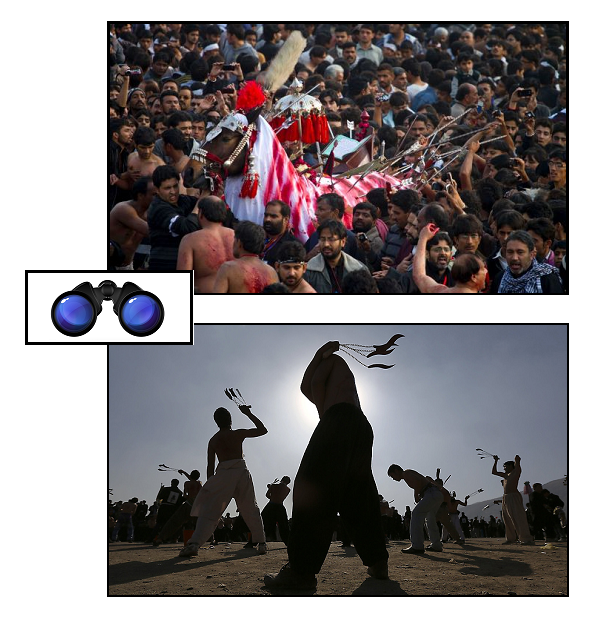
As you can see depicted in the lower panel above, Shiite mourning can include flagellation with chained blades, not something that sits easily with most westerners — yet as Roy Mottahedeh has said (quoted in SA Hayder, Reliving Karbala: Martyrdom in South Asian Memory):

Self-mutilation in emulation of the “passion” of heroes who are human yet divine is no stranger to the West: flagellants who whipped themselves both in penance and in remembrance of the scourging and crucifixion of Jesus appeared in almost every western European country in the Middle Ages…

The upper panel above depicts Husayn’s horse, riderless and bloody, and can perhaps give us some sense of the dark ceremonial beauty of the occasion for those whose grief transcends time and unites them in aspiration with Husayn himself — their flagellation attesting to their wish that they themselves could have stood beside him on that day so long ago, standing for truth against an army of injustice.

**

Their grief may be trans-temporal, but the possibility of dying for their faith persists to this day, for Sunni militants of the jihadist sort view Ashura differently — primarily as a day of fasting first performed by Moses and continued by Muhammad — and detest the breakaway sect of the Shia as rafidun, heretics.

In Iraq, Ashura there has seen millions of pilgrims visiting Karbala this year, with comparatively little violence:

Millions of Shiites flooded the Iraqi shrine city of Karbala on Sunday for the peak of Ashura rituals, which have been largely spared the attacks that struck pilgrims in past years. A bomb wounded 10 pilgrims in Diyala province, north of Baghdad, but it was the first such attack since a car bomb against pilgrims killed three people on November 17.

Farther afield, what the Pakstani police describe as a “major terror plot to attack the Muharram processions in Karachi” was avoided this year when “large amounts of explosive material, two suicide jackets and grenades” were confiscated during a raid, with the Minister for Religious Affairs declaring that the Tehreek-e-Taliban were behind the plots. Elsewhere in Pakistan:

At least five persons were killed and over 70 others injured on Sunday when a Shia procession was targeted with a bomb at Dera Ismail Khan in Pakistan’s restive northwest, the second such attack in the city in as many days.

Meanwhile in Kabul:

For the past week, the Afghan capital has been draped with black cloth arches and festooned with huge colored banners. Mournful, pounding chants pour from loudspeakers across the city, filling the air with slow martial intensity.

The dramatic display is all part of Muharram and the 10-day Shiite festival that commemorates the slaying of Imam Hussein, a 7th-century holy figure and early champion of Islam. But it is also a symbol of the growing religious and political freedom that Afghanistan’s long-ostracized Shiites have had in the past decade.

That’s from a Washington Post piece yesterday titled Afghan’s Shiite minority fears a return to old ostracism — and the next two paragraphs bear out the title:

Now, as Western military forces prepare to leave the country by 2014, Afghan Shiites, most of whom are from the Hazara ethnic minority, fear that their window of opportunity may slam shut again, leaving larger rival ethnic groups as well as Taliban insurgents, who are radical Sunni Muslims, dominating power.

“Everything we have achieved, our ability to come out and participate in society, has been in the shade of the international community and forces,” said Mohammed Alizada, a Hazara Shiite who was elected to parliament in 2009. “We are very concerned that once they leave, the fundamentalists will reemerge, ethnic issues will return, and we will lose what we have gained.”

Tribal politics, sectarian issues, the impending departure of US forces, the Taliban, cross-border alliances — and the sheer power of devotion — all these are intricately intertwined in today’s Afghanistan and its future. We may do well to understand something of the meaning of this day of Ashura, in our own calendar, 25th November 2012.

**

Annemarie Schimmel, the great Harvard scholar of Islamic mysticism, has a fine essay on the poetry of Ashura, encompassing both Sunni and (strongly Shia-influenced) Sufi traditions, Karbala and the Imam Husayn in Persian and Indo-Muslim literature. The mindset is very different from contemporary secular westernism, seeing death itself — and the grief that accompanies it — as a prelude to resurrection, and thus part of the timeless love-play of God with those who love him:

In having his beloved suffer, the divine Beloved seems to show his coquetry, trying and examining their faith and love, and thus even the most cruel manifestations of the battle in which the ‘youthful heroes’, as Shah Latif calls them, are enmeshed, are signs of divine love.

The earth trembles, shakes; the skies are in uproar;
This is not a war, this is the manifestation of Love.

The poet knows that affliction is a special gift for the friends of God, Those who are afflicted most are the prophets, then the saints, then the others in degrees’, and so he continues:

The Friend kills the darlings, the lovers are slain,
For the elect friends He prepares difficulties.
God, the Eternal, without need what He wants, He does.

**

The spirit here is not too far from that of the Greek philosopher Plotinus, who wrote in his Enneads [III.ii.15]:

Men directing their weapons against each other- under doom of death yet neatly lined up to fight as in the pyrrhic sword-dances of their sport- this is enough to tell us that all human intentions are but play, that death is nothing terrible, that to die in a war or in a fight is but to taste a little beforehand what old age has in store, to go away earlier and come back the sooner.

together with that of the early Christian Father, Origen, who wrote [De Martyrio, 39]:

And let each of us remember how many times we have been in danger of an ordinary death, and then let us ask ourselves whether we have not been preserved for something better, for the baptism in blood which washes away our sins and allows us to take our place at the heavenly altar together with all the companions of our warfare.

**

In India, indeed, the martyrdom of Husayn takes on an interfaith character in some places, as Hindus and Christians join Muslims in Ashura commemorations, as Naim Naqvi relates:

One can observe the richness and beauty of the diversity of Indian Culture at the occasion of Muharram. Since the martyrdom of Imam Hussain, Muharram ceremonies are observed all over the world including India. Hindus take part in them with great reverence and devotion. The tragedy of Karbala has become the harbinger for interfaith understanding in the Indian sub-continent. Participation of Hindus in the mourning rituals of Imam Hussain has been a feature of Hinduism for centuries in large parts of India. Hindus, Sikhs, Jains and even Christians observe Muharram. In the city of Varanasi which is the holiest city for Hindus many Hindu families participate in Muharram processions.

Describing the participation of one such Hindu family in Orissa, we read:

District police chief Lalit Das said Padhihary family has been doing this every year for the last 338 years, adding other local Hindu families also participate in the procession.

Muslims said it reflected the perfect harmony between the two communities in the area.

Thanksgiving and Kasab: pardon and penalty

Thursday, November 22nd, 2012

[ by Charles Cameron — i suppose this is about the state’s claim to a monopoly of violence, seen from both ends ]
.

I don’t want to go too far with this one, and I’ll start with the turkey and pardon, because pardon and forgiveness and thanksgiving all fit together and might as well be celebrated at this season — but as you’ll see, pardon has its dark side, even if it takes an anthropologist named Magnus Fiskesjö and his pamphlet titled The Thanksgiving Turkey Pardon, the Death of Teddy’s Bear, and the Sovereign Exception of Guantánamo to point it out:
.

But around the same time a turkey gets a reprieve in the US, a terrorist in India gets the death penalty.

I think it’s important to remember the Mumbai atrocities of 2008,and of which Ajmal Kasab (depicted below, and recently deceased) was the sole surviving perpetrator — if for no other reason than because he’s considered a martyr by some, and will be avenged.

But first, let me wish a Happy Thanksgiving! to all Zenpundit’s American readers, and good wishes to all others.

**

The problem with martyrdom… is that it’s a force-multiplier. Okay when the force is purely spiritual, not so much when it runs to violence and terror…

photo credit: Outlook India

Retired Indian intelligence chief Bahukutumbi Raman, whose tweets I often follow to articles on his Raman’s strategic analysis blog, warned us all:

Before the execution of Ajmal Kasab, the Pakistani terrorist of the Lashkar-e-Toiba (LET), who had participated in the 26/11 terrorist strikes in Mumbai, at Pune on the morning of November 21, 2012, our security agencies must have examined the likelihood of retaliation by jihadi terrorists in Pakistan and India and strengthened security precautions to prevent retaliatory attacks.

The LET and the organisations associated with it would want a quick retaliation.

And then he went into detail

Sure enough, Reuters then tells us:

Pakistan’s Taliban movement threatened on Thursday to attack Indian targets to avenge the country’s execution of Mohammad Ajmal Kasab, the lone survivor of the militant squad responsible for a rampage through Mumbai that killed 166 people in 2008. Kasab was hanged on Wednesday amid great secrecy, underscoring the political sensitivity of the November 26, 2008, massacre, which still casts a pall over relations between nuclear-armed rivals Pakistan and India.

“We have decided to target Indians to avenge the killing of Ajmal Kasab,” said Taliban spokesman Ehsanullah Ehsan by telephone from an undisclosed location.

**

In the course of the coronation liturgy for Queen Elizabeth II, the words justice and mercy crop up quite often — justly and justice 8 times, and merciful and mercy 28. It appears to be a sovereign’s right and obligation to administer both, and during the ceremonial they are brought together as a symbolic pair.

The Sceptre with the Cross is given into her right hand, with the words:

Receive the Royal Sceptre, the ensign of kingly power and justice

while the Rod with the Dove is given into her left hand, with the words:

Receive the Rod of equity and mercy.
Be so merciful that you be not too remiss,
so execute justice that you forget not mercy.
Punish the wicked, protect and cherish the just,
and lead your people in the way wherein they should go.

Justice is only fair: it seems, however, that it should be tempered with mercy.

**

Let me simply add that my own preference would be to have remitted the death penalty in Kasab’s case, and given him a life term in which to think about the lives he took. As for the turkey — happy stuffings!

I remember too, today, my friend and mentor Wallace Black Elk, and his wife, Grace Spotted Eagle. It was Wallace who — at least once — said:

They called us “Indians” when they came, so we have a nickname. But we are Earth people, we are original. When they come here, I welcome them with open arms, give them a turkey dinner, corn, and all the vegetables, all the greens.

Because this is a land of abundance…

Of films, riots and hatred I: Benedict XVI in Lebanon

Sunday, September 16th, 2012

[ by Charles Cameron — where to begin? let’s start with peace ]
.

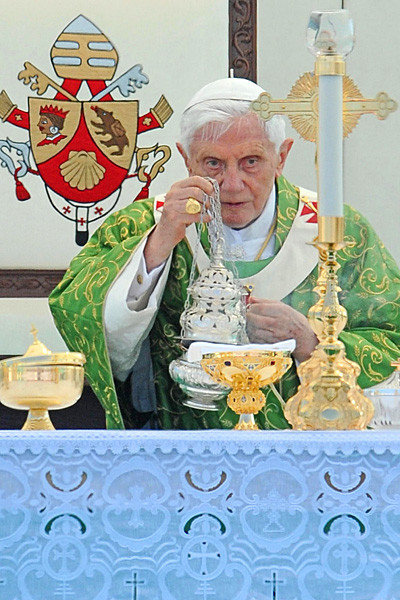
Photo credit: Ciro Fusco, EPA

.

Pope Benedict XVI has been in the Lebanon these last three days, and after an extremely turbulent week in which many discordant religious and / or “religious” notes have been sounded, I thought I’d begin what I imagine will be a series of posts from my POV on the mayhem with some words of peace (Heb: Shalom; Ar: Salaam) from the Pontiff, seen above celebrating an open air mass on the Beirut beachfront.

**

The Pope was in the Lebanon to sign a Catholic document of some significance, the Apostolic Exhortation Ecclesia in Medio Oriente, and it is from that document that I would like to extract some specific paragraphs:

Here’s the kernel of the situation as the Pope sees it, going into it —

How many deaths have there been, how many lives ravaged by human blindness, how many occasions of fear and humiliation! … How sad it is to see this blessed land suffer in its children who relentlessly tear one another to pieces and die!

— grief at human folly.

**

Benedict then begins to address the situation, offering us his definition of peace:

For the sacred Scriptures, peace is not simply a pact or a treaty which ensures a tranquil life, nor can its definition be reduced to the mere absence of war. According to its Hebrew etymology, peace means being complete and intact, restored to wholeness. It is the state of those who live in harmony with God and with themselves, with others and with nature.

Since we are not yet in harmony with each other…

Authentic witness calls for acknowledgment and respect for others, a willingness to dialogue in truth, patience as an expression of love, the simplicity and humility proper to those who realize that they are sinners in the sight of God and their neighbour, a capacity for forgiveness, reconciliation and purification of memory, at both the personal and communal levels.

He observes that such a dialogue should be theologically oriented rather than politically driven:

The Church’s universal nature and vocation require that she engage in dialogue with the members of other religions. In the Middle East this dialogue is based on the spiritual and historical bonds uniting Christians to Jews and Muslims. It is a dialogue which is not primarily dictated by pragmatic political or social considerations, but by underlying theological concerns which have to do with faith.

This dialogue can be grounded in in the one God common to the Abrahamic faiths:

Jews, Christians and Muslims alike believe in one God, the Creator of all men and women. May Jews, Christians and Muslims rediscover one of God’s desires, that of the unity and harmony of the human family. May Jews, Christians and Muslims find in other believers brothers and sisters to be respected and loved, and in this way, beginning in their own lands, give the beautiful witness of serenity and concord between the children of Abraham.

It will demand humility rather than triumphalism:

The truth cannot unfold except in an otherness open to God, who wishes to reveal his own otherness in and through my human brothers and sisters. Hence it is not fitting to state in an exclusive way: “I possess the truth”. The truth is not possessed by anyone; it is always a gift which calls us to undertake a journey of ever closer assimilation to truth. Truth can only be known and experienced in freedom; for this reason we cannot impose truth on others; truth is disclosed only in an encounter of love.

I imagine that some will find here an echo of the Qur’an:

Let there be no compulsion in religion.

— Quran 2. 256

Thus far the pope has expressed his grief at the circumstances, and outlined the basic issues between religions. He now turns his analysis to the situation within the religions:

Like the rest of the world, the Middle East is experiencing two opposing trends: secularization, with its occasionally extreme consequences, and a violent fundamentalism claiming to be based on religion.

Benedict is well know for his opposition to the “occasionally extreme consequences” of secularism: here he speaks in favor of what he terms “healthy secularity”.

Some Middle Eastern political and religious leaders, whatever their community, tend to look with suspicion upon secularity (laïcité) as something intrinsically atheistic or immoral. It is true that secularity sometimes reduces religion to a purely private concern, seeing personal or family worship as unrelated to daily life, ethics or one’s relationships with others. In its extreme and ideological form, secularity becomes a secularism which denies citizens the right openly to express their religion and claims that only the State can legislate on the public form which religion may take. [ … ]

A healthy secularity, on the other hand, frees religion from the encumbrance of politics, and allows politics to be enriched by the contribution of religion, while maintaining the necessary distance, clear distinction and indispensable collaboration between the two spheres.

Religious fundamentalism is the second challenge the Pope addresses:

Economic and political instability, a readiness on the part of some to manipulate others, and a defective understanding of religion help open the door to religious fundamentalism. This phenomenon afflicts all religious communities, and denies their long-standing tradition of coexistence. It wants to gain power, at times violently, over individual consciences, and over religion itself, for political reasons.

Here he addresses his colleagues in religious leadership:

I appeal urgently to all Jewish, Christian and Muslim religious leaders in the region to seek, by their example and by their teaching, to do everything in their power to eliminate this menace which indiscriminately and fatally affects believers of all religions.

He then drives the point home by quoting his own words on an earlier occasion:

“To use the revealed word, the Sacred Scriptures or the name of God to justify our interests, our easy and convenient policies or our violence, is a very grave fault.”

**

That’s the substance of the Pope’s message in the context of recent disturbances in the region. There were a couple of notes he touched on, however, that interested me not for any connection with recent events, but for specific theological connotations:

Growth by individuals in the life of faith and spiritual renewal within the Catholic Church will lead to the fullness of the life of grace and theosis (divinization).

Theosis is a term more commonly found among Eastern Christians, and I wouldn’t want to define the doctrine in words, though I’ll suggest that its spirit is captured in the English mystic Thomas Traherne‘s magnificent meditation [Century I. 29]:

You never enjoy the world aright, till the Sea itself floweth in your veins, till you are clothed with the heavens, and crowned with the stars: and perceive yourself to be the sole heir of the whole world, and more than so, because men are in it who are every one sole heirs as well as you. Till you can sing and rejoice and delight in God, as misers do in gold, and Kings in sceptres, you never enjoy the world.

One of Benedict’s comments specifically addresses an issue of importance as Christianity and Islam find common ground in the Middle East:

In those unfortunate instances where litigation takes place between men and women, especially regarding marital questions, the woman’s voice must also be heard and taken into account with a respect equal to that shown towards the man, in order to put an end to certain injustices.

He gives an account of the Catholic doctrine of scriptural interpretation, which will be of interest to those concerned with such things in specifically Catholic, more generally Christian or comparative contexts:

The representatives of the various schools of textual interpretation were agreed on the traditional principles of exegesis accepted by the Churches of both East and West. The most important of these principles is the conviction that Jesus Christ incarnates the intrinsic unity of the two Testaments and consequently the unity of God’s saving plan in history (cf. Mt 5:17). The disciples would only come to understand this unity after the resurrection, once Jesus had been glorified (cf. Jn 12:16). A second principle is fidelity to a typological reading of the Bible, whereby certain Old Testament events are seen as a prefiguration (a type and figure) of realities in the new Covenant in Jesus Christ, who is thus the hermeneutical key to the entire Bible (cf. 1 Cor 15:22, 45-47; Heb 8:6-7). The Church’s liturgical and spiritual writings bear witness to the continued validity of these two principles of interpretation, which shape the ecclesial celebration of the word of God and inspire Christian witness. The Second Vatican Council went on to explain that the correct meaning of the sacred texts is found by considering the content and unity of the whole of Scripture, in the light of the living Tradition of the whole Church and the analogy of faith.

He also addressed the question of liturgical renewal, in a similar spirit, both orthodox (little o) and catholic (little c):

Such a renewal must of course be undertaken, to the extent possible, in cooperation with those Churches which are not in full communion, yet are also heirs to the same liturgical traditions. The desired liturgical renewal must be based on the word of God, on the proper tradition of each Church, and upon the new insights of Christian theology and anthropology.

As an aside — anthropology is an interesting word to have made its way into that statement. I must admit I am not sure whether he’s in any way suggesting something along the lines of “cultural anthropology” — which has a fair amount to say about ritual and how it functions — but I’m pretty sure his main meaning here is something closer to the original meaning of the word — along the lines of the “sound understanding of man” that he’d mentioned in an earlier passage in the Exhortation.

One passage suggested to me that Benedict might be alluding to the Muslim terminology of the Companions of the Prophet, and suggesting some measure of similarity with the disciples of Christ:

By rediscovering its original inspiration and following in the footsteps of those first disciples whom Jesus chose to be his companions and whom he sent out to preach (cf. Mk 3:14), the Christian presence will take on new vitality.

I’m hoping that will prove to be a deft touch, a tiny but significant gesture of friendship.

**

Finally, Pope Benedict makes another reference which must have resonated with his Eastern Catholic and Orthodox co-religionists, returning to the grief with which he began his orations, appealing to Mary as Theotókos, “the one who gives birth to the one who is God”:

The heart of Mary, Theotókos and Mother of the Church, was pierced (cf. Lk 2:34-35) on account of the “contradiction” brought by her divine Son, that is to say, because of the opposition and hostility to his mission of light which Christ himself had to face, and which the Church, his mystical Body, continues to experience. May Mary, whom the whole Church, in East and West alike, venerates with affection, grant us her maternal assistance. Mary All-Holy, who walked in our midst, will once again present our needs to her divine Son. She offers us her Son. Let us listen to her, for she opens our hearts to hope: “Do whatever he tells you” (Jn 2:5).

In so doing, he remembers also, and reminds us all, of those who are martyred for their Christianity in a world where religion can so often be your excuse to kill, or another’s excuse to kill you.

Landmines in Paradise Garden

Wednesday, August 8th, 2012

[ by Charles Cameron — pros and cons of an important piece by Scott Atran — who among us can comprehend religion? ]
.

At play (Minesweeper) in the Fields of the Lord (Bosch, Garden of Eden)

.
Scott Atran, the anthropologist who gave us the book Talking to the Enemy, has got it right (as to importance) but wrong (as to procedure) in his latest, significant piece on Foreign Policy, God and the Ivory Tower: What we don’t understand about religion just might kill us.

First, the importance of the issue he’s discussing – understanding religions (emphatically plural, IMO):

Religion molds a nation in which it thrives, sometimes producing solidarity and sacred causes so powerful that citizens are willing to kill or die for a common good (as when Judea’s Jews around the time of Christ persisted in rebellion unto political annihilation in the face of the Roman Empire’s overwhelmingly military might). But religion can also hinder a society’s ability to work out differences with others, especially if those others don’t understand what religion is all about. That’s the mess we find ourselves in today, not only among different groups of Americans in the so-called culture wars, but between secular and Judeo-Christian America and many Muslim countries.

Time and again, countries go to war without understanding the transcendent drives and dreams of adversaries who see a very different world. Yet we needn’t fly blindly into the storm.

Atran is exactly right: we needn’t fly blindly into the storm — but to avoid flying blindly we need to understand those “drives and dreams of adversaries who see a very different world” — and to avoid flying into the storm at all we may (all of us, friends and foes alike) need to understand our own “transcendent drives and dreams” better than we do at present.

The question is, who can help us do that?

That’s what I mean by the procedure — the path that should be taken to achieve that kind of understanding. And note: there are different kinds of understanding — theoretical, imaginative, visceral… dispassionate, empathetic, impassioned…

**

Atran’s answer is science:

Science can help us understand religion and the sacred just as it can help us understand the genome or the structure of the universe. This, in turn, can make policy better informed.

There’s only one problem there. I can believe that scientists of extraordinary breadth and insight – Einstein, Bohr, Oppenheimer, Gell-Mann, Feynman probably – and social scientists — Bateson certainly, Victor Turner, Atran perhaps – my lists are not exhaustive – could make useful suggestions for scientific approaches to the field of religion.

But scientists in general? As Atran notes:

If you look at the prestigious U.S. National Academy of Sciences or Britain’s Royal Society, well over 90 percent of members are non-religious. That may help explain why some of the bestselling books by scientists about religion aren’t about the science of religion as much as the reasons that it’s no longer necessary to believe.

Non-believers may “get” what’s dangerous about religions, but they almost certainly won’t “get” what’s marvelous and inspiring about them.

And believers are no better – they may get what’s great about their own tradition, but still see nothing but perdition in the traditions of others…

So to get a decent set of insights worth experimenting with — or modeling, for that matter — requires a blend of subtle thinkers to include some social anthropologists, some scholars of comparative religion, some sociologists with fine-tuned statistical skills, some depth psychologists… believers, skeptics, atheists and agnostics… with a whole wild variety of plumages, specialties and interests.

Yes, and some poets, historians, some hard scientists. Yes.

**

How easy is it to get things wrong?

In his paper Reframing Sacred Values [link is to .pdf] written with Robert Axelrod — the political scientist whose contest for winning strategies for the iterated Prisoner’s Dilemma game put “tit for tat” and agent based modeling on the map in his books The Evolution of Cooperation and The Complexity of Cooperation — Atran speaks of “Rational versus Devoted Actors“.

The distinction is a significant one. And the paper itself is important because, as Atran and Axelrod suggest:

Counterintuitively, understanding an opponent’s sacred values, we believe, offers surprising opportunities for breakthroughs to peace. Because of the emotional unwillingness of those in conflict situations to negotiate sacred values, conventional wisdom suggests that negotiators should either leave sacred values for last in political negotiations or should try to bypass them with sufficient material incentives. Our empirical findings and historical analysis suggest that conventional wisdom is wrong. In fact, offering to provide material benefits in exchange for giving up a sacred value actually makes settlement more difficult because people see the offering as an insult rather than a compromise. But we also found that making symbolic concessions of no apparent material benefit might open the way to resolving seemingly irresolvable conflicts.

But who is to say which actors are “devoted”?

The most devoted may be the one who stands in most need of redemption, the one who has sinned the most, not the one who has been the most pious. Let me put that another way: the most devoted may be the drunken reveler rather than the regular church- or mosque-goer.

**

Consider:

Inigo was a courtier, a conquistador, a musketeer. The commandments were of course unquestionable in theory, but practice was entirely another matter. Church was for times of danger or for celebration of victory, and he never prayed so hard to our Lady as before a duel. In his last years when he had no need to be boastful, he was quoted by his secretary- biographer: “Though he was attached to the faith, he lived no way in conformity with it and did not avoid sin. Rather, he was much addicted to gambling and dissolute in his dealings with women, contentious and keen about using his sword.”

Inigo found plenty of trouble…

A scientist might not think such a person a reliable example of religious fervor. An antagonist of religion might think it illustrates the flaws of religion perfectly.

The passage in question comes from a life of St. Ignatius of Loyola, founder of the Jesuits.

Religion is a subtle matter. We may think it a matter of belief, but it may be a matter of behavior – orthopraxy vs orthodoxy is the distinction the folks in religious studies make — or of visionary experience.

It may “take one to know one” – as Thomas Merton, the Catholic contemplative understood the Buddhist contemplatives he met. But then he was open to the possibility that others might have intuitions not dissimilar to those he himself had had. “I’m deeply impregnated with Sufism,” he once wrote — Sufism being the mystical strand in Islam. Indeed, I received a letter from him myself while still a student at Oxford, in which he wrote of his life in the Abbey of Gethsemani, “here you get beaten for being a dervish. I am bruised for this all day long.”

**

But again, one can be blinded by one’s own faith to the merits of the faiths of others. And this is also a subtle business.

Retired US Gen. Jerry Boykin, for instance, said in April last year (link is to YouTube video):

Sharia law is a very serious threat in America. We are being invaded by a group of people who see it as their absolute imperative to establish a legal system in America which will in fact destroy our Constitution to be replaced by this thing called Sharia law.

One wonders what Boykin might make of the late California Presbyterian teacher, RJ Rushdoony — a figure, I’m guessing, far to the General’s right?

As is widely known, the New Testament contains a “Great Commission” which Christ gave to his apostles after his Resurrection:

Then Jesus came to them and said, “All authority in heaven and on earth has been given to me. Therefore go and make disciples of all nations, baptizing them in the name of the Father and of the Son and of the Holy Spirit, and teaching them to obey everything I have commanded you. And surely I am with you always, to the very end of the age.” — Matthew 28:18-20.

Rushdoony, in his master work The Institutes of Biblical Law, makes it clear that in his views, this constitutes a divine mandate to bring Biblical law into effect in all nations: “The fulfillment of that covenant is their great commission: to subdue all things and all nations to Christ and His law-word” (Institutes, p. 14) and this is to be achieved in terms of a single world order, “The goal is the developed Kingdom of God, the New Jerusalem, a world order under God’s law” (Institutes, p. 357).

Sadly, the church no longer recognizes the full implications of the Great Commission, and has fallen into a heresy that is political in nature: “The church today has fallen prey to the heresy of democracy” (Institutes, p. 747). In truth, the laws of a democratic society will need to be replaced by the laws of God as set forth in the Old Testament: “While all Scripture is God’s law word, the heart of that law is the law of Moses” (Institutes, p. 675).

Here’s where it gets trickier, though:

Slavery, too, will need to be reinstituted: “The (Biblical) Law here is humane and also unsentimental. It recognizes that some people are by nature slaves and will always be so. It both requires that they be dealt with in a godly manner and also that the slave recognizes his position and accepts it with grace” (Institutes, p. 251).

**

This thing called “religion” is difficult to pin down. It has extremes that appear unconscionable even to many who claim devotion to the same scriptures as do the extremists. It features violence, peace, apocalypse as destruction and apocalypse as fresh creation.

Atran is an anthropologist – he surely knows this.

The study of religion involves walking through a minefield — in the gardens of Paradise…

Switch to our mobile site