zenpundit.com » al qaida

Archive for the ‘al qaida’ Category

Gaming the Connections: from Sherlock H to Nada B

Sunday, December 29th, 2013

[ by Charles Cameron — the game of Connect the Dots in play and practice ]
.

CIA's (now ret'd) Nada Bakos examines the Al Qaida board in the HBO docu, Manhunt

.

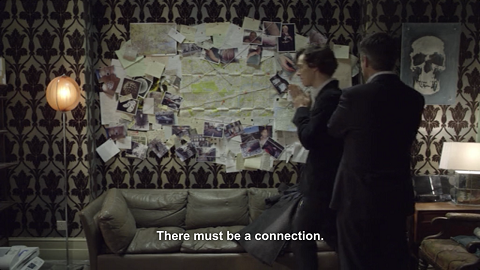
Manhunt, the HBO documentary, does what (not having been there and seen that at the time) appears to be a decent job of recreating some of the cognitive stratregies employed by CIA officers in the OBL hunt. The one I’m interested in here is the building of a “link chart” or cognitive map — law enforcement “evidence board” — the idea being (a) to note known connections visibly, and (b) to encourage the mind to make intuitive leaps that reveal previously unknown connections between nodes… or “dots”.

Sophisticated software does this sort of thing algorithmically with regard to (eg) network connections via phone-calls, but the human mind is still better than AI at some forms of pattern recognition, and that’s the aspect that interests me here.

Aside:

For more on the cognitive significance of the link chart in Manhunt, see my post Jeff Jonas, Nada Bakos, Cindy Storer and Puzzles.

**

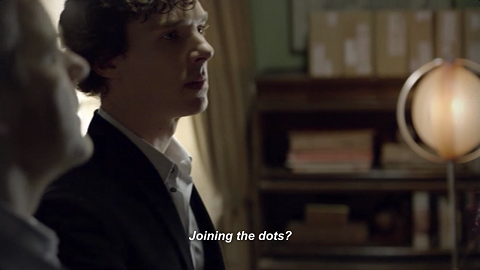
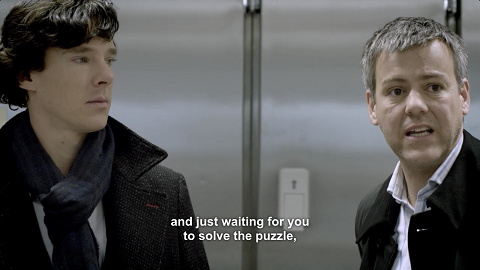
Benedict Cumberbatch‘s Sherlock lays out the way it works —

**

Okay, so one way to visualize connections is to make a fairly random collage of relevant photos, names, dates and places, and tie it together with links of string or ribbon. That’s the equivalent of what in HipBone games terms we’d call a “free-form” game, and it works well for the “divergent”, initial brainstorming phase of thought. But it does little to bottle its own energy, to focus down, to force the mind — in the no less powerful “convergent” phase — into perceiving even more links than occur spontaneously in building the link chart in question.

HipBone‘s preformatted boards take the cognitive process to that second stage. They work on one of the most powerful ingredients in creativity: constraint. Business writer Dave Gray of Communication Nation puts it like this:

Creativity is driven by constraints. When we have limited resources — even when the limits are artificial — creative thinking is enhanced. That’s because the fewer resources you have, the more you are forced to rely on your ingenuity.

But that premise doesn’t just hold true for business problem-solving — it’s at the heart of creative thinking at the Nobel level, too, in both arts and sciences. Consider mathematician Stanley Ulam, writing in his Adventures of a Mathematician:

When I was a boy I felt that the role of rhyme in poetry was to compel one to find the unobvious because of the necessity of finding a word which rhymes. This forces novel associations and almost guarantees deviations from routine chains or trains of thought. It becomes paradoxically a sort of automatic mechanism of originality…

Here’s how the poet TS Eliot puts it:

When forced to work within a strict framework the imagination is taxed to its utmost – and will produce its richest ideas.

A Hipbone Gameboard such as the Waterbird, Dartboard, or Said Symphony board is chosen precisely to challenge the mind with third, fourth and fifth rounds of “creative leaps” — thus adding both divergent and convergent cognitive styles to this form of graphical analysis.

That’s my point here — and a plug for HipBone-Sembl style thinking.

**

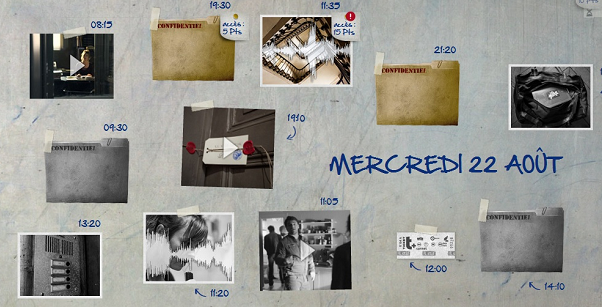
I can’t resist adding a couple of instances in which the meme of “connecting the dots” via a link chart or evidence board has crept from TV series that I enjoyed into the world of games — this first one based on the terrific French detective series, Engrenages, retitled Spirals for British consumption:
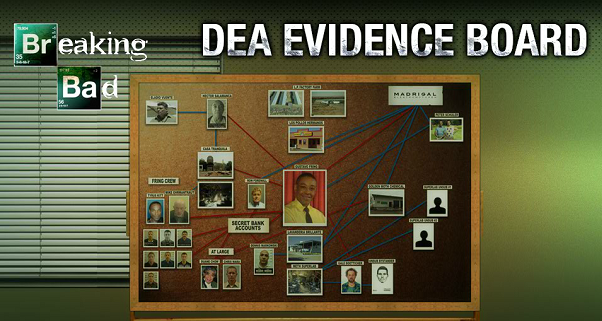
— and this one for fans of the US TV series, Breaking Bad:
On Islam 1: Reuel Mark Gerecht

Tuesday, November 26th, 2013

[ by Charles Cameron — on an impressive video, featuring Matt Levitt and Reuel Gerecht on Hezbollah ]
.

Matthew Levitt‘s contribution to a recent panel at the International Soy Museum was a tour de force. Levitt, whose work as a CT analyst has included stints with both the FBI and Treasury, was discussing his most recent book, Hezbollah: The Global Footprint of Lebanon’s Party of God — both the book and his talk are strongly recommended.

It is, however, his colleague Reuel Marc Gerecht‘s contribution to that session that I wish to highlight here, because [starting at 44.40] he made a point about Hezbollah from his own CT experience that he still finds it necessary to make in 2013, some two decades after his service with the CIA commenced in the 1990s:

One of the things I was struck by when I came into the Agency, and I was struck by it on the day that I left the Agency, which was: you almost never had officers either on the clandestine side or in the directorate of analysis, the Directorate of Intelligence, talk about God. You just didn’t have that many people sort of put it together and talk about what actually motivated people.

You know, there was almost an assumption out there, Oh, the Iranians were upset with us because of our dealing with the Shah etcetera, but the actual analysis of the Iranian complaint against the United States was distinctly secular. Even the analysis of the Hezbollah was distinctly secular. And it never made any sense, particularly if you started to have some exposure to these individuals, and you suddenly realized that no, their motivations aren’t secular usually, their motivations are actually deeply spiritual, they’re religious, they’re about God.

— and [starting 53.04]:

There is a profound reflex in the West to look at a group like Hezbollah, and to look at their Iranian sponsors, and to take God out of the equation. Don’t do that. We wouldn’t do it with al-Qaida. Don’t do it with these groups either. If you do that, if you neuter them of their religious belief, if you look at it as just an ethnic movement, if you look at it as just a sectarian movement, if you look at it as just the Shi’a getting even in Lebanon, then you’re making an atrocious analytical mistake, which will bushwhack you, I guarantee you, over and over again. You have to keep God in this equation…

The one bright spot in this dismal account of the secular mindset blinding itself to religious passion is Gerecht’s statement: “We wouldn’t do it with al-Qaida”.

**

For more on the way our own worldviews can blind us to the worldviews of others, see my post on Gaidi Mtaani, together with the two follow ups to that post which I shall be posting here shortly.

Myanmar between Woolwich and Al-Aqsa 2: graphical innovation

Wednesday, October 23rd, 2013

[ by Charles Cameron — in which jihadis utilize the graphical technique known as kinetic typography for what may be the first time — follow on to part 1: interfaith hatred ]
.

**

Today the Combating Terrorism Center at West Point notified their mailing list of the launch of their Militant Imagery Project online. It’s a very helpful resource, covering much of the same issues as Artur Beifuss & Francesco Trivini Bellini, Branding Terror: The Logotypes and Iconography of Insurgent Groups and Terrorist Organizations and Asiem El Difraoui, The Jihad of Images — which I discussed briefly in Jottings 7: Two for the iconography of terror a while back.

The CTC explains:

The use of propaganda and imagery by terrorist groups has long been an understudied dimension of the broader field of political violence. This project explores the use of imagery and visual themes by militant groups, focusing largely on jihadist media production. Jihadist organizations and individuals inspired by their message are prolific producers and distributors of visual propaganda, and their efforts have expanded exponentially online. However, these images frequently utilize themes which can be inscrutable to those not familiar with the sub-culture. It is our hope that this project will provide academics, practitioners, and students with a basic contextual understanding of the ideas these images convey before they turn to the larger questions of why they are employed, how they work, and what responses they may elicit.

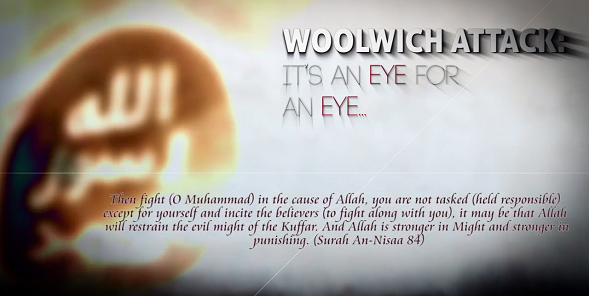
It is in that spirit that I would point you to the following three screengrabs from the Al-Shabaab video I discussed in my previous post…

**

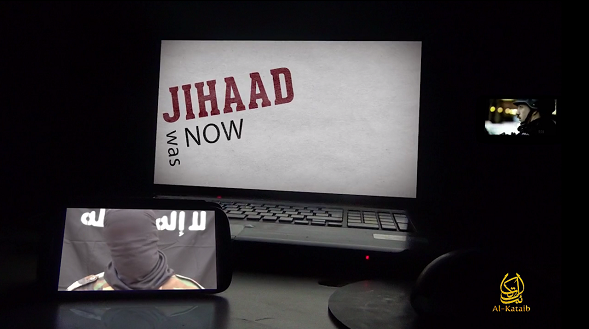
Imagine the images tilting and changing, as the words spoken on the soundtrack are gradually spelled out typographically on screen in this sequence:

Jihad was now global. Jihad in the West — Madrid — London — Paris — Boston — Jihad was now coming home to the West, And it was making a dramatic entrance… WOOLWICH ATTACK

Here are the screengrabs:

**

These three screengrabs illustrate what may well be the first use of the technology called “kinetic typography” or more simply “moving text” in jihadist propaganda. Somali news outlet Harar24‘s Editorials team claim it’s a first, writing:

It is not unusual for jihadi videos to be laden with high graphics and effects. However Al-Shabaab this time used a never technique never adopted before in any jihadi videos, kinetic typography.

The best way to investigate kinetic typography in depth is via Marco Papale‘s video site, the Kinetic typography Channel on Vimeo.

**

I don’t intend to embed the Shabaab piece itself, but here for your further illumination is the Grandmaster Flash sample rom which the screengrab at the top of this post was taken, in full:

That’s kinetic typography!

Myanmar between Woolwich and Al-Aqsa 1: interfaith hatred

Wednesday, October 23rd, 2013

[ by Charles Cameron — in which jihadis take on Jews, Christians, Muslims and Buddhists, quite an interfaith haul for hatred ]
.

Aaron Zelin at Jihadology posted an hour-long video entitled Woolwich Attack a week or so ago, and I found it particularly interesting on two accounts: first, that it makes a multi-faith attack that includes Buddhism in its catalogue of enemies of Islam, and second, that it uses an innovative feature of modern digital typography. Here, I’ll concentrate on the first. Here’s the video’s title:

**

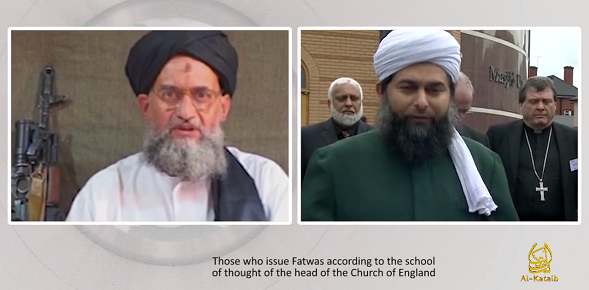
Christianity as a target is well represented in the form of Dr Justin Welby, the recently-appointed Archbishop of Canterbury:

Notice also the lower of these two screengrabs, this one showing Ayman al-Zawahiri (left) berating a leading Muslim spokesman in the UK, Ibrahim Mogra of the Muslim Council of Britain (right), for speaking at the same event as the Archbishop. The damning subtitle suggests he’s one of those “who issue Fatwas according to the school of thought of the head of the Church of England”.

**

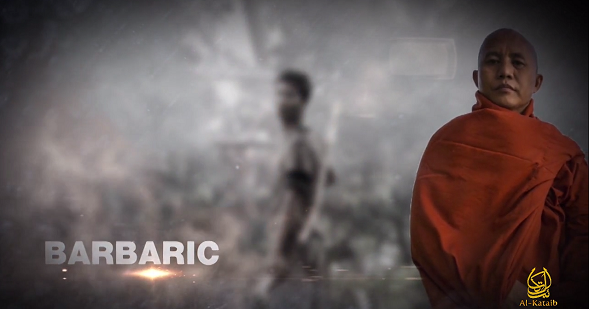
It wasn’t the attack on Christians or fellow Muslims that caught my eye, though, but the unexpected presence of the monk Wirathu, the rhetorical leader of Myanmar’s recent Buddhist rioting against Burmese Muslims. I’d seen his face on Time magazine and elsewhere, but it came as a bit of a shock here in a jihadist video — I’d filed him and his 969 movement under “Buddhism” rather than “Islam” in my mental listing of violent movements with religious underpinnings.

Ugly, ugly.

**

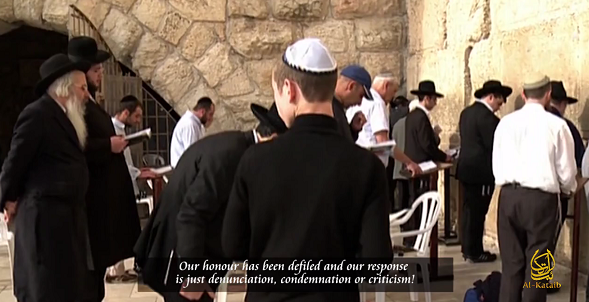
Finally, no invitation to jihad these days is complete without its mention of the al-Aqsa mosque and Jerusalem — and it is here that Judaism comes in for attack. Consider these two screengrabs:

**

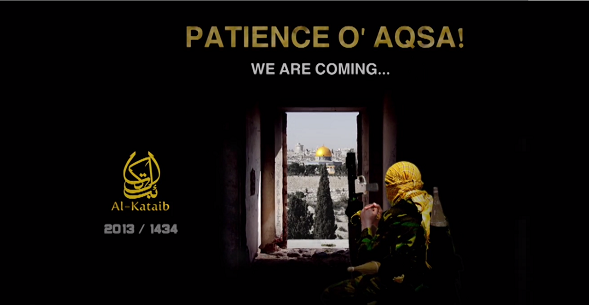
The video closes, significantly, with a long shot of the Dome of the Rock through a window…

Yesterday my friend William Benzon made a post titled On Describing a Painting which began:

Harvard art historian Jennifer Roberts bills her article thus: The Power of Patience: Teaching students the value of deceleration and immersive attention. OK. But I take a different lesson from it, one about one of my current hobby horses: description. Roberts focuses on an 18th Century painting by John Singleton Copley, A Boy with a Flying Squirrel. Her point is that the more you look at the painting, the more you notice and hence the more you can note in a written description. She asks her students to spend a full three hours with a single painting.

Of her own experience with that painting she observes:

It took me nine minutes to notice that the shape of the boy’s ear precisely echoes that of the ruff along the squirrel’s belly—and that Copley was making some kind of connection between the animal and the human body and the sensory capacities of each. It was 21 minutes before I registered the fact that the fingers holding the chain exactly span the diameter of the water glass beneath them. It took a good 45 minutes before I realized that the seemingly random folds and wrinkles in the background curtain are actually perfect copies of the shapes of the boy’s ear and eye, as if Copley had imagined those sensory organs distributing or imprinting themselves on the surface behind him. And so on.

She begins her next paragraph: “What this exercise shows students is that just because you have looked at something doesn’t mean that you have seen it.”

Looking at that final screengrab with this in mind, I see a close correlation between the golden Dome that focuses our attention on the Noble Sanctuary / Temple Mount, and the round, yellow-gold keffiyeh of the jihadist observing it through his window — “making some kind of connection between” them, to echo the words of Harvard’s Elizabeth Cary Agassiz Professor of the Humanities…

It’s a skilled and meaning-filled use of the medium.

**

In my second post in this series, I’ll point to a significant development in graphics and technology introduced in this video.

Fun and War Games

Monday, October 7th, 2013

[ by Charles Cameron — the curious case of the tug of jihad ]
.


.

Bill Ardolino‘s caption at Long War Journal for the above video under the heading Takfiri tug of war reads:

Unverified video of a tug of war contest “between Jabhat al Nusra and Islamic state in Aleppo.” Al Qaeda and its rebranded offshoots have attempted to burnish their bloody, intolerant image in Syria with a series of family-friendly events.

Personally, I think it’s more likely a takbiri than a takfiri tug of war, takfir being the practice of denouncing others as outisde the pale of Islam, whereas takbir is the cry “Allahu Akbar” — Great is God — which I believe is the cry heard here. In any case, one would hardly cry takfir on someone and the engage in a friendly tug of war with them.

And perhaps “unverified” is the key word here in any case: who? wheere? when.

**

But let’s get real.

Here’s Cole Bunzel at Jihadica on the conflict between Jabhat and the Islamic State folk. As he says, after mentioning the tug-of-war and ice-cream parties:

While Syria’s jihadis on the ground may have achieved a modus vivendi in many areas (JN and ISIS fighters have been filmed playing tug-of-war in Aleppo), tensions in jihadi media remain pronounced.

Here’s more:

The Shumukh administrators are not the first jihadis to try to mediate the ISIS-JN dispute. To remind readers, this dispute broke out in April last year when al-Baghdadi, emir of the then-Islamic State of Iraq (ISI), declared JN to be a mere “extension” of ISI and henceforward dissolved. Simultaneously, he extended the Islamic State’s writ to Sham, or greater Syria, thus begetting the Islamic State of Iraq and Sham (ISIS). When JN’s leader, Abu Muhammad al-Jawlani, rejected al-Baghdadi’s instruction to disband, Ayman al-Zawahiri stepped into the fray to “decide the case.”

In late May he issued a written directive, leaked to al-Jazeera, pronouncing against al-Baghdadi. The AQC emir annulled the Islamic State’s incorporation of Syria, ordering ISI and JN to remain separate entities observing separate jurisdictions—Iraq and Syria respectively.

Zawahiri, however, had overestimated the weight of his authority. From the Islamic State’s perspective, it was he, and not al-Baghdadi, who had overstepped his bounds.

This all sounds closer to fitna than fun

Bunzel concludes:

The momentum, however, both material and intellectual, appears to favor the Islamic State, al-Baghdadi, and his contempt for Zawahiri’s effort to restrain him.

The sudden ascendancy of al-Baghdadi marks a signal achievement for the defiantly reborn Islamic State. Contrary to popular perceptions, this achievement is in no way a triumph for AQC but rather comes at its expense. Al-Baghdadi, the rising standard-bearer of the jihadi ideology traditionally undergirding al-Qaeda, appears for the moment the triumphant leader of something quite distinct from an “al-Qaeda group.”


Switch to our mobile site