zenpundit.com » al qaida

Archive for the ‘al qaida’ Category

The matter of the Black Banners and Benghazi

Wednesday, November 9th, 2011

[ by Charles Cameron — flag of AQ in Iraq, Benghazi, implications for Arab Spring, for AQ, millennarian / Mahdist implications, cautions ]

.

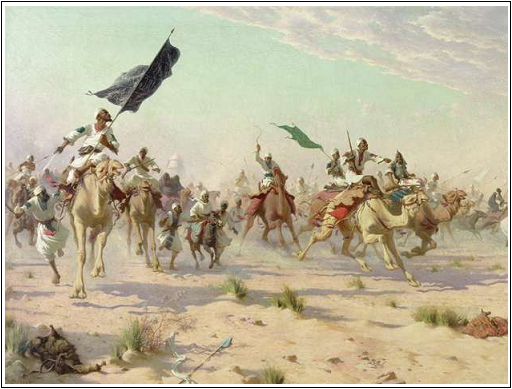
omdurman.png
black banner of the Mahdi at Omdurman 

The question of whether a certain flag flying in Benghazi and elsewhere is in fact an (or teh) Al-Qaida flag has now reached Andrew Sullivan.

Sullivan quotes Will McCants of Jihadica at some length, and also links to the relevant pieces by Aaron Zelin of Jihadology and Adam Serwer, now of Mother Jones. McCants and Zelin are very much the right people to be reading on this topic, and while Serwer’s remit is wider, he’s a bright lad too.

Here’s Sullivan’s money quote from McCants:

[The flag’s] appearance in Benghazi certainly raises questions… Nevertheless, the appearance of the flag in other Arab countries is not necessarily evidence of growing support for al Qaeda or terrorist group’s presence. It could just as easily be youth taking advantage of their newfound freedom to scare their elders, or repressed Salafis using the most shocking symbol possible to voice their anger in public. There is also an element of “Wish You Were Here” photography to many of the photos of the ISI’s flag being unfurled around the Arab world and posted in jihadi forums. This is not to say that the appearance of the flags, particularly in protests, should be ignored. But more corroborating evidence is needed before hitting the panic button.

Okay?

I want to take this a step further.

As McCants very briefly and understatedly indicates in his piece, black flags or banners are associated in Islam not only with the Prophet, but with the Figure at the Far End of Time, the one that’s awaited, the Mahdi. So there are really two questions raised by the presence of these flags:

1:

Are they at some level indicative of Al Qaida?

That’s the question that people seem to be asking, and answering with either an incautious, unqualified “yes yes” or a more cautious and informed “maybe, but let’s not jump to hasty conclusions, there are many shades of influence between vague sympathy and radical participation”.

The “more corroborating evidence” that McCants feels is needed “before hitting the panic button” might include some unobtrusive interviews with the folks waving (or hoisting) those banners, or cheering them on, to see what a bunch of them have to say for themselves… But to me, that’s the less interesting of the two questions.

More interesting, because it deals with the undertow not the height of the tide, how flammable the kindling is, rather than whether it has already been ignited, its potential, not just its currently kinetic energy… is this one:

2:

Are these flags at some level indicative of Mahdist expectation?

Black banners are associated in ahadith with the “end times” expectation that a triumphant army will sweep from Khorasan to Jerusalem.

I have covered this ground repeatedly on ZP, because I believe it is underplayed in most western narratives on the topic of jihad, and most recently I’ve pointed to its significance in Ali Soufan‘s recent book, The Black Banners.  Fwiw, the black flags are also mentioned, and a version of the Khorasan hadith cited, in Syed Saleem Shahzad‘s book, Inside Al-Qaeda and the Taliban, pp 200-01, though there the emphasis is on the ghazwa-e-hind, a topic I’ll be returning to…

Here’s one version of the hadith:

Messenger of Allah said: “If you see the Black Banners coming from Khurasan go to them immediately, even if you must crawl over ice, because indeed amongst them is the Caliph, Al Mahdi.” [Narrated on authority of Ibn Majah, Al-Hakim, Ahmad]

Here’s Ali Soufan’s comment on what he learned as an Arabic speaking FBI interrogator of such AQ figures as KSM and Abu Jandal:

I was to hear that reputed hadith from many al-Qaeda members I interrogated. It was one of al-Qaeda’s favorites. […] It is an indication of how imperfectly we know our enemy that to most people in the West, and even among supposed al-Qaeda experts, the image of the black banners means little…

So – along side the question of what the specific flag in question (with the Shahada and Prophet’s seal) means in terms of support for AQ within parts of the Arab Spring — there’s another question to be quietly and unobtrusively investigated – overlapping to some extent with the AQ question, but separate, distinct, less “obvious” to western minds, and in some ways more significant.

What does the presence of this particular black banner, or any black banner more generally, tell us about the state of apocalyptic expectation?

3:

Use with caution:

Just as the presence of black flags may indicate any number of different shades of interest in or sympathy with AQ, so that presence may indicate any number of different shades of interest in or sympathy with Mahdist expectations.

Here again, “more corroborating evidence” is needed “before hitting the panic button” – and here again, that would presumably require some unobtrusive interviews with the folks waving (or hoisting) those banners, or cheering them on, to see what a bunch of them actually have to say for themselves… about the Mahdi, about the end times and “final war” — and most of all, specifically about the hadith regarding black banners, and the victorious army from Khorasan.

Let me just quote from the opening paragraph of Timothy Furnish‘s book Holiest Wars: Islamic Mahdis, Their Jihads, and Osama bin Laden, and from the closing paragraph of Richard Landes‘ monumental, magisterial overview, Heaven on Earth: the Varieties of the Millennial Experience.

Furnish:

Muslim messianic movements are to fundamentalist uprisings what nuclear weapons are to conventional ones: triggered by the same detonating agents, but far more powerful in scope and effect.

Landes:

I respectfully submit that we will do better in the face of this immense challenge if we understand the varieties and dynamics of the most protean belief in human history: millennialism.

4.

And let me add one further caution:

This one is about the analysis of those unobstrusive — and I do mean, unobtrusive! — interviews, and also about quotes like the ones I’ve just given from Furnish and Landes.

The excitable (Richard Landes calls them “roosters”) will tend to overstate the current of apocalyptic enthusiasm, because it’s exciting — because they will in fact by the very nature of apocalyptic expectation be what Landes terms “semiotically aroused”.  The cautious (Landes calls them “owls”) on the other hand, will understate the current, because it seems jejeune or hysterical (compare, in the west, the way we mock the old guy with tattered coat and “end is nigh” banner).

So our analysis (and our reading of any materials concerning apocalyptic expectation, including my own posts here on ZP) needs to be alert, but not excited.  Neither overstating, nor overlooking, a matter of considerable significance.
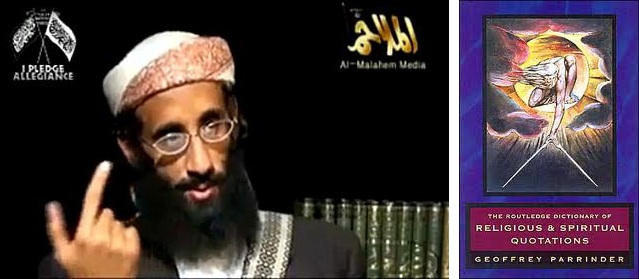
Al-Awlaqi and the Rebbetzin?

Thursday, November 3rd, 2011

[ by Charles Cameron — tracking an al-Awlaqi quote through Jewish, Christian, Islamic and Hindu sources ]

.

awlaqi.jpg

.
I was reading JM Berger‘s CTC Sentinel piece about al-Awlaqi‘s Constants on the Path of Jihad, which is itself an expansion of al-Uyayri‘s original text, and found myself feeling vaguely uneasy about one of al-Awlaqi’s interpolations.

Berger’s example of how al-Awlaqi frequently “expanded al-‘Uyayri’s citations into living, breathing stories, often at significantly greater length, transforming the legalistic argument into an emotionally and politically loaded discourse” concerns the “People of the Ditch” motif found in the Qur’an and hadith:

In the story, a king is persecuting believers in Allah. He orders them to renounce their religion or be thrown into a flaming ditch or trench to die. All of the believers throw themselves in. One woman, carrying her baby, hesitates, and Allah inspires the baby to speak to her, saying “Oh Mother! You are following al-Haqq [the truth]! So be firm!” As a result, she carries him into the fire and succeeds in achieving martyrdom.

Al-Uyayri makes a brief mention of this story; Al-Awlaqi expands on it, transforming (in Berger’s words) “al-‘Uyayri’s perfunctory citation into an emotional journey that engages the listener and broadens the original point to emphasize the importance of taking even one step toward jihad.” He does this by commenting:

This woman, because she took the first step, and that is the willingness to jump in the trench, when she was about to retreat, Allah helped her. So if you take that first step towards Allah, Allah will make many steps towards you. If you walk towards Allah, Allah will run towards you.

*

So far so good. But isn’t al-Awlaqi quoting someone here?  I had an itch in the back of my head…

I thought I should check, and what I found frankly surprised me. I mean, was he really quoting the Rebbetzin Esther Jungreis?

We have a promise from HaShem that if we take just one step toward Him, He will take two steps toward us.

Not likely.

Perhaps it was a Christian source he had in mind…

A common saying in my church and in many Christian circles is the following: “Take One Step Toward God and He Takes Two Steps Toward You”

Nope.  Surely, it must have been a Hadith:

Allah (swt) says: “Take one step towards me, I will take ten steps towards you. Walk towards me, I will run towards you.”

After all, he can hardly have been quoting the Hare Krishna devotees, can he?

in 1972 In Denver, I remember hearing all the time from the temple devotees to encourage me as a new bhakta… “you take one step towards Krsna and He’ll take 10 steps towards you”.

And no, that particular phrase doesn’t seem to be in the Routledge Dictionary of Religious and Spiritual Quotations — perhaps because it’s hard to know quite where to put it…

*

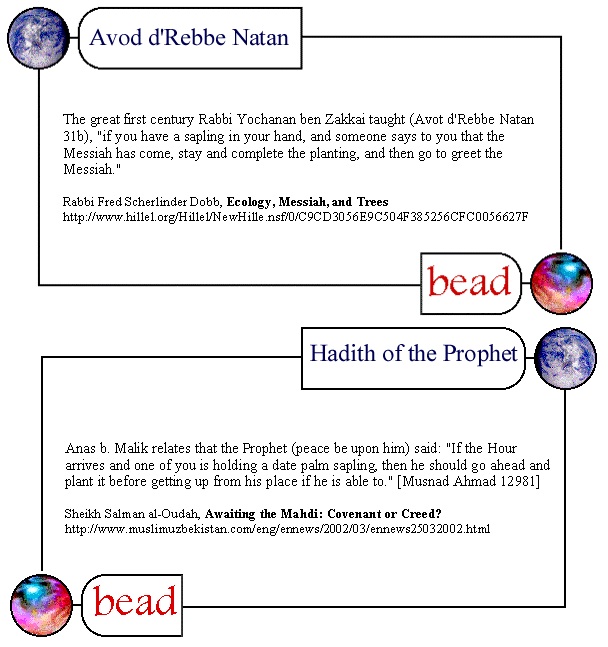
My own favorite among cross-religious commonalities of this sort, fwiw, is this one:

dyad_planting.jpg

*

BTW, nice to see both Berger and Chris Anzalone in the Sentinel — and the Flagg Miller cover-piece on early bin Laden tapes is interesting, too.

Arab Spring and apocalyptic dawn

Sunday, October 2nd, 2011

[ by Charles Cameron — Mahdism and the Arab Spring, depth of apocalyptic expectation not limited to militant circles ]

.

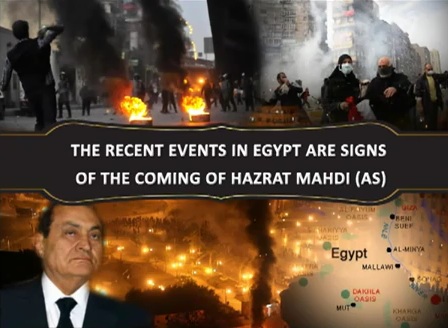
recent-events.jpg

screen-cap from a Feb 2011 video associated with Harun Yahya, see below

I’ve been holding back on posts about Shi’ite apocalypticism, because it seems to me that President Ahmadinejad‘s influence is on the wane for reasons not entirely disconnected from his keen and oft-expressed expectation of the soon coming of the Hidden Imam.

I have posted a couple of times recently on Sunni apocalyptic — but there my focus has been on AQ, Taliban and the black banners of Khorasan, as illuminated recently by the books of Syed Saleem Shahzad and Ali Soufan. My next forays will hopefully concern another strand of militant Sunni apocalyptic– the traditions of jihad against India (Ghazwa-ul-Hind) — and I’d also very much like to turn my attention some more to some of the eschatological issues in current Christian circles in the US.

But first: a quick glimpse of apocalyptic expectation in the Arab Spring.

1.

Under the title Mubarak’s fall spawns End of Times prophecies, Yasmine Fathi recently reported in Egypt’s Al Ahram online:

The idea of Mubarak as Anti-Christ has caught fire on social networking sites, with many users presenting Muslim Hadiths, sayings of the Prophet, in support of the theory. While others dispute the notion, they nevertheless posit Mubarak’s very existence as a sign that the end is indeed nigh.

One website noted that, according to certain Islamic beliefs, doomsday will come after Egypt is ruled by a leader whose first name is “Mohamed” and second name is “Hussein,” of which “Hosni” – Mubarak’s middle name – is a variation. This, say doomsday-watchers, constitutes further proof that his existence – and recent fall – represented a sign that the end of time can be expected any day now.

One theory currently making the rounds on the web suggests that the world will end on 26 September – this Monday – due to massive earthquakes caused by a rare planetary alignment. The quakes, believers say, will make Japan’s recent disaster look like a walk in the park.

Even Egypt’s Coptic Patriarch, Pope Shenouda III, referred to the prediction, joking at the end of his last weekly sermon, “We’ll meet again next Wednesday after the earthquake, God willing.”

After the theory was savaged by local and international scientists, however, the public’s attention has shifted again to the year 2012 – only three months away – which many fatalists fear will be our last year on earth, since the Mayan calendar ends on 21 December of next year.

The first point to note here is that apocalyptic sentiment is alive and thriving in the Arab world — and not just in the militant jihadist circles of AQ and the like — or Hamas — either.

That’s a significant datum — and our cue for another reading of JP Filiu‘s Apocalypse in Islam.

2.

The number and variety of strands converging in these few brief paragraphs is impressive:

social networking
apocalyptic expectation catching fire
Mubarak’s name as a sign
a date certain — a week from now
cross-religious banter from Pope Shenouda

— and there’s even a reference to the “Mayan” chronology with its 2012 end-date — which (though Fathi doesn’t mention it) just happens to coincide with the Saudi dissident Sheikh Safar al-Hawali‘s ETA for the return of Jerusalem to Islam on the final page of his pamphlet, The Day of Wrath.

3.

Let’s go back to Fathi for a more nuanced — and theologically informed — view:

But according to Amena Nosseir, professor of Islamic theology and philosophy at Cairo’s Al-Azhar University, the true date of the “final hour” will never be revealed to mankind.

“God has not bestowed knowledge of the final hour to any of his prophets or worshippers, and there’s a holy wisdom behind his decision to withhold this information,” she said. “God created humans to create life on this planet, so it doesn’t make sense that he would give them the knowledge of when the end of time will be.”

Even al-Hawali qualifies his suggested date thus:

Therefore, the end -or the beginning of the end- will be 1967 + 45 = 2012, or in lunar years 1387 + 45 = 1433.

This is what we hope will happen, but we do not declare it to be absolutely certain, but if the fundamentalists would like to bet with us, as Quraysh did with Abu Bakr concerning the Qur’anic prophecy concerning the Romans, then without doubt they will lose, although we cannot guarantee that it will be that exact year!

Setting a date for time to end may be the most reliable method yet devised for proving oneself unreliable.

4.

There are other stirrings.

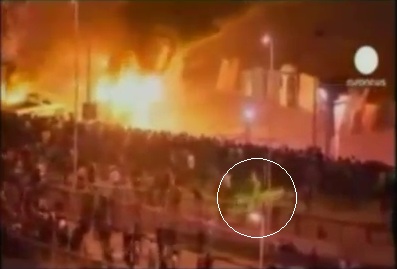
Harun Yahya, an influential Turkish figure, reports that a green horse and rider can be discerned in a recent Cairo video, and proposes that the rider is Khidr — the teacher of Moses in Sura 18 of the Qur’an (which the great scholar Louis Massignon terms “the apocalypse of Islam”) and a mysterious figure of inspiration in Islamic lore…

khidr-in-egyptian-video.jpg

He also “reads” Mubarak as an eschatological figure — the Rook — and indeed, this entire video — only five minutes long and readily available on YouTube — is worth watching, to get a visceral sense of how strong this narrative current is:

BTW: see Halverson, Goodall and Corman‘s Master Narratives of Islamist Extremism for a sense of how significant “narrative” is… and then, yes, reread Filiu!

*

Hat-tip for a hot tip to Bryan Alexander.

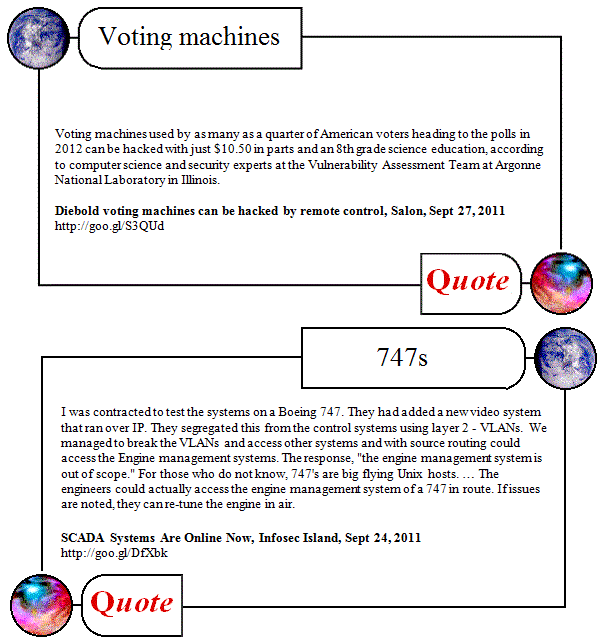
Mapping our interdependencies and vulnerabilities [with a glance at Y2K]

Wednesday, September 28th, 2011

[ by Charles Cameron — mapping, silos, Y2K, 9/11, rumors, wars, Boeing 747s, Diebold voting machines, vulnerabilities, dependencies ]


www.fun1001.com | Send this image to your friend

The “bug” of Y2K never quite measured up to the 1919 influenza bug in terms of devastating effect — but as TPM Barnett wrote in The Pentagon’s New Map:

Whether Y2K turned out to be nothing or a complete disaster was less important, research-wise, than the thinking we pursued as we tried to imagine – in advance – what a terrible shock to the system would do to the United States and the world in this day and age.

1.

My own personal preoccupations during the run-up to Y2K had to do with cults, militias and terrorists — any one of which might have tried for a spectacle.

As it turned out, though, Al Qaida’s plan to set off a bomb at Los Angeles International Airport on New Year’s Eve, 1999 was foiled when Albert Ressam was arrested attempting to enter the US from Canada — so that aspect of what might have happened during the roll-over was essentially postponed until September 11, 2001. And the leaders of the Ugandan Movement for the Restoration of the Ten Commandments of God, acting on visionary instructions (allegedly) from the Virgin Mary, announced that the end of the world had been postponed from Dec 31 / Jan 1 till March 17 — at which point they burned 500 of their members to death in their locked church. So that apocalyptic possibility, too, was temporarily averted.

2.

Don Beck of the National Values Center / The Spiral Dynamics Group, commented to me at one point in the run-up:

Y2K is like a lightening bolt: when it strikes and lights up the sky, we will see the contours of our social systems.

— and that quote from Beck, along with Barnett’s observation, pointed strongly to the fact that we don’t have anything remotely resembling a decent global map of interdependencies and vulnerabilities.

What we have instead is a PERT chart for this or that, Markov diagrams, social network maps, railroad maps and timetables… oodles and oodles of smaller pieces of the puzzle of past, present and future… each with its own symbol system and limited scope. Our mapping, in other words, is territorialized, siloed, and disconnected, while the world system which is integral to our being and survival is connected, indeed, seamlessly interwoven.

I’ve suggested before now that our mapping needs to pass across the Cartesian divide from the objective to the subjective, from materiel to morale, from the quantitative to the qualitative, and from rumors to wars. It also needs a uniform language or translation service, so that Jay Forrester system dynamic models can “talk” with PERT and Markov and the rest, Bucky Fuller‘s World Game included.

I suppose some of all this is ongoing, somewhere behind impenetrable curtains, but I wonder how much.

3.

In the meantime, and working from open source materials, the only kind to which I have access – here are two data points we might have noted a litle earlier, if we had decent interdependency and vulnerability mapping:

quo-vulnerabilities.gif

Fear-mongering — or significant alerts?  I’m not tech savvy enough to know.

4.

Tom Barnett’s point about “the thinking we pursued as we tried to imagine – in advance – what a terrible shock to the system would do to the United States and the world in this day and age” still stands.

Y2K was what first alerted me to the significance of SCADAs.

Something very like what Y2K might have been seems to be unfolding — but slowly, slowly.

Are we thinking yet?

Down the rabbit hole: researching the “jikhad”

Thursday, September 22nd, 2011

[ by Charles Cameron — cross-posted from Chicago Boyz – a meander on the perils and promise of research, jihad, typos, books and more ]
.
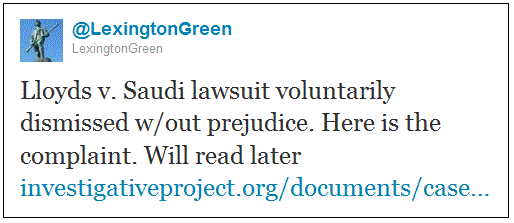
It begins with an email from Lexington Green saying I might be interested in a tweet he had posted earlier this morning:

The Insurance Journal tells us:

Defendants named in the complaint were Kingdom of Saudi Arabia, The Saudi High Commission for Relief of Bosnia & Herzegovina, Saudi Joint Relief Committee for Kosovo and Chechnya, Saudi Red Crescent Society, National Commercial Bank, Al Rajhi Banking and Investment Company. Also included as defendants are three Saudi citizens connected to these organizations, Prince Salman Bin Abdul Aziz Al Saud, Suleiman Abdel Aziz Al Saud and Yassin Al Qadi.

The case is Underwriting Members of Lloyd’s Syndicate 3500 v. Kingdom of Saudi Arabia, 11-00202, U.S. District Court, Western District of Pennsylvania.

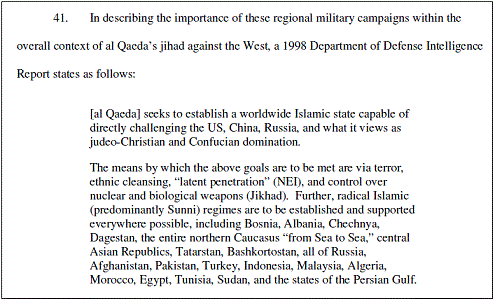
Okay, I’m curious. I go to the complaint [.pdf] and start reading… and on page 9, I find:

That’s interesting. A DIA report, better look that up. But there’s no reference provided…

So I googled for “latent penetration” NEI which sent me back to versions of the court filing, and then for “latent penetration” and found that Robert W. Schaefer on p. 166 of his book, The Insurgency in Chechnya and the North Caucasus: From Gazavat to Jihad, quotes [with minor variations] from what is obviously the same DIA document and in footnote 29, p 165 identifies it as “Declassified DIA intelligence report NC 3095345, October 16, 1998, 3 (obtained through the Freedom of Information Act).”

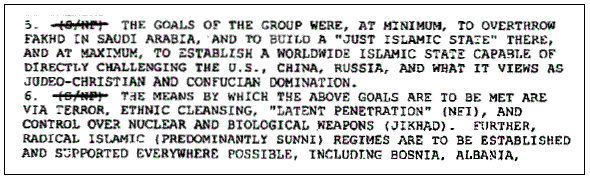
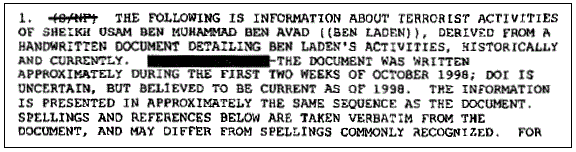
Onwards to locate NC 3095345, which can be found here [.pdf] and contains the following relevant text on p. 3:

So that’s the source of the description of AQ’s overall plan in the Lloyds complaint.

But what’s “latent penetration”? The DIA document even has it in quote marks – does that make it a technical term?

Back to Google.

The FBI uses the term “latent penetration” – maybe I’m onto something! In their Electronic Biometric Transmission Specification (EBTS) [.pdf] on p. 58 they offer the “following list of TOTs is applicable to latent friction ridge searches transmitted to the FBI”:

fbi-latent-prints.gif

I have to admit – a Latent Penetration Query sounds like just the thing I’m after – but the FBI appears to think of “latent penetration” in terms of fingerprints…

Okay, next up. A quick look at David Waterman and Andrew A. Weiss‘ book, Vertical Integration in Cable Television, (AEI, 1997) tells us:

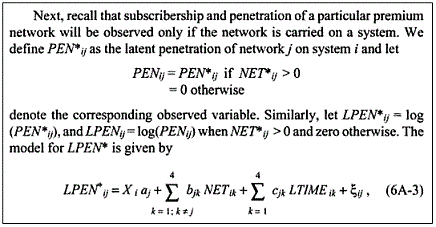
latent-penetration-in-cable-television.gif

That’s all a bit above my head, and in any case I don’t watch cable TV… and the networks in question aren’t terrorist networks, they’re cable networks…

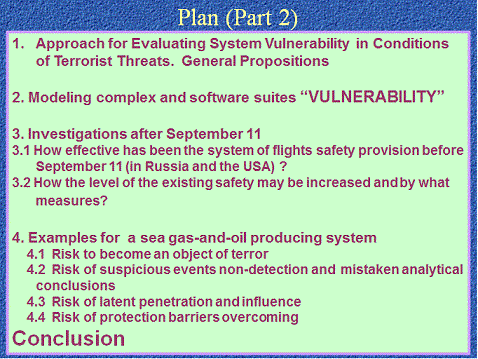
When I add the word “terror” into my search, however, I get directed to Prof. Kostogryzov Andrey‘s paper [.ppt] addressing the question of a “methodical approach for the evaluation of systems vulnerability in conditions of terrorist threats” for a symposium at the University of Texas, Arlington – which sounds promising.

Searching the good professor’s powerpoint for “latent penetration” takes me to slide 36, however, where I read:

symposium-slide-36.gif

To be honest with you, I don’t feel any closer to understanding “latent penetration” beyond a sort of general “potentially getting inside the opposition” kind of sense.

So let’s get back to NEI – which is what the Lloyds transcription has in parens immediately after the quote-marked phrase “latent penetration” – what’s that about?

Well, on closer examination, it looks as though Lloyds got that wrong, and the DIA document — compare their E’s and F’s in the typed excerpt above and I think you’ll agree — actually says NFI…

Phew! NFI.

What’s that?

The DIA probably classifies its acronyms, but this particular document has been declassified and NFI hasn’t been redacted, so perhaps the Free Dictionary acronym finder will be able to help…

I quickly dismiss such possibilities as National Fatherhood Initiative and get down to my three basic possibilities:

NFI … No Further Information (available)
NFI … National Foreign Intelligence
NFI … No Freaking Idea

The last of these describes my own feelings at this point, although “freaking” would be the milder way to put it. So it’s down to guesswork: I’ll go with #2.

Okay: according to this particular DIA report, AQ “seeks to establish a worldwide Islamic state” by means that include “latent penetration” — I still have only the vaguest idea [OTVI] what that means — and “control over nuclear and biological weapons (Jikhad)”.

Jikhad?

The DIA docu self-describes thus:

dia-self-descript.gif

Variant spellings, okay…

But I’m wondering if “Jikhad” is one of them…

Back to the search engines, where I discover the word does have prior art in a terrorist – indeed, a specifically AQ — context, to wit:

jikhad-book-cover-med.jpg

$149.95, call it $150 on Amazon, and available for free shipping

Well, you can’t judge a book title by its cover, so I have an inquiry in to the good folks at the University of Calgary library, which has a copy – but I’m guessing “Jikhad” is a typo in both cases, aren’t you?

*

And what grand purpose does all this serve?

None, you may think – the complaint has been withdrawn, as Lex tells us, “without prejudice” – so the issue is, if I may use a legal term despite the fact that IANAL, “moot”.

Unless one is interested in the prices of books these days, or the frequency of spelling vagaries on their printed covers, or possible Arabic words bearing on terrorism that one hasn’t run across previously, or fingerprints, or the reliability of a document of which LTC Schaefer notes (p. 165, n 29):

It is important to note that no evaluation of the information detailed in the report is included in the declassified version; and anyone who deals with intelligence will tell you that text without context is pretext. It is entirely possible that this document was passed to U.S. Intelligence by the Russians in order to bolster the evidence linking the Chechens with Al Qaeda.

On second thoughts, we can learn something here about care in reading sources – about the transmission errors that commonly crop up when texts are translated or transmitted – and about the importance of context.

Text without context is pretext.

That whole paragraph of LTC Schaefer’s is worth the price of admission.


Switch to our mobile site