zenpundit.com » creativity

Archive for the ‘creativity’ Category

When they say it’s a game-changer…

Thursday, July 26th, 2012

[ by Charles Cameron — are they talking about shooting for a goal, hitting your target, making a move — or lofting one up the fairway? ]
.

As you may have gathered, I really love that quote from the philosopher MacIntyre. Here we go again:

Image courtesy of my friend Oink, aka Peter Feltham. It seems like gameplay gets more risky by the hour…

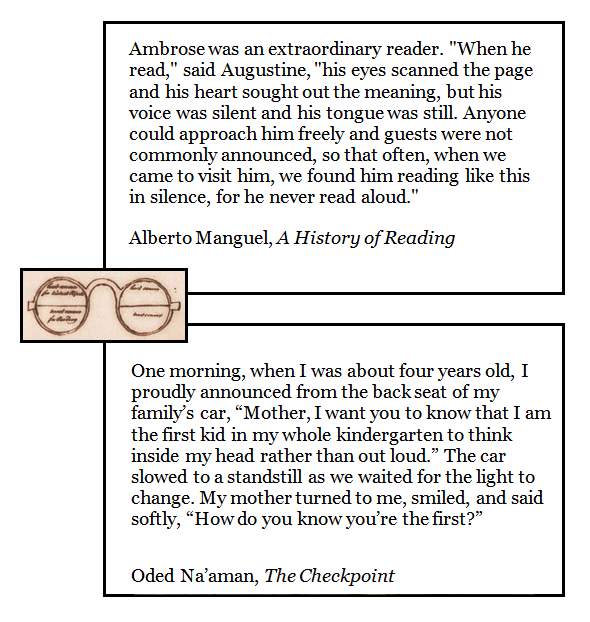
Silent reading, silent thinking, bifocal glasses

Thursday, July 26th, 2012

[ by Charles Cameron — two forms of creativity: far out and close in ]
.


.
Some of the most obvious things aren’t obvious at all, until you think of them. The things my friend Derek Robinson talks about as being in the beforeground. Too close to notice / right under our noses all along.
.
And I think that’s one of the principles of creative thinking — a lot of creative detailing takes place out on the bleeding edge, where someone pushes the limits of existing knowledge that little bit farther, and sometimes those insights can be revolutionary. But profound revelations also come from questioning the most basic assumptions — as Cambridge University Press blogged last year, celebrating the centenary of the Russell-Whitehead Principia Mathematica, vol II:

Principia attempted to ground mathematics in logic and the authors left no stone unturned in their attempt to create the ultimate definition of mathematics. For example, they were well into volume two before they had proved that one plus one equals two! They concluded their proofs with the laconic statement: “The above proposition is occasionally useful.”

BTW, that’s a point I also addressed in the context of my work on social entrepreneurship for the Skoll Foundation:

IMO, we need some funding sources that understand that the next significant breakthrough, too, will be all but invisible — and who therefore look specifically for projects that are categorized by their radical rethinking of the seemingly known and obvious.

**

For anyone who’s curious, the bifocals pictured in the tiny “specs” section of my graphic above come from Ben Franklin‘s original letter proposing the idea of bifocal glasses, courtesy of the Library of Congress (link is to complete image).

The Odel Na’aman story, The Checkpoint: Terror, Power, and Cruelty is up at the Boston Review site. I haven’t read it yet, just tasted the first paragraph.

There are times when it helps to have bifocal (contrapuntal) vision…

The best war game is a library of windows

Tuesday, July 3rd, 2012

[ by Charles Cameron — Escher, Borges, simulating the future, wargames, A Pattern Language, Sembl ]
.

MC Escher, Relativity

.
Ridiculous phrase, a library of windows. Unless you think, as I do, of books as windows onto different worlds, in which case it makes a whole lot of sense, and a decent library has more windows onto more profoundly different worlds than any physical room — and here we are getting into the territory of Jorge Luis Borges (links to Library of Babel) and Maurits Escher (image above).

And let me just state for the record that Godel Escher Bach could just as well have been Escher Carroll Borges, and that a comparison between the logics of Escher and Borges is one of the desiderata of our times.

That’s a Sembl move.

**

Let’s expand the concept of window to include the sort of inter-worldview glimpse that Haaretz describes today here:

Last week, in a small beit midrash (study hall) named after Rabbi Meir Kahane in Jerusalem’s Shmuel Hanavi neighborhood, an emergency meeting was convened to discuss instigating freedom of religion and worship on the Temple Mount. It was a closed meeting attended by representatives of the Temple Institute, HaTenu’ah LeChinun HaMikdash (the Movement to Rebuild the Holy Temple) and the Temple Mount Faithful, as well as two representatives of Women for the Mikdash, and others. The activists met to try to understand how they could overcome the authorities, who they believe are plotting against them, and return to the Temple Mount. At this meeting, Haaretz was offered a rare behind-the-scenes glimpse of the most ardent activists in the battle to Judaize the Temple Mount.

**

Here’s the meat of the post, as yet uncooked. Back in 2005, but brought to my attention today by Rex Brynen at Paxsims, is this piece from Strategy Page:

After eight years of effort, and spending over $300 million, the U.S. Army has officially received its new wargame (WARSIM) for training battalion, brigade, division, and as big as you want to get, commanders, and their staffs. Now even the most elaborate commercial wargame would not get $300 million for development, and eight years to create the system. But wargames for professional soldiers have different requirements, and a troublesome Department of Defense bureaucracy to deal with. First, the requirements. Commercial wargames shield the player from all the boring stuff (support functions, especially logistics.) But professional wargames must deal with these support activities, because in a real war, these are the things commanders spend most of their time tending too. …

WARSIM covers a lot of complex activities that a commander must deal with to achieve battlefield success. Besides logistics, there’s intelligence. Trying to figure out what the enemy is up to is, next to logistics, the commanders most time consuming chore.

— which in turn was referenced by Michael Peck writing in a Kotaku piece today titled Why It’s So Hard to Make a Game Out of the 21st Century:

Let’s build a game. Let’s make it a strategy game. We will realistically simulate global politics in the 2030s. Perhaps a sort of Civ or Supreme Ruler 2020-type system.

Where shall we start? How about something easy, like choosing the nations in the game? It’s simple enough to consult an atlas. We’ll start with Britain…but wait! Scotland is on the brink of declaring independence from the United Kingdom. Should Britain be a single power, or should England and Scotland be depicted as a separate nation? What about Belgium splitting into Flemish and Walloon states? And these are old, established European nations. How will states like Syria and Nigeria look in two decades? It was only a bit over 20 years ago that the Soviet Union appeared to be a unshakeable superpower that controlled Eastern Europe and Central Asia.

**

Let’s cook that meat, let’s make a meal of it.

Peck’s piece goes into many other ways in which predictive gaming isn’t terribly productive.

But it left me asking the question, what would I do with a game-sized budget, if my aim was to push military and intelligence towards greater insight.

And my answer would be to embed information in walls. In corridors…

To build windows at sparse and irregular intervals into the internal corridors that connect any given office in the Pentagon or three-letter agency — or my local preference (hush, I know it’s the Glorious Fourth tomorrow) MI-5 and -6 — through which analysts and decision makers can glimpse snippets of information.

Which can then fall into the deep well of memory.

It is deep within that well of half-forgotten knowledge, ST Coleridge tells us, that the “hooks-and-eyes of memory” link one thought with another to build a creative third.

**

A wall, then. I would build a wall embedded with facts and fancies, maps and illustrations, graphs and stats, film clips and news clips, anecdotes and quotes — even, perhaps, tiny alcoves here and there with books free for the taking, music CDs, DVDs of movies, old, new, celebrated, strange…

And I would be constantly shifting and rearranging the “views” from my windows, so that what was seen yesterday would not be what would be seen tomorrow — yet with a powerful index of words, topics, themes, memes, image contents, names of actors, newscasters, authors and so forth, so that what was once seem and dimly recalled could be recaptured.

**

The concept here is pretty much the exact opposite of having a huge black poster proclaiming Creativity Matters!

Don’t get me wrong, creativity does matter (get that poster and others here), but it “works in mysterious ways its wonders to perform” — and the way to entice it is to see things out of the corner of the eye…

The windows I’m looking for, therefore, offer glimpses you wouldn’t necessarily notice if you were deep in thought or conversation, and conversely, wouldn’t see twice and grow so familiarized to that they’d become irrelevant by repetition. They’d be glimpsed in passing, their esthetic would be that of Christopher Alexander’s Zen View, pattern 134 in his brilliant work — the closest we have to a Western I ChingPattern Language:

The idea, then, is to seed the memory with half-conscious concepts, patterns, facts and images, carefully selected and randomly presented — so that those hooks and eyes have the maximum chance of connecting some scrap of curious information with a pressing problem.

Which is how creativity tends to work.

**

That way each corridor becomes a game-board — but it is in the analyst’s focused mind that the game is played and won.

What you’d get, in effect, would be community-wide, ongoing free-form gameplay in complete alignment with the web-based game we’re currently developing at Sembl. Games of this genre will also have powerful application in conflict resolution.

And peace.

Copywrong?

Friday, June 29th, 2012

[ by Charles Cameron — borrowing as the nature of creativity from lichen to origami, copyright ]
.

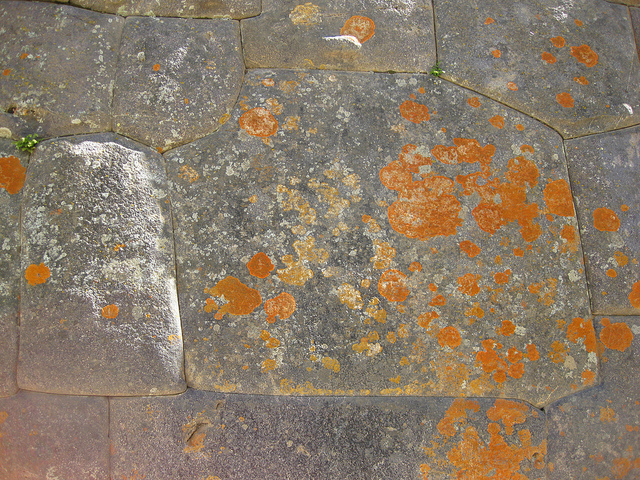
Lichen covered wall, Incan ruins of Ollantaytambo. Cusco, Peru

**

Leonardo in his Treatise on Painting came up with what he called “a new theoretical invention for knowledge’s sake … of great utility in bringing out the creativity in some of these inventions”:

This is the case if you cast your glance on any walls dirty with such stains or walls made up of rock formations of different types. If you have to invent some scenes, you will be able to discover them there in diverse forms, in diverse landscapes, adorned with mountains, rivers, rocks, trees, extensive plains, valleys, and hills. You can even see different battle scenes and movements made up of unusual figures, faces with strange expressions, and myriad things which you can transform into a complete and proper form constituting part of similar walls and rocks. These are like the sound of bells, in whose tolling, you hear names and words that your imagination conjures up.

Borrow, he says, from nature.

Michelangelo, you may recall, used to see statues in chunks of marble, then chip away the excess to reveal what had been there all along…

**

The stone-cutters whose marvelous ingenuity pieced together the stone wall in the Incan ruins of Ollantaytambo, Peru, depicted above in a photo by Teosaurio (under a CC BY-SA 2.0 license) borrowed stone from nature in somewhat the same manner, brilliantly.

Nature repaid the compliment, adding the colors of lichen to the sunlit and shadowed grey of stone.

**

In Paris, the artist Mademoiselle Maurice has been adding her own kind of lichen to the shadowed and sunlit walls of Paris, in an installation she calls spectrum – her lichen being composed entirely of small, colored origami folds, by way of honoring the origami peace cranes of Hiroshima artist Sadako Sasaki.

image: Mlle Maurice, abstract paper rainbow

**

Origami?

Origami is an exquisite art in its own right, demonstrating once again that mathematics belongs as much to the arts and humanities as it does to the sciences and technology.

[Consider this bleeding together of arts and sciences as something of a crusade of mine. Photography is art, and it does not became science just because the photograph is of stars rather than stones: photography is science, and it does not become art simply because the stars are beautiful.]

One genius of the artful mathematics of folding would be Robert Lang, who, as Kevin Kelly just told us, “helped NASA design satellite folding/unfolding solar panels” and “uses computers to devise folding patterns to create impossibly detailed 3D organisms from a single piece of paper…”

One can hardly deny that his work is quite lovely:

Butterfly image: Robert Lang, Origami Insects Vol 2, ed. Makoto Yamaguchi

**

One might wonder whether Lang is the genius, or mathematics? Does he borrow from God, from some principle immanent in universe?

His diagram depicted, left, below, “will, when folded by him, turn into a convincing Rhinoceros Beetle”

Of the Rhinosceros beetle or of the butterfly one might ask, as William Blake asked of the Tyger:

Did He smile His work to see?
Did He who made the lamb make thee?

Science, naturally, somewhat believes it has the answer…

**

Compare and contrast:

image: Kevin Kelly, from the Technium

**

Inappropriately appropriated? The very concepts battle each other into oxymoron fatigue.

The painter Susan Morris borrowed Robert Lang’s beautiful design, itself a WoA — useful bureaucratese devised by a friend of mine for filing Works of Art in a category of their own – to make the painting, also a WoA, depicted above, right.

Morris, it seems to me, takes Lang in a direction pioneered by Frank Stella:

image: Frank Stella, Harran II

**

It was Kevin Kelly who juxtaposed Lang and Morris in the image above — in what I’d have claimed was a WoA in my DoubleQuotes format if I’d done it myself — so as to discuss copyright.

Or more precisely, copy — right or wrong?

Nature copies, without apology, with beauty – and, in the case of certain poisonous spores, without remorse. And are we not nature?

Here’s Leonardo again:

Don’t underestimate this idea of mine, which calls to mind that it would not be too much of an effort to pause sometimes to look into these stains on walls, the ashes from the fire, the clouds, the mud, or other similar places. If these are well contemplated, you will find fantastic inventions that awaken the genius of the painter to new inventions, such as compositions of battles, animals, and men, as well as diverse composition of landscapes, and monstrous things, as devils and the like. These will do you well because they will awaken genius with this jumble of things.

To study, to copy, to derive: this awakens genius. Who am I to disagree?

Tree series, I: This is how nature thinks

Saturday, June 23rd, 2012

[ by Charles Cameron — this one’s a companion piece for One bead for a rosary and the first of three more or less contemplative / creative posts on trees. ]

.


.

This is how nature thinks: this is one of nature’s thoughts, and it’s the kind of thought that comes late, after much else has been worn away and only essence remains, the kind we find in our elders and call by the name wisdom.

We don’t think of trees as thoughts, but perhaps we should: our idea of mind might broaden.

*

And rivers.

We spend a great deal of our time thinking and speaking in straight lines. One of the straight lines I tent to think along and speak about is the idea that we might want to think differently, to braid our linear ideas perhaps, to listen to the voices of others and join ours to theirs, making somehow a thought that is many-voiced, a thought stream that reflects on itself, echoes itself, has eddies of questioning, rapids, calm stretches, still ponds… “pondering”, my friend Derek suggests.

There are certain people who, I trust you’ll agree, are deliciously frank and frankly strange: we call them by affectionate negative names – he or she’s “an ornery old cuss” we say, perhaps – I suppose I may be one myself, and my language old-fangled, but I trust again that you get my drift.

Gnarly.

Now there’s another word for them. It comes from the gnarls in wood, and the poet Hopkins applies it to the nails that tear the hands of Christ: With the gnarl of the nails in thee, niche of the lance…

A gnarly character has come to conclusions you probably don’t share, but you feel a grudging admiration for the forthrightness with which this character has pursued some intricate and personal logic to its unordinary conclusion.

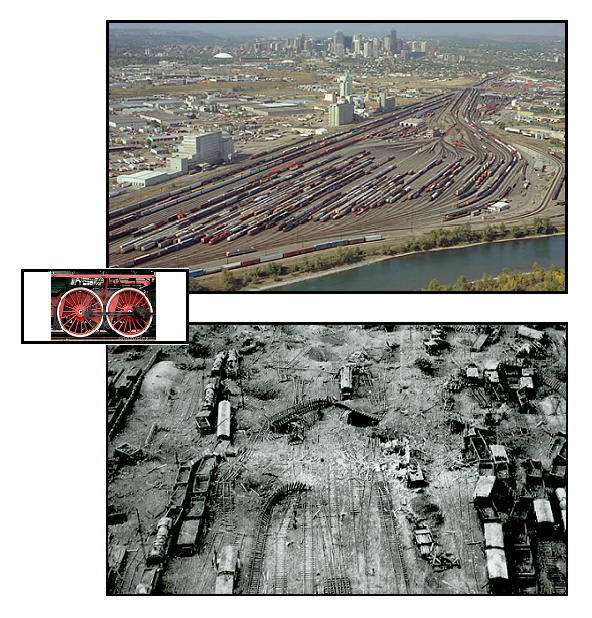
I have presented various images for a kind of thinking that is many-braided, communal yet irrepressibly individualistic, including a railway marshaling yards after a bombing raid and the multiple complex paths of the Mississippi.

*

Please consider the tree above – seen in a photo by Rick Goldwasser of a Bristlecone Pine from the White Mountains in California – as exemplifying the gnarly, intensely personal, complexly braided thought of a Beethoven in the late quartets and sonatas, the Hammerklavier and Grosse Fuge – or the unfinished late masterworks of a Michelangelo.

A tree, a way of thinking – and appreciation for that which is bone-weary yet resolute, difficult yet rewarding, which swirls like water yet is almost as still as stone.

* * *

The Grosse Fuge, performed by the Takács Quartet:

The Hammerklavier, performed by Mitsuko Uchida:

These, also, are among nature’s thoughts.

Another magnificent example of which is GM Hopkins’ poem, The Wreck of the Deutschland, from which that line about “the gnarl of the nails in thee” is drawn…


Switch to our mobile site