zenpundit.com » creativity

Archive for the ‘creativity’ Category

Klimt under the microscope, then on to bigger things

Saturday, March 17th, 2012

[ by Charles Cameron – the “internal” complexity from which we relate to both the simplest and most complex issues and problems in the “external” world ]
.

The painting is by Gustav Klimt: your eye sees it, you know it’s a painting, reproduced here in pixels, you can read the text that accompanies it — a Nobel laureate wrote it — which describes just one chemical level of the complexity in you that responds to the painting, reproduction, pixels, blog post..

Viewing the painting, reading the accompanying text — they’re complex activities. You notice the woman’s head, “detached” for her body by that golden necklace, might see the beheaded head she’s holding almost out of the picture frame, lower right — might or might not know the story of Judith and Holofernes, which gives the painting a cultural intensity of particular interest to Israel under threat — Alexander Kafka sketched the background thus in the Chronicle article that brought all this to my attention today:

In 590 BC, to protect her besieged city of Bethulia, the alluring Jewish widow Judith drank with and seduced the attacking Assyrian general Holofernes. When he fell into a drunken, sated heap, she decapitated him with his own sword and displayed his head as trophy, rallying her fellow citizens to rout the Babylonians.

And if the writer hadn’t forewarned you, you might well have missed that echo effect of the beheaded Holophernes and the necklaced head of his beheader.

All of which touches on meaning, while Nobel laureate (and long-time Klimt collector) Eric Kandel‘s commentary deals in neurotransmitters: dopamine, oxytocin, vasopressin, norepinephrine, serotonin, acetylcholine

*

Gilles Fauconnier and Mark Turner have a fine book out called The Way We Think: Comceptual Blending and the Mind’s Hidden Complexities in which they lay out some fascinating aspects of how the brain builds for us the “blend” of different impulses, correspondences and perceptions that we consider to be “the world we live in”…

They quote Sir Charles Sherrington‘s celebrated description of the mind waking from sleep as an enchanted loom in his Man on his Nature:

The brain is waking and with it the mind is returning. It is as if the Milky Way entered upon some cosmic dance. Swiftly the head mass becomes an enchanted loom where millions of flashing shuttles weave a dissolving pattern, always a meaningful pattern though never an abiding one; a shifting harmony of subpatterns.

And it’s with that “shifting harmony of subpatterns” within us that we meet and attend to the shifting patterns of the world around us — a world that features its own “complex, n-dimensional and constantly shifting” problems, which we seek to understand and resolve via insights and solutions %i(that would also make good tight soundbites) for the TV.

*

Indeed — are those two weaves of complex shifting patterns, within us and around us, distinct — or one and the same?

Eh?

Of railroad tracks and polyphonic thinking

Thursday, February 23rd, 2012

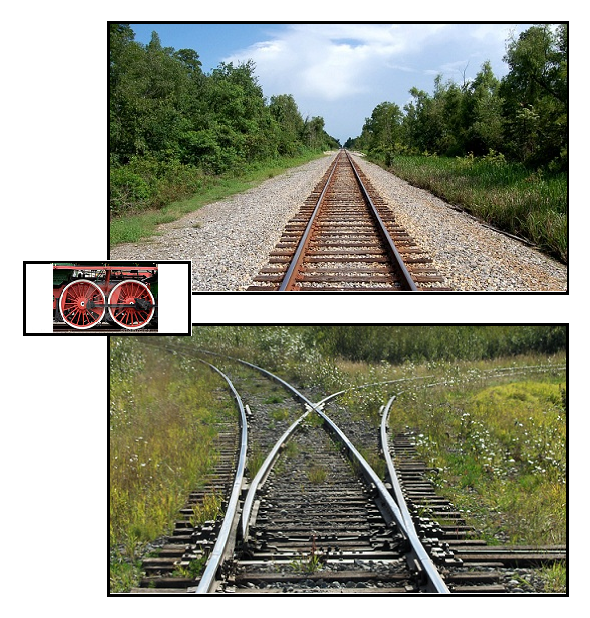
[ by Charles Cameron — more on the graphical mapping of heresy, radicalization, decision points, multiple ideas and complex issues, and some illustrations from railroad land ]

.
Here’s a railway track illustration of, say, the difference between true Islam (the straight track) and bida (the introduction of new ideas into the religion, deviation, heresy).

This graphic could equally represent the radicalization process, with the “point switching” occurring when the decision is made to switch from sympathizing to active participation, or from participation in the virtual dimension (say by posting on the forums) to the preparation and execution of acts of violence.

Locating the “switching points” would then be a significant part of a successful de-radicalization program, and I’d suggest that the concept of jihad as a matter of obligation (fard ‘ayn) would be one such.

*

What follows is essentially a quick-and-dirty pattern language of train tracks, switching points, marshaling yards, etc — I’ve even included one water-slide — to stir creative insights about linear thinking, multiple voices, multiple lines of thought, elegance and the polyphony of ideas

I’m posting this because any strategic and / or creative thinking that includes the perspectives and voices of multiple stakeholders will require polyphony, as will any approach to the complex dynamics in play in wicked problems…

And much else besides.

*

First, we have linear thinking — and a dilemma:

Then, there’s complication — not the same as complexity, and not nearly so hard to figure out —

— and a wicked problem, where the issues are indeed complex, and the problem itself may shift unexpectedly if, for instance, there’s another bombing run just as you are fixing things up after the last one…

And finally, by way of inspiration, there is always the possibility of elegance —

— and (here’s where I switch to the water-slide) — there’s always the possibility of playfulness…

*

Finding ways to think graphically, elegantly and a bit playfully about wicked problems is what I’m after here…
.

*******************************************************************************

Addendum

Friend JM Berger aka @intelwire sent me a link to this image:

and commented, “I think it’s more like this, no single point of departure, no single destination, loopbacks, dead ends” — nice one, JM!

The speeds of thought, complexities of problems

Wednesday, February 1st, 2012

[ by Charles Cameron — instinct, rationality, creativity, complexity and intelligence ]
.

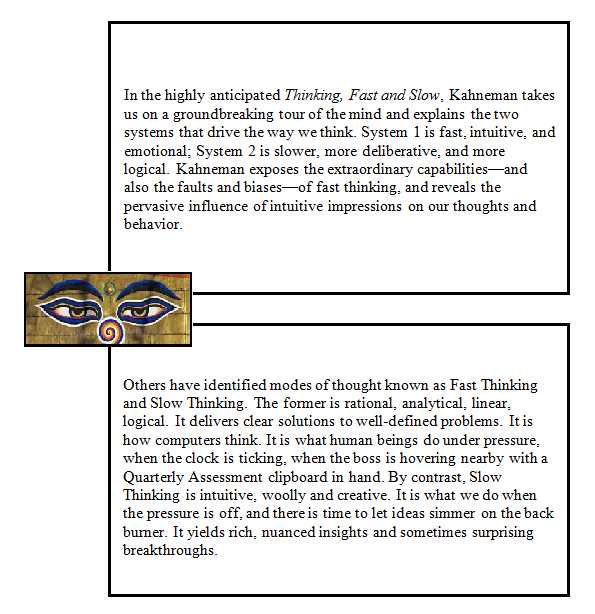
Guy Claxton, Hare Brain, Tortoise Mind
Daniel Kahneman, Thinking, Fast and Slow

You might think, taking a quick glance at their titles, that these two books would be in substantial agreement with one another about the speeds of thought. But consider these two comments, in one of which the deliberative, logical mind is “slower” than the intuitive and emotional — while in the other, it is the rational mind that is “faster” and the intuitive mind which is “slower”. Brought together, the two quotes are amazing — it would seem that either one or the other must be wrong:

\

Happily, I don’t believe either one is wrong — I think it’s more a matter of there being three speeds of thought, and the two books in question using different terminologies to emphasize different distinctions between them.

Here’s a more extended version of Guy Claxton’s position:

Roughly speaking, the mind possesses three different processing speeds. The first is faster than thought. Some situations demand an unselfconscious, instantaneous reaction. … Neither a concert pianist nor an Olympic fencer has time to figure out what to do next. There is a kind of ‘intelligence’ that works more rapidly than thinking. This mode of fast, physical intelligence could be called our ‘wits’. (The five senses were originally known as ‘the five wits’.)

Then there is thought itself — the sort of intelligence which does involve figuring matters out, weighing up the pros and cons, constructing arguments and solving problems. A mechanic working out why an engine will not fire, a family arguing over the brochures about where to go for next summer’s holiday, a scientist trying to interpret an intriguing experimental result, a student wrestling with an examination question: all are employing a way of knowing that relies on reason and logic, on deliberate conscious thinking. … Someone who is good at solving these sorts of problems we call ‘bright’ or ‘clever’.

But below this, there is another mental register that proceeds more slowly still. It is often less purposeful and clear-cut, more playful, leisurely or dreamy. In this mode we are ruminating or mulling things over, being contemplative or meditative. We may be pondering a problem, rather than earnestly trying to solve it, or just idly watching the world go by. What is going on in the mind may be quite fragmentary. What we are dunking may not make sense. We may even not be aware of much at all. As the English yokel is reported to have said: ‘sometimes I sits and thinks, but mostly I just sits’. […]

That third mode of thinking is the one Claxton identifies with “wisdom” — which is interesting enough. Just as interesting, though, is his identification of this slowest mode of thought with “wicked problems”:

Recent scientific evidence shows convincingly that the more patient, less deliberate modes of mind are particularly suited to making sense of situations that are intricate, shadowy or ill defined. Deliberate thinking, d-mode, works well when the problem it is facing is easily conceptualised. When we are trying to decide where to spend our holidays, it may well be perfectly obvious what the parameters are: how much we can afford, when we can get away, what kinds of things we enjoy doing, and so on. But when we are not sure what needs to be taken into account, or even which questions to pose — or when the issue is too subtle to be captured by the familiar categories of conscious thought — we need recourse to the tortoise mind.

I haven’t read either book, and I’d hope that Kahneman as well as Claxton actually addresses all three speeds of thought. But my immediate point is that the slowest of the three forms of thought is the one that’s best suited to understanding complex, wicked and emergent problems.

And that’s the one that can’t be hurried — the one where the Medici Effect takes effect — and the one which provides Claxton with one of his finest lines, with which he opens his book, a western koan if ever I saw one:

There is an old Polish saying, ‘Sleep faster; we need the pillows’, which reminds us that there are some activities which just will not be rushed. They take the time that they take.

More on that front shortly, insha’Allah and the creek don’t rise.

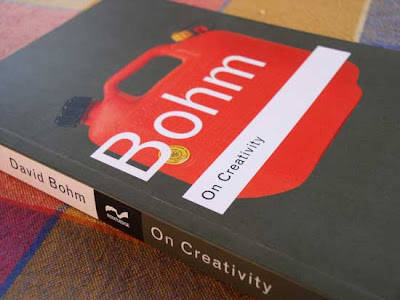
Book: On Creativity

Friday, January 27th, 2012

On Creativity by David Bohm 

A former student, now an adult, stopped by and gave me a copy of of On Creativity by the late and controversial quantum physicist David Bohm. Thumbing through quickly, On Creativity had an air of consilience to it that I think I will find enjoyable, though I am not sure I will agree with Bohm’s conceptions of thought and mind. At least, the book should challenge some of my preconceived opinions.

Thus, making it useful.


Blues for Ali Abdullah Saleh and Etta James

Saturday, January 21st, 2012

[  by Charles Cameron – pop irony for Yemen, requiem for Etta James ]

.

.

There’s a lot of doubling up here: for starters, the lyrics each of the two songs have a significant amount of double entendre, and there’s a terrific parallelism between them – as well as some real differences between the two singers and genres…

But that’s just the beginning.  The linkage between these two songs on the level of their lyrics – up down, stay go – has nothing to do with the fact that I was playing them today.

I ran across one of these songs today because I’m fascinated by the ways pop culture can model, influence, and even on occasion drive events in the global seriousphere – and the other simply because I had a vague blog-acquaintance at one time with someone who played with Etta James, and wanted to note her passing with sadness, gratitude, and a few minutes appreciative listening.

1.

So the Middle East Channel over at Foreign Policy featured a mash of Katy Perry’s Hot n’ Cold along with some quotes from Ali Abdullah Saleh today, in which he too doesn’t seem to know whether he’s coming or going — video below.

I also heard Clay Shirky‘s TED presentation Why SOPA Is a Bad Idea today as it happens, and he was saying that every times new recreational tools came along – analog tools like the photocopier, tape recorder and VCR as well as digital tools and technologies like the internet, file-sharing, laptops and tablets – industrial concerns like the publishing, movie and music industries fought them.  Why?

Because it turned out we’re not really couch potatoes. We don’t really like to only consume. We do like to consume, but every time one of these new tools came along, it turned out we also like to produce and we like to share. And this freaked the media businesses out — it freaked them out every time.

So yeah, someone serious enough about Yemen to mock President Saleh and savvy enough to make a YouTube video of Katy Perry intercut with choice selections from Saleh’s speeches – that’s just what Shirky’s talking about, it’s human nature, it’s creative

And sometimes stuff like that can go viral – so it’s not just pop music, it’s more than that, as Bob Dylan said, it’s “life, and life only”.

2.

And Etta’s song? — again, video below…

To me, Etta’s song, voice and life between them bring up a whole different set of issues. Here’s where “love” trumps “morality”.

Etta James’ obituary in The Guardian contains this paragraph:

Her approach to both singing and life was throughout one of wild, often desperate engagement that included violence, drug addiction, armed robbery and highly capricious behaviour. James sang with unmatched emotional hunger and a pain that can chill the listener. The ferocity of her voice documents a neglected child, a woman constantly entering into bad relationships and an artist raging against an industry and a society that had routinely discriminated against her.

Is that “immoral” – as one part of my brain would like to conclude?  Or is it glorious — is a voice soaked in whiskey and wreathed in smoke the only voice that can chill us like that, that can bring us to our senses, to our knees, to compassion?

Is this — “and armed robbery’ — the price we sometimes have to pay for artistry?

One way of dealing with this recurring business of those who bless us with extraordinary gifts despite their own lives seeming at times wretched and accursed is – to tweak a well-worn phrase slightly – to hate the sin but love the singer.

I think that’s cheap.  I think Etta – and many others – was hollowed out, and that it’s that hollowing, precisely, that gave her the depth and the voice to reach us so profoundly.  So I lament Etta’s passing today, and have taken time out to let her sing to me.

Etta James: may she rest in peace.

3.

Katy Perry:

4. Etta James:

5.

h/t Maureen Lang and taters.


Switch to our mobile site