Friday, July 26th, 2013
[ by Charles Cameron — food for thought, or empty calories? ]
.

Sources:
Heart Sutra
Hezbollah
**
Pondering.
There’s definitely a form here, a commutative form, and the Buddhist part is interesting because it asserts some kind of commutation is possible between a datum and its own absence — as though the “created” world of Genesis could be viewed as exactly mirroring the “ex nihilo” from which it arises.
But the Hezbollah identity? That should be of interest to the Europeans who just made a point of distinguishing between political and military versions of Hezbollah!
Beyond that, pondering.
Posted in Buddhism, Charles Cameron, europe, hezbollah, Lebanon, logic, scriptures, terrorism, Uncategorized | Comments Off on Emptiness and Hezbollah
Sunday, July 14th, 2013

[ by Mark Safranski – a.k.a “zen”]
A remarkably blunt article on SF/SOF (“special forces” is being used as an umbrella term for both) in the context of policy and strategy, from the perspective of an emerging great power by LTG Prakosh Katoch of the Indian Army. The American example of SOCOM in Afghanistan/Iraq/GWOT has obviously had an impact here, as has the negative example of Pakistani use of terrorists as proxy forces and ISI covert operatives for direct action in Indian territory and elsewhere. Quite aside from global conflicts and the bilateral rivalry with Pakistan, India also faces more than a dozen long term irregular conflicts with their own dynamics, such as the Naxalite–Maoist insurgency , which Katoch places in the context of Chinese strategic ambitions against India.
A must read.
Optimizing the Potential of Special Forces
….In India, the lack of strategic culture, more on account of keeping the military out from strategic military decision making, has led the hierarchy to believe that conventional forces coupled with nuclear clout can deter us from irregular threats. Nothing can be farther from the truth. Pakistan, though conventionally inferior, has been successfully playing her ‘thousand cuts policy’ knowing full well that India has failed to develop the required deterrent. It is our inability to find a cure to this Achilles’ heel, that has led China, which was hitherto using Pakistan as proxy to wage irregular war on India, now directly aids and supports insurgent and terrorist outfits inside India.
….Why the US has managed to secure its mainland post 9/11 is not only because of an efficient Homeland Security organisation but because the US Special Forces (USSF) are operating in 200 countries including India. Significantly, USSF have undeclared tasks such as conducting proactive, sustained ‘man-hunts’ and disrupt operations globally; building partner capacity in relevant ground, air and maritime capabilities in scores of countries on a steady – state basis; helping generate persistent ground, air and maritime surveillance and strike coverage over ‘under-governed’ areas and littoral zones and employing unconventional warfare against state-sponsored terrorism and trans-national terrorist groups globally. Before 26/11, Al-Qaeda had planned similar operations against New York but could not because the USSF had infiltrated Al-Qaeda. One cannot guard the house by simply barricading it. You must patrol the streets and the area outside.
Growing inter-dependence and interlinking of terrorist groups regionally and internationally should be a matter of serious concern. It is not the US alone that has deployed its Special Forces abroad. This is the case with most advanced countries including UK, Russia, Israel, China and even Pakistan. Pakistan’s SSG was operating with the Taliban in Afghanistan and has been active in Jammu and Kashmir, Nepal and Bangladesh, primarily training anti-India forces. There is a strong possibility of their presence in the Maldives and Sri Lanka as well, aside from presence within India. The Chinese have been smarter. For all the development projects throughout the globe, including in Myanmar, Nepal, Pakistan-POK, Sri Lanka, Bangladesh and Seychelles, contracts underway by PLA-owned/affiliated companies employ serving and veteran PLA soldiers and disguised Special Forces with assigned tasks, including evacuation of Chinese citizens from that country in case of emergencies.
Read the rest here.
Posted in 21st century, analytic, army, COIN, Communism, counterinsurgency, counterterrorism, cultural intelligence, defense, Foreign Internal Defense, foreign policy, geopolitics, Hybrid War, ideas, illegal combatants, India, insurgency, intellectuals, islam.insurgency, military, military professionalism, military reform, non-state actors, organizations, pakistan, security, state terrorism, strategist, strategy, Strategy and War, Tactics, terrorism, theory, war, warriors | 18 Comments »
Wednesday, July 10th, 2013
[ by Charles Cameron — listen up if you get the chance ]
.
It is possible that this post will reach some of you in time to tune in to this testimony:
**
I’m posting this here because I hope some of you will be able to watch this session live, but also because I think it’s indicative of a shift that is happening — and it’s a shift I’ve been hoping for and wanting to talk about here on Zenpundit. That shift has to do with the blogosphere, and to my mind it’s a very positive one.
I’ll have more on that later — but first, I wanted to get the word out about this session. More, hopefully, a few hours from now.
Posted in Aaron Zelin, africa, America, Charles Cameron, counterterrorism, daveed gartenstein-ross, foreign policy, terrorism, testimony, Uncategorized | 4 Comments »
Sunday, July 7th, 2013
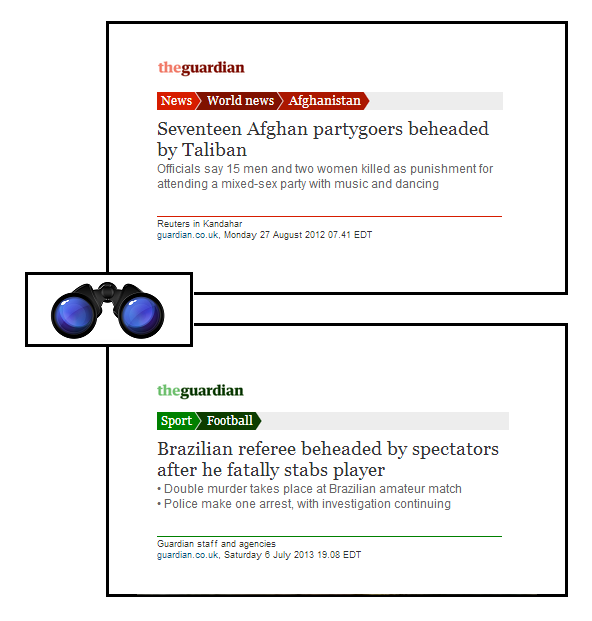
[ by Charles Cameron — beheadings and the questions they raise ]
.
**
Tim Furnish, friend of this blog, had a piece titled Beheading in the Name of Islam in the Middle East Quarterly back in 2005, in which he wrote:
The February 2002 decapitation of Wall Street Journal reporter Daniel Pearl, true to its intention, horrified the Western audience. Chechen rebels, egged on by Islamist benefactors, had adopted the practice four years earlier, but the absence of widely broadcast videos limited the psychological impact of hostage decapitation. The Pearl murder and video catalyzed the resurgence of this historical Islamic practice. In Iraq, terrorists filmed the beheadings of Americans Nicholas Berg, Jack Hensley, and Eugene Armstrong. Other victims include Turks, an Egyptian, a Korean, Bulgarians, a British businessman, and a Nepalese. Scores of Iraqis, both Kurds and Arabs, have also fallen victim to Islamist terrorists’ knives. The new fad in terrorist brutality has extended to Saudi Arabia where Islamist terrorists murdered American businessman Paul Johnson, whose head was later discovered in a freezer in an Al-Qaeda hideout.
For myself, convinced as I am that perceived, preached or proclaimed divine endorsement for such killings plays a major role in facilitating them, the existence of what are overtly at least non-religious examples of the same brutal behavior are valuable, albeit humanly distressing, for the questions they raise:
is the brutal behavior in question a bestial aspect of human nature in general, and religion merely a thin veneer with which it sometimes conveniently clothes itself?
or are sports in some way alternative modalities of group transcendence — and thus effectively religious in their essence?
**
Bryan Alexander, another friend, comments today on a related story at his gothic-themed blog, Infocult, under the heading When sports fans attack, Russian remix.
DoubleQuote Sources:
Seventeen Afghan partygoers beheaded
Brazilian referee beheaded
Posted in blog-friends, Charles Cameron, islamist, russia, sports, terrorism, Uncategorized | 3 Comments »
Saturday, June 22nd, 2013
[ Charles Cameron — opening of my review of Vahid Brown & Don Rassler, Fountainhead of Jihad: The Haqqani Nexus, 1973-2012 for Pragati magazine ]
.
Deep insight into the Haqqani Network
Haqqani Network is at the centre of a nexus of jehadi violence in a triangle of relations with the Pakistani Taliban, the Pakistani military and al-Qa’ida.
.

.
by Charles Cameron
.
Charlie Wilson, the gaudy US congressman from Texas whose support for arming the mujahideen during the Soviet occupation of Afghanistan gave the name Charlie’s War to George Crile’s book (and the Tom Hanks feature adaptation of the same name), drank, lusted, flirted, bribed and persuaded with cheerful abandon — and once referred to Jalaluddin Haqqani as “goodness personified.”
That same Jalaluddin Haqqani, Vahid Brown and Don Rassler argue in their book, Fountainhead of Jihad: the Haqqani Nexus, 1973-2012, was pushing the line of obligatory global jihad even before Abdullah Azzam, and was the first to recruit Arab “foreign fighters” to the jihad back in the 1980s. The network that paragon of goodness established is still, some forty years later, continuing in a tradition that began before the Durand Line was scrawled across a map, already in place when the British attempted to ‘take’ Afghanistan in the First Afghan War of 1839 — and that has arguably prevailed repeatedly in that mountainous, mutinous region against all comers since Iskandar tried his own fortune at what would later be called the Great Game.
Read the rest at Pragati
**
The book, from the admirable Hurst Publishers in London and Columbia University Press in the US is available on Amazon and elsewhere.
Pragati is the magazine of India’s Takshashila Institution.
Posted in Afghanistan, book, Charles Cameron, extremists, India, pakistan, recommended reading, terrorism, Uncategorized | Comments Off on Book review: Fountainhead of Jihad


