zenpundit.com » academia

Archive for the ‘academia’ Category

Chet on TEMPO….Rao on OODA

Tuesday, July 26th, 2011


At Fabius Maximus, Dr. Chet Richards reviews TEMPO by Dr. Venkat Rao, enjoying the book as much as I did, if not more. Chet has some particularly incisive comments, positive and critical, in his review, which I suggest you read in full:

Book Review: Tempo

…Rao draws on Boyd in several places, as well on sources ranging from the topical, such as Gladwell and Taleb, to the foundational (e.g., Camus and Clausewitz), to the downright obscure – know anything about The Archeology of Garbage? Do the words wabi and sabi ring a bell?

The result is a synthesis, what Boyd called a “snowmobile,” that combines concepts from across a variety of disciplines to produce a cornucopia of new ideas, insights and speculations. You may be confused, challenged, outraged, and puzzled (some of the language can be academic), but you’ll rarely be bored because every chapter, often every page, has something you can add to the parts bin for building your own snowmobiles.

Let me highlight just a couple, of special interest to folks familiar with Boyd’s concepts. Near the end of the book, Rao introduces an expanded version of “legibility”:

A piece of physical reality is legible if it is obviously the product of coherent human agency, a deliberate externalization of a mental model. When human and natural sources of order are harder to tease apart, you get greater illegibility (p. 133 – and I warned you about the academic language).

Then a couple of paragraphs later, he claims that:

Used with adversarial intentions, Boyd’s OODA can be understood as a deliberate use of illegibility to cause failure.

At first, this seems silly. Boyd only considers conflict between groups of human beings (Patterns of Conflict, 10), so all uses of his strategic concepts would seem to be prima facia examples of legible phenomena. On the other hand, and this is an example of what makes Rao’s little book so valuable, some commentators, such as Stalk and Hout in 1990’s Competing Against Time, point out that victims of a Boyd-style attack can rarely identify the cause of their problems – often blaming bad luck or incompetent, self-serving and treacherous idiots in their own organizations. Boyd made this clear in his own work, such as in Patterns of Conflict, 132, when he suggested that his victims would exhibit a variety of traumatic symptoms including confusion, disorder, panic, chaos, paralysis and collapse – indicating unrelenting attack by forces outside the scope of their own mental models…

Chet concludes with a suggestion for Venkat (with which I concur):

…As for where to go from here, Rao might write more about tempo. This will seem strange to him, I’m sure, but pages go by with hardly a mention of the concept. This means that we need another book from him. I’d suggest expanding on some of the concepts that he raises but doesn’t find space to develop. Here are three ideas: […]

But you will have to go over to Fabius Maximus to read the rest. Venkat, in turn responded to Chet over at his blog, Ribbonfarm:

Chet Richards’ Review of Tempo on Fabius Maximus

….Overall, Chet comes to the conclusion that Tempo resonates with the Boydian spirit of decision-making. I don’t entirely get out of jail free though:

Perhaps his unfamiliarity with the original briefings, however, led him to  make one characterization that is incorrect, although widely believed:

The central idea in OODA is a generalization of Butterfly-Bee: to simply operate at a higher tempo than your opponent. (118)

Guilty as charged. I didn’t spend enough time exploring how OODA gets beyond merely “faster tempo” to “inside the adversary’s tempo.” That’s something I hope to explore in a more nuanced way in a future edition. Over the last 6-8 months, I think I’ve come to understand the subtleties a lot better, and the challenge is to now spend more time thinking through clear definitions and examples….

I think everyone who has explored the OODA Loop concept, including John Boyd himself, initially gravitated to the aspect of cycling “faster” than one’s oponent because it is a natural assumption that resonates with our own experiences. We have all seen competitions where one player or athlete was “quicker” in reading situations and arriving at the right intuitive decision – usually most of us have been both the faster as well as the slower and more hesitant person. It’s the first scenario that springs to mind and being “faster” gives an obvious comparative advantages. Obvious does not mean “only” though.

What made the “faster” interpretation of OODA Loop really stick in the culture though, IMHO, was this unfortunate but easily understood graphic:

NOT THE REAL OODA LOOP

As a result, we get critical arguments that the OODA Loop is really something germane only to binary situations similar to the high pressure aerial combat that Boyd experienced in the Korean War or as a tactical fighter pilot instructor (or Musashi’s sword fighting) and not something generally useful in military strategy. An odd argument, given that Clausewitz liked to use binary metaphors to describe the nature of war.

The next graphic, which better illustrates the simultanaeity and dynamic nature of the OODA Loop, with other potential avenues of exploitation than just going “faster” (which will swiftly hit diminishing returns in any event) does not lend itself as easily to nearly instant comprehension:

THE ‘OFFICIAL” OODA LOOP:
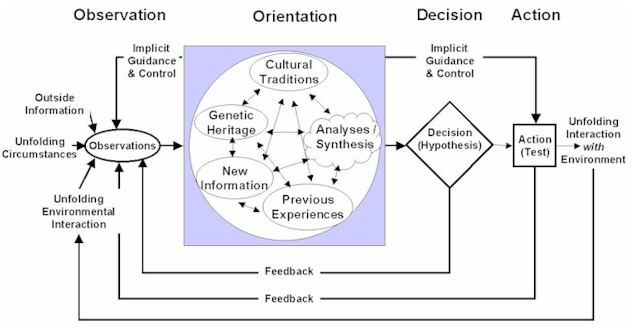
With these cognitive relationships operating continuously, mostly subconsciously with automaticity and in an iterative fashion, a different set of meanings to the phrase “inside your oponent’s OODA Loop” than just going “faster”, like a formula one race car zooming around a track.
Wylie’s Military Strategy

Saturday, July 23rd, 2011

 by J. Scott Shipman

Wylie

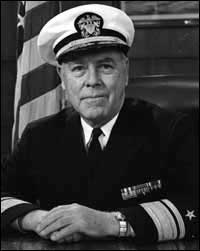
Military Strategy, by Rear Admiral J.C. Wylie, Jr., USN (1911-1993)

This is a very brief review and recommendation for a book that I discovered recently. Admiral Wylie’s short Military Strategy (about 85 pages in the original edition) was published in 1967, but written in the mid-fifties while Wylie was “at sea in a single-screw low-speed amphibious cargo ship.” He remarked these ships were “not demanding  of a captain’s attention as is, for instance, a destroyer.”My copy was published in 1989 by the  Naval Institute Press  as part of their Classics of Seapower series and has an excellent preface by John B. Hattendorf that will give those unfamiliar with Wylie’s life experience a good foundation. This copy also has a postscript written by Wylie “twenty years later” and three related essays published previously in Proceedings magazine.

Given Military Strategy’s brevity, I’ll resist the urge to provide long quotes. Wylie and an associate’s search for articulating the relevance of the navy in the never-ending budget battles brought them in contact with the famed mathematician John von Neumann of Princeton. Wylie used a paraphrase of von Neumann as a starting point: “With respect to strategy as a subject of study, its intellectual framework is not clearly outlined, and its vocabulary is almost nonexistent. These two primary tasks are badly in need of doing…” He sets out to do just that and does a nice job.

Wylie defines strategy as: “A plan of action designed in order to achieve some end; a purpose together with a system of measures for its accomplishment.” He discusses the military mind and strategy, and how often the military focuses on principles to the exclusion of real strategy. Wylie outlines methods of studying strategy that are simple and well thought-out. Wylie makes a compelling case for a general theory of strategy. He says: “A theory is simply an idea designed to account for actuality or to account for what the theorist thinks will come to pass in actuality. It is orderly rationalization of real or presumed patterns of events.” Further, he continually stresses the importance of assumptions being based in reality, and not wishful thinking or the last war/battle.

His chapter on existing theories is worth the price of the book. He provides a type of Cliff’s Notes overview of the four theories he sees as core: the maritime, the air, the continental, and the Maoist. Of the last, he masterfully lifted sections from Mao’s On Guerilla Warfare, Che Guevera on Guerilla Warfare, and Vo Ngugen Giap’s People’s War People’s Army. He observed of the later, “these books are not only theory, the portray a hard reality of contemporary warfare.” To our people in uniform, in particular, unfamiliar with these books, Wylie provides an accessible and informative introduction to the type of war being waged by Islamic jihadists and how they attempt shape the battle field.

He develops a brilliant point that destruction doesn’t necessarily translate into control, and that often destruction is driven more by emotion than strategy.

Wylie goes on to provide a general theory of strategy that, using his words, has “substance and validity, and practicality.” As Seydlitz89 said in a recent comment thread here: “Wylie is amazing.  So many ideas in such a small book!  He misread Clausewitz and overrated Liddell Hart – which are probably connected, but overall?  He comes up with some very basic ideas about strategic theory which are ever sooooo useful.  I’ve re-read his small book several times and always come up with something that either I’d forgotten or that I had missed earlier.  Wylie’s basic approach to theory is as a practitioner, not as an academic, much like Clausewitz before him.”

Indeed, Wylie provides a nice scaffold for any type of strategy, military or business. For me his approach was refreshing in a genre where, more often than not, dogma and ego walk hand-in-hand.  Time and again, he offers that his ideas may be wrong and encourages readers to think and wrestle with the concepts provided. Wylie writes in his postscript: “As far as I know, no one as ever paid attention to it [the book]. I don’t know whether this is because it is so clear and obviously valid that no one needs to, or because it is of no use at all. I suspect it could be the latter, but I really do not know.”

This little book comes with my highest recommendation. If you’re in uniform and just getting started with strategic concepts/thinking, this is an excellent place to start.

Interesting referenced titles:

Military Concepts and Philosophy, Henry E. Eccles 

The Military Intellectuals in Britain, 1918-1939, Robin Higham 

An Introduction to Strategy, General Andre Beaufre 

Theory of Games and Economic Behavior, John von Neumann 

Strategy in Poker, Business and War, John McDonald 

More Books Arrived….

Tuesday, July 19th, 2011

Doing some heavy duty research…..Amazon will be doing well this year on my dime:


Architect of Global Jihad by Brynjar Lia

A Terrorist’s Call to Global Jihad by Jim Lacey

Modern Strategy by Colin Gray

Carl Prine’s Rebuttal to “Be honest: Who actually read FM 3-24?”

Wednesday, July 13th, 2011

My amigo and SWJ News co-columinst Crispin Burke recently put forth a very interesting and provocative jeremiad “Be honest: Who actually read FM 3-24?” and one of his targets, journalist and Iraq war veteran Carl Prine, has been duly provoked, Prine has responded in great detail yesterday at Line of Departure:

Starbuck is wrong

Starbuck is wrong.

And in his drive to keep getting it wrong, he’s trying to rewrite FM 3-24, the military’s chief doctrinal publication on counterinsurgency.

But that just makes him more wrong.

He’s wrong about me.  He’s wrong about what I believe.  He’s wrong about the literature that informs FM 3-24.  He’s wrong about what the manual says and he’s wrong about what it left out.  He’s wrong about historiography.  He’s wrong about how a caste of top officers and diplomats came to understand “strategy” in the wake of the occupation of Iraq.

Let’s help get him right.  Or, at least, less wrong.  He’s a good man.  We need to turn him and ensure he quits taking shots at me I don’t deserve!

….The problem to anyone who studies Malaya, however, is that since the publication of the memoirs of exiled communist leader Chin Peng a dozen years ago, we now know that the civic, military and political policies under the British “hearts and minds” approach didn’t defeat the revolution.

Instead, the revolt was irreparably broken by brutal operations against the guerrillas, then a most coercive “screwing down the people” phase that dispossessed or killed thousands of Chinese, followed by draconian “population control” measures that, as Peng put it, starved the guerrillas in the bush because they snapped their rat lines and cut off their rice.

The “hearts and minds” initiatives designed to bring medical care, education, social welfare and other aid to the resettled Chinese and woo them to the colonial government’s side from 1952 – 1954 didn’t crack the back of the insurgency, a point now pretty much beyond dispute.

Why?  Because the previous “hearts and minds” claptrap as the cause of pacification in Malaya was contradicted by the Malayan Chinese, most especially those guerrillas who took up arms against the British regime!

You know, the people targeted by a population-centric counterinsurgency.  The people most counter-insurgents in their pop-centric fantasies almost never discuss except as abstractions, the human yarn wefted and warped by their long needles of war.

One finds “Hearts and Minds” prominently mentioned 11 times in Dr John Nagl’s valentine to Templer and colonial Malaya, Eating Soup with a Knife; to Nagl it’s the stuff of police services and economic development and whatnot with the psychology of the people being the center of gravity those reforms are meant to snatch.

And Nagl would like the best burglar of hearts and minds to be a learning, nimble and evolving military-political institution such as the U.S. Army.  It’s no small wonder, then, that Nagl became a dominant voice in FM 3-24 and that many of this thoughts in Eating Soup came to dominate the manual, too.

Or, as the introduction to FM 3-24 echoes soupily, “by focusing on efforts to secure the safety and support of the local populace, and through a concerted effort to truly function as learning organizations, the Army and Marine Corps can defeat their insurgent enemies.”

This is mere euphemism and wasn’t worth the ink that it cost taxpayers to print it.  But it sets the stage for the rest of FM 3-24, which follows a hearts and minds template that Starbuck doesn’t apparently realize is borrowed from mid-century….

Ouch. Note to self: if I ever decide to square off against Carl, I will make sure to do my homework. Read the rest here.

First, I would point out to readers here for whom some of this in both essays is inside baseball, that the tone is less harsh and the substantive distance between Burke and Prine less great in  the comments sections of both blogs than it first appears in reading their posts. It is a healthy, no-holds barred exchange and not a flame war.

Secondly, it is an important exchange, tying together COIN disputes over theory, historiography, empirical evidence, operational and tactical “lessons learned”, strategy, policy (Clausewitzian sense), politics (colloquial sense) and personalities that have raged for five years across military journals, think tanks, the media, the bureaucracy and the blogosphere. In some ways, these essays can serve as a summative of the debate. I say “some ways”, because what is the most important element or effect of America’s romance with COIN will differ markedly depending on whom has the floor. My own beef is not with doing COIN, it is with not doing strategy.

As Crispin and Carl’s vignette about General Creighton Abrams demonstrated, American historians are still having savagely bitter arguments about the war in Vietnam. For that matter, everyone who lived through the era did and still does. It is a wound that never seems to heal and has crippled our politics to this day, even as the veterans of Vietnam now turn to gray.

The 21st century COIN wars have not ripped American society apart down to the soul the way Vietnam did. As with the Korean War, the soldiers and marines in Afghanistan and Iraq fought bravely, at times desperately, to a general and mild approbation back home that sometimes looked a lot like indifference. Even the anti-war protestors mostly made a point of stating they were not against the troops, the venemous public malice of the 1960’s New Left radicals in the 2000’s was a property only of the lunatic fringe.

But COIN itself will be a historical argument without end.

A Library vs. a Collection

Thursday, June 30th, 2011

Recall the “antilibrary ” discussion some years back, prompted by Nassim Nicholas Taleb?

The other day, I was having a conversation in the comments section regarding ancient Chinese philosophers with my learned friend Lexington Green, when I had cause to quote Nassim Nicholas Taleb, from his most recent book The Black Swan: The Impact of the Highly Improbable:

The writer Umberto Eco belongs to that small class of scholars who are encyclopedic, insightful, and nondull. he is the owner of a large personal library ( containing thirty thousand books), and separates vistors into two categories: those who react with ‘Wow! Signore professore dottore Eco, what a library you have! How many of these books have you read?’ and others – a very small minority- who get the point that a private library is not an ego boosting appendage but a research tool. Read books are far less valuable than unread ones. The library should contain as much of what you do not know as your financial means, mortgage rates, and the currently tight real estate market allow you to put there. You wil accumulate more knowledge and more books as you grow older, and the growig number of unread books on the shelves will look at you menacingly. Indeed, the more you know, the larger the rows of unread books. Let us call the collection of unread books an antilibrary.

A passage that immediately made me feel better about having resigned myself to falling further and further behind in reading the books that I keep purchasing ( I’m now also periodically finding myself going to IKEA to buy shelf extensions. I’ve resigned myself to that too).

Taleb was advocating building a library – an organized assemblage of books on a wide range of topics, of which the unread portion was your antilibrary. Libraries, private or public, are wonderful things, functioning in an earlier time as the poor man’s university. Andrew Carnegie endowed public libraries for that purpose and in past ages, wealthy patrons opened the doors of their private libraries to their favored scholars, like King George III did for Samuel Johnson.

My library is sizable but disorderly and eclectic. There are books on Turkic kingdoms and network theory, art history and classical economics, political memoirs and diplomatic papers, the “great books” and sci fi. And of course a great deal of books on strategy and history. My friends Lexington Green and Dave Schuler have far larger personal libraries and Lex’s, I can say firsthand, seems to be much better organized than mine ( though, admittedly, that would not be hard).

Recently, one of my uncles, an academic, decided he wanted to make me the eventual recipient of a major portion of his library, along with the funds to transport and shelve the books. This generous offer came with a proviso – that his collection is to be kept intact and passeed on only to someone else who would agree to keep it so. And it is really a collection and not a library. Naturally, I agreed

The difference between a library and a collection is puposeful focus and quality. My uncle decided on the advice of one of his mentors to really become a collector and decided to target the Hanoverian period of British history and only read and collect books that related directly in some way to the book previously read. He also specifically wanted to acquire rare editions and copies with the marginalia of important people from the period for purchase. My uncle also made a habit of going to the best rare and used bookstores (when he visits Illinois, Bookman’s Alley is his faviorite) wherever he happened to be. The uncle has been doing this for at least thirty+ years and has read his way forward to the early 20th century and in recent years, developed an extensive sub-collection dedicated to T.E. Lawrence.

Interestingly enough, none of this has anything remotely to do with his area of academic expertise (he has two doctorates; in a hard science and another in a medical specialty) but he’s made himself into more of an expert on the historiography of this period of British history than are most professional historians.The reason is a tunnel-like focus, which is the primary distinguishing characteristic between a building a general library and building a collection. There’s a comprehensiveness to a collection that becomes an end in itself.

books.jpg


Switch to our mobile site

