zenpundit.com » Vietnam War

Archive for the ‘Vietnam War’ Category

Strategy and Perception, Part II.

Monday, March 26th, 2012

To continue, my last post was inspired by analysis by Jason Fritz at Inskspots and I would like to continue to use excerpts from his post as a foil to ruminate about strategy:

Delicate strategic balancing: perception’s role in formulating strategy

….We have a whole suite of problems with our strategy in Afghanistan, foremost of which are a failure to state specific and achievable ends as well as a misalignment of ways and means to achieve the pitifully-described desired ends we have written down. But if our strategic success now depends upon selling to the Afghans that we mean well and that they are now more skeptical than not of us, well we have a very, very serious problem. Balancing the Say-Do equation is an imperative. However, if public perception is that mistakes and crimes committed by individual U.S. service members is indicative of U.S. policy or strategy, then public communications begins to drive strategy instead of the other way around.

Incidentally, I agree completely with Jason’s emphasis that we do not have the fundamentals right on strategy and Afghanistan. To an extent, worrying about “Perception” when you do not have Ends, Ways and Means in sync is akin to fretting about the paint job and waxing of your automobile while the battery is dead, the engine is shot and your car is up on blocks with the tires stolen. Nevertheless, perception will always be at least a contingent factor in strategy, affecting the friction of your diplomatic and theater environment, the attitude of the home front and the political will of elite decision makers.

The classic example of perception having a strategic impact is the Tet Offensive and the effect it had on America’s Eastern Establishment political elite and the Johnson administration directing the war in Vietnam. While Tet was a debacle militarily for the southern Communist cadres that composed the Viet Cong, the offensive struck the American political center of gravity hard. SECDEF McNamara resigned, the antiwar movement was energized and Tet indirectly contributed to the primary results in New Hampshire that caused President Lyndon Johnson to withdraw from the race for president in 1968 and subsequently order a halt to bombing North Vietnam. The mighty Democratic Party, which had dominated American politics since 1933, was riven by an ideological civil war that played out in the streets of Chicago.  Had Hanoi been prepared to seek a negotiated settlement, Johnson likely would have given away the store (a TVA on the Mekong!) to secure peace.

….Public communications and information operations to influence perceptions are ways, but the U.S. keeps falling into the trap of making perceptions ends in themselves. If our ends, ways, and means were better formed and aligned, I suspect that the “Do” side of the equation would be solid enough to negate the affects of mistakes. But this is not the situation in Afghanistan where continued programs of questionable efficacy, strategic drift with regard to ends (compare this and this for instance), andcontinued support for an illegitimate and ineffectual government abound. If ways and means are not succeeding (to what ends?!?) or are the wrong ways and means entirely then your strategy rests in total upon Afghan perception that you’re making a difference instead of in part, which amplifies individual disasters such as we’ve seen of late. While it is unlikely that the United States will change course at this juncture, we need to start paying attention to this phenomenon now and avoid it in the future so we can avoid codifying perceptions as ends and put influencing them back where they belong: as ways. A successful strategy would go a long way to restoring this balance. Once again, maybe in the next war.

I think Jason has put his finger on another problem altogether here. His description of “perception” in that paragraph is one of political perception of a foreign audience of our actions as they constitute an ongoing, apparently unending process to which there is no conclusion in the sense of a defined End, just an arbitrary time limit (to which we are only kinda, sorta, maybe sticking to).  Actually “audience” is not even the right word, as the Afghans are interested participants and actors as well as onlookers who happen to be on the weaker side of an asymmetric dynamic. Weak does not equate to “powerless”, and as we have stupidly set very high strategic goals that require the voluntary consent, adoption and cooperation of the Afghan people to reach, withholding of consent, passive or active resistance or armed insurgency are Afghan bargaining alternatives to abject submission to our wishes. As occupation in the form of unending process looks a lot like foreign domination of Afghanistan by infidels and their corrupt and predatory collaborators, it is not surprising that the Afghans of all stripes are bargaining hard after ten long years.

American civilian leaders running the Afghan war are politicians and lawyers, for whom unending process (like for example, the Federal budget) rather than results is familiar and comfortable and for whom irrevocable choice making is anathema. Crafting a usefully effective military strategy is difficult if one of the unspoken, sub rosa, goals is to “keep all options open as long as possible” which precludes commitment to and vigorous pursuit of a prioritized, specific End to the exclusion of others in as short a time as possible.

This perspective, while perhaps a career advantage for a politician, is over the long haul ruinous for a country in a statesman, as the net result becomes burning money and soldier’s lives to garner nothing but more time in which to avoid making a final decision, hoping to be rescued by chance (Once in a blue moon in warfare, a Tsarina dies or an Armada sinks and changes fortunes, but most nations losing a war ultimately go down to defeat).

A defined and concrete End, by contrast, yields a different perceptual effect because uncertainty for soldiers and onlookers alike is reduced. Foreigners can calculate their own interests and costs with accuracy and decide if opposition, neutrality or alliance will be to their advantage. Now it may be that a desired strategic End is so provocative that it is best kept secret until a sudden victory can be presented to the world as fait accompli, but that is still a very different thing from elevating process of Ways and Means over distant, ambiguously unrealistic and vaguely defined Ends. Loving policy process and tactical excellence above strategic results when employing military force gets you a very long and likely unsuccessful war.

However, somebody else said it much better than I can  2500 years ago….

….When you engage in actual fighting, if victory is long in coming, then men’s weapons will grow dull and their ardor will be damped. If you lay siege to a town, you will exhaust your strength
Again, if the campaign is protracted, the resources of the State will not be equal to the strain
Now, when your weapons are dulled, your ardor damped, your strength exhausted and your treasure spent, other chieftains will spring up to take advantage of your extremity. Then no man, however wise, will be able to avert the consequences that must ensue.
Sun Tzu

A Wound That Does Not Cease to Bleed: The War in Vietnam

Wednesday, February 29th, 2012

Amigo of ZP blog, West Point military historian Colonel Gian Gentile, throws down the gauntlet in his review of Lewis Sorley’s new biography, Westmoreland: The General Who Lost Vietnam, in The National Interest:

The Better War That Never Was

DID GENERAL Westmoreland lose Vietnam? The answer is no. But he did lose the war over the memory of the Vietnam War. He lost it to military historian Lewis Sorley, among others. In his recent biography of William C. Westmoreland, Sorley posits what might be called “the better-war thesis”—that a better war leading to American victory was available to the United States if only the right general had been in charge. The problem, however, is that this so-called better war exists mostly in the minds of misguided historians and agenda-driven pundits.

In the battle over the memory of the Vietnam War, Sorley annihilates Westmoreland and leaves his character and reputation in smoldering ruins. Yet Sorley’s victory in the fight for the memory of Vietnam has not brought us a balanced historical biography of Westmoreland.  

 ….The better-war thesis argues that if only the U.S. Army had concentrated from the start on building up the South Vietnamese armed forces and winning the hearts and minds of the South Vietnamese people through limited applications of military force, we would have won the war. But the question remains: Precisely how could tactical adjustments early in the war have overpowered the political constraints placed on the army by the Johnson administration, which kept it from taking the fight to the North Vietnamese? Or the dysfunctional nature of the South Vietnamese government and military that precluded them from standing on their own? Or the declining popular support and political will in the United States as the war dragged on without a decent end in sight? Or, perhaps most importantly, how could tactical adjustments toward better methods of counterinsurgency have overpowered a communist enemy that fought the war totally while the United States fought it with limited means? In his Westmoreland biography, Sorley essentially ignores these questions.

Could the United States have prevailed in Vietnam? Yes, but it would have had to commit to staying there for generations, not a mere handful of years. The Vietnam War was an attempt at armed nation building for South Vietnam. Nations and their societies, however, are not built overnight, especially when they are violently contested by internal and external enemies. Thus, to prevail in Vietnam, the United States would have needed the collective will that it mustered to win World War II and would have had to be able to maintain it for generations. That kind of will—or staying power—was never a real possibility.

In war, political and societal will are calculations of strategy, and strategists in Vietnam should have discerned early on that the war was simply unwinnable based on what the American people were willing to pay. Once the war started and it became clear that to prevail meant staying for an unacceptable amount of time, American strategy should have moved to withdraw much earlier than it did. Ending wars fought under botched strategy and policy can be every bit as damaging as the wars themselves.

Well worth the read, not least for Gian’s model of how one historian carefully dismantles the thesis of another.

We are a mere three years from the fiftieth anniversary of Lyndon Johnson’s escalation of the Vietnam War, less than two years from the fiftieth anniversary of the assassination of John F. Kennedy that brought LBJ into power and a year from the fiftieth anniversary of the infamous coup d’etat against American client, President Ngo Dinh Diem, that JFK had approved. Finally,  fifty years ago, Kennedy drastically increased the American military advisory mission to South Vietnam to just under 10,000 men and signed off on clandestine operations against North Vietnam.

All those fiftieth anniversaries amount to a golden jubilee of rancor.

The bitterness sown by the lost war in Vietnam still burns in American politics like red hot coals. Less bright perhaps than the open flame of 1968, but if you scratch the surface, you will find with no less heat. The war spawned division and polarization that twisted our politics and poisoned public debate to this day, echoing now as farce as much as tragedy.

During the 1980’s, Vietnam historiography was virtually a cottage industry. It was the subject that ate the profession as a generation of academics who cut their academic teeth during the era of antiwar protest on campus acquired tenure, middle-aged paunches and lost hair while nursing their political grievances in their scholarship. I personally recall, as an  undergraduate, the war being referenced (usually along with vitriolic abuse of Ronald Reagan) in every humanities class, no matter how remote the course, with some professors being known for the quality of their off-topic rants.

While Westmoreland bears heavy responsibility for his part in a losing a war, even as theater commander in Saigon he was only an executor, not a maker, of strategy, much less national policy. Westmoreland did not lose Vietnam in a stunning battlefield capitulation, so Gentile is right to defend “Westy” from being scapegoated for the poor strategic reasoning hatched in the Oval Office. Where Westmoreland was at fault was in his inability to either intellectually comprehend the bigger strategic picture in which he found himself struggling (most likely) or if he did, to effectively articulate the strategic environment in Southeast Asia to a domineering President who was stubbornly determined to brook no contrary advice (possible). Had Westmoreland tried, he likely would have failed (Brute Krulak’s effort in this regard got him physically ejected from the Oval Office by the seat of his pants by Johnson himself. I am dubious that LBJ would have been any happier with contradiction of policy from Westmoreland).

Gentile, much like my professors of yore, is deeply interested in the congruence between events in his own time with those of the Vietnam era., in particular, the salience of counterinsurgency doctrine in the wars of Iraq and Afghanistan. There is, of course, some continuity between the Vietnam era and today present, a historical thread seized by the COINdinistas themselves in their veneration of Galula and slurping knife-blade portions of soup, but the continuity has limits. I suspect a Millennial generation vet of Kandahar or Fallujah, should they venture to become a historian, will frame and seek to explain their wars without much reference to the societal touchstone that is Vietnam.

Perhaps by then, for American society, Vietnam will have finally ceased to bleed.

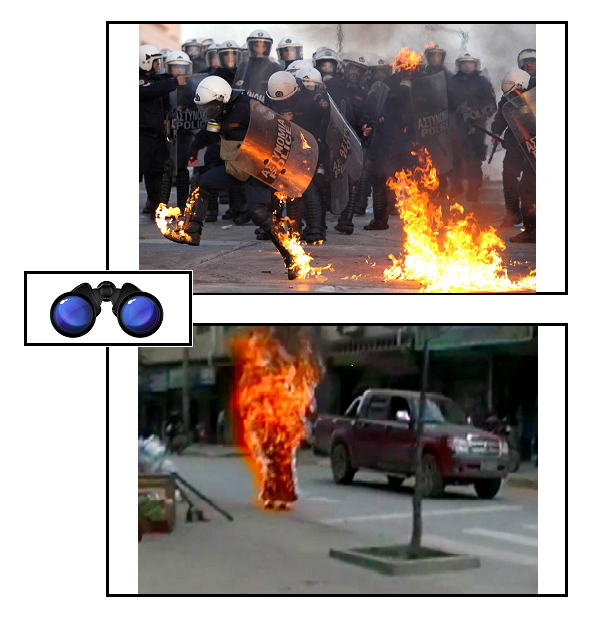
On fire: issues in theology and politics – i

Sunday, February 26th, 2012

[ by Charles Cameron — suicide, protest, martyrdom, the self-immolation of Buddhist monastics ]
.

You can set your enemies on fire, you can set yourself on fire, you can blow yourself and your enemies up…

Protest, mayhem, suicide, martyrdom?

*

As usual, my interest is in the theological sanctions and constraints involved — in this case, by Buddhist self-immolation — so this excerpt from a Q&A with Lobsang Sangay, the prime minister of the Tibetan government-in-exile caught my eye:

Q: Does Buddhism allow self-immolation?

A: It’s a complex issue. One could refer to Jataka tales, which concern the previous births of the Buddha. In one story, the Buddha, in a previous incarnation, gives up his body to feed a starving tigress and her four cubs. Some other stories also talk about self-sacrifice by the Buddha.

Although suicide is violent and prohibited in Buddhism, some Buddhists believe it depends on the motivation. If you do it out of hatred and anger, then it is negative. But if you do it for a pure cause … it’s such a complex theological issue. You can’t go either way or have a definitive answer. But the action is tragic, so painful.

That’s a start: it’s a theologically complex issue…

The young Karmapa Lama, second in influence only to the Dalai Lama himself, is quoted in a Guardian report as discouraging this form of protest:

These desperate acts … are a cry against the injustice and repression under which they live. But I request the people of Tibet to preserve their lives and find other, constructive ways to work for the cause of Tibet.

In Buddhist teaching life is precious. To achieve anything worthwhile we need to preserve our lives.

It should be noted, however, that a number of monks in exile from China are depicted in the same article, bearing posters that call the self-immolators “burning martyrs”.

Robert Thurman, Je Tsongkhapa Professor of Indo-Tibetan Buddhist Studies at Columbia and president of New York’s Tibet House, provides his own justification for such acts:

When you destroy your body, you violate your own life, the lives of what Buddhists call “the 84,000 cells” that constitute it. This does seem violent. Yet in this case, the individual sacrifices herself to appeal to her enemy, to convey the perhaps all-too-subliminal message that they have nothing to fear from her, that she will resist their relationship of fear and harm by removing herself from being the target of their ultimately self-destructive, evil behavior. That is true non-harming—perfect resistance by complete surrender. If your victim prevents you from harming her by harming herself and taking herself out of your reach, then why were you afraid of her and wanting to harm her in the first place? Since she won’t harm you, she must love you. She wants you to stop fearing and hating; she wants you to be happy! Indeed, she cries out to you with her very life to wake up and behold the power of love—how it does not fear death, how it gives itself away to reality, how it overwhelms hatred.

And we should remember that even within Buddhism, self-immolation is not an exclusively Tibetan phenomenon. Here’s the celebrated Vietnamese zen monk and poet Thich Nhat Nanh, hearkening back to the days of the Vietnam War in his open letter “In Search of the Enemy of Man” (addressed to Martin Luther King):

The self-burning of Vietnamese Buddhist monks in 1963 is somehow difficult for the Western Christian conscience to understand. The Press spoke then of suicide, but in the essence, it is not. It is not even a protest. What the monks said in the letters they left before burning themselves aimed only at alarming, at moving the hearts of the oppressors and at calling the attention of the world to the suffering endured then by the Vietnamese. To burn oneself by fire is to prove that what one is saying is of the utmost importance. There is nothing more painful than burning oneself. To say something while experiencing this kind of pain is to say it with the utmost of courage, frankness, determination and sincerity. During the ceremony of ordination, as practiced in the Mahayana tradition, the monk-candidate is required to burn one, or more, small spots on his body in taking the vow to observe the 250 rules of a bhikshu, to live the life of a monk, to attain enlightenment and to devote his life to the salvation of all beings. One can, of course, say these things while sitting in a comfortable armchair; but when the words are uttered while kneeling before the community of sangha and experiencing this kind of pain, they will express all the seriousness of one’s heart and mind, and carry much greater weight.

The Vietnamese monk, by burning himself, says with all his strength and determination that he can endure the greatest of suffering to protect his people. What he really aims at is the expression of his will and determination, not death. To express will by burning oneself, therefore, is not to commit an act of destruction but to perform an act of construction, that is to suffer and to die for the sake of one’s people.

In a later post, I’ll return to Nhat Hanh‘s comment about monastic ordination, comparing it with the symbolism of the “red” given to cardinals on their elevation to that dignity.

*

Someone who is neither a monk or nun, nor a Tibetan, nor even a Buddhist — a Tunisian street vendor named Mohamed Bouazizi — set himself on fire in Sidi Bouzid not so long ago, and the rippling wave of events triggered by that act have included the toppling of long-entrenched dictators — is it so remarkable that an 18 year old nun, Tenzin Choedon, and other Tibetans too might hope that an act of self-immolation would galvanize the population around them and the world, resulting in the toppling of the hated Han regime in their part of the world?

I am not sure whether Prof. Thurman’s attempt to tie the Buddhist monastics’ mode of self-sacrifice to the notion, “see, we’re no threat” really works, but it is surely worth considering when it comes from a man who often speaks as a western mouthpiece for the Dalai Lama…

There are of course differences between monastics and laypeople.

Bouazizi’s self immolation was an act of despair, Tenzin Choedon’s an act of courage — as the photos of her standing there, ablaze and unflinching, while another woman offers a silk scarf into the flames in the traditional gesture of respect clearly show.

And when Prof. Thurman declares that the nun wanted her people to be happy, he surely doesn’t mean that she wanted them to be pleased at the sight of her standing there in the middle of the street ablaze — but that she wanted her people to be liberated from the repressive yoke they were and are under, and to feel the joy that comes with liberation from dictatorship.

But Bouzazi’s act, too, must have required considerable courage, while Tenzin Choedon’s act was surely also born of desperation. We humans, as individuals, are by our very nature blended beings.

***

As an Addendum:

Khenpo Karthar Rinpoche in his book, Dharma Paths, tells the Jataka tale of the Buddha giving his body to feed some tiger cubs as follows:

In one of his previous lives, the Buddha was born as the youngest of three princes. When he was only five years old, the three princes were in a forest playing together at hide-and-seek and other games. As they were walking in the forest, they came to a cave where they saw a wounded female tiger with five cubs. The mother tiger was very weak and was unable to provide food for the baby tigers. The Buddha’s older brothers went to search for some food, and they asked the young prince to stay near the cave to take care of the mother tiger and the five cubs.

While the Buddha was taking care of the wounded tiger and her five cubs, he began to think that it was not proper to kill other beings and give their flesh to the tiger. He found some large thorns and pressed them into neck, and as the blood came out, he let the cubs and their mother suck the blood. In fact, he gave his whole body to the five cubs and their mother as an act of generosity. As he did this, the Buddha prayed, “Right now I am only able to give temporary help to these starving beings, just removing their hunger. May these tigers who are enjoying my flesh, blood, and bones be reborn to a higher realm, and may I be able to teach them and lead them out of cyclic existence.”

We are naturally entitled to take the Jataka tales as scriptures, morality tales, or legends, fairy-tales — but the Rinpoche makes it clear in his telling that the bodhisattva who would later become Gautama Buddha “gave his whole body”.

In the Chod ritual of Tibetan Buddhism, practitioners symbolically give their own flesh to sate the hungry demons…

Debating a Failure of Generalship and Leadership

Tuesday, October 18th, 2011

A fascinating online discussion between US Army intellectuals Colonel Gian Gentile, Colonel Paul Yingling and journalist and Iraq War veteran Carl Prine:

Paul Yingling  A Failure in Generalship  –AFJ

….Having spent a decade preparing to fight the wrong war, America’s generals then miscalculated both the means and ways necessary to succeed in Iraq. The most fundamental military miscalculation in Iraq has been the failure to commit sufficient forces to provide security to Iraq’s population. U.S. Central Command (CENTCOM) estimated in its 1998 war plan that 380,000 troops would be necessary for an invasion of Iraq. Using operations in Bosnia and Kosovo as a model for predicting troop requirements, one Army study estimated a need for 470,000 troops. Alone among America’s generals, Army Chief of Staff General Eric Shinseki publicly stated that “several hundred thousand soldiers” would be necessary to stabilize post-Saddam Iraq. Prior to the war, President Bush promised to give field commanders everything necessary for victory. Privately, many senior general officers both active and retired expressed serious misgivings about the insufficiency of forces for Iraq. These leaders would later express their concerns in tell-all books such as “Fiasco” and “Cobra II.” However, when the U.S. went to war in Iraq with less than half the strength required to win, these leaders did not make their objections public.

Gian Gentile A Few Questions for Colonel Paul Yingling on Failures in GeneralshipSmall Wars Journal

….Perhaps you see it differently, but the failure that I see in American generalship in both wars in Iraq and Afghanistan (with precedence in Vietnam) is the idea that tactical and operational excellence through a certain brand of counterinsurgency (or any other form of tactical innovation) can rescue wars that ultimately are failures of strategy, or as Schlesinger more harshly puts it “national stupidity.”

In light of how you respond to these questions might you consider writing “A Failure of Generalship, Version 2” for Afghanistan?

If not, might you spell out the differences between what you saw as the failure of American generalship in Iraq from 2003-2006 with the past two years plus in Afghanistan.  In other words, how has American generalship been a failure in Iraq and not in Afghanistan?

Paul Yingling The Gentile-Yingling Dialogue: ISAF Exit Strategy – Neither International nor an Exit nor a Strategy – Small Wars Journal

….Those of us charged with strategic thinking ought to heed this example.  Imagine a failed Pakistan that results in a terrorist organization acquiring one or more nuclear weapons.  What would our response be in the aftermath of such a crisis?  What intelligence capabilities do we need to locate compromised nuclear materials?  What civil security and law enforcement measures might disrupt or minimize the impacts of such a threat?  What counter-proliferation capabilities are required to seize and render safe compromised nuclear weapons or materials?  Imagine further the capabilities required to avoid such a crisis.  What diplomatic measures might change the Pakistani strategic calculus that lends support to extremism?  What broader engagement with Pakistani civil society might render this troubled country less amenable to radical ideology?  Now imagine still further back to the institutional arrangements that generate national security capabilities.  Do we have the right priorities?  Are we buying the right equipment?  Are we selecting the right leaders?  Are we making the best use of increasingly scarce tax payer dollars?

Too often, what passes for strategic thought in the United States is actually a struggle among self-interested elites seeking political, commercial or bureaucratic advantage.  Such behavior is the privilege of a country that is both rich and safe.  However, a pattern of such behavior is self-correcting: no country that behaves this way will stay rich or safe for long.

Carl Prine A Colonel of Truth – Line of Departure

….Gentile and I agreed nevertheless that Yingling failed to seal the deal by naming names, something that would’ve allowed readers the chance to test empirically whether the LTC’s overall thesis had merit.  Here’s Yingling’s nutgraf, words scribbled during the worst days in Iraq when Gentile commanded a cavalry squadron in Baghdad and I was stuck in Anbar as a lowly infantry SPC:

These debacles are not attributable to individual failures, but rather to a crisis in an entire institution: America’s general officer corps. America’s generals have failed to prepare our armed forces for war and advise civilian authorities on the application of force to achieve the aims of policy. The argument that follows consists of three elements. First, generals have a responsibility to society to provide policymakers with a correct estimate of strategic probabilities. Second, America’s generals in Vietnam and Iraq failed to perform this responsibility. Third, remedying the crisis in American generalship requires the intervention of Congress.

….Perhaps because it was so brief, Yingling’s essay lacked subtlety.  It’s not true that America’s generals in Vietnam saw the conflict merely in terms of conventional warfare, although some surely did.  He spun a dubious bit of scholarship on Malaya by John Nagl into a larger argument about Cold War generals choosing to orient American arms toward highly kinetic campaigns – as if the threat of Soviet arms in Europe had nothing to do with that.  And he peppered his analysis with bromides that remain unproven, perhaps my favorite being the chestnut that “?opulation security is the most important measure of effectiveness in counterinsurgency.”

That read better in 2007 than it does today. But Yingling’s larger point held true:  America’s generals failed to adapt our shrinking forces to how policymakers might direct their use, even if there was a re-emphasis on operations other than conventional war both in practice (Kurdistan, Bangladesh, Haiti, Somalia, Kovoso, Bosnia, Timor, Cambodia) and theory.

This is an important discussion because the failure of generalship is merely part of a larger paradigm of leadership by abdication and moral evasion that is corroding the fabric of American society to a degree not seen since the 1970’s. Or perhaps since the 1870’s. Colonel John Boyd once chided his brother officers for being willing to take a bullet for their country but not willing to risk their careers for their country. How much worse then is an elite civilian political class that grabs the largesse of government contracts with great gusto but is chronically unable to do the hard work of providing strategic leadership when in office?

Truman’s famous desk sign that indicated the buck stopped at his desk. To update the sign to fit the spirit of the times would require replacing it with a dead fish rotting from the head.

Carl Prine’s Rebuttal to “Be honest: Who actually read FM 3-24?”

Wednesday, July 13th, 2011

My amigo and SWJ News co-columinst Crispin Burke recently put forth a very interesting and provocative jeremiad “Be honest: Who actually read FM 3-24?” and one of his targets, journalist and Iraq war veteran Carl Prine, has been duly provoked, Prine has responded in great detail yesterday at Line of Departure:

Starbuck is wrong

Starbuck is wrong.

And in his drive to keep getting it wrong, he’s trying to rewrite FM 3-24, the military’s chief doctrinal publication on counterinsurgency.

But that just makes him more wrong.

He’s wrong about me.  He’s wrong about what I believe.  He’s wrong about the literature that informs FM 3-24.  He’s wrong about what the manual says and he’s wrong about what it left out.  He’s wrong about historiography.  He’s wrong about how a caste of top officers and diplomats came to understand “strategy” in the wake of the occupation of Iraq.

Let’s help get him right.  Or, at least, less wrong.  He’s a good man.  We need to turn him and ensure he quits taking shots at me I don’t deserve!

….The problem to anyone who studies Malaya, however, is that since the publication of the memoirs of exiled communist leader Chin Peng a dozen years ago, we now know that the civic, military and political policies under the British “hearts and minds” approach didn’t defeat the revolution.

Instead, the revolt was irreparably broken by brutal operations against the guerrillas, then a most coercive “screwing down the people” phase that dispossessed or killed thousands of Chinese, followed by draconian “population control” measures that, as Peng put it, starved the guerrillas in the bush because they snapped their rat lines and cut off their rice.

The “hearts and minds” initiatives designed to bring medical care, education, social welfare and other aid to the resettled Chinese and woo them to the colonial government’s side from 1952 – 1954 didn’t crack the back of the insurgency, a point now pretty much beyond dispute.

Why?  Because the previous “hearts and minds” claptrap as the cause of pacification in Malaya was contradicted by the Malayan Chinese, most especially those guerrillas who took up arms against the British regime!

You know, the people targeted by a population-centric counterinsurgency.  The people most counter-insurgents in their pop-centric fantasies almost never discuss except as abstractions, the human yarn wefted and warped by their long needles of war.

One finds “Hearts and Minds” prominently mentioned 11 times in Dr John Nagl’s valentine to Templer and colonial Malaya, Eating Soup with a Knife; to Nagl it’s the stuff of police services and economic development and whatnot with the psychology of the people being the center of gravity those reforms are meant to snatch.

And Nagl would like the best burglar of hearts and minds to be a learning, nimble and evolving military-political institution such as the U.S. Army.  It’s no small wonder, then, that Nagl became a dominant voice in FM 3-24 and that many of this thoughts in Eating Soup came to dominate the manual, too.

Or, as the introduction to FM 3-24 echoes soupily, “by focusing on efforts to secure the safety and support of the local populace, and through a concerted effort to truly function as learning organizations, the Army and Marine Corps can defeat their insurgent enemies.”

This is mere euphemism and wasn’t worth the ink that it cost taxpayers to print it.  But it sets the stage for the rest of FM 3-24, which follows a hearts and minds template that Starbuck doesn’t apparently realize is borrowed from mid-century….

Ouch. Note to self: if I ever decide to square off against Carl, I will make sure to do my homework. Read the rest here.

First, I would point out to readers here for whom some of this in both essays is inside baseball, that the tone is less harsh and the substantive distance between Burke and Prine less great in  the comments sections of both blogs than it first appears in reading their posts. It is a healthy, no-holds barred exchange and not a flame war.

Secondly, it is an important exchange, tying together COIN disputes over theory, historiography, empirical evidence, operational and tactical “lessons learned”, strategy, policy (Clausewitzian sense), politics (colloquial sense) and personalities that have raged for five years across military journals, think tanks, the media, the bureaucracy and the blogosphere. In some ways, these essays can serve as a summative of the debate. I say “some ways”, because what is the most important element or effect of America’s romance with COIN will differ markedly depending on whom has the floor. My own beef is not with doing COIN, it is with not doing strategy.

As Crispin and Carl’s vignette about General Creighton Abrams demonstrated, American historians are still having savagely bitter arguments about the war in Vietnam. For that matter, everyone who lived through the era did and still does. It is a wound that never seems to heal and has crippled our politics to this day, even as the veterans of Vietnam now turn to gray.

The 21st century COIN wars have not ripped American society apart down to the soul the way Vietnam did. As with the Korean War, the soldiers and marines in Afghanistan and Iraq fought bravely, at times desperately, to a general and mild approbation back home that sometimes looked a lot like indifference. Even the anti-war protestors mostly made a point of stating they were not against the troops, the venemous public malice of the 1960’s New Left radicals in the 2000’s was a property only of the lunatic fringe.

But COIN itself will be a historical argument without end.


Switch to our mobile site