zenpundit.com » insight

Archive for the ‘insight’ Category

Simultaneity II: the pictorial eye

Wednesday, April 11th, 2012

[ by Charles Cameron — when sequence becomes simultaneous, the pictorial eye, rethinking thinking, continuing from Simul I ]
.

What better day to begin writing this second post on simultaneity than the day on which Google celebrated the birthday of Eadweard Muybridge with a Google Doodle — not that I’ll get the post finished within those same 24 hours!

The film — sequence of frames? stills? which would you call it? — that Muybridge took of a horse, used in that Google Doodle [view it in motion, here], is celebrated as showing beyond a doubt that when galloping, all four of a horse’s hooves may be in the air at the same time.

But is it — Muybridge’s work product — sequential, ie a film, or simultaneous, ie the presentation of many moments at one time?

That question gets to the heart of an issue that all narrative faces, as we shall see. First, the pictorial side of things.

*

Hans Memling‘s Passion of Christ (above) tells the gospel narrative, from Christ’s entry into Jerusalem and the Last Supper through his crucifixion, entombment and resurrection to his appearances in Emmaus and by the sea of Galilee in one canvas, much as Bach’s Matthew Passion [link is to Harnoncourt video] tells major portions of the same narrative in three hours of unfolding musical drama.

*

David Hockney has recently been working on forms of what I can only call “asynchronous synchrony” — as exemplified here:
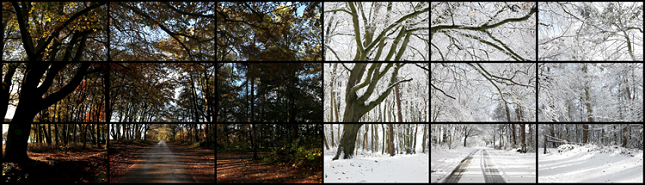

Stills from Woldgate 7 November 2010 11:30 AM (left) and Woldgate 26 November 2010 11 AM (right). Credit: ©David Hockney

This image comes from a fascinating article describing Hockney’s current work by Martin Gayford, titled The Mind’s Eye, which you can find in MIT’s Technology Review, Sept/Oct 2011:

We are watching 18 screens showing high-definition images captured by nine cameras. Each camera was set at a different angle, and many were set at different exposures. In some cases, the images were filmed a few seconds apart, so the viewer is looking, simultaneously, at two different points in time. The result is a moving collage, a sight that has never quite been seen before. But what the cameras are pointing at is so ordinary that most of us would drive past it with scarcely a glance.

As with the Muybridge video above, “the viewer is looking, simultaneously, at different points in time”. Here Hockney does this with video cameras — but he achieves something of the same effect of time-displacement with still photos, too, as you can see in his brilliant portrait of the sculptor Henry Moore, hosted on the British Council’s Venice Biennale site.

Here is Gayford’s concluding paragraph, tying Hockney’s work into the larger context of our need for multiple frames of reference:

“Don’t we need people who can see things from different points of view?” Hockney asks. “Lots of artists, and all kinds of artists. They look at life from another angle.” Certainly, that is precisely what David Hockney is doing, and has always done. And yes, we do need it.

*
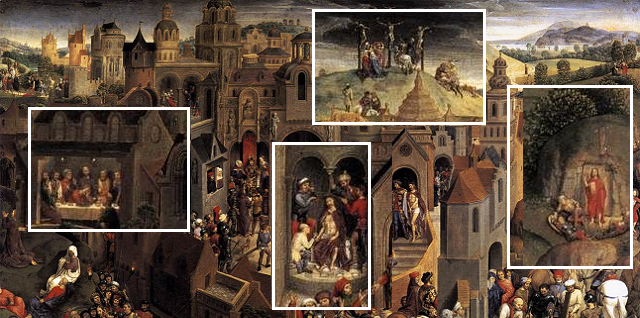
Memling again — and here I have enlarged and “framed” four of the 23 scenes from the passion of Christ which he has incorporated in the one painting: the Last Supper, the Crowning with Thorns, the Crucifixion, the Resurrection — Thursday evening through Sunday, and from life to death and back again.

*

It was Holy Week for Christians just last week, so perhaps you will forgive my having been preoccupied with images of the passion during the season set aside for such meditations — but what I want to point out to you is timeless, and indeed brings the transcendent into the everyday. Let’s take a look at a Hitchcock film next, then, and see how a contemporary videographer Jeff Desom has remixed the already Hockney-like Rear Window [link to IMDb] to create his own time-lapse telling of the tale [link to Vimeo], from which I took this screen-grab:

*

Time-lapse — simultaneity? The philosopher Alfred North Whitehead once wrote:

The communion of saints is a great and inspiring assemblage, but it has only one possible hall of meeting, and that is the present; and the mere lapse of time through which any particular group of saints must travel to reach that meeting-place, makes very little difference.

And so it is with this other Memling painting — and many others like it, by artists old and new:
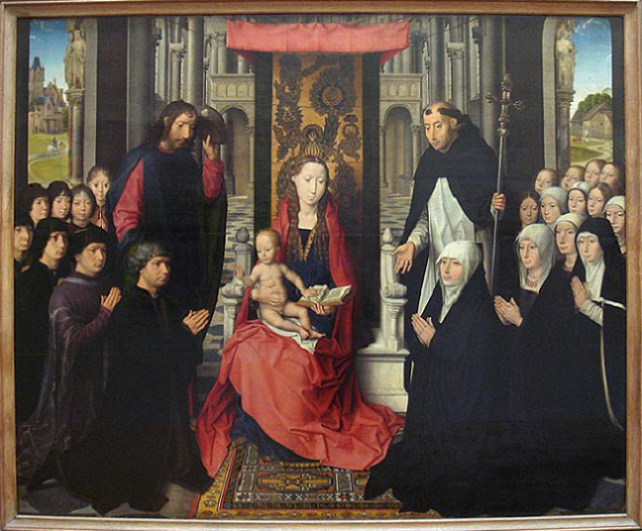
Here we see the Virgin Mary and Christ child with Saints Dominic and James — there’s an eleven centuries gap right there, St Dominic lived from 1170 – 1221, more than a millennium after Christ — and Memling has St Dominic presenting his patron, the spice trader Jacques Floreins with his family to Christ, circa 1490. With everyone dressed in late 15th-century fashions…

Whitehead — co-author with Bertie Russell of Principia Mathematica — see how amazing this is? — could have been thinking of Memling: “the mere lapse of time through which any particular group of saints must travel to reach that meeting-place, makes very little difference”.

*

Coming up next: how this affects our understanding of story.

____________________________________________________________________________

For an understanding of the setup David Hockney uses for his multiple-video takes, see here and specifically this and this. For the setup used by Jeff Desom in his Rear Window remix, see here and specifically this.

Countering Violent Extremism: variants on a theme II

Monday, April 2nd, 2012

[ by Charles Cameron — modeling / scoring recruitment conversations as a flow of ideas, continued from CVE Variants I ]
.

Look, in any guidance, in any persuasion, there’s a conversation.

In the image above, the flow is from Anwar al-Awlaki, who already knows and speaks, to Nidal Hasan, who listens and thinks and is persuaded.

But what interests me more than that specific conversation, limited as it was to a handful of emails, is the overall route taken by many different conversations between what the NYPD calls a “spiritual sanctioner” and a prospective recruit.

We know that like a river, any conversation will have its eddies and flows — but if it’s a successful conversation, if it leads to persuasion, if it radicalizes the recruit… then the eddies won’t have prevented or reversed the flow, they’ll just have been a natural part of it.

*

Mitchell D. Silber and Arvin Bhatt addressed the stages they believed the radicalization process generally followed in their report for the NYPD, Radicalization in the West: The Homegrown Threat, and the steps they described after self-identification — in which the proto-jihadist comes to think of themselves as within the broad Salafist thought-stream, were these:

Indoctrination is the phase in which an individual progressively intensifies his beliefs, wholly adopts jihadi-Salafi ideology and concludes, without question, that the conditions and circumstances exist where action is required to support and further the cause. That action is militant jihad. This phase is typically facilitated and driven by a “spiritual sanctioner”.

While the initial self-identification process may be an individual act, as noted above, association with like-minded people is an important factor as the process deepens. By the indoctrination phase this self-selecting group becomes increasingly important as radical views are encouraged and reinforced.

Jihadization is the phase in which members of the cluster accept their individual duty to participate in jihad and self-designate themselves as holy warriors or mujahedeen. Ultimately, the group will begin operational planning for the jihad or a terrorist attack.

*

For the record: I do understand that the “conversational terrain” of the radicalization process is going to be considerably more twisty and convoluted than any map — as indeed do Silber and Bhatt, who write “Although this model is sequential, individuals do not always follow a perfectly linear progression.”

Let’s take a close look.

Here, for starters, is a diagram from Jeff Conklin, the guy who brought us wicked problems, showing in red the linear path that the creativity books tell you you should take from problem to solution — and in blue, the zigzag path an “actual” designer’s mind might take on its way to that solution — from the first chapter of Conklin’s book, Dialogue Mapping: Building Shared Understanding of Wicked Problems

I’ve paired Conklin’s diagram with a Von Kármán Vortex Street (I wrote about those recently in Having eyes to see) showing eddies within a successful flow, from M Van Dyke‘s An Album of Fluid Motion — both images are a little too “pure” and “diagrammatic” to fit the actual complexity of human thought.

Recruitment conversations will have their eddies, but it’s both the general route of the flow and the specificities of those eddies that would interest me — not because I wish to “police” those thoughts but because I wish to understand them — and any eddies that repeat themselves from one recruitment conversation to the next will likely contain useful hints as to inherent weak points in the sanctioner’s argument.

*

Let me be clear about this. As to our using such an understanding in an attempt to police the thoughts of a “suspect” community – I would think that would be a piss-poor approach to take, with pretty immediate blowback effects.

What I am trying to get at here is not “how to do CVE” – a topic best left to others, and specifically to those who contest the thrust of the recruitment argument from within the same general theological tradition – but how to better understand the conceptual drivers in play in the recruitment process. I am asking, if you like, for concept-level mapping of the terrain. And I should probably have said something about that in my first post in this series.

Here again, non-linearity seems to be the order of the day — and we need to understand what that implies and learn to think in comparably non-linear ways.

*

Spiritual sanctioner: what a concept! That’s someone who gives you the fear of hell for after-burners and the hope of paradise as your aim and destination…

And those after-burners burn hot, hot, and that aimed-for Paradise is cool, so very cool…

*

Leaping quickly back to non-linearity, then: Dan McCauley, in a very recent Small Wars Journal article, Creative Thinking: Linking Environment, Vision, Change, and Strategy, explains:

The human mind does not work in a linear or list-like fashion. The most common forms of communication are speech or writing, but these are limited by time and space to one word at a time. Research shows that the brain is far more multidimensional and capable of processing enormous amounts of information using images, color, relationships, associations, and other depictions in addition to speech or the written word. Defined as “seeking original ways to reach goals when the means to do so are not readily apparent,” creative thinking uses divergent and convergent thinking. Divergent thinking begins at a common point and generates a variety of thoughts, whereas convergent thinking begins from various data points or potential solutions and searches for the one that best addresses the competing requirements.

So there’s more to non-linearity than just adding some feedback loops into a model that would otherwise move smoothly from premise to conclusion. There’s a whole, rich and ambiguous broth of a world in which each problem is found, and the whole, rich and ambiguous broth of each mind with which we approach it…

*

By the time he presented his testimony before the Senate Homeland Security and Governmental Affairs Committee in November, 2009, Silber had developed his idea of the sanctioner one stage further:

In 2007, we discussed the concept of a “spiritual sanctioner”, an individual who provides religious justification for violent political extremism for individuals who are radicalizing. Within the last six months we have identified a new catalyst for radicalization – what we call the “virtual spiritual sanctioner”. Although he is not the only one, Anwar al Awlaqi, based in Yemen is exemplar of this concept.

The recognition of an online component to recruitment may have been pretty obvious even then — but the February 2011 Lieberman / Collins report, A Ticking Time Bomb: Counterterrorism Lessons From The U.S. Government’s failure To Prevent The Fort Hood Attack picks up on the notion of “virutal spiritual sanctioners” and adds a small but significant detail to the overall picture of how we currently think about (and hence model and prepare ourselves against) such threats:

These individuals provide a false sense of religious justification for an act of terrorism over the internet.

*

Which brings me to my last point. As David Martin Jones and MLR Smith say in Whose Hearts and Whose Minds? The Curious Case of Global Counter-Insurgency:

The process of radicalisation is obviously a complex one. Certainly, the passage to the act of terrorism cannot be reduced solely to religion.

That’s right: but to label the religious element in the recruitment discourse “a false sense of religious justification” comes close to dismissing it as irrelevant.

To return to my earlier statement, the after-burners of hell and the aim of Paradise alike are extremely vivid in the imagination to those whose sensibilities are attuned to them.

That’s why Hafez Abdul Qayoom of the Afghan Ulema Council could tell Rod Nordlund of the NY Times:

To Muslims, and especially to Afghans, religion is much higher a concern than civilian or human casualties … When something happens to their religion, they are much more sensitive and have much stronger reaction to it.

That’s why Robert R Fowler wrote of his al-Qaeda in the Islamic Maghreb captors:

Kidnappings of Westerners have fueled debate among securocrats as to whether our AQIM captors might simply bandits flying an Islamic flag of convenience. I know that to be the wrong answer. Our kidnappers were utterly focused religious zealots who believed absolutely in their cause.

We post-enlightenment westerners mostly have a hard time accepting, let alone intuitively feeling this.

Having eyes to see…

Saturday, March 31st, 2012

[ by Charles Cameron — looking through the eyes of tech, math, art, flies, and intelligence ]
.

Imaging the winds and the waters

I’ve been raising questions about the varieties of ways of seeing here — asking whether guardian angels can be more than guys on night watch and if so what that “more” means, invoking William Blake’s fourfold vision [see move 4], and so forth. And I tend to emphasize the visionary over against the material.

I thought I’d do something different this time, and show you two views of the world that science brings us, that we couldn’t have seen half a century ago unless you were Theodore von Kármán (below, upper image)…

let alone a century ago, unless you were Vincent van Gogh (lower image).

*

In descending order, these four images are:

  • the winds over a portion of the Americas, as depicted by Fernanda Viégas and Martin Wattenberg a few days ago, see also their current live feed
  • a NASA image drawn from the Goddard Scientific Visualization Studio‘s Perpetual Ocean animation, hi-res Gulf Stream image
  • a diagram of a Kármán vortex street, from Arthur E. Bryson, Jr., Demetri P. Telionis, “Kármán vortex street,” in AccessScience, ©McGraw-Hill Companies, 2008
  • and Vincent van Gogh, Starry Night, in the Museum of Modern Art, New York.

The gentleman in the meditation goggles — he calls them “eye-bags” — featured in the “mini-SPECS” section of the Winds and Waters SPECS is my friend David Woolley, who alerted me to these simulations on his Just think of it blog today. David, btw, is the fellow who designed and wrote PLATO Notes, the first permanent, general-purpose online conferencing system, back in 1973.

The eyes features in the “mini-SPECS” of the Kármán / van Gogh SPECS are a fly’s “compound” eyes — “compound meaning that each eye has hundreds of facets (ommatidia or simple eyes).

*

And that’s the point, isn’t it?

We as the human community have many eyes, many perspectives — the visionary, the technological, the abstract, the photographic, the artistic, the consensus, the minority opinion — such as that of Mr Justice Douglas in Sierra Club vs Morton, perhaps? …

Our intelligence — our intel too — should build on a rich and wide array of ways of seeing. After all…

… unless the above is just a recruitment slogan.

Nancy Fouts and the heart of the matter

Thursday, March 22nd, 2012

[ by Charles Cameron — Nancy Fouts, sculpture, juxtaposition, essence of creativity, pocket universes, Arthur Koestler, Mark Turner ]
.

Nancy Fouts is an American artist based in London. I ran across her work a while ago thanks to Michael Weaver on Google+, and was immediately struck by the intensity of her images, each one of which seemed like a landmark from a larger geography, more precisely focused and dense with meaning than our own world usually appears to be.

First impression:

.
The first image I saw was of a snail on the straight edge of a razor blade (above, left) — an image out of the script of Apocalypse Now to be sure, but presented by Fouts in sharp detail and unadorned by any other context, visually, direct from eye to mind and heart.

This may be the image many people first see of her work — very, very striking, exquisite, terrifying if you allow it to be so, and yet as clear and simple, almost, as a single drop of water on a leaf.

Singer and song:

.
But it was this next image that conquered me:

The juxtaposition is impeccable: sewing machine, record on turntable – and the overlap between the two, the link, the vesica piscis between them, is the needle.

The music of Bach, Handel, and Vivaldi — particularly on harpsichord — has been disparagingly called “sewing-machine music”. If that phrase gave rise to this marvelous image, perhaps the slight can be forgiven.

The sewing-machine? It’s a Singer. And in what must surely be an ironic, gender-influenced choice coming to us from an artist so assured and exacting — the music that the needle draws from the groove of the record is, as you can tell from the record label, the music of His Master’s Voice.

Philosophical aside:

.
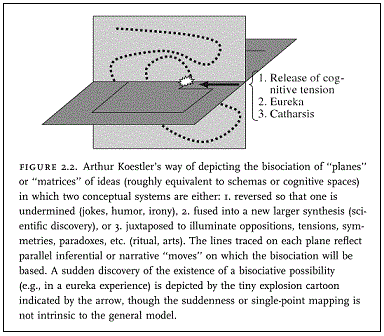
I have pointed before to this diagram from Mark Turner‘s The artful mind: cognitive science and the riddle of human creativity, based on those in Arthur Koestler‘s The Act of Creation (eg those on pp 35 and 37):

koestler-model.gif

It shows the essence of the creative act — the “release of cognitive tension” that occurs when some form of analogy, similitude, overlap allows the mind to join conceptual clusters from two fields in a “creative leap”.

Nancy Fouts’ work doesn’t merely make use of such twinned field overlaps, it makes twinned fields with overlap the defining quality of her works.

She is aiming right at the heart of the creative process. And it shows.

Moving further afield:

.
In that earlier post of mine, I talked about Ada, Countess of Lovelace, and noted that her analogy between Charles Babbage‘s Analytical Engine and Jacquard‘s mechanical loom, famously expressed by her thus:

The Analytical Engine … weaves algebraic patterns, just as the Jacquard-loom weaves flowers and leaves.

was precisely the creative leap that led to the us of punched card systems in computation from Babbage to Watson…

I could give other examples. The Taniyama-Shimura conjecture which formed the basis of Andrew Wiles‘ proof of Fermat‘s Last Theorem, bridges two previously distinct branches of mathematics precisely by showing that for every elliptic curve, there is a related modular form

And no, I don’t understand the mathematics. But I understand the concept of twinned fields, and the power of their overlap.

Some favorite tropes:

.
Back, then, to Nancy Fouts:

One thing that interests me about her work is that she has a few simple “essences” that she returns to time and again: in this case, bees, forms that resemble honeycombs, and by implication, honey.

In my own work, making similar connections between what we might paradoxically call “kindred ideas in unrelated fields” — I might set Nancy’s honeybees across from the verse from the Upanishads [Brihadaranyaka, fifth Brahmana, 14] which says:

This Self is the honey of all beings, and all beings are the honey of this Self.

Another of Nancy’s tropes connects nature and music…

The piercing:

.
And thimbles, those miniature emblems of armor and protection, are another recurring theme:

Let’s take a look at that last image, of the thimble transpierced by a needle.

I believe it has a history — again, accessible via an associative leap. Here are three images of the “wounded healer” motif, two of them specifically images of the Inuit shaman who has harpooned himself — a motif which the anthropologist and zen roshi Joan Halifax writes “captures the essence of the shaman’s submission to a higher order of knowing”:

Armor, the defenses we have in place to protect our selves, and vulnerability, the ability to to allow our selves to be wounded, so that the “self” which is “the honey of all beings” may shine through us. The paradox of Selflessness and Self.

Koan and sacrament:

.
Among wounded healers, we might count the crucified Christ, his side pierced by the spear of a Roman soldier — and here I might suggest that Fouts contrasts (image below, left) the self-sacrifice at the heart of Christianity with the pugilistic approaches of some proponents of his message:

And the image of Christ (right) balancing on a high wire?

Again I’m reminded of the language of shamanism. The anthropologist Barbara Myerhoff studied the religious beliefs and practices of the Huichol or Wixaritari of the Mexican Sierra Madre Occidental, with Ramon Medina Silva, a mara’akame or shaman of the tribe.

In her book, Peyote Hunt: The Sacred Journey of the Huichol Indians, she describes a feat of balance that Ramon performed, which appeared to serve a “sacramental” function for his people – providing them with what Cranmer‘s Book of Common Prayer calls “an outward and visible sign of an inward and spiritual grace”:

One afternoon Ramon led us to a steep barranca, cut by a rapid waterfall cascading perhaps a thousand feet over jagged, slippery rocks. At the edge of the fall Ramon removed his sandals and told us that this was a special place for shamans. We watched in astonishment as he proceeded to leap across the waterfall, from rock to rock, pausing frequently, his body bent forward, his arms spread out, his head thrown back, entirely birdlike, poised motionlessly on one foot. He disappeared, reemerged, leaped about, and finally achieved the other side. We outsiders were terrified and puzzled but none of the Huichols seemed at all worried. The wife of one of the older Huichol men indicated that her husband had started to become a mara’akame but had failed because he lacked balance.

It’s easy to read the description — but by no means as easy to keep one’s balance — something that Fouts’ image perhaps suggests more vividly than words easily can.

Richard de Mille describes the mara’akame‘s function in Huichol society as to “cross the great chasm separating the ordinary world from the otherworld beyond,” and suggests that Medina Silva’s feat of acrobatics on the barranca that day is to be understood as offering “a concrete demonstration in this world standing for spiritual balance in that world.”

Myerhoff herself was never entirely sure whether Medina Silva was “rehearsing his equilibrium,” or giving it “public ceremonial expression” that afternoon: it is clear, however, that for the Huichols, such feats of balance possess a resonance and meaning that extends beyond the “merely” physical.

Bringing the viewer into the picture

.
I may of course be projecting some of my own ideas onto Nancy Fouts’ work — and indeed, perhaps that’s the point.

She has some pretty fierce observations to make concerning matters religious — Christian, Buddhist and other — and I’ll leave those who are interested to make their own discoveries on her website. I don’t doubt there are places where her sympathies and my own overlap, and others where we differ.

Fouts speaks a direct and visceral language of images — and her juxtapositions, carefully chosen and choreographed as they are, provoke us to feel and think.

Thank you, Nancy.

No need to reach for the gun, fellas — but that’s art.

_________________________________________________________________________________________

credits for images of Harpooned Shaman: Charlie Ugyuk (left); David Ruben (right).

The Said Symphony: move 19

Sunday, March 18th, 2012

[ by Charles Cameron – extended analytic game on Israeli-Palestinian conflict — for those who wish to catch up, our game thus far consists of an intro to the game and game board, followed by moves 1-5, 6-9, then moves 10-11 which together constitute a meditation, moves 12, 13-15, 16-17, and most recently before this, move 18 with cadenza ]

Move 19: The view from above

Move content:

Discussing strategy, the very canny LTG (USMC, Ret’d.) Paul Van Riper had this to say:

What we tend to do is look toward the enemy. We’re only looking one way: from us to them. But the good commanders take two other views. They mentally move forward and look back to themselves. They look from the enemy back to the friendly, and they try to imagine how the enemy might attack them. The third is to get a bird’s-eye view, a top-down view, where you take the whole scene in. The amateur looks one way; the professional looks at least three different ways.

A bird’s-eye view, a hawk’s eye view, a top-down view, an overview, a view from 30,000 feet, a God’s eye view, a view from above, a zoom…

If move 18 and its cadenza gave us a view of the depth of vision or insight that is necessary for a full and rich understanding of the world we live in — its qualitative or spiritual scope, if you like — this next move, with its picnic and drone-sight, addresses its breadth in space and time — materially and quantitatively speaking.

The classic expression of the sheer material scope of the universe was put together by Charles and Ray Eames in their justly celebrated film, Powers of Ten, from which the lower of these two images is drawn:

Here are some other relevant scans of the scope of things, in terms of time and space:

The Scale of the Universe 2
A Brief History of The Universe
The Known Universe
A Time-Lapse Map of Every Nuclear Explosion Since 1945

These are impressive videos to be sure, but as an aside I’ll invite you to ask yourselves how well they compare with this zoom in words, a poem by the zennist, ecologist, essayist and poet Gary Snyder, from his book, Axe Handles: Poems:

Such breadth of vision, such craft.

*

If this “material scope of things” too has a cadenza, it would be that all of this is shot through with some primary oppositions, dappled as the poet Gerard Manley Hopkins would have it, with swift, slow; sweet, sour; adazzle, dim — as indicated in the drone-sight and picnic double image at the head of this move.

This dappling, this constant flux of opposites, takes many forms — day and night lead to the more abstract light and dark, which can then be interpreted morally as good and evil, to which we respond with repulsion and attraction as the case may be, building our worldviews from love or fear…

At different scales the opposites that matter most to us may have different names and shadings, but here I’d just like to draw attention to the dappling of our world with:

competition and cooperation
Darwin‘s natural selection and Kropotkin‘s mutual aid
duel and duet (ah! — a favorite phrasing of mine)
war and peace

Provocatively, we find this dappling in scriptures, too, wherein the ripples of such verses as “The LORD is a man of war: the LORD is his name” (Exodus 15.3) dropped like a stone into the pond of the human mind, meet with the ripples of other verses such as “God is love; and he that dwelleth in love dwelleth in God, and God in him” (I John 4.16).

There are times when we take such oppositions literally, perhaps too literally, and times when we begin to see oppositions as abstract and theoretical end-points to what is in fact a yin-yang process continually unfolding…

Which brings me by a commodius vicus of recirculation to this image of the great opposition between war and peace, its dappling, its unfolding:

Links claimed:

To the Lamb, move 18: this move presents the material scope of the universe in counterpoint to its visionary scope as laid out in move 18 with its cadenza.

To Revelation, move 17 — the word revelation means unveiling, as we have seen, and our sciences and technologies, with their spectra of telescopes, microscopes, cameras and zooms, are unveiling and revealing to us much about the physicality of the world we live in — much that was accounted for in other times and places through intuition, vision and poetry.

This scientific and technical revelation of material existence, for many of us moderns, has largely eclipsed the mode of visionary revelation of move 17 — yet it cannot eradicate it. Implicit in this move, then, is the sense that we carry with us both subjective and objective, inner and outer, qualitative and quantitative understandings — though the data that “sight” and “insight” provide us with may be different in kind, and resolving them may be something of a koan to us, the deep problem in consciousness as philosophers of science have named it — and that we can discount neither one if we are to have and maintain a rich sense of our situation.

Comment:

If the two previous moves have shown us the scope of the universe we co-inhabit, perhaps we should now make our own zoom in, much as James Joyce did when he had the schoolboy Stephen inscribe his name and address in his geography book as Stephen Dedalus, Class of Elements, Clongowes Wood College, Sallins, County Kildare, Ireland, Europe, The World, Universe – an address that Stephen then read both forwards and backwards, finding himself in one direction, and finding in the other that he had no means of knowing what might lie beyond the universe…

Imagine then, skipping rapidly from (unimaginable) cosmos via such things as the intriguingly named End of Greatness to galaxy or nebula…

…solar system and planet — whence we can slow down and zero gently in on the Middle (or as my friend Ralph Birnbaum would call it, the Muddle) East, Israel / Palestine, Jerusalem / Al Quds / the Temple Mount / Noble Sanctuary – and to such matters of contemplative vision and tribal passion as the first, second and projected third Temples, the al-Aqsa mosque.

Our increasing focus will bring us, then, to that the rock which Jews believe marks the place where Abraham bound his son Isaac (the Akedah), and which Muslims believe to be the place of ascent of the Prophet to the celestial realms (the Mi’raj) on his Night Journey (Qur’an, Al-Isra).

Here again myth and history collide, and both visionary and material considerations merge in the heart of the what my friend the Israeli journalist Gershom Gorenberg has justly called “the most contested piece of real estate on earth”.


Switch to our mobile site