zenpundit.com » cognition

Archive for the ‘cognition’ Category

A note about nodes

Monday, March 5th, 2012

[ by Charles Cameron – places, people, neurons, ideas, with Kabul and Khost providing illustrations ]
.


[ illus: Starlight, from PNL ]

I was just reading Matthieu Aikins‘ GQ account of The Siege of September 13 in Kabul, when a couple of sentences caught my eye, not because of the attack itself, but because they reminded me of a point I want to make about the way we think these days about networks, nodes and linkages:

Salangi’s SUV was passing down the main road north of the embassy when the sound of gunshots and his police radio simultaneously erupted. He told his driver to turn around and head toward the sounds.

At Massoud Circle, the next roundabout down from Abdul Haq, they encountered a bottleneck of police vehicles, and so Salangi continued on foot, ducking as he heard the crack and whine of bullets passing close by…

What specifically caught and rerouted my attention was that phrase, “Massoud Circle, the next roundabout down from Abdul Haq” — Abdul Haq Circle, I’d read earlier in the article, “is a wide traffic roundabout named for a deceased mujahideen commander”, as presumably is the circle named for Massoud.

So we have two roundabouts connected by a road… and two deceased mujahideen commanders.

Or to put that another way, we have two nodes and a connection between them, twice over — in once case the nodes are places, and in the other the nodes are people.

*

Further into the article, I found a graphic showing the two places and the road connecting them — and an image of two people in Kabul that day, one extending an arm of care to the other. These two men weren’t Abdul Haq and Massoud, of course, but two people nonetheless. So in each graphic, we have two nodes and a connection:

A great deal of time and treasure goes into the analysis of networks of communication — cellphone to cellphone, person to person — or travel — place to place — (a) because the patterns can be revealing, and (b) because the data (what number called what number, e.g., how often Nidal Hassan emailed al-Awlaki, or what route bought Abu Dujanah from Amman to Khost) is unambiguous when obtained.

*

We’re also fond of neural nets, eh? — whether the “artificial” nets of AI or the “biological” nets of the brain — and again, these are unambiguous, scientists and technicians love them, and software developed with Congress-friendly budgeting implications is required to process them.

But what about ideas?

What about minds, what about the subjective side of persons and travels and communications and contacts and brains — what about thoughts, what about admiration?

That’s the node-link-node mapping that I find most interesting: it utilizes the most complex software (human intelligence), and demands the least complex support system (cappucino, napkin and pencil) — and some of its nodes and their linkages (beliefs, e.g., leading to actions) are among the richest features of the human behavioral landscape.

*

The idea that jihad is an individual obligation, for instance, is a staple of AQ-style theology. It is my contention, indeed, that acceptance of that idea is the religious foundation on which acts of jihadist suicide are based.

And by the same token, these suicide acts are then viewed in terms of martyrdom, since they were enacted in the cause of Allah, giving rise to such eulogies as this one, offered by AQ to Abu Dujanah after the Khost event:

May Allah have mercy on you, our dear Abu Dujanah, and may He raise your ranks in register of the inhabitants of Paradise. By the Lord of the Ka’bah, indeed you have succeeded, our dear Abu Lailah, Allah willing. You were truthful, and you became known. You set an example, and you were truthful in word and deed. You followed the speakers and writers before you. May Allah be pleased with you . Your patience, Jihad, and tolerance of hardships were in Allah’s Cause. Your prayers and insistency was for Allah, and was your solitude and secret conversation. Thus, your reward is with Allah. Allah is your Lord and Protector, and Allah willing, our next meeting will be in Al-Firdaws Al-A’la, our dear beloved brother.

Such logic, such rhetoric, and such devotion are of the essence of what we confront in the jihad…

*

And richest of all for us to come to terms with: the person to person transmission of such ideas…

Metacognition and War

Friday, February 24th, 2012

A nice piece by Diana Wueger at Gunpowder & Lead:

Thinking About Thinking About War 

….Reading the heated op-eds about the necessity of war with Iran and/or Syria, it strikes me that they’re nothing new. The strange overconfidence on display in the 1910s – that war would be quick, easy, and end favorably – was echoed in the run up to Iraq and is being rehashed today. This reminded me of theRubicon Theory of War, a barely-noted article from last summer’s issue of International Security that offers valuable food for thought, particularly for those charged with thinking or writing about war. The authors address the overconfidence conundrum, namely, that people who should know better than to think war will be quick and easy often act like this is their first rodeo. The authors conclude:

When people believe they have crossed a psychological Rubicon and perceive war to be imminent, they switch from what psychologists call a “deliberative” to an “implemental” mind-set, triggering a number of psychological biases, most notably overconfidence. These biases can cause an increase in aggressive or risky military planning. Furthermore, if actors believe that war is imminent when it is not in fact certain to occur, the switch to implemental mind-sets can be a causal factor in the outbreak of war, by raising the perceived probability of military victory and encouraging hawkish and provocative policies.

Their research suggests humans are only rational actors until we make a decision – cross the Rubicon – at which point our mental apparatus will go through whatever logical leaps necessary to avoid questioning that decision. The authors frame this idea in terms of mind-sets – deliberative vs. implemental – to account for the full range of attendant biases, which they’ve laid out in a helpful table….

“I Call the Left Hemisphere the Berlusconi of the Brain”

Sunday, February 12th, 2012

The RSA video below is very, very good. It gave me several insights:

First, that two of our more negative trends in American society – the tendency to politicize all aspects of life, no matter how trivial and then, after bitterly polarizing them, subject activities to litigation that were never meant to be regulated in a free society – is a result of a Left hemisphere -dominant cultural “ratchet”.

The cognitive capacity to isolate, compartmentalize and analyze free of context is a biological-psychological driver behind the “cultural imperialism” of the domains of politics and law to subsume and dominate all other human activities; this is quite apart from the content of specific ideologies held by the advocates, which could easily aggravate or inhibit these tendencies. It would also help if the most ideological of our politicians and lobbyist-activists were not also themselves lawyers with a professional training in crafting tunnel-visioned micromanaging language.

Secondly, the thesis in this RSA video might help explain the mystery of Joseph Tainter’s The Collapse of Complex Societies– the stubborn rationalization of piling on ever greater degrees of complexity, despite empirical evidence of harm or decline mustered by advocates of social control that goes beyond protecting rice bowls or the horse-trading/bargaining. Much of the vast TSA security theater promoted by DHS, for example, represents a huge economic waste in terms of expense, spillover costs and opportunity costs while doing very little to increase security from terrorist attacks.

It becomes very difficult to secure agreement to reduce higher complexity levels to simpler structures or forms, once they are established. Instead, more complexity is usually added to route around the problem. In terms of the above example, the Obama administration is belatedly trying to undo years of post-9/11 nonsensical regs that deters legitimate business and scientific travelers from visiting the United States with various new tourism-friendly initiatives, but is avoiding the obvious solution of reducing the size and scope of DHS/TSA authority that has made air travel here a nightmare in the first place.  In fact, there are moves by the administration to expand TSA authority into all public spaces to habituate Americans to a greater degree of  (admittedly less sinister) scrutiny than East Germans once had from Stasi.

Check it out:

The speeds of thought, complexities of problems

Wednesday, February 1st, 2012

[ by Charles Cameron — instinct, rationality, creativity, complexity and intelligence ]
.

Guy Claxton, Hare Brain, Tortoise Mind
Daniel Kahneman, Thinking, Fast and Slow

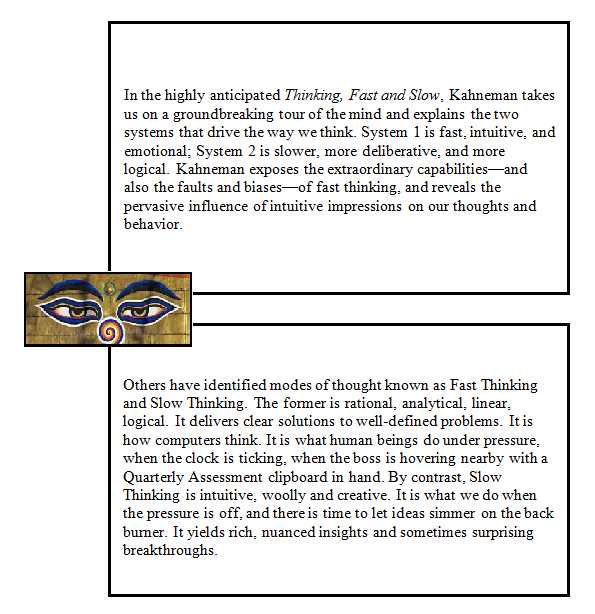
You might think, taking a quick glance at their titles, that these two books would be in substantial agreement with one another about the speeds of thought. But consider these two comments, in one of which the deliberative, logical mind is “slower” than the intuitive and emotional — while in the other, it is the rational mind that is “faster” and the intuitive mind which is “slower”. Brought together, the two quotes are amazing — it would seem that either one or the other must be wrong:

\

Happily, I don’t believe either one is wrong — I think it’s more a matter of there being three speeds of thought, and the two books in question using different terminologies to emphasize different distinctions between them.

Here’s a more extended version of Guy Claxton’s position:

Roughly speaking, the mind possesses three different processing speeds. The first is faster than thought. Some situations demand an unselfconscious, instantaneous reaction. … Neither a concert pianist nor an Olympic fencer has time to figure out what to do next. There is a kind of ‘intelligence’ that works more rapidly than thinking. This mode of fast, physical intelligence could be called our ‘wits’. (The five senses were originally known as ‘the five wits’.)

Then there is thought itself — the sort of intelligence which does involve figuring matters out, weighing up the pros and cons, constructing arguments and solving problems. A mechanic working out why an engine will not fire, a family arguing over the brochures about where to go for next summer’s holiday, a scientist trying to interpret an intriguing experimental result, a student wrestling with an examination question: all are employing a way of knowing that relies on reason and logic, on deliberate conscious thinking. … Someone who is good at solving these sorts of problems we call ‘bright’ or ‘clever’.

But below this, there is another mental register that proceeds more slowly still. It is often less purposeful and clear-cut, more playful, leisurely or dreamy. In this mode we are ruminating or mulling things over, being contemplative or meditative. We may be pondering a problem, rather than earnestly trying to solve it, or just idly watching the world go by. What is going on in the mind may be quite fragmentary. What we are dunking may not make sense. We may even not be aware of much at all. As the English yokel is reported to have said: ‘sometimes I sits and thinks, but mostly I just sits’. […]

That third mode of thinking is the one Claxton identifies with “wisdom” — which is interesting enough. Just as interesting, though, is his identification of this slowest mode of thought with “wicked problems”:

Recent scientific evidence shows convincingly that the more patient, less deliberate modes of mind are particularly suited to making sense of situations that are intricate, shadowy or ill defined. Deliberate thinking, d-mode, works well when the problem it is facing is easily conceptualised. When we are trying to decide where to spend our holidays, it may well be perfectly obvious what the parameters are: how much we can afford, when we can get away, what kinds of things we enjoy doing, and so on. But when we are not sure what needs to be taken into account, or even which questions to pose — or when the issue is too subtle to be captured by the familiar categories of conscious thought — we need recourse to the tortoise mind.

I haven’t read either book, and I’d hope that Kahneman as well as Claxton actually addresses all three speeds of thought. But my immediate point is that the slowest of the three forms of thought is the one that’s best suited to understanding complex, wicked and emergent problems.

And that’s the one that can’t be hurried — the one where the Medici Effect takes effect — and the one which provides Claxton with one of his finest lines, with which he opens his book, a western koan if ever I saw one:

There is an old Polish saying, ‘Sleep faster; we need the pillows’, which reminds us that there are some activities which just will not be rushed. They take the time that they take.

More on that front shortly, insha’Allah and the creek don’t rise.

Book: On Creativity

Friday, January 27th, 2012

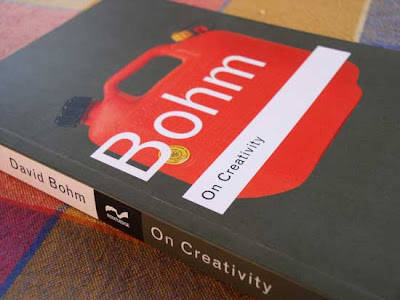
On Creativity by David Bohm 

A former student, now an adult, stopped by and gave me a copy of of On Creativity by the late and controversial quantum physicist David Bohm. Thumbing through quickly, On Creativity had an air of consilience to it that I think I will find enjoyable, though I am not sure I will agree with Bohm’s conceptions of thought and mind. At least, the book should challenge some of my preconceived opinions.

Thus, making it useful.


Switch to our mobile site