zenpundit.com » cognition

Archive for the ‘cognition’ Category

Ruminating on Strategic Thinking II. : Social Conditions

Tuesday, January 3rd, 2012
A follow up to Part I.

How does a society, as opposed to individuals, develop a capacity for “strategic thinking” ?

While war is an obvious answer, it is not an advisable first resort. First of all, although war teaches hard lessons about strategy, the costs of losing a war are high. Secondly, the costs of winning a war can be high. Thirdly, few people, relatively speaking to the number involved, have any direct input into genuinely strategic decisions during wartime; most will either gain tactical experience or be relegated to support functions. At best, wars seem to create a cohort of excellent tactical leaders with the potential to, someday, mature into strategic leaders or strategists. At worst, from a war, the wrong lessons may be drawn and institutionalized to create a future disaster.

What conditions produce strategic thinkers for a state? A brief example from American history:

Here are some of the US leadership of WWII, the postwar “Wise Men” and their Cold War successors, collaborators, thinkers and military chiefs:

Franklin Roosevelt, Henry Stimson, Joseph Grew, Dean Acheson, Douglas MacArthur, Charles E. Bohlen, George F. Kennan, Paul Nitze, George C. Marshall , Harry S. Truman, Robert A. Lovett, Dwight D. Eisenhower  , John J. McCloy , W. Averell Harriman, William Donovan, James F. ByrnesChester Nimitz,  John Foster Dulles,  James Forrestal, Vannevar Bush,  Allen Dulles, Ernest King, Albert Wohlstetter, Dean Rusk, Hyman RickoverHerman Kahn, Robert McNamara,  Bernard Brodie, Fritz G. A. KraemerMcGeorge BundyRichard Nixon, Thomas Schelling, Henry Kissinger

Some commonalities that these individuals shared, sometimes in pluralities and others in large majorities:

Above average to very high IQ
Middle class to high socioeconomic status
Eastern Establishment
Fraternal organizations
Male
Protestant
Episcopalian
Ivy League education
Law 
Politics
Military service
Diplomacy
Wall St.
Harvard
Yale
Princeton
Columbia
Harvard Law
Military Academy
University of Chicago
Berkeley
Skull & Bones
Scroll & Key
WWI
WWII
RAND
Executive Branch
Nuclear weapons/arms control/power

This list could be expanded or reduced on a number of grounds. For example, the list is composed of men primarily because almost no women, with very few exceptions, even from elite backgrounds, had an opportunity during the first 2/3 of the 20th century to contribute to strategic decisions or policy making. We could also include other characteristics, but what we have is sufficient for some broad generalizations.

  • First, these men generally engaged in careers that featured complex activities that stressed and rewarded incisive analysis of factual scenarios, assessment of risk and potential benefits, intuitive judgment and organizational abilities – law, politics, the stock market, diplomacy and corporate leadership. A minority of the list had formal training in advanced mathematics.

  • Secondly, the men all had the social wherewithal and ambition to gain entry into educational and social institutions that were by definition, highly exclusive on more than a strictly meritocratic basis. For many from higher SES families, this presented no significant barrier but for the “outsiders” like Kennan, Nixon or Rickover, it was a formidable obstacle to overcome. In either case, there were social mores or even commonly held prejudices to which they had to adapt in order to “fit in”. Despite this demonstration of social intelligence, most members of our list were not  professional politicians (but those that were made an impact on American history much greater than that of an “average” president).

  • Thirdly, the presence of such overlapping experiential commonalities, while not creating a formal “strategic community” was probably sufficient to impart a strategic mentalité as to how the world really worked, red in tooth in claw, as well as implicit ideological assumptions as how the world ought to work, if perfected. This meant that strategic debates about American national security could take place within the framework of commonly held assumptions and reference points. While certain individuals might be disliked (MacArthur, Truman, Nixon) or regarded warily, with little trust (Nixon, FDR, Kahn) their strategic arguments were nevertheless widely understood within the elite and could be assessed on their merits – an excellent environment for building an elite consensus and continuity on matters of policy and strategy. This condition may be a political prerequisite for a democratic state’s formulation and adoption of a successful grand strategy.

If we wonder why the United States has been so ineffective at strategy in recent years, maybe we should look at how our current (and most importantly, future) elite’s formative experiences have sharply diverged from their strategically gifted WWII-Cold War predecessors.
Iconic: compare and contrast III

Saturday, December 24th, 2011

[ by Charles Cameron – Iraq war, beginning and ending, analytic power of similarity ]

.

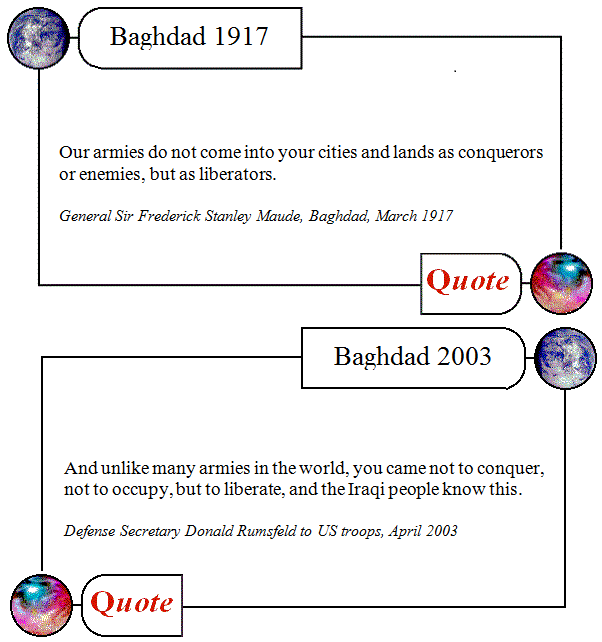
I’ve thanked Zen for his Iconic Compare and Contrast post already, but I’d like to run with his juxtaposition of images from the end of the Iraq war, and book-end it with an early DoubleQuote of mine from the beginning, thus:

That’s the beginning of the war, as I saw it “binocularly” — and here’s its ending, as Zen captured it:

Different though they are — one verbal, one visual — I think they go well together. I think they belong together.

But that’s essentially an aesthetic intuition.

*

And — apart from thanking Zen — that’s the thing I want to talk about.

The two quotes, eighty-six years apart, about an (anglophone) army in Baghdad coming there to liberate, not to conquer, are similar enough that they should give us pause for thought. They challenge us to think long and hard about the similarities between the two situations — and they challenge us to think no less hard and long about their differences.

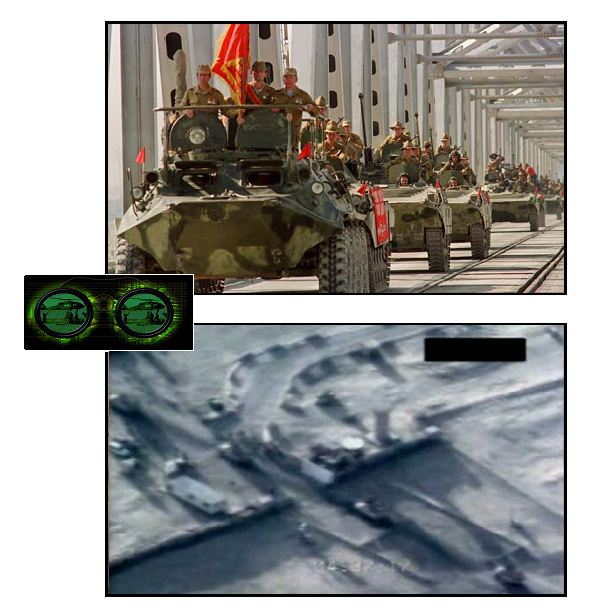
Likewise, it’s the similarities between the two images Zen chose — of the Soviet withdrawal from Afghanistan and the US exit from Iraq — that give that juxtaposition its power.  And Zen has chosen very carefully:

Not only are there two lines of vehicles stretching back from the foreground away into the distance in each image, but the angle from which the two columns are seen is about the same — and there are even two “tracks” in each photo reinforcing the vanishing point — two tracks to the right of the vehicles in the Afghan photo, the edge of the road and a what looks like the shadow of an overhead cable in the photo from Iraq.

*

But let’s take this a bit further. The following juxtaposition is every bit as much a juxtaposition of the Soviet and American withdrawals as the pair of images Zen picked, but this time we have an aerial view of the US convoy — so the visual “rhyme” between the two images is no longer there — and even though the aerial shot is an intriguing one, what a difference that makes!

There’s nothing in that juxtaposition to make you go, yes!

On the level of what’s being referred to, the troop withdrawals from Afghanistan and Iraq,  this pair of images has the same properties as the two images that Zen selected.  But it doesn’t capture our attention in nearly the same way.

And the same would have been true if I’d picked a different sentence from Rumsfeld‘s speech to juxtapose with General Maude‘s “not as conquerors or enemies but as liberators” — such as, “You’ve unleashed events that will unquestionably shape the course of this country, the fate of the people, and very likely affect the future of this entire region.” I’d still be comparing and contrasting two speeches from the beginnings of two occupations of Baghdad.  But there’d be no oomph to the comparison.

*

Because — and this is what I am trying to get at, the basic principle of HipBone analysis and what distinguishes it from otherwise similar modes of brainstorming and mind-mapping — the recognition of pattern, of salient sameness, of close parallelism or opposition is the criterion for success or failure in a HipBone-style juxtaposition.

Zen’s graphic example has that closeness — even down to those two parallel tracks beside and to the right of the vehicles.  My two quotes from Maude and Rumsfeld have that.  And it’s that closeness of match that makes a juxtaposition powerful.

Analogy works this way, rhyme works this way, fugue works this way, graphic match (in cinematography) works this way — it’s basic to the arts, basic to rhetoric, and basic to the way our analogically-disposed minds think.

It is not a method for arriving at conclusions, it’s a method for posing questions. And it sits right at the juncture where analysis admits it is not a science but an art.

Zen’s Iconic Compare and Contrast: Nine Years

Saturday, December 24th, 2011

I would like to depart from my usual style and take a leaf out of Charles Cameron’s playbook – notably his last post. Consider this a “Part II”.

Here are my selections:

Friendship Bridge, Afghanistan – February 16, 1989

….Many troops wondered how the Iraqis, whom they had worked closely with and trained over the past year, would react when they awakened on Sunday to find that the remaining American troops on the base had left without saying anything.

“The Iraqis are going to wake up in the morning, and nobody will be there,” said a soldier who identified himself only as Specialist Joseph. He said he had emigrated to the United States from Iraq in 2009 and enlisted a year later, and refused to give his full name because he worried for his family’s safety…..

Tampa Highway, Iraq – December 18, 2011

War without a strategy is like driving without a map – and in both cases you may not like your destination.

Ruminating on Strategic Thinking

Wednesday, December 21st, 2011

“Let the Wookiee win….”

Warning! Thinking out loud in progress…..

Strategy is often described as the alignment of “Ends-Ways-Means” and “planning” to achieve important goals and several other useful definitions related to matters of war, statecraft and business.  That great strategists have come in many forms, not just between fields but demonstrating tremendous variance within them – ex.  George  Marshall vs. Alexander the Great vs. Carl von Clausewitz – indicates that strategic thinking is a complex activity in terms of cognition.

What are some of the mental actions that compose “strategic thinking” or “making strategy”? A few ideas:

  • Recognition of important variables
  • Assessment of the nature of each variable
  • Assessment of the relative importance of each variable
  • Assessment of the relationships among the variables
  • Assessment of the relationship between the variables and their strategic environment
  • Assessment of current “trajectory” or trend lines of variables
  • Assessment of costs to effect a change in the position or nature of each variable
  • Assessment of the strengths and weaknesses of the variables as a functioning system
  • Recognition of systemic “choke points”, “tipping points” and feedback loops.

  • Probabilistic estimation
  • Logical reasoning
  • Introspection 
  • Extrapolation
  • Simplification
  • Metacognition
  • Horizontal Thinking
  • Insight
  • Imagination (esp. at “grand strategic” level)

  • Logistical estimation of costs
  • Normative evaluation of potential benefits
  • Understanding of temporal constraints
  • Recognition of opportunity costs
  • Recognition of boundary conditions
  • Recognition of physical constraints of strategic environment (terrain, weather, distance etc.)
  • Recognition of patterns in the history of the strategic environment

  • Net assessment of the maximum capabilities of a political community (first ours, then theirs)
  • Understanding of organizational structure of a political community
  • Recognition of stakeholders in the political community 
  • Understanding of decision making process of the political community
  • Understanding the power relationships of the decision making process of the political community
  • Understanding the distribution of resources within the political community
  • Recognition of the touchstone points of the cultural identity of the political community (positive and negative) and worldview
  • Assessment of morale of the political community and the community’s moral code
  • Assessment of psychology of individual adversary decision makers
  • Identification of points of comparative advantage
  • Recognition of how different bilateral outcomes/shifts will affect third parties
  • Assessment of relationship between the adversaries and between them and third parties

This list is not comprehensive. In fact, I have a question for the readership, particularly those with military service and/or a good grasp of military history:

Where do the interpersonal skills or “emotional intelligence” abilities that comprise the activity we term “leadership” fit into strategic thinking? Or is it a separate but complementary suite of talents? We often assume that great strategists are the great leaders, but we tend to forget all of the generals who were popular yet mediocre in the field and gloss over the human faults of those who won great glory.

I have some ideas but I would like to hear yours. Or any additional suggestions or comments you would care to make.

We spend far too much time on content, and not enough time on form

Tuesday, December 13th, 2011

[ by Charles Cameron — recursion as form — this one’s for analysts: poets should know it already ]

.

We spend far too much time on content, and not enough time on form.

We spend far too much time on the data, and not enough time on relationships. It is pattern that connects the dots with accuracy, not more dots – quality of insight, not quantity of information.

And pattern is underlying form.

Haiku is a form. The sonnet is a form, the sonata is a form. And just to juxtapose sonnet and sonata is to recognize the formal relationship between them.

1.

Recursion is the form that Doug Hofstadter explores in his book, Godel Escher Bach, and you’ll find it every time one mirror reflects another mirror (what color does a chameleon turn when placed on a mirror?), every time there’s a doll inside a doll inside a Matrioshka doll, often in the form of a paradox (“this sentence is meaningless”) – and when people take photos of themselves holding photos of themselves…

as in the pic of Noam Chomsky and Morris Halle and (in case your politics doesn’t agree so much with Chomsky) the one below them of Jacob Appelbaum and Donald Knuth in my “specs” image at the top of this post.

2.

Content can be powerful, but form really doubles up on the power. Here’s one way of thinking about it: form is what tightens information into meaning.

A couple of news reports in the last couple of days have caught my attention because of their form:

Charter of Open Source Org is Classified, CIA Says

Open Source Works, which is the CIA’s in-house open source analysis component, is devoted to intelligence analysis of unclassified, open source information. Oddly, however, the directive that established Open Source Works is classified, as is the charter of the organization. In fact, CIA says the very existence of any such records is a classified fact.

“The CIA can neither confirm nor deny the existence or nonexistence of records responsive to your request,” wrote Susan Viscuso, CIA Information and Privacy Coordinator, in a November 29 response to a Freedom of Information Act request from Jeffrey Richelson of the National Security Archive for the Open Source Works directive and charter.

“The fact of the existence or nonexistence of requested records is currently and properly classified and is intelligence sources and methods information that is protected from disclosure,” Dr. Viscuso wrote.

This is a surprising development since Open Source Works — by definition — does not engage in clandestine collection of intelligence. Rather, it performs analysis based on unclassified, open source materials.

That’s hilarious, it’s so misguided: I don’t know whether to laugh or barf (not a word I ever expected to use in my writings, but there you go).

3.

That’s sad, this one’s just plain tragic:

Protesters calling for religious tolerance attacked with stones, threatened with death

Police are investigating a violent attack on a ‘silent protest’ calling for religious tolerance, held at the Artificial Beach to mark Human Rights Day.

Witnesses said a group of men threw rocks at the 15-30 demonstrators, calling out threats and vowing to kill them.

One witness who took photos of the attacked said he was “threatened with death if these pictures were leaked. He said we should never been seen in the streets or we will be sorry.”

Killing your enemies for reasons of religion is one thing: killing those who work for peace between you and your religious enemies is no worse of the face of it – it’s religious killing, no more and no less, in both cases — but it drives the point home with considerable, poignant force.

Keep your eye out for recursion, it’s an interesting business. And respect form – it empowers content.

4.

You’ll find recursion right at the heart of Shakespeare: his plays were performed in a round theater (the “wooden O” of Henry V) called the Globe, whose motto was “totus mundus agit histrionem” – roughly, “the whole world enacts a play” – a notion which Shakespeare put into the mouth of the melancholy Jaques in As You Like It:

All the world’s a stage,
And all the men and women merely players.
They have their exits and their entrances,
And one man in his time plays many parts…

A martial version of this idea, indeed, can be found in the philosopher Plotinus, who wrote in his Enneads (3.ii.15):

Men directing their weapons against each other — under doom of death yet neatly lined up to fight as in the pyrrhic sword-dances of their sport — this is enough to tell us that all human intentions are but play, that death is nothing terrible, that to die in a war or in a fight is but to taste a little beforehand what old age has in store, to go away earlier and come back the sooner. So for misfortunes that may accompany life, the loss of property, for instance; the loser will see that there was a time when it was not his, that its possession is but a mock boon to the robbers, who will in their turn lose it to others, and even that to retain property is a greater loss than to forfeit it.

Murders, death in all its guises, the reduction and sacking of cities, all must be to us just such a spectacle as the changing scenes of a play; all is but the varied incident of a plot, costume on and off, acted grief and lament. For on earth, in all the succession of life, it is not the Soul within but the Shadow outside of the authentic man, that grieves and complains and acts out the plot on this world stage which men have dotted with stages of their own constructing.

5.

I thought it would be interesting to see if recursion had power, too, in the field of religion, and this passage from Ephesians (4.8) sprang to mind…

When he ascended up on high, he led captivity captive, and gave gifts unto men…

That’s a lovely recursion, “leading captivity captive”. But I think we can go deeper. John Donne‘s sonnet Death be not proud reaches to the very heart of the Christian message, it seems to me –it parallels the passage from Ephesians closely, while focusing in on the hope of resurrection with its stunning conclusion:

Death, thou shalt die.

Here’s the whole thing: profound content in impeccable form:

Death be not proud

Death be not proud, though some have called thee
Mighty and dreadfull, for, thou art not so,
For, those, whom thou think’st, thou dost overthrow,
Die not, poore death, nor yet canst thou kill me.
From rest and sleepe, which but thy pictures bee,
Much pleasure, then from thee, much more must flow,
And soonest our best men with thee doe goe,
Rest of their bones, and soules deliverie.
Thou art slave to Fate, Chance, kings, and desperate men,
And dost with poyson, warre, and sicknesse dwell,
And poppie, or charmes can make us sleepe as well,
And better then thy stroake; why swell’st thou then;
One short sleepe past, wee wake eternally,
And death shall be no more; death, thou shalt die.

6.

What do you think?


Switch to our mobile site