zenpundit.com » cognition

Archive for the ‘cognition’ Category

Guest Post: Few’s The Serenity Prayer for Grand Strategy

Thursday, May 26th, 2011

[Cross-posted from SWJ Blog]

Major Mike Few, one of the SWJ Blog’s trusty editors opines on the nuts and bolts of “doing grand strategy”. Pay close attention to points #2 and #7. Hopefully, the first of many guest posts here by Major Few, if I can steal some of his time from Dave Dilegge 🙂 :

The Serenity Prayer for Grand Strategy: Nine-Step Recovery Method for Reframing Problem Solving

by Mike Few

Recently, our authors began to shift from problem definition to reframing problem solving. Over the last year, we published some remarkable works effectively describing Iraq, Afghanistan, Mexico, Libya, and others. Simultaneously, we published several series on design and wicked problems.

The challenge we are posing is can someone produce a concise document applying design to an existing problem? If we cannot find practical application or wisdom, then the process becomes a moot effort. Below is my white board attempt to provide an example and discussion for others to follow. This blog post is similar to many of the discussions our authors and readers have daily in the classroom and nightly at the pub or dinner with colleagues. Simply put, I am merely merging the sum of our published thought and discussions.

Three years ago, I was challenged to determine if my experiences in big wars and counterinsurgency could be applied to the macro level. On the tactical level, I found that I simply relearned the lessons of those that had come before me, the countless art of war and warfare. However, when I consider how my thinking had changed, I feel that perhaps there are some lessons that can be applied for us all.

In combat, I finally learned the limits of my own control. This understanding freed me to concentrate focusing on changing the things that I could control. I look at framing problem solving in international relations in a similar manner. It’s kind of like the Serenity Prayer for Grand Strategy. So, as a practical exercise, below is an example of how I would use Design, Wicked Problems, and Military Decision Making Process using the example of Mexico.

1. Define what we cannot control. We cannot “fix” Mexico. They are a sovereign nation-state, and they must choose to work on their internal issues. Moreover, our “solution” to their problems may not be a proper fit despite our best intentions. Our intervention efforts in Central and South America over the past sixty years (or more) have had mixed results.

2. Define the problem as it is not as we wish to see it. Are we really in a war on poverty, drugs, education, terrorism, and governance? Are we really at war? Labels are often limiting, but there needs to be some common framework to understanding. Typically, that can be driven by good communication and active listening. We must learn to transcend how “I” see the problem and work towards how the collective group sees the problem accounting for all stakeholders.

3. Define our relationship. How does the US and Mexico see each other? This perception requires a degree of self-introspection and humility. Are we a brother attempting to help our sibling overcome addiction or work through difficult financial times? Are we a parent disciplining a spoiled child? Are we a spouse in a broken marriage? How we see ourselves defines our national interest. If we see ourselves as the parent, then we’re self-imposing a conceptual block.

As Martin Luther King wrote while sitting in the Birmingham Jail,

“Moreover, I am cognizant of the interrelatedness of all communities and states. I cannot sit idly by in Atlanta and not be concerned about what happens in Birmingham. Injustice anywhere is a threat to justice everywhere. We are caught in an inescapable network of mutuality, tied in a single garment of destiny. Whatever affects one directly, affects all indirectly. Never again can we afford to live with the narrow, provincial “outside agitator” idea. Anyone who lives inside the United States can never be considered an outsider anywhere within its bounds…In any nonviolent campaign there are four basic steps: collection of the facts to determine whether injustices exist; negotiation; self-purification; and direct action.”

4. Describe what we are currently doing and how we can adjust these things.

– Impact of NAFTA
– Border Security
– FID efforts in Mexico
– Counter-Drug efforts in Mexico
– Counter-Drug efforts in the United States
– Anti-Gang efforts in the United States

5. Discuss the cost benefits of future intervention efforts and internal reforms

– Comprehensive immigration reform
– Dream Act
– Expanded Counter-Drug efforts
– Expanded FID efforts to better strengthen Mexico’s Army and Police internal security forces
– State Department “better” governance efforts (Plan Colombia)- to include judicial and economic issues
– Legalizing drugs in the continental United States (demand side interdiction)
– Comprehensive Prison Reform in the United States
– Treasury Department financial interdiction to narco banking
– Promoting and expanding free press in Mexico through Twitter, Facebook, and new media

6. Describe Area of Influence- Central and South America

– Illegal immigration from Guatemala
– Drug Trafficking from Colombia

7. Ask the hard questions

-What are the key factors driving the problem?
-What is the causality?
-And, if the analysis is from a U.S. perspective, to what degree and in what ways is the problem a problem for the United States?
-what ways do those in power benefit by the status quo?

8. Rethinking the Assumptions

-What are the desired outcomes?
-Is the policy driving the process or is the effort outcome based?
-Are our efforts helping or hurting?

9. Timing of Implementation

– Simultaneous, Sequential, or Cumulative
-Prepare to accept that some items are not decision points; Rather, they are processes that change and morph over time.

Special thanks to those that contributed to the proofreading of this post, and I would like to specifically highlight Dr. Nancy Robert’s methodology for teaching any class on problem solving,

A. Creativity
B. Problem Framing
C. Systems thinking
D. Entrepreneurship and Innovation
E. Collaboration in Networks

Now, let the discussion and writing continue…
Towards a Pattern Language for CT? III

Tuesday, May 17th, 2011

[ by Charles Cameron — all middle and no end ]

.

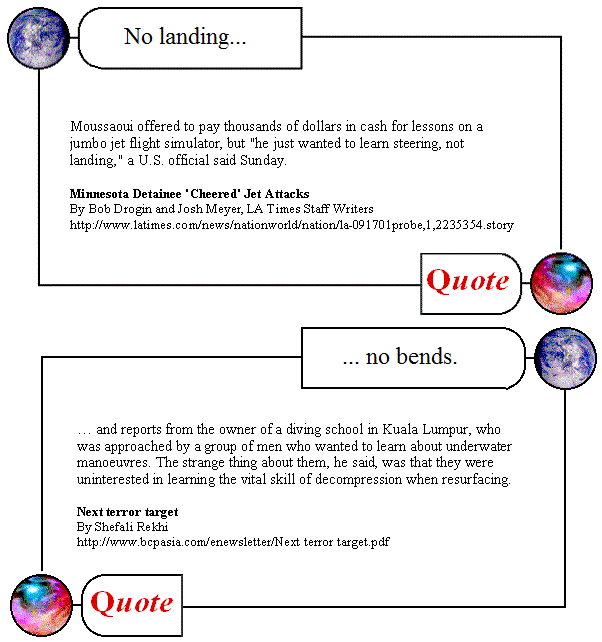
And while I’m at it, I might as well post one of the very first DoubleQuotes I put together when I was first experimenting with the format, sometime between October 2003 and June 2004

quo-pilots-divers.gif

I thought then, and I think now, that a walkway lined with dozens of little plaques presenting odd snippets of fact like either one of those would be a marvelous device for triggering associations in ambulatory analysts…

And it is a recurring pattern, isn’t it?

Ominously, there have been cases of terrorist pirates hijacking tankers in order to practice steering them through straits and crowded sea-lanes-the maritime equivalent of the September 11 hijackers’ training in Florida flight schools. These apparent kamikazes-in-training have questioned crews on how to operate ships but have shown little interest in how to dock them. In March 2003, an Indonesian chemical tanker, the Dewi Madrim, was hijacked off Indonesia. The ten armed men who seized the vessel steered it for an hour through the busy Strait of Malacca and then left the ship with equipment and technical documents.
.
Gal Luft and Anne Korin, Terrorism Goes to Sea, Foreign Affairs, Nov/Dec 2004

It helps to be alert to rhyming between ideas

Creativity and the laughable

Monday, May 16th, 2011

[ by Charles Cameron — creativity, Taliban, Leonardo, pareidolia, Virgin Mary, Kwan-yin ]
*

.
Sharing, as I do with Zen, a keen interest in the creative process, I am used to the idea that an idea that seems trivial at first, the very expression of which risks making oneself a laughing-stock, may well carry the seed of success.

Whitehead is quoted as saying, “Every really new idea looks crazy at first.” Einstein, “If at first the idea is not absurd, then there is no hope for it.” Nils Bohr, “Your theory is crazy, but it’s not crazy enough to be true.” The idea is not even confined to physicists and mathematicians. Mark Twain observed, “The man with a new idea is a crank – until the idea succeeds.” And Winston Churchill, “No idea is so outlandish that it should not be considered with a searching but at the same time steady eye.”

I was therefore intrigued to read this account of the origins of the Taliban’s recent Kandahar prison break:

One of the surprising mujahideen squad in the city of Kandahar, who by his connections gained full knowledge of the inside and outside of the prison, pondered one day whether it could be possible to dig a tunnel from the inside of a house on the other side of the street to the prison as a means to releasing the prisoners. This fantasy and imagination seemed laughable at first even to its owner; he dared not share his opinion with others. But, after more time and continued thinking, he reached a conclusion. On one of these days, while he was riding a motorcycle with two of his comrades, he shared that view with them. They thought it impossible initially and deemed it a fruitless, dangerous attempt. Finally, they placed their trust on God and shared their opinion with the mujahideen high command in Kandahar. With guidelines from the command, the aforementioned four revealed [to] their trusted comrades their decision to implement this plan regardless of its risks and even if it looked impossible.

The sentence that really got my attention was this one:

This fantasy and imagination seemed laughable at first even to its owner; he dared not share his opinion with others.

*

Leonardo da Vinci once wrote of having “a new and speculative idea, which although it may seem trivial and almost laughable, is none the less of great value in quickening the spirit of the invention.”

His “trivial and almost laughable” idea?

It is this: that you should look at certain walls stained with damp or at stones of uneven colour. If you have to invent some setting you will be able to see in these the likeness of divine landscapes, adorned with mountains, ruins, rocks, woods, great plains, hills and valleys in great variety; and then again you will see there battles and strange figures in violent action, expressions of faces and clothes and an infinity of things which you will be able to reduce to their complete and proper forms. In such walls the same thing happens as in the sound of bells, in whose strokes you may find every word which you can imagine.

Essentially, Leonardo is suggesting that we use what’s effectively the Rorschach technique to induce pareidolia (I think that’s the state) and elicit mental contents – images triggered by the mind’s eagerness to sense meaning – thus imitating the universe itself in bringing something out of nothing, out of the potent void.

*

This is, however, the same psychological mechanism that brought us the sale of a grilled cheese sandwich for $28,000 on eBay – because it “looked like” the Virgin Mary

That’s not a note I’d like to end on, however — so I’ll just remind myself that we don’t “know” what the Virgin Mary looks like, and pass on to the rather charming story of a similar pareidolic image, this one possessing the almost miraculous property of looking simultaneously like the Blessed Virgin and the bodhisattva of compassion, Kuan-Yin:

Situated in the East Bay area, near the lovely city of San Francisco, the Purple Lotus School is witnessing yet another miracle. … In April 1996, when the great “Merit Wall” on campus had just been constructed, a mysterious face appeared on the wall immediately after the cement dried. … Buddhists who have witnessed this phenomenon believe this to be the face of the compassionate Bodhisattva Kuan-Yin. … Others have believed this image to be that of the Virgin Mary. Magia and Junia Chou, the daughters of the Purple Lotus Society’s Master Samantha Chou, attend a Catholic elementary school. Upon seeing the image, both called out earnestly and delightedly, “Look! It’s the Virgin Mary!” … With the essence of Enlightenment and universal wisdom in mind, perhaps one can argue that a distinction between the two is not important after all.

*

It’s laughable, I know — but I must confess I like the “meaning” I can draw from that…

Guest Post: Shipman Reviews The New Digital Storytelling by Bryan Alexander

Thursday, May 12th, 2011


J. Scott Shipman, the owner of a boutique consulting firm in the Metro DC area that is putting Col. John Boyd’s ideas into action, is a longtime friend of this blog and an occasional guest-poster.

Book Review: The New Digital Storytelling

by J. Scott Shipman

Bryan Alexander’s  The New Digital Storytelling, Creating New Narratives With New Media is an excellent, highly readable, and comprehensive treatment of storytelling in our digital world. Dr. Alexander manages in 230 pages of text to capture the universe of available methods, processes, resources and tools available to storytellers, as of 2010. His 36 pages of notes and bibliography includes an exhaustive list of websites and sources used.

Dr. Alexander aimed his book at “creators and would-be practitioners,” storytellers looking for new digital ideas, to include teachers, marketers, and communications managers. Whatever your background, he assures in the introduction, “herein you will find examples to draw on, practical uses to learn from, principles to apply, and some creative inspiration.” I can’t speak for those in the target audience, but as one with but a casual interest in storytelling, I can say Dr. Alexander delivered! Over the course of the couple of days of reading, I came up with about a half-dozen ideas and discovered my MacBook Pro has a lot more under the hood than I ever appreciated or used.

That said, Dr. Alexander warns that his book is not a “hands-on manual” on the tech media discussed. In fact, he assumes the reader will not “be a technologist” and the material is presented accordingly. He says:

The New Digital Storytelling straddles the awkward yet practical divide between production and consumption, critique and project creation.”

The book is divided into four parts:

Part I Storytelling: A Tale of Two Generations

In Chapter 1 Dr. Alexander provides an unambiguous meaning to digital storytelling: “Simply put, it is telling stories with digital technologies.” The medium providing this review to you is my digital story about the book. But that is just the beginning; just about every digital device imaginable is being used to tell stories; blogs, social media, videos, and even in Twitter’s 140 character limit, storytelling genres are emerging [readers at zenpudit.com will recall Charles Cameron’s use of Twitter feeds following UBL’s death]. As Alexander points out, “no sooner do we invent a medium than do we try to tell stories with it.”

In Chapters 2 & 3, Dr. Alexander provides a history of digital storytelling in two parts; part one is what he calls “the first wave.” From foundations in the 70’s and 80’s (his reference to the 1983 movie War Games brought back memories) to the evolution and importance of hypertext. Alexander asks, “How do hypertexts work as digital stories? Users—reader—experience hypertext as an unusual storytelling platform. We navigate along lexia (“multiple readable chunks”) picking and choosing links to follow.” This point truly “clicked” for me; one of the pleasures of reading zenpundit.com is the ubiquity of supporting links and how sometimes these links lead to unexpected, but valuable adventures. Often I’ve landed in a place I would never have found if not for the first “story.” Alexander writes that Web 2.0 has allowed for “the ability to create content for zero software cost is historically significant, and now par for the course.” He points out with the ubiquity of hardware (both PCs and mobile devices) and the social element (social media, for example) a means of of delivery and an architecture are in place where potential storytellers have a low barrier to entry—to get their story out. Alexander includes gaming devices (mobile and console) in the review of the Web 2.0 phenomena.

Part II New Platforms for Tales and Telling

Chapter 4 is a comprehensive review of Web 2.0 storytelling and the fragility of systems existing today, but perhaps gone tomorrow. Dr. Alexander covers distinct types of blogs used in sharing stories; blogs are ubiquitous and the barriers to entry negligible. He covers epistolary novels and diary/journal-based stories and provides numerous examples. One example was News from 1930, which “posts selections from each day’s Wall Street Journal” during the early days of the Great Depression—in essence, a blog as a realtime history lesson. But as we know, the blogosphere is bigger than history, there also exists a market for various fictional stories which include reader interaction/collaboration. Also included are examples of character blogging (as Alexander notes: “Bloggers are characters”) where personalities are revealed over time in a serial nature. Twitter has developed into a unique format for storytelling, forcing the user to pack as much as possible in precious few words/characters. Wikis, social images and Facebook are also covered and explained in ways that made me think about “how” I use social media.

Chapter 5 covers in detail social media storytelling…and this is one of my favorite chapters. Alexander explains podcasts in a way that was accessible and in a way that made me want to “do” a podcast! A podcast is limited to audio, but a web video places a whole new spin on our ability to digitally tell our stories. Chapter 5 is rich in resources and insight.

In chapters 6 and 7 Alexander discusses gaming and storytelling. This may be the part of the book that was over my head (I’m dubious of the real utility of “gamification” in a meaningful/productive way). One sentence did jump off the page: “One key aspect of game-based storytelling is the immersion of the player in the story’s environment.” Indeed, “intimacy” is an enormous missing ingredient in more than storytelling and absolutely necessary in proficiency in just about any endeavor. One other sentence made a big impression: “Children also learn a deep secret about art, which is that the less detailed the representation of a character, the easier it is for us to identify with him or her.” I believe guys like the internet Oatmeal guy and the creator of Zen’s recent post  have figured out this phenomena isn’t limited to children.

Part III Combinatorial Storytelling; or, The Dawn of New Narrative Forms

Chapters 8 through 11 covers the networked book, mobile devices, and alternate reality games. The networked book resonated with me because of something from my distant career on submarines (early 80’s); we would write a story where periodically storytellers would add a sentence and half to an evolving text. The results were always amusing and never predictable. Networked books sound very similar to our collaborative efforts 30 years ago, but with the ubiquity of digital tools, opportunities abound. For example “transmedia storytelling,” where “story content is distributed across multiple sites and media; the movie trilogy, an anthology of animated films, comics, computer games, a massively multiplayer online game, Web content, and additional DVD content.” This dispersion of story content and the variety of venues allows users a more “immersive experience”—-the intimacy Alexander described earlier. Mobile devices are literally changing just about every aspect of our world from political meetings, classrooms, clinics “now that those present can hit the Web for fact checking or peer support.” An excellent recent example was the squashed attempt of the United States Naval Institute’s board to change the organization’s mission. Platforms like Twitter, Facebook, and LinkedIn were used to get the word out to members who took action. New tablet devices will continue to drive this phenomena. Alexander’s treatment of alternate reality games revealed “worlds” created with our world by game participants of such products as Second Life.

Part IV Building Your Story

In the final chapters, Dr. Alexander provides example of “how to” build a digital story, using the classic Center for Digital Storytelling workshop model. For me, this was the most thought-provoking section. The description of how a workshop is conducted, the questions used to prompt creative/insightful “story-able” thought is worth the price of the book. Alexander inventories the software available for audio, images, video editing, publication, concept mapping, and other production tools. This inventory of tools describes the appropriateness of each with respect to the level of experience of the storyteller. Digital storytelling in education is covered in Chapter 14 and is a rich resource for parents and educators who want to leverage the digital world.

The New Digital Storytelling should be the standard guide for anyone who wants to use all the new digital gadgets available to tell their story; this book is an excellent one-stop resource. I plan to use what I’ve learned in the expansion of my family tree history to an A/V platform and have already built a to-do list to get started.

One closing thought; the irony isn’t lost that this “book” about digital storytelling is made of paper, glue, and ink. I can only imagine what an adventure this would be if presented digitally where all the links were connected…a digital story on how to tell digital stories.

The New Digital Storytelling comes with my highest recommendation. Get this book, use those tools, and tell your stories.

Answering Ronfeldt’s Question About the Nature of Strategy

Wednesday, May 4th, 2011

RAND emeritus scholar and co-author of the classic Netwars and Networks, David Ronfeldt asked an astute question in reaction to my post proposing a grand strategy board:

I almost always see strategy defined as the art of relating ends and means.  It’s defined that way time after time, often but not always with a few extra criteria added here and there.  Usually something about plans or resources.  But I’ve long felt that I’d prefer to define strategy as the art of positioning.  That presumes a consideration of ends and means, but in my view, it’s not as abstract a definition, and gets to the core concern right away.  In looking around for who else may favor such a definition, the best and almost only leader I find is Michael Porter and his writings about corporate strategy.  He’s says explicitly that strategy is the art of positioning – apropos market positioning in particular.  maybe in some long-forgotten moment, that’s where I got the notion in the first place.  Meanwhile, i’ve been told that, of military strategists, Jomini emphasizes positioning the most.  This is not my area of expertise.  I’d like to know more:  is the “ends and means” view so accepted, so basic, so adaptable, that it’s not worth questioning?  What’s to be gained, and/or lost, by the “positioning” view?  Is there any strategy that isn’t about positioning? 

This is a great question, because it is a clarifying question about fundamentals.

I am not familiar with Micheal Porter’s work, but Chet Richards pointed out in his excellent Certain to Win that there are some significant differences in applying strategic thinking to business compared to using strategy in war. While war and the market both represent dynamic, competitive environments which require actors to adapt to survive, war is a destructive enterprise while business is ultimately transactional, cooperative and constructive, though you may have to overcome competition and conflict first. Conflict and competition on which the state and society place tight legal constraints to which buyers and sellers must conform.  Arguably, this explains the drift toward oligopolistic competition in regulated capiltalist economies: the constraints of rule of law which govern market actors would tend to give an even greater emphasis to “positioning” in peaceful economic competition than in warfare.

What about “positioning” and strategy generally?

Strategy is indeed defined by most experts as the alignment of Ends -Ways -Means. In my opinion, it is the most practical starting point for people of any level of strategic skill to consider what is to be done in the short or medium term within a known framework ( a theater, region, an alliance system, nation-state etc.). “Positioning” falls within this trinity under “ways” – for example, something as simple as seizing the high ground or as complicated as maneuver warfare theory is, in essence, an effort to acquire a comparative advantage over your opponent. Having comparative advantages are always good but they are usually transitory rather than being something that can be “locked in” permanently ( though man has tried – ex. the Great Wall of China, Constantinople on the Dardanelles, the age of fortresses in 16th-17th C. Europe, Mercantilist Policy, Massive Retaliation etc.). Normally, you have to keep moving, tactically adjusting your position in response to your opponent’s efforts to re-balance.

Positioning also exists outside the trinity of Ends-Ways-Means as the initial starting conditions that shape subsequent strategy. The phrase “Where you stand depends on where you sit” conveys the lesson that our perspectives, our premises, are deeply affected from where we begin. Geopolitical theory is rooted in this idea but positioning can be something other than physical location – politics and culture are positional because they are embeded with values and what we value to some extent determines what our Ends are going to be and how we perceive and define the problem for which we will employ a strategy to overcome.

The latter kind of positioning can be *very* problematic because ideological concerns inflame passions, distort our rational calculus of matching means to ends and generally introduce ever larger amounts of irrationality into strategic decision making at the expense of empirical observation. Boyd would call this a “mismatch” with reality from a corrupted OODA Loop and a textbook example would be the behavior of Imperial Japanese leaders in WWII. Launching an unwinnable war with the United States and prosecuting it almost to national annihilation was driven to a demonstrable extent by Japanese cultural norms related to honor, debt (on-giri), the “Imperial Will” and dysfunctional constitutional arrangements that made extricating Japan from a strategic cul-de-sac politically impossible. To a lesser extent, American prosecution of the war in Vietnam and the occupation of Iraq share similar irrationality derived from a priori ideological positioning.

A final observation:

When time horizons are very long and/or the problem is ill-defined and the framework boundaries vague or unknown or uncertainty high, the cognitive requirements for strategic thinking shift and it may not be possible to move beyond speculating as to Ends to the point where action should or even can be taken effectively. More information may be required. 0r greater means than exist. The problem may only be a hypothetical potentiality, rather than an actual problem. This point is one that is likely to be disputed as even being in the realm of strategy and could belong in that of theory or politics, depending on your perspective.

Many readers here are students of strategy or even professional strategists. In the interest of brevity, I’ve avoided getting into the specifics of schools of strategic thought or Clausewitz vs. Sun Tzu or Jomini, but I’d like to invite readers to weigh in on Dr. Ronfeldt’s question or my response as they wish.


Switch to our mobile site