zenpundit.com » cognition

Archive for the ‘cognition’ Category

Fisking McCaffrey’s Futurism

Monday, March 24th, 2008

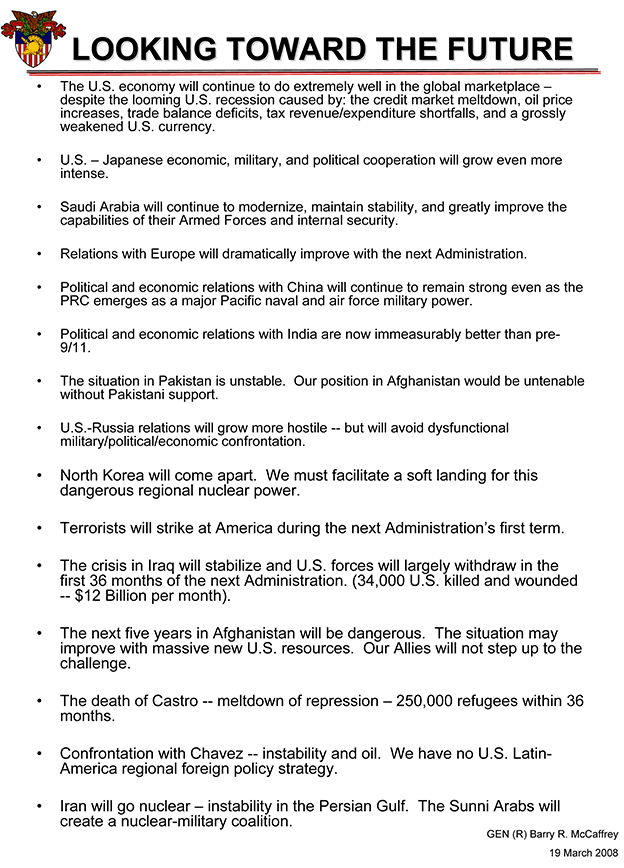
Yesterday, The SWJ Blog ( and blogfriends on Twitter, one of whom characterized it as “weak”) aleted me to a futurist slide by General Barry McCaffrey with his predictions of potential national security events faced by the United States in the near term. I’m certain this was in the context of a much larger presentation, given to a specific group with stated policy concerns; unfortunately, those particulars are unknown to me:
futurism.gif

My commentary:

First of all, one notes the number of “safe” predictions in the sense that none of these represent even the likeliest of outliers much less scenarios representing true, statistical rarity, “Gray Swans”. There’s a certain probalistic logic to doing so – the status quo more often than not in any given scenario will continue uninterrupted except by minor adjustments. On at least half of this list, given the breadth and/or vagueness, I’m certain that McCaffrey will be able in five years to say that he was more right then wrong. Unfortunately, the narrow number of domains from which he is extrapolating – nothing on cutting edge tech, applied science, the environment, macrodemographics, religious fundamentalism or interesting “intersectional” possibilities – leaves  policy makers with a vision that may be more susceptible to a Black Swan event than before by reinforcing previously held expectations.

Sidebar: I’d love to see Art Hutchinson, Tom Barnett, John Robb , Michael Tanji and the gents at Kent’s Imperative also critique the slide.

Now, in fairness, to the good General, a few of his bullet points are more interesting than others. I think McCaffrey’s called a hard landing for Cuba correctly unless Raul Castro has a secret admiration for Deng Xiaoping and the comprehension of economics to execute a Deng-like transition. It will be difficult for Cuba to really open up without the economic logic of the American market and favorable asylum policies for Cubans immediately kicking in as it did for the East Germans when the other Soviet bloc states ceased cooperating with Honecker’s repressive policies. With Chavez too, I think General McCaffrey is correct given that there is a little remarked friction between Venezuela the oil producer and America the refiner of Venezuelan oil ( refining capacity is itself a choke point along with oil production nor is all crude created equal; some is more expensive to refine than others). Finally, the temptation for al Qaida to “send a message” to the new administration and create downstream political effects may prove well-nigh overwhelming; it may even override their present policy of waiting until to pull off a catastropic level act of terror.

How do you see it ? Comments, questions, rants are all welcome.

New! Vandergriff’s Adaptive Thinking Blog & Cameron’s Cognitive Mapping Blog

Sunday, March 23rd, 2008

Military education reformer and author Don Vandergriff has joined the blogosphere and  he is off to a nice start:

First of all, my hat’s off to anyone that ventures out and participates in something like the adaptability conference. It takes moral courage to admit, “maybe I can get better, let’s see what happens here.” More compliments to the person’s organization if the organization was willing to support and encourage its people to get better. Too many organizations focus on the short term profit and simply don’t want to lose control of its people, don’t take the opportunity to make a long term investment in making its people more competent and confident. These attributes are the hallmark of adaptability.

I use a series of different games and scenario based education to involve the students (or participants) in the discussion about how to evolve adaptability in themselves and in their organization. The students end up doing the talking and usually solving or finding the answers to their questions. Each and every time any group does these exercises, they assume that I, as the facilitator, limit what they can do, like asking question to broaden their assumptions and courses of actions, and that I will always say no if they do ask a question, like “can we have more time.”

I will leave you with this thought, after doing this approach with games and getting similar results from audiences the past 50 times, why do students box themselves in? What does that tell us about ourselves and our organizations, when we always assume the negative? How does this limit our “evolutionary adaptability”?

Facilitation is the skill that separates the great teacher, who leaves an intellectual legacy in the form of students whose worldviews they have been profoundly impacted, from the scholar who is merely competent in the classroom. The latter knows their field while the former knows how to elicit students to think about the field in a deep and meaningful way.

Not all “star” scholars are great facilitators because that skill requires a good deal of self-restraint to guide students to the point where they can make the leap to discovery and comprehension on their own ( genuine learning, in other words). A high tolerance for failure and error is required because students will initially go down well-trod blind alleys ( well trod to the instructor, not to the students – this is a perspective that academics frequently overlook) before realizing that they need to generate alternative solutions. Facilitation, unlike pontification, keeps students cognitively active and on-task with timely re-direction or adaptively ( modeling for the students) takes advantage of a student insight to create a learning moment for the larger group.

I look forward to reading more in this vein from Major Vandergriff in the future ( Hat tip to DNI )

Charles Cameron, who already blogs in his area of professional expertise at Forensic Theology, has added Hipbone Out Loud to his arsenal:

Understanding is modeling, mapping.

In this blog, I want to capture the glimpses I have of an extraordinary world, each glimpse being a tiny area of a vast map – certainly more sophisticated than any individual can generate with data visualization tools and modeling software, perhaps more complicated than a single culture can grasp as a collective – but important, as it is the matrix in which our individual and cultural life-maps fall.

You will find I favor quotes and anecdotes as nodes in my personal style of mapping – which lacks the benefits of quantitative modeling, the precision with which feedback loops can be tracked, but more than compensates in my view, since it includes emotion, human identification, tone of voice.

The grand map I envision skitters across the so-styled “Cartesian divide” between mind and brain. It is not and cannot be limited to the “external” world, it is not and cannot be limited to the quantifiable, it locates powerful tugs on behavior within imagination and powerful tugs on vision within hard, solid fact.

Doubts in the mind and runs on the market may correlate closely across the divide, and we ignore the impacts of hope, fear, anger and insight at our peril.

I’ve featured the writing of Charles Cameron here before because he produces posts rich in both complexity and depth, generating intriguing horizontal-thinking patterns that would have easily escaped my attention.  This another blog that I’ll be checking frequently.

Deep Understanding

Friday, March 21st, 2008

Michael Tanji points to this report by RAND to explain why the IC isn’t demonstrating any.

Part of the problem, I will hazard is a guess, is legacy security and pesonnel policies. “Deep understanding” of cultural-political variables of foreign societies requires a mix of academic historical, linguistic and social science expertise coupled with extensive “in-country” experience. Ideally, in the same analyst but failing that at least within the same analytical team. Aside from the collector-analyst division which could stand some erasure, many of the most useful sort of moldable, raw, talent – children of native speakers and Americans with extensive experience living overseas – have a difficult time getting through the clearance process.

Then, once these folks are in, cultivation of a strategic perspective – which includes synthesis, intuition and imagination and a long time horizon alongside analysis – have to become a priority over narrow analytical-reductionism and a “presentist” mindset. We have guys who do the latter already, they’re called journalists and the best of them do it very well. The IC should be playing at another level.

Adaptive Leadership Conference

Wednesday, March 19th, 2008

It isn’t quite being “liveblogged” but DNI is putting up posts on The Adaptive Leadership Conference.

I had the pleasure of meeting Maj. Don Vandergriff at Boyd 2007 and his brief on adaptive thinking, while targeted at reforming military education, has a facilitated “free play” nucleus that would be applicable to a wide variety of secondary and postsecondary educational settings to develop creative thinking based problem solving skills in students. Many of Vandergriff’s ideas are laid out in his book,Raising the Bar: Creating and Nurturing Adaptability to Deal with the Changing Face of War.

Hopefully, DNI will soon be providing an analysis of some of the presentations.

The Virtue of Recess

Sunday, March 9th, 2008

Recess is a historical staple of elementary education in America and it is still not uncommon to see children granted small amounts of time for “free play” or educational games in the primary grades. Unfortunately, this practice is under fire in recent years. Some critics of public education or politicians would prefer to see that time devoted to increased amounts of formal, skill-drill exercises; but aside from the fact that test-prep activities quickly hit the point of

diminishing returns in terms raising a school district’s aggregate mean test scores ( a little is good, a lot is not) the so-called ” wasted free time”, is actually neurologically vital for the optimum cognitive development of children’s brains. It’s good for us older folks too but that’s a topic for another day.

A report from the excellent Eide Neurolearning Blog:

Remembering to Play

“Several recent articles remind us of the importance of play. From NPR, Old-fashioned play builds serious skills, and NYT, Taking Play Seriously.Also from the American Academy of Pediatrics (The Importance of Play for Health Child Development pdf : “Play allows children to use their creativity while developing their imagination, dexterity, and physical, cognitive, and emotional strength. Play is important to health brain development…Undirected play allows children to learn how to work in groups, to share, to negotiate, to resolve conflicts, an to learn self-advocacy skills.” An increased in hurried lifestyles and school-based academic performance may leave a child with little unstructured time. In one survey by the National Association of Elementary School Principals, 30% of kindergarten classes no longer had recess periods

….An additional point made in the NYT article, was the importance of play for the development of the cerebellum. For kids with sensory processing disorders, this is a big one. Sometimes the earliest indication that something isn’t “quite right” is when a child avoids the normal rough-and-tumble play on the playground. That’s why without intervention, a child may accumulate even fewer play experiences and fall even farther behind their classmates with time.”

Read the rest and find additional brain-learning resources here.

While older students do not have “recess”, time for creative, exploratory and imaginative learning activities should be a regular aspect of core academic classses.  The chance to “play” with concepts, solve puzzling scenarios, smash ideas up in a synthesis, articulate  new or unorthodox  solutions to old problems is a teaching strategy for students to arrive at a deeper understanding of the subject at hand. It trains them to create and evaluate analogies, test the logical soundness of each other’s ideas, debate and experiment. Less structured but goal-directed time is a valuable investment as independent thinking cannot be cultivated in a classroom where every moment is direct instruction and rigidly scripted. At some point, the training wheels have to come off if we are to discover which students can ride on their own and which ones need additional guided practice.

Furthermore, in relation to “play”, music, the arts, sports and drama play a critical role in brain growth and do not represent “frills” but a central modality for integration of concepts, application of learning and generation of insight. As subjects, they are the brain’s “Right” side exercises to the ” Left” side’s analytical-logical reasoning provided by mathematics instruction and science classes.

As a society, we have gone berserk on overscheduling children into formal activities, academic as well as extracurricular, to the point where some elementary age kids show signs of anxiety, burn-out and depession or have time with their families that is not devoted to some kind of structured, formal, event. I find that many students lack any real cognitive independence, normal childhood creativity or the ability to negotiate social interactions with peers without hands-on, adult, supervision. A kind of well-meaning, suburban, shelteredness that produces a vaguely “institutional” passivity in many children.

Our students need both structured learning as well as some degree of “space” or “freedom” in order to maximize their intellectual and emotional growth, not either-or.


Switch to our mobile site

