Fisking McCaffrey’s Futurism
Monday, March 24th, 2008Yesterday, The SWJ Blog ( and blogfriends on Twitter, one of whom characterized it as “weak”) aleted me to a futurist slide by General Barry McCaffrey with his predictions of potential national security events faced by the United States in the near term. I’m certain this was in the context of a much larger presentation, given to a specific group with stated policy concerns; unfortunately, those particulars are unknown to me:
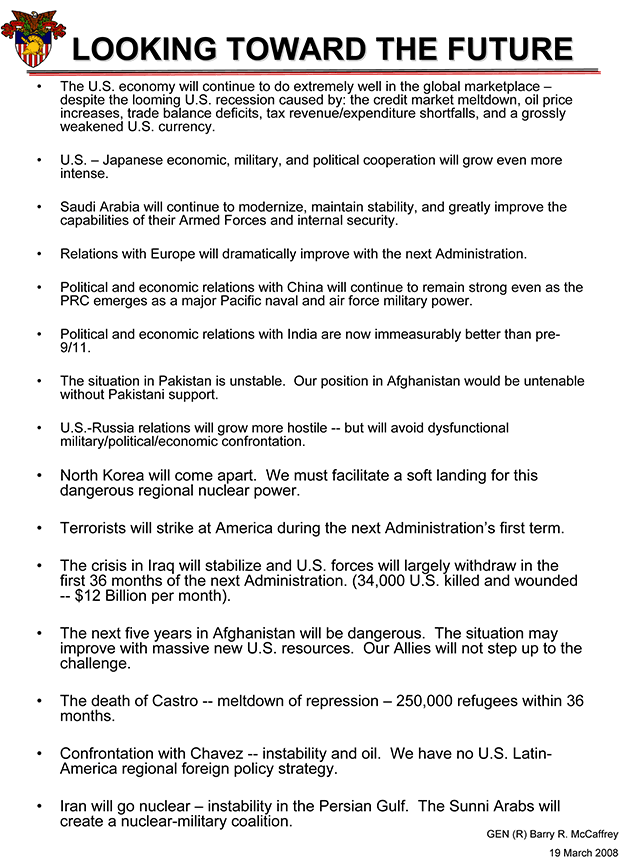
My commentary:
First of all, one notes the number of “safe” predictions in the sense that none of these represent even the likeliest of outliers much less scenarios representing true, statistical rarity, “Gray Swans”. There’s a certain probalistic logic to doing so – the status quo more often than not in any given scenario will continue uninterrupted except by minor adjustments. On at least half of this list, given the breadth and/or vagueness, I’m certain that McCaffrey will be able in five years to say that he was more right then wrong. Unfortunately, the narrow number of domains from which he is extrapolating – nothing on cutting edge tech, applied science, the environment, macrodemographics, religious fundamentalism or interesting “intersectional” possibilities – leaves policy makers with a vision that may be more susceptible to a Black Swan event than before by reinforcing previously held expectations.
Sidebar: I’d love to see Art Hutchinson, Tom Barnett, John Robb , Michael Tanji and the gents at Kent’s Imperative also critique the slide.
Now, in fairness, to the good General, a few of his bullet points are more interesting than others. I think McCaffrey’s called a hard landing for Cuba correctly unless Raul Castro has a secret admiration for Deng Xiaoping and the comprehension of economics to execute a Deng-like transition. It will be difficult for Cuba to really open up without the economic logic of the American market and favorable asylum policies for Cubans immediately kicking in as it did for the East Germans when the other Soviet bloc states ceased cooperating with Honecker’s repressive policies. With Chavez too, I think General McCaffrey is correct given that there is a little remarked friction between Venezuela the oil producer and America the refiner of Venezuelan oil ( refining capacity is itself a choke point along with oil production nor is all crude created equal; some is more expensive to refine than others). Finally, the temptation for al Qaida to “send a message” to the new administration and create downstream political effects may prove well-nigh overwhelming; it may even override their present policy of waiting until to pull off a catastropic level act of terror.
How do you see it ? Comments, questions, rants are all welcome.
 .
.


