zenpundit.com » youtube

Archive for the ‘youtube’ Category

Some interesting pre-debate readings, left and right

Monday, October 22nd, 2012

[ by Charles Cameron — first, the humor, then the serious stuff — including insider and outsider claims as to who belongs with what religious grouping ]
.

Two items from my inbox on this day of the Presidential Foreign Policy debate play humorously with the, for want of a better term, issue of Muslims and Mormons:

On the top, Tim Furnish, author of the book Holiest Wars and an expert on Mahdism, heads up a brief post on his MadhiWatch blog with an image out of South Park and the caption: The quintessential Mormon v. the original Mahdi! It’s ON! That’s from the right.

From the left, Frank Schaeffer, who “left” the movement his influential “right” father, the evangelical theologian Francis Schaeffer, helped found, and is now an Orthodox Christian of a more sacramental and liberal stripe, plays a rather different game in his Huffington Post piece, posted under their Comedy header, and purportedly describing an “alternative USA somewhere on a planet far away and not so long ago…”

Okay, that’s the fun. The serious part, for me, boils down to these two things:

**

Schaeffer has a point, I think, in mocking the Billy Graham organization’s sudden and opportunistic dropping of Mormonism from the list of cults on their My Answer page.

I support the right of Latter-day Saints to call themselves Christians, since they follow the teachings of Jesus Christ as they understand them.

I support the right of other Christians to view them as non-Christian, should they feel obliged in good conscience to do so, since Mormons consider the revelations of Joseph Smith on a par with the canonical gospels, much as Moslems consider the revelation to Muhammad as a completion of the Towrat and Injil (Jewish and Christian revelations).

And I don’t much like the term “cult” as applied to people whose beliefs differ from one’s own in any case, since it tends to dehumanize those to whom it is applied, as witness the tragedy of the Branch Davidians in Waco not too many years ago.

I am not entirely opposed to the idea of adjusting religion to suit a changing world, but I have to say this move on the part of the Graham organization appears to be a totally inauthentic PR move, made for political and not theological reasons, and wide open to the appearance of hypocrisy. If, on the other hand, it leaves all concerned more willing to respect each other as individuals across theological borders, that’s something I can readily applaud.

As usual, there are nuances within nuances to be considered.

**

And Tim Furnish’s use of an image from South Park (I imagine it’s from their Super Best Friends episode) is pure eye-candy. It’s an attention grabber, all right, and it’s function is to point you to Furnish’s recent piece on History News Network, titled What Would a Mitt Romney Foreign Policy Look Like? We’ll learn more about that tonight, I imagine, but Furnish’s column makes interesting preparatory reading:

Ironically, rather like Obama, Romney sees the events of the “Arab Spring” and the abortive “Green Revolution” in Iran through neo-Wilsonian lenses, as evidence of Middle Eastern masses yearning to breathe free — a “struggle between liberty and tyranny, justice and oppression, hope and despair.”

Interestingly enough, the question of who can or should not be tagged with a particular label is central to Furnish’s post. Discussing Romney’s use of the term “extremism” seven times in his Virginia Military Institute [VMI] addresss, he writes:

Only once, note, did he preface the term with the adjective “Islamic.” However, by that one example of intellectual honesty, Romney locates himself light-years ahead of the Obama administration, which actively discourages honest discussion of the fact that 61 percent — 31 of 51 — of the foreign terrorist organizations on the State Depatment’s list thereof are Islamic and which, further, sanctions counter-terrorist trainers who dare to utter words such as “jihad.” One wishes he would simply call an Islamic extremist spade a spade — but Romney is allowing himself to be constrained by his stable of advisors, as well as, perhaps, the pro-Islamic tendencies inherent in the Church of Jesus Christ of Latter Day Saints. Someone needs to tell the Governor that naming Islamic extremism in the defense of Western civilization is no vice.

FWIW, I am in favor of recognizing that jihadists are influenced by their own versions of Islamic doctrine, within widely varying degrees of flexibility, so the phrase “Islamist extremists” makes some sense to me. And I am equally in favor of allowing those Muslims who see the jihadist’s theology as alien and contrary to their own Muslim tradition to make it clear that in their understanding of Islam, the “jihadists” represent an aberration from the faith. Nuance again, nuance.

Okay, that reference above to the “pro-Islamic tendencies inherent in the Church of Jesus Christ of Latter Day Saints” is linked to another of Furnish’s pieces for HNN, in which he asks Has Mitt Romney’s Mormonism Influenced His Views on Islam? — in which Furnish quotes Romney thus:

I spoke about three major threats America faces on a long term basis. Jihadism is one of them, and that is not Islam. If you want my views on Islam, it’s quite straightforward. Islam is one of the world’s great religions and the great majority of people in Islam want peace for themselves and peace with their maker. They want to raise families and have a bright future. There is, however, a movement in the world known as jihadism. They call themselves jihadists and I use the same term. And this jihadist movement is intent on causing the collapse of moderate Muslim states and the assassination of moderate Muslim leaders. It is also intent on causing collapse of other nations in the world. It’s by no means a branch of Islam. It is instead an entirely different entity. In no way do I suggest it is a part of Islam [emphasis added].

Here’s where the delicate balance is required.

On the one hand, we need to be clear — especially on the analytic and policy-making levels — on the ways in which Islam can be and is being interpreted as providing divine sanction for sustained campaigns of terroristic violence.

And on the other, we should in no way encourage — particularly at the level of popular public opinion — the idea that we are “at war with Islam”, an idea which leads to such things as the dehumanizing and killing of American (not necessarily even Muslims) citizens within our own shores, and an increasing sense that America is in fact at war with Islam in the minds of some few Muslims here and many more abroad — who then become prey for further radicalization, as rage on each extreme fuels the other in the multiple echo-chambers and feedback loops of YouTube and the net.

**

And for what it’s worth, Tim F and Frank S — you should both talk to your editors about proof-reading. Tim, the Mormon church is the Church of Jesus Christ of Latter-day Saints if I’m not mistaken, with a hyphen and lower-case “d” in “Latter-day” — strictly FTR. And Frank — you get Dinesh D’Souza‘s first name right on two occasions — why spell it Dnish and Dinish on two others?

Oh well, we all make mistakes. I tried to type the word “to” the other day. You might think that’s simple enough, but I spelled it “typo”. Oops!

Feel free, y’all, to let me know what I’ve mis-spelled, misunderstood, or just plain missed, okay?

An Afghan Buddha koan

Friday, October 5th, 2012

[ by Charles Cameron — for Madhu ]
.

Our friend Madhu has requested that I post poems here on occasion, and this particular poem made me think of her and her request, so here it is:

A copper and gold koan
.

The world happened, the world is drifting away,
the farther away the world floats the deeper into the mists.

In Mes Aynak, Afghanistan, the remains
of a buddhist monastery already eroded by time are adrift,
a sitting buddha is floating into the mist,
headless, gold paint still on his knees and robe,
the devotion has drifted, lifted its focus
to the one without a second, the buddha left
whatever he left in memory, lingering, to gather aromas
of other ideas, realms, dust, archaeology, oblivion,
there is change, ceaseless change,

and adults must decide: is the wealth implied by the copper
beneath the buddha worth more than a trace of halo,
as the moon moves once again across a brilliant night sky.

.
Koans are those brilliant paradoxes zen buddhism uses to pry the mind open, I think they’re important aids to handling complexity, and I have a post about them coming up shortly. Here, it’s enough to say that the issue of copper mining vs archaeology in Mes Aynak seems to me to be a living, breathing koan.

**

It’s awkward, when you write an “ekphrastic” poem, a poem about a painting or photo, to have the image right there when the poem is read, because it trammels the reader’s mind in much the same way that a film can trammel the mind of a reader into “seeing” only the film-maker’s Gandalf, no longer her or his own.

And I’m going on at some length about this, because next up is the image from which that particular poem was built, but I’d like the image to be, as they’d say in the newsprint world, “below the fold” as you read the poem.

So here it is, #4 in a fine series of photos in a Foreign Policy photo essay which I recommend, although I’ve taken this particular (smaller) version from a CNN page, since the subtitle in the lower right corner explains the basic situation handily:

You can hear the archaeologist Brent Huffman, who took the photo, talk about the situation here — local reactions pro and con, who the Taliban are shooting at, the likelihood that the Chinese operation will in fact benefit the locals and more:

The koan of balancing material with immaterial values remains, but in this circumstance the likelihood of local Afghans receiving litter or nothing from the mining project likely tips the scales.

You can petition Afghan President Hamid Karzai for preservation…

But then he’s another wild-card in the continuing Great Game, isn’t it?

On Super Mario Brothers and mental parcours games

Wednesday, October 3rd, 2012

[ by Charles Cameron — cross-posted from Sembl, side-scrollers for the mind, light but deep ]
.

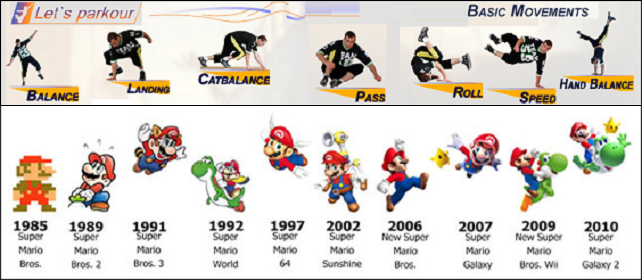
According to 25 Years of Super Mario Bros: A Look Back Through Mushroom Kingdom History, from which I grabbed the Mario Bros portion of the graphic at the foot of this page, “Since 1985’s release of the second-most selling console game of all-time, over 200 Nintendo titles have featured the eponymous Mario Bros” — on which I’ve played perhaps three or four levels of one or two early versions.

The Super Mario Bros side-scrollers (image above, left) are the work of the brilliant Shigeru Miyamoto, and part of what I find so fascinating about them is the way in which they resemble the mind-blowing practice known as Parcours (image, right), which apparently developed from the work of one David Belle, born in 1973 — who would have been 12 when the first Super Mario Bros game came out.

Let’s take a look at Super Mario Bros and Parcours, and then move on to the issue of parcours for the adventuring mind.

**

First, for those of you who don’t remember them, here’s what the early Mario Bros games were like…

I don’t think there’s much doubt that the Super Mario Bros games are essentially digital versions of Parcours, and you can see by comparing the video above with this next one:

Finally, this video from Jesse La Flair confirms the comnnection, at least in the mind of one top flight traceur:

**

My own question is: what would a mental parcours game look like?

I was thinking for a while last week about what a Mario-like side-scrolling game of mental parcours would be like. We already have the “creative leap” side pretty well covered with the various variants of Sembl we’ll be developing, so I thought about other types of mental agility, and what a game might look like if it incorporated a bunch of them — induction? deduction? causality? the sorts of pattern skills that go into IQ tests? — in a side-scroller with playful graphics…

Two things:

One: my friend Derek Robinson pretty quickly informed me that the actual build of such a game would be enormously complex — I resisted him, saying I wasn’t aiming to build the entire game, just to get the idea down on paper to see whether we could get the initial phases funded…

And two: I ran across Lumosity:

Let’s just say Lumosity seems to have a variety of cognitive skills well in hand, which leaves me free once again to concentrate on what Derek calls the mind’s opposable thumb.

**

That’s a brilliant concept, I think, and gets to the heart of what we’re working on with Sembl.

The various other conceptual skills that essentially add up to linear thinking — Zen calls it vertical thinking, see this helpful diagram — are important, and well-studied. They work best where what you are talking about is quantifiable and amenable to logic and cause and effect analysis, and is explored within fields, not across them.

But lo, that approach may help you quantify the trees and evaluate them as board feet of lumber, but consistently misses the forest, the greater context, the big picture –the combined systemic impact of many tiny details, insects, mosses, the tree as ecosystem within an ecosystem, and the ecosystems within that – the time scale, the slow growth, the root system, the transformation of mulch into nourishment, the sudden spurt of tiny leaves in spring, the photosynthesis — and the human wonder — the glory, dappled sunlight on fallen leaves, the shelter afforded to lovers by a weeping willow (I’m thinking of one willow in an Oxford college garden, but I’m time-traveling and I digress) – the poetry, of beech and birch, copper beech and silver birch, the trees, the words, the metals…

Context, quality, complexity, systems, dynamics, process, simplicity, value, passion, poetry – these are the things linear thinking has problems with. Poetry, passion, value, simplicity, process, dynamics, systems, complexity, quality, context – these are the things horizontal thinking does best.

**

That’s it.

Oh, and hey — just because I like the tiny antics they’re getting up to in the graphics:

Let not thy left hand know what thy right hand doeth

Tuesday, October 2nd, 2012

[ by Charles Cameron — this post is about comparisons — what you make of them, and what they make of you, death calculus, and Handel ]
.


.

Scraped from my morning read, these two quotes — a tweeted headline from Breitbart and a gobbit of the Jerusalem Post — neatly illustrate a paradox I’ve been wrestling with, the way more profound souls wrestle with angels [link is to Rilke].

It’s the paradox of comparison.

**

On the one hand, I can barely imagine what it would be like to build — with, say, enough funds for a latter-day Manhattan Project — a Department whose job it was to monitor all activities and ensure even-handedness in the allocation of resources.

So that not ever would a Presidential aide on vacation receive a security detail until each and every ambassador had an equivalent force of marines around them at any given moment, in embassy or out.

I mean, what about consuls, or CIA heads of station — are they ambassadorial enough? Members of the cabinet on vacation? Members of the National Security Council? How far do we need to go with our even-handedness? Is Benghazi different from London? Londonistan?

How would one possibly assure oneself that no “hand” of government, left, right, center, upper, lower, or oblique to all of the above, ever arranged things in a way that compared foolishly with the way some other “hand” of government had arranged something more or less similar?

**

Let’s go to what my friend Bryan Alexander calls the death calculus. Since we’re interested in terrorism here, I’ll pull quotes from a couple of pieces that you can read in full if this topic interests you. Two paras from TomDispatch:

In 2008, 14,180 Americans were murdered, according to the FBI. In that year, there were 34,017 fatal vehicle crashes in the U.S. and, so the U.S. Fire Administration tells us, 3,320 deaths by fire. More than 11,000 Americans died of the swine flu between April and mid-December 2009, according to the Centers for Disease Control and Prevention; on average, a staggering 443,600 Americans die yearly of illnesses related to tobacco use, reports the American Cancer Society;5,000 Americans die annually from food-borne diseases; an estimated 1,760children died from abuse or neglect in 2007; and the next year, 560 Americans died of weather-related conditions, according to the National Weather Service, including 126 from tornadoes, 67 from rip tides, 58 from flash floods, 27 from lightning, 27 from avalanches, and 1 from a dust devil.

and:

The now-infamous Northwest Airlines Flight 253, carrying Umar Farouk Abdulmutallab and his bomb-laden underwear toward Detroit on Christmas Day 2009, had 290 passengers and crew, all of whom survived. Had the inept Abdulmutallab actually succeeded, the death toll would not have equaled the 324 traffic fatalities in Nevada in 2008; while the destruction of four Flight 253s from terrorism would not have equaled New York State’s 2008 traffic death toll of1,231, 341 of whom, or 51 more than those on Flight 253, were classified as “alcohol-impaired fatalities.”

Two paras from a Salon piece [copied here sans links and emphases]:

“The number of people worldwide who are killed by Muslim-type terrorists, Al Qaeda wannabes, is maybe a few hundred outside of war zones. It’s basically the same number of people who die drowning in the bathtub each year,” said John Mueller, an Ohio State University professor who has written extensively about the balance between threat and expenditures in fighting terrorism.

Last year, McClatchy characterized this threat in similar terms: “undoubtedly more American citizens died overseas from traffic accidents or intestinal illnesses than from terrorism.” The March, 2011, Harper’s Index expressed the point this way: “Number of American civilians who died worldwide in terrorist attacks last year: 8 — Minimum number who died after being struck by lightning: 29.” That’s the threat in the name of which a vast domestic Security State is constructed, wars and other attacks are and continue to be launched, and trillions of dollars are transferred to the private security and defense contracting industry at exactly the time that Americans — even as they face massive wealth inequality — are told that they must sacrifice basic economic security because of budgetary constraints.

**

My points?

On the one hand, that the world is far too complex to avoid disparities that can draw mockery down on the heads of those one might wish to mock.

And on the other, that comparisons also have an invaluable role to play in giving us a sense of the relative peaks and valleys of the terrain we live in — and may be literally or metaphorically mountaintop removal / valley fill coal mining in preparation for our children’s children…

**

Here’s a “DoubleQuote” for you:

Or for the musically inclined:

Now there’s a fascinating comparison (between the mining and the music) that doesn’t tell you much. Or does it?

**

Onwards to the issue of that sacred plateau in Jerusalem, featured as my second “reading for the day” at the top of this post.

It appears that you can be arrested for carrying a concealed knife on the Noble Sanctuary — or tallit or tefillin on Temple Mount — same place, different perspective.

That’s the sort of comparison that makes me catch my breath with wonder.

As the Famous Thinkers School might ask, giving you a pencil and a blank sheet of paper: can you draw this conclusion?

**

The full text of Matthew 6.3 reads in the KJV:

But when thou doest alms, let not thy left hand know what thy right hand doeth:

Marangolo P and associates uses a significant variant of that verse in the title of a learned paper: Let not thy left hand know what thy right hand knoweth. The case of a patient with an infarct involving the callosal pathways.

Brain malfunctions (and brain surgeries) can provide windows of considerable interest on our human condition, as the writings of Oliver Sacks so eloquently demonstrate.

The symmetry: Charlie Hebdo

Saturday, September 22nd, 2012

[ by Charles Cameron — my apologies for an earlier incomplete draft, quickly withdrawn — first of two, on loose cannonry and mirror imagery — second will deal with recent events in Benghazi ]
.


.

Charlie Hebdo recently published some cartoons featuring the prophet…

Okay, I’m always on about symmetry.

I posted a piece titled Messianic symmetries on ZP a while back, noting that both Ahmadinejad and Netanyahu can be viewed as exercising “leadership that makes decisions out of messianic feelings” — the quote comes from an unimpressed ex-Shin Beth director describing Bibi; Ahmadinejad makes the case for his own Mahdist leabings quite well himself.

Symmetry seems like an important analytic category to me, either because it’s there in the build of the world, or because it’s there in the build of the mind. Either way, I think we should take careful notice of symmetries.

Asymmetries I’ll talk about in my next post.

**

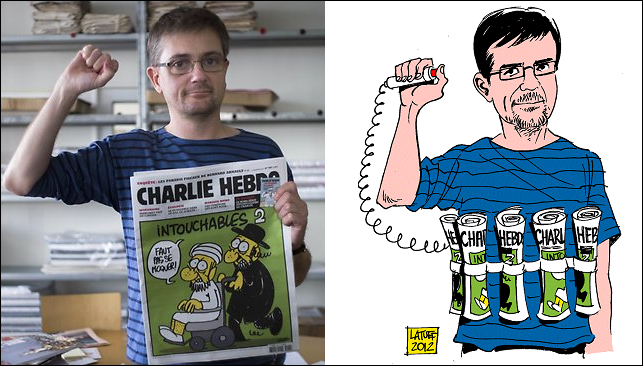
What about the cartoon above, right? It’s clearly based on the photo above, left, which shows Stéphane Charbonnier, the editor of Charlie Hebdo, holding his magazine with its offensive cartoons / vindication of free speech. And the suggestion is clear that he’s some kind of suicide bomber.

But who is he blowing up, exactly? Himself, and perhaps his staff and anyone else who happens to be within a few yards of his office at the time? France, Europe, the western world — the world itself? And how much irony should we read into the cartoon portrait?

They may have learned the technique from the Tamil Tigers, but these days, in the immediate wake of widespread rioting over the video clip and in the context of someone publishing cartoons that satirize the prophet, it’s clearly Islamist suicide bombers who provide the model for the cartoon of the cartoonist above.

Tit for tat? An eye for an eye? You’re just setting yourself up for a fatwa like Salman Rushdie?

**

Incendiary rhetoric on one side leads to incendiary behavior on the other, validating the incendiary rhetoric and making the escalation to incendiary behavior all the more probable.

Some of the incendiary rhetoric has its origin in holy books, which also preach peace.

There are Coptic Christians utterly blindsided by the virulence of the video, attributed to one of their number. There are Libyan Muslims utterly blindsided by the virulence of the attack on the US Embassy, attributed to some of their own.

**

I want to focus not on the specifics of the topic, but on the symmetry.

One writer, observing the partition of India and Pakistan, wrote:

The rioters brought the train to a stop. Those who belonged to the other religion were methodically picked out and slaughtered. After it was all over, those who remained were treated to a feast of milk, custard pies and fresh fruit.

Before the train moved off, the leader of the assassins made a small farewell speech: “Dear brothers and sisters, since we were not sure about the time of your train’s arrival, regretfully we were not able to offer you anything better than this most modest hospitality. We would have liked to have done more.”

Commenting on this paragraph, Ali Sethi wrote recently in the New Yorker:

That is all there is: murder—methodical and quick—followed by a feast and an ingratiating speech. Note the withholding of tags: we don’t know the location of the massacre or the religion of the killers. All we have is a spurt of base instincts.

The point here is that whenever you see a symmetry of opposites, it’s worth considering that symmetry in the abstract, as well as weighing the particular issues that drive your own side or the other.

That, I’d suggest, is one of the implications of that Paul van Riper remark I’m fond of quoting:

What we tend to do is look toward the enemy. We’re only looking one way: from us to them. But the good commanders take two other views. They mentally move forward and look back to themselves. They look from the enemy back to the friendly, and they try to imagine how the enemy might attack them. The third is to get a bird’s-eye view, a top-down view, where you take the whole scene in. The amateur looks one way; the professional looks at least three different ways.

**

I am concerned about hatred, simmering here, boiling over there. I am concerned about what sparks hatred, and what fans it. What I want to draw your attention to here, though, is the process by which one hatred fuels abother, the process of mirror imaging.

Mark Juergensmeyer, a terrific scholar of religion who has published on topics ranging from Gandhi‘s nonviolence to the violence of religionists who consider themselves sanctioned by the scriptures of various religions, makes the point in a recent Religion Dispatches post thus:

The US-based Islamophobes behind the insulting and amateurish video “The Innocence of Muslims,” and those behind the violent protests it allegedly caused around the Muslim world, are kindred hatemongers. Both are extremists with a political agenda, and both want to use this incident to discredit the legitimacy of the moderate governments in power in their respective countries. There is a symbiotic relationship between the strident protesters and the bigoted filmmakers; each needs the other.

We are in a hall of incendiary mirrors, with plenty of kindling: in my view, we should avoid playing with matches.

**

Thank God, there are also asymmetries.

In a companion post, I’ll take a look at recent, very promising events in Benghazi (h/t to Pundita for a pointer to this particular article), the not particularly unsurprising but unwelcome attitude of a Pakistani minister, and the imbalances that go along with the dangerous balances I’ve discussed in this post.

**

Oh, and let me digress…

I won the Divinity essay prize back in my schooldays at Wellington College, and received my chosen prize book, the Liber Usualis with its glorious collection of Gregorian Chants, from the then Minister of Defence, John Profumo, MP. Not long thereafter, it was discovered that he pillow talked with one Christine Keeler, a night lady of class, who also pillow talked with the Russian defence attaché. And the story was broken, week by glorious week, by the British satirical magazine, Private Eye.

Which I consequently have an affection for, after all these years. And I tell you this, because Charlie Hebdo, or Weekly Chuck as we might call it over here is, I’d suggest, a plausible latter-day French rough equivalent of Private Eye.

I don’t really like our guys posting inflammatory materials, you see, but I also have an affection for freedom of speech — and for magazines with a satirical bite, too…

So sue me, I contain multitudes.


Switch to our mobile site