zenpundit.com » science

Archive for the ‘science’ Category

Introducing the Person / Position Paradox

Saturday, October 6th, 2012

[ by Charles Cameron — ye olde war of science vs religion embodied in Rep. Paul Broun, with sundry comparisons to human rights, UN, dominionism, JFK, creeping shariah etc ]
.

.

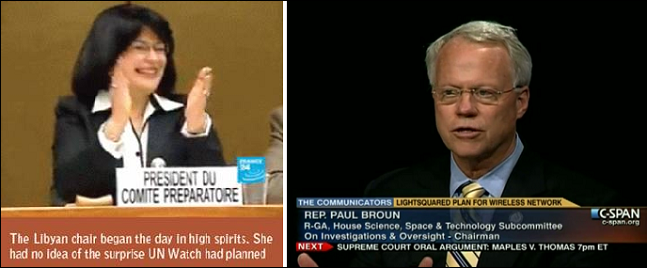
Lest we forget, Muammar Gaddafi‘s Libya, in the person of Ms. Najat Al-Hajjaji (above, left), was elected to preside over the United Nations Commission on Human Rights in 2003:

The Commission on Human Rights — meeting this morning under a new procedure two months in advance of its annual six-week session — elected Najat Al-Hajjaji of the Libyan Arab Jamahiriya as Chairperson for 2003, along with three Vice-Chairpersons and a Rapporteur.

And as recently as May 2010, still under Col. Gaddafi’s rule, Libya was elected a member of the UN Human Rights Council, and only suspended in February 2011.

Might we call this an instance of a Person / Position Paradox?

**

You know I like what I term “forms” as analytic tools — this would be another one to keep an eye out for, a particularly intriguing sub-type of the self-referential paradoxes I discussed in an earlier post.

It isn’t, of course, an analytical breakthrough for me to recognize the paradox inherent in a brutal dictatorship gaining the chair of the international Human Rights Commission at this late date: the United States protested Libya’s nomination at the time, which is why there had to be a secret ballot in the first place.

Let’s look at some of the accompanying language. Here’s Ms. Al-Hajjaji herself:

In an address following the ballot, Ms. Al-Hajjaji said among other things that the Commission must send a message that it would deal with human rights in all countries, and not just some of them; that it would take into account in its activities the world’s many different religious, cultural and historical backgrounds; and that among its tasks was to affirm the universality, indivisibility, and complementarity of human rights

Who could complain about that? And here’s the UN High Commissioner, praising the system that got her elected for its wisdom:

High Commissioner for Human Rights Sergio Vieira de Mello, also speaking briefly, reviewed his recent mission to the Democratic Republic of the Congo and to Angola, lauded the Commission’s new procedure for early election of a Bureau, and said it was important for the Commission to demonstrate that it could manage with wisdom, speed and restraint its procedural business so as to create the best possible spirit and conditions for addressing and resolving the many substantive issues on its agenda.

The lesson I learn here?

Paradoxes of this kind lead to a divergence of words from truths — in line with de la Rochefoucauld‘s maxim:

Hypocrisy is the homage vice pays to virtue.

**

Now comes the potentially contentious part.

Rep. Paul Broun MD (R-GA) (top, right), member of the US House Committee on Science, Space and Technology and chairman of the US House Science Subcommittee on Investigations and Oversight, told the Liberty Baptist Church of Hartwell, Georgia’s Sportsman’s Banquet last month:

God’s word is true. I’ve come to understand that. All that stuff I was taught about evolution and embryology and the Big Bang Theory, all that is lies straight from the pit of Hell. And it’s lies to try to keep me and all the folks who were taught that from understanding that they need a savior. You see, there are a lot of scientific data that I’ve found out as a scientist that actually show that this is really a young Earth. I don’t believe that the Earth’s but about 9,000 years old. I believe it was created in six days as we know them. That’s what the Bible says.

As a student of religions, I don’t find that statement particularly surprising: while the original 1611 edition of the King James Version of the Bible doesn’t include Archbishop Ussher‘s dating of the creation to 4004 BC, many versions of the KJV since 1701 have done so, the wildly popular “dispensationalist” Scofield Reference Bible, first published in 1909, does so… and Broun is being somewhat generous in allowing for the passage of 9,000 years since creation, where others might see the earth as entering the seventh (Sabbath) day (or millennium) about now…

As a religious belief, then, this is one of many attempts to fit chronology to scripture. I recall from my days studying the religious impact of millennial rollover (“Y2K”) concerns that one Rabbi Pinchas Winston claimed the year 2,000 (5760 in the Jewish calendar) would be a year of purification:

The secret regarding this is that, at the end of the year 5760 from creation, the verse, ‘I [God] will remove the impure spirit from the land’ (Zechariah 13.2) will be fulfilled.

For my source and further millennial date issues in Islam, Hinduism etc, see my chapter, Y2KO to Y2OK in Cathy Gutierrez and Hillel Schwartz, eds., The End that Does: Art, Science and Millennial Accomplishment, Equinox, 2006.

Politics, though — and the politics of science and science funding at that? Here’s more of Rep. Broun’s talk, explaining how Broun’s theology affects his politics:

And what I’ve come to learn is that it’s the manufacturer’s handbook, is what I call it. It teaches us how to run our lives individually, how to run our families, how to run our churches. But it teaches us how to run all of public policy and everything in society. And that’s the reason as your congressman I hold the Holy Bible as being the major directions to me of how I vote in Washington, D.C., and I’ll continue to do that.

**

I’m afraid this reminds me all too clearly of RJ Rushdoony‘s Institutes of Biblical Law, which opens with the following words:

When Wyclif wrote of his English Bible that “This Bible is for the government of the people, by the people, and for the people,” his statement attracted no attention insofar as his emphasis on the centrality of Biblical law was concerned. That law should be God’s law was held by all…

Those are the opening words of Rushdoony’s Introduction to his magnum opus. And I know, I know, I’m cherry-picking from its 850-page first volume, but on p. 251 he writes:

The law here is humane and also unsentimental. It recognizes that some people are by nature slaves and will always be so. It both requires that they be dealt with in a godly manner and also that the slave recognize his position and accept it with grace.

Is this all just another version of “creeping” theocracy?

Compare John Hubbard, Arkansas State Rep, whose book Letters to the Editor: Confessions of a Frustrated Conservative (not on Amazon) apparently includes this choice morsel:

… the institution of slavery that the black race has long believed to be an abomination upon its people may actually have been a blessing in disguise …

**

Some possible parallels that may be worth pondering, coming at similar issues from a diversity of angles — hopefully with enough different implications to generate some questioning of easy assumptions:

Can a Catholic be POTUS (JFK, eg) without serving the every whim of a foreign Head of State? Can a Mormon be POTUS without serving the wishes of a living prophet, seer and revelator? Can a person who aspires to the highest post in a “government of the people, by the people, for the people” be relied upon if he says things like this?

There are 47 percent of the people who will vote for the president no matter what. All right, there are 47 percent who are with him, who are dependent upon government, who believe that they are victims, who believe that government has a responsibility to care for them, who believe that they are entitled to health care, to food, to housing, to you name it. … And so my job is not to worry about those people — I’ll never convince them that they should take personal responsibility and care for their lives.

And what if he then admits he was in error?

In this case, I said something that’s just completely wrong.

Is that hypocrisy (see above) — or humility? And come to that: in politics, is honesty a vice?

**

But I’m sliding from religion into politics here, unless you take the Gettysburg Address as one of the central documents — akin to a scripture — of American civil religion. Or remember it was the Bible translator John Wyclif who said those words about government of, by, and for the people first…

Religion, not politics, is my concern and my “beat” — but right now, the “Warfare of Science With Theology” (to quote the apt title of Andrew Dickson White’s celebrated 1895 book) is once again in full swing, so the question of whether Rep. Broun’s positions as a a member of the US House Committee on Science, Space and Technology and chairman of the US House Science Subcommittee on Investigations and Oversight, given his views on voting according to his reading of the Bible, is also an instance of the Person / Position Paradox?

**

It seems to me that questions such as these are of vital to many of us. The question is: are they vital to our democratic principles — or to our salvation?

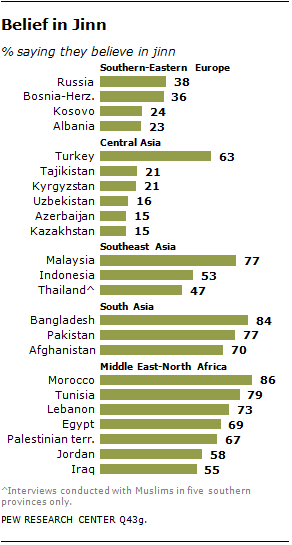
Pew II: Prevalence of belief in the Jinn

Monday, August 13th, 2012

[ by Charles Cameron — Corbin on Queen Bilqis, Qur’an and hadith regarding jinn, Pew statistics on belief in jinn — with some earlier Natsec implications & a non-serious suggestion from contemporary physics ]
.

La Jinn the Mystical Genie of the Lamp
from the Yu-Gi-Oh card game

.

I’ve been “fond” of the jinn (djenoun) since first encountering them in the brilliant short stories of Paul Bowles, and notably his A Hundred Camels in the Courtyard.

But that’s a literary fondness, neither science nor belief-based on my part. In my view, that’s only right and proper, since djenoun belong in the realm of imagination — or better said, the Imaginal, as Henry Corbin terms it — see note 16, p, 326. of his Creative Imagination in the Sufism of Ibn ‘Arabi, where he speaks of the Sheikh’s Bilqis Queen of Saba in his poetry as a being “born from a jinn and a woman” — it’s a fascinating passage, connecting Bilqis with Jesus in terms of the (unorthodox) angelology that Corbin envisioned uniting the Abrahamic faiths at a visionary level.

**

Here are two of the mentions of jinn in the Qur’an:

And the Jinn race We had created before from the fire of a scorching wind. [Sura 15, 27]

Say: It has been revealed to me that a company of Jinns listened (to the Qur’an). They say ‘We have really heard a wonderful Recital! It gives guidance to the Right and we have believed therein: We shall not join (in worship) any (gods) with our Lord. And exalted is the Majesty of our Lord: He has taken neither a wife nor a son.’ [Sura 72, 1-3]

And here is a tale of the Prophet and a jinn, as narrated by the Companion Malik ibn Anas:

The Prophet said to the jinni: “This is the stride of a jinni, as well as the tone of his voice!” The jinni replied: “My name is Hamah ibn Laqqis ibn Iblis.” The Prophet said: “Only two generations seperate you from him [Iblis].” He replied: “True.” The Prophet asked: “How long have you lived?” The jinni replied: “Almost all of time. I was a small boy when Abel was killed. I believed in Noah and repented at his hands after I stubbornly refused to submit to his call, until he wept and wept. I am indeed a repentant — God keep me from being among the ignorant! I met the prophet Hud and believed in his call. I met Abraham, and I was with him when he was thrown in the fire. I was with Joseph, too, when his brothers hurled him into the well—I preceded him to its bottom. I met the prophet Shu’ayb, and Moses and Jesus the son of Mary, who told me: ‘If you meet Muhammad, tell him Jesus salutes thee!’ Now I’ve delivered his message to you, and I believe in you.” The Prophet said: “What is your desire, 0 Hamah?” He said: “Moses taught me the Torah, Jesus the Gospels, can you teach me the Qur’an?” So the Prophet taught him the Qur’an.

The Tasneem Project

**

Literal vs metaphorical, let alone imaginal belief is not something the interviewers who conducted the Pew poll had the leisure to distinguish — but for the record, here are their findings as to the Muslim belief in jinns:

According to the Quran, God created jinn as well as angels and humans. Belief in jinn is relatively widespread – in 13 of 23 countries where the question was asked, more than half of Muslims believe in these supernatural beings.

In the South Asian countries surveyed, at least seven-in-ten Muslims affirm that jinn exist, including 84% in Bangladesh. In Southeast Asia, a similar proportion of Malaysian Muslims (77%) believe in jinn, while fewer in Indonesia (53%) and Thailand (47%) share this belief.

Across the Middle Eastern and North African nations surveyed, belief in jinn ranges from 86% in Morocco to 55% in Iraq.

Overall, Muslims in Central Asia and across Southern and Eastern Europe (Russia and the Balkans) are least likely to say that jinn are real. In Central Asia, Turkey is the only country where a majority (63%) of Muslims believe in jinn. Elsewhere in Central Asia, about a fifth or fewer Muslims accept the existence of jinn. In Southern and Eastern Europe, fewer than four-in-ten in any country surveyed believe in these supernatural beings.

In general, Muslims who pray several times a day are more likely to believe in jinn. For example, in Russia, 62% of those who pray more than once a day say that jinn exist, compared with 24% of those who pray less often. A similar gap also appears in Lebanon (+25 percentage points), Malaysia (+24) and Afghanistan (+21).

The survey also asked if respondents had ever seen jinn. In 21 of the 23 countries where the question was asked, fewer than one-in-ten report having seen jinn, while the proportion is 12% in Bangladesh and 10% in Lebanon.

**

Two markers concerning National Security concerns regarding Pakistan, nuclear weapons and those who believe (literally, energetically) in jinns — from the early 2000s, but dating back by implication to the era of Zia ul-Haq:

Just after the September 2001 terrorist attacks in the U.S., Pakistan’s intelligence service detained two retired nuclear scientists who had met with senior members of al Qaeda, including Mr. bin Laden, during charity work in Afghanistan. One, Sultan Bashiruddin Mahmood, was a former director at the Pakistan Atomic Energy Commission and a controversial Islamic scholar who had postulated that energy could be harnessed from fiery spirits called djinns.

WSJ, Inside Pakistan’s Drive To Guard Its A-Bombs

But as a subscriber to a brand of what is known to practitioners as “Islamic science,” which holds that the Koran is a fount of scientific knowledge, Mr. Bashiruddin Mahmood has published papers concerning djinni, which are described in the Koran as beings made of fire. He has proposed that these entities could be tapped to solve the energy crisis, and he has written on how to understand the mechanics of life after death.

NY Times, Pakistani Atomic Expert, Arrested Last Week, Had Strong Pro-Taliban Views

— together with a Pakistani critique:

If a scientist is European or Hindu he will be restricted in his vision by reason. A Muslim scientist has unlimited scope; he will relate his science to miracles, mostly performed by himself. Sultan Bashiruddin, our top enrichment expert, believed he could draw electricity from a captured jinn. (For Pakistan’s needs just one jinn would suffice.)

Khaled Ahmed, Scientists, our kind

There are times when beliefs have, or might just have, consequences.

**

Jinn are significant not only for their own sakes, so to speak, but also for their etymological implications. To quote again from the Tasneem Project:

One saying of the Prophet (aws) mentions that, “God divided the jinn and the humans into ten parts. One part makes up the human race, and the other nine parts is made up of the jinn.” The invisible is everywhere. The Arabic language itself bears witness to how the invisible realm insinuates itself on everyday life. In Arabic, each time the two letters jeem and nun occur together, as in jinn, they convey the meaning of invisible or hidden. Thus, paradise is jannah because paradise is hidden from the human sight; janin is the foetus in the womb; the expression ajannahu al-layl means the night covered him.

The jinn, like paradise itself, are among the hidden secrets…

**

And how large is the universe, that it might encompass the angels and jinn? Hugh Everett III quite brilliantly argued for what has come to be known as the “many worlds” hypothesis in quantum measurement while still a grad student:

Hugh Everett III was a student in his mid-twenties in 1957 when he presented his revolutionary formulation of quantum mechanics in his PhD thesis. Everett himself called his theory variously; pure wave mechanics, the relative-state formulation of quantum mechanics, and the theory of the universal wave function. His theory, however, came to be popularly known as the many-worlds interpretation, because it predicts that everything that might happen, does in fact happen. As the physicist Bryce DeWitt later described it, Everett’s theory predicts that our universe is composed of countless parallel universes that are each constantly splitting into yet further copies, and in the process, creating copies of each observer, each of which subsequently observes a different quantum universe and splits into further copies.

While a science fiction fan might embrace such a theory simply by dint of how cool it would be if something like that were true, one might naturally wonder what good scientific reason one might have for believing that our universe is in fact composed of countless parallel splitting universes.

**

The whole article from which that quote was taken, The Quantum Measurement Problem and the Everett Interpretation, is indeed worth reading. But whereas physicists and (most) science fiction writers might confine their “many worlds” to physical, “materialist” universes, students of the imaginal are under no such restriction, as the same Tasneem Project article suggests:

The Muslim universe has always been made up of multiple worlds – the Qur’an itself refers to “universes” in the plural, in its open chapter al-fatihah. According to prophetic tradition, the cosmos consists of 18000 universes. …

So the jinn when summoned might come — somewhat unexpectedly — from one of Everett’s more hidden “many worlds”, perhaps?

A Bigger Bang for the Book?

Friday, August 10th, 2012

[ by Charles Cameron — apocalypse out-movied, science fiction overwhelmed, what in the world is the world coming to? and whither SF? ]
.

I could hardly be expected not to share with you my delight in this, from the Onion [turn down your volume control before you click, it’s preset to wake the dead]:

**

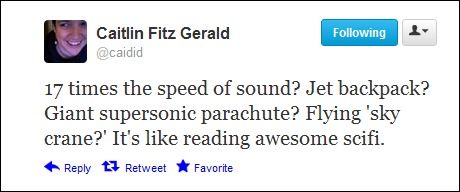
But I don’t think the Book (of the Revelation of St John on Patmos) is the only thing that’s getting out-gunned these days. Consider this tweet from Caitlin Fitz Gerald aka @caidid:

The thing is — aside from terraforming Mars [Frederick Turner, Kim Stanley Robinson] or visiting spaces deeper out, we’ve accomplished or are accomplishing much of what “hard” (ie science-based) science fiction imagined for us. And to my mind, that suggests the possibility that writing hard SF will be getting a whole lot more difficult, and that character and culture will increasingly be what divides the best from the bland.

Still plenty of room for the likes of Jack Vance and his brilliant and beautiful Moon Moth, though.

**

So, will the End Bang be bigger than the Big Bang? Or is there a principle of symmetry that makes them exquisitely equal and opposite?

Landmines in Paradise Garden

Wednesday, August 8th, 2012

[ by Charles Cameron — pros and cons of an important piece by Scott Atran — who among us can comprehend religion? ]
.

At play (Minesweeper) in the Fields of the Lord (Bosch, Garden of Eden)

.
Scott Atran, the anthropologist who gave us the book Talking to the Enemy, has got it right (as to importance) but wrong (as to procedure) in his latest, significant piece on Foreign Policy, God and the Ivory Tower: What we don’t understand about religion just might kill us.

First, the importance of the issue he’s discussing – understanding religions (emphatically plural, IMO):

Religion molds a nation in which it thrives, sometimes producing solidarity and sacred causes so powerful that citizens are willing to kill or die for a common good (as when Judea’s Jews around the time of Christ persisted in rebellion unto political annihilation in the face of the Roman Empire’s overwhelmingly military might). But religion can also hinder a society’s ability to work out differences with others, especially if those others don’t understand what religion is all about. That’s the mess we find ourselves in today, not only among different groups of Americans in the so-called culture wars, but between secular and Judeo-Christian America and many Muslim countries.

Time and again, countries go to war without understanding the transcendent drives and dreams of adversaries who see a very different world. Yet we needn’t fly blindly into the storm.

Atran is exactly right: we needn’t fly blindly into the storm — but to avoid flying blindly we need to understand those “drives and dreams of adversaries who see a very different world” — and to avoid flying into the storm at all we may (all of us, friends and foes alike) need to understand our own “transcendent drives and dreams” better than we do at present.

The question is, who can help us do that?

That’s what I mean by the procedure — the path that should be taken to achieve that kind of understanding. And note: there are different kinds of understanding — theoretical, imaginative, visceral… dispassionate, empathetic, impassioned…

**

Atran’s answer is science:

Science can help us understand religion and the sacred just as it can help us understand the genome or the structure of the universe. This, in turn, can make policy better informed.

There’s only one problem there. I can believe that scientists of extraordinary breadth and insight – Einstein, Bohr, Oppenheimer, Gell-Mann, Feynman probably – and social scientists — Bateson certainly, Victor Turner, Atran perhaps – my lists are not exhaustive – could make useful suggestions for scientific approaches to the field of religion.

But scientists in general? As Atran notes:

If you look at the prestigious U.S. National Academy of Sciences or Britain’s Royal Society, well over 90 percent of members are non-religious. That may help explain why some of the bestselling books by scientists about religion aren’t about the science of religion as much as the reasons that it’s no longer necessary to believe.

Non-believers may “get” what’s dangerous about religions, but they almost certainly won’t “get” what’s marvelous and inspiring about them.

And believers are no better – they may get what’s great about their own tradition, but still see nothing but perdition in the traditions of others…

So to get a decent set of insights worth experimenting with — or modeling, for that matter — requires a blend of subtle thinkers to include some social anthropologists, some scholars of comparative religion, some sociologists with fine-tuned statistical skills, some depth psychologists… believers, skeptics, atheists and agnostics… with a whole wild variety of plumages, specialties and interests.

Yes, and some poets, historians, some hard scientists. Yes.

**

How easy is it to get things wrong?

In his paper Reframing Sacred Values [link is to .pdf] written with Robert Axelrod — the political scientist whose contest for winning strategies for the iterated Prisoner’s Dilemma game put “tit for tat” and agent based modeling on the map in his books The Evolution of Cooperation and The Complexity of Cooperation — Atran speaks of “Rational versus Devoted Actors“.

The distinction is a significant one. And the paper itself is important because, as Atran and Axelrod suggest:

Counterintuitively, understanding an opponent’s sacred values, we believe, offers surprising opportunities for breakthroughs to peace. Because of the emotional unwillingness of those in conflict situations to negotiate sacred values, conventional wisdom suggests that negotiators should either leave sacred values for last in political negotiations or should try to bypass them with sufficient material incentives. Our empirical findings and historical analysis suggest that conventional wisdom is wrong. In fact, offering to provide material benefits in exchange for giving up a sacred value actually makes settlement more difficult because people see the offering as an insult rather than a compromise. But we also found that making symbolic concessions of no apparent material benefit might open the way to resolving seemingly irresolvable conflicts.

But who is to say which actors are “devoted”?

The most devoted may be the one who stands in most need of redemption, the one who has sinned the most, not the one who has been the most pious. Let me put that another way: the most devoted may be the drunken reveler rather than the regular church- or mosque-goer.

**

Consider:

Inigo was a courtier, a conquistador, a musketeer. The commandments were of course unquestionable in theory, but practice was entirely another matter. Church was for times of danger or for celebration of victory, and he never prayed so hard to our Lady as before a duel. In his last years when he had no need to be boastful, he was quoted by his secretary- biographer: “Though he was attached to the faith, he lived no way in conformity with it and did not avoid sin. Rather, he was much addicted to gambling and dissolute in his dealings with women, contentious and keen about using his sword.”

Inigo found plenty of trouble…

A scientist might not think such a person a reliable example of religious fervor. An antagonist of religion might think it illustrates the flaws of religion perfectly.

The passage in question comes from a life of St. Ignatius of Loyola, founder of the Jesuits.

Religion is a subtle matter. We may think it a matter of belief, but it may be a matter of behavior – orthopraxy vs orthodoxy is the distinction the folks in religious studies make — or of visionary experience.

It may “take one to know one” – as Thomas Merton, the Catholic contemplative understood the Buddhist contemplatives he met. But then he was open to the possibility that others might have intuitions not dissimilar to those he himself had had. “I’m deeply impregnated with Sufism,” he once wrote — Sufism being the mystical strand in Islam. Indeed, I received a letter from him myself while still a student at Oxford, in which he wrote of his life in the Abbey of Gethsemani, “here you get beaten for being a dervish. I am bruised for this all day long.”

**

But again, one can be blinded by one’s own faith to the merits of the faiths of others. And this is also a subtle business.

Retired US Gen. Jerry Boykin, for instance, said in April last year (link is to YouTube video):

Sharia law is a very serious threat in America. We are being invaded by a group of people who see it as their absolute imperative to establish a legal system in America which will in fact destroy our Constitution to be replaced by this thing called Sharia law.

One wonders what Boykin might make of the late California Presbyterian teacher, RJ Rushdoony — a figure, I’m guessing, far to the General’s right?

As is widely known, the New Testament contains a “Great Commission” which Christ gave to his apostles after his Resurrection:

Then Jesus came to them and said, “All authority in heaven and on earth has been given to me. Therefore go and make disciples of all nations, baptizing them in the name of the Father and of the Son and of the Holy Spirit, and teaching them to obey everything I have commanded you. And surely I am with you always, to the very end of the age.” — Matthew 28:18-20.

Rushdoony, in his master work The Institutes of Biblical Law, makes it clear that in his views, this constitutes a divine mandate to bring Biblical law into effect in all nations: “The fulfillment of that covenant is their great commission: to subdue all things and all nations to Christ and His law-word” (Institutes, p. 14) and this is to be achieved in terms of a single world order, “The goal is the developed Kingdom of God, the New Jerusalem, a world order under God’s law” (Institutes, p. 357).

Sadly, the church no longer recognizes the full implications of the Great Commission, and has fallen into a heresy that is political in nature: “The church today has fallen prey to the heresy of democracy” (Institutes, p. 747). In truth, the laws of a democratic society will need to be replaced by the laws of God as set forth in the Old Testament: “While all Scripture is God’s law word, the heart of that law is the law of Moses” (Institutes, p. 675).

Here’s where it gets trickier, though:

Slavery, too, will need to be reinstituted: “The (Biblical) Law here is humane and also unsentimental. It recognizes that some people are by nature slaves and will always be so. It both requires that they be dealt with in a godly manner and also that the slave recognizes his position and accepts it with grace” (Institutes, p. 251).

**

This thing called “religion” is difficult to pin down. It has extremes that appear unconscionable even to many who claim devotion to the same scriptures as do the extremists. It features violence, peace, apocalypse as destruction and apocalypse as fresh creation.

Atran is an anthropologist – he surely knows this.

The study of religion involves walking through a minefield — in the gardens of Paradise…

Aurora, Samarra, Vermont…

Tuesday, July 24th, 2012

[ By Charles Cameron — the gun issue, complexity, human beings being humans and the world we live in ]
.

As always, I’m a fence-sitter bridge-builder, not wanting to take sides, preferring to talk with them.

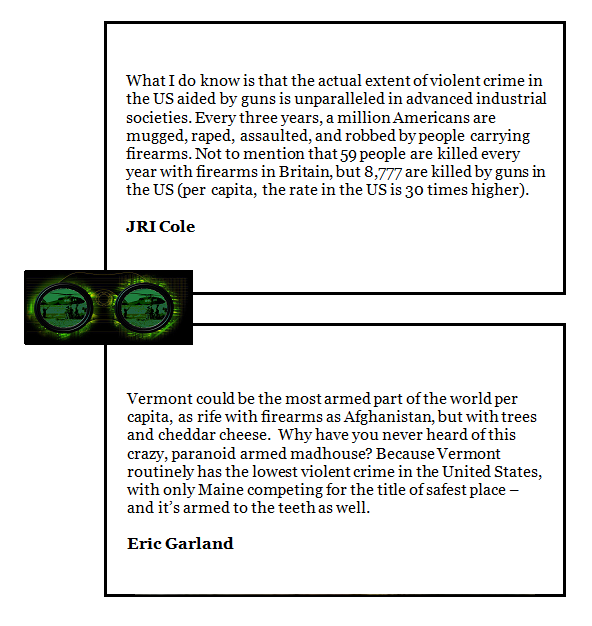
The irritating beauty of these two quotes is that either one taking separately might seem like a “case closed” argument in favor of guns or gun control — but taken together, they show the world to be a dappled place.

Here’s the lead-in to that Vermont quote:

One facet of Vermont life is neither famous nor quaint: Vermonters are armed to the teeth. Guns are absolutely everywhere. Rifles. Pistols. Shotguns. Muzzle-loaders. Semi-automatics. 50 caliber tripod-mount “semi” automatics that could take out aircraft. Every firearm you can possibly imagine. Vermont could be the most armed part of the world per capita, as rife with firearms as Afghanistan, but with trees and cheddar cheese…

Things are weird that way: just when you think you’ve got them figured out, there’s an exception to the rule… a black dot in the white part of the yin-yang symbol… an anomaly that challenges the easy paradigm.

Dappled, as Hopkins puts it.

**

Pied Beauty
by Gerard Manley Hopkins, SJ
.

GLORY be to God for dappled things—
For skies of couple-colour as a brinded cow;
For rose-moles all in stipple upon trout that swim;
Fresh-firecoal chestnut-falls; finches’ wings;
Landscape plotted and pieced—fold, fallow, and plough;
And áll trádes, their gear and tackle and trim.

All things counter, original, spare, strange;
Whatever is fickle, freckled (who knows how?)
With swift, slow; sweet, sour; adazzle, dim;
He fathers-forth whose beauty is past change:
Praise him.

**

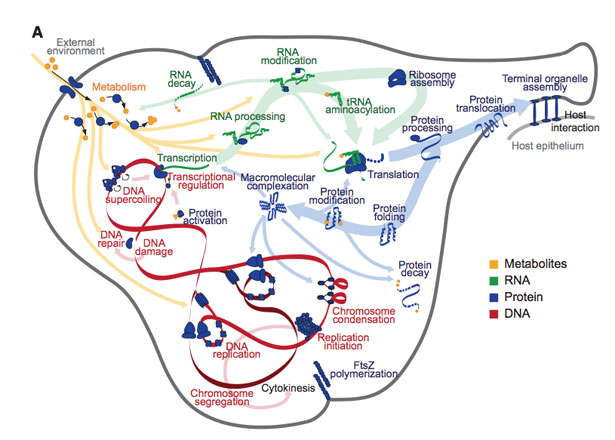
The world is complex: scientists using microscopes and a suite of 128 computers recently (and triumphantly) managed to simulate the genome of one of the smallest micro-organisms in the world, Mycoplasma genitalium (neat name, that):

Alexis Madrigal (another neat name, btw) writes:

“Right now, running a simulation for a single cell to divide only one time takes around 10 hours and generates half a gigabyte of data,” lead scientist Covert told the New York Times. “I find this fact completely fascinating, because I don’t know that anyone has ever asked how much data a living thing truly holds.”

One cell. One division. Half a gig of data. Now figure that millions of bacteria could fit on the head of a pin and that many of them are an order of magnitude more complex than M. genitalium.

Yup. So think how complex the world is. No wonder we name things, divide stuff up into categories — use quite a large chunk of our brains for making distinctions.

But then think how complex the humans studying M. genitalium (still like that name, but this’ll be the last time I mention it) themselves must be… As Madrigal (really a nice name, you can almost sing it) goes on to point out:

Or ponder the idea that the human body is made up of 10 trillion (big, complex) human cells, plus about 90 or 100 trillion bacterial cells. That’s about 100,000,000,000,000 cells in total. That’d take a lot of computers to model, eh? If it were possible, that is.

**

Complexity looks at complexity with a view to modeling it. Simple, you think? Complex, you’d say?

The world’s a subtle place, and I might just go live in Vermont.

But people get shot in Vermont too, from time to time — there’s always a black and bleeding bullet-hole in the white half of the yin yang symbol — this world is hopelessly dappled.

And you know that story Somerset Maugham tells about Samarra?

There was a merchant in Bagdad who sent his servant to market to buy provisions and in a little while the servant came back, white and trembling, and said, Master, just now when I was in the marketplace I was jostled by a woman in the crowd and when I turned I saw it was Death that jostled me. She looked at me and made a threatening gesture, now, lend me your horse, and I will ride away from this city and avoid my fate. I will go to Samarra and there Death will not find me. The merchant lent him his horse, and the servant mounted it, and he dug his spurs in its flanks and as fast as the horse could gallop he went. Then the merchant went down to the marketplace and he saw me standing in the crowd and he came to me and said, Why did you make a threating getsture to my servant when you saw him this morning? That was not a threatening gesture, I said, it was only a start of surprise. I was astonished to see him in Bagdad, for I had an appointment with him tonight in Samarra.

Idries Shah tells a version of the same story as “When Death Came to Baghdad” in his Tales of the Dervishes, but with Samarkand rather than Samarra as the fatal destination.

It just might be the same with Vermont.


Switch to our mobile site