Archive for the ‘science’ Category
More on Boyd & Beyond II and Boydian Theory
Wednesday, October 19th, 2011Two posts of note:
USNI Blog (Lucien Gauthier) – Training Sailors to be Autodidactic
….The conference spent a lot of time on the first half of the OODA-Loop, Observing and Orienting. At some point I became convinced that the type of Sailor we need is one that is a “situational autodidact”. Major Marcus Mainz, USMC, during his presentation made the brilliant comment that “training is for the known, education is for the unknown” in this sense, the spirit in which we must educate our Sailors must be towards making them capable of educating their self as needed when the unknown presents itself to them.
….For Sailors to take greater advantage of their experiences, they need to actively question their actions. By this, I mean that a person analyses a question more than they do a statement. But, it has been my experience that when someone recants an experience they had, it is a rare thing to hear someone say anything in terms of ‘why’ they did something. Much more often someone only tells the ‘what’ of their actions. Think of the Socratic Method, where Socrates would answer his students questions with another question. A Sailor who has internalized such a ‘Socratic process’ would be in a position to provide more cogent feedback as well as learn from their mistakes more often than we do today.
What I am saying is not that the training we offer Sailors falls short of its objectives as they stand today. But, that the spirit of the training is not where it needs to be-we focus our objectives too much on acting rather than orienting. The training our Sailors receive are based on concrete and testable objectives that can be measured, quantified and turned into metrics, that fit well into powerpoint. We do no help Sailors to become autodidactic-we are not training them to become students of their environment, but rather students of their school house.
We start to approach training Sailors to be autodidacts of their environment in the Operational Risk Management training we receive (One thing about ORM: It is Boyd’s OODA-Loop operationalized. The Navy has totally ripped off Boyd, and yet we never mention his name outside of the Warfare Universities-shame on us). We need more and deeper training on ORM and how this method applies to everything we do, whether we consciously realize it or not. In giving this deeper level or ORM, we should also find Sailors able to be more articulate of the process they’ve gone through. Thereby becoming able to better train others of their experiences….
Naval affairs is not my bailwick, but my understanding of following online discussions by experts in the field like General Robert Scales, is that Professional Military Education across all the services is a) in need of significant reform and b) is facing a future of restricted budgets and possible deep cuts. My only firsthand knowledge of PME comes from a brief stint in June at The Army War College, courtesy of Dr. Steve Metz. The AWC curriculum was explained to me in detail by Col. Bill Lord, and while they were hitting the right notes in terms of trying to inculcate a strategic epistemology, the time frame allowed for doing so is extremely compressed.
Fast Transients –Boyd’s Conceptual Spiral – New Edition
This is from Dr. Chet Richards as well as Chuck Spinney….
Download Conceptual Spiral (152 KB PDF), Boyd’s take on the origin and importance of novelty:
Novelty is not only produced by the practice of science/engineering and the pursuit of technology, it is also produced by the forces of nature, by our own thinking and doing as well as by others. Furthermore, novelty is produced continuously, if somewhat erratically or haphazardly. Now, in order to thrive and grow in such a world, we must match our thinking and doing, hence our orientation, with that emerging novelty. (28)
Adds the original page numbers, which may seem a little odd because for readability this edition spreads several of Boyd’s originals over two or even three pages. All of these will have the same number.
We are wired to crave and be attracted to novelty, it sets us thinking and generates insights and stimulates our creativity.
Autonomy, Mastery, Purpose
Tuesday, October 18th, 2011An research-based look at human motivation by Dan Pink:
Interestingly, the direction of corporate/billionaire driven Education Reform runs counter to most of this, being centered in strongly Taylorist ethos of micromanagement and continuous quantitative measurement, rote and synchronized usage of teaching scripts and routines, with the intention of erasing autonomy of both teachers and students. Standardized competence, set at a level of basic skills, is their systemic learning objective rather than mastery – for which they wish to charge the taxpayers a boatload of money. #EpicFail.
In honor of Ada, Countess of Lovelace
Friday, October 7th, 2011[ by Charles Cameron — childhood memories, computer history, creative thinking, analogy, bead game ]
.

This menacing old pile, Horsley Towers — John Julius Norwich said of it in his Architecture of southern England, “The over-riding idiom seems to be vaguely Italianate Gothic, but in reality East Horsley is like nothing but itself, a grotesque Victorian Disneyland which has to be seen to be believed – and may not be even then” — was home to Ada, Countess of Lovelace, daughter of the poet Lord Byron.
Today is Ada Lovelace Day, and I have special reasons to honor her.

For one thing, I grew up inside these gate-towers, in the last little house before the Lovelace estate proper began, and certain features of the first fields on the way to the big pile were my childhood haunts, the old oak with its dark and mysterious hollow wound, the clovered grass and cow pats, the small mound for boyish climbing, the bramble bushes with their delicious blackberries…
*
But it is as a devotee of Hermann Hesse‘s great Bead Game that I want to celebrate Ada Lovelace today —
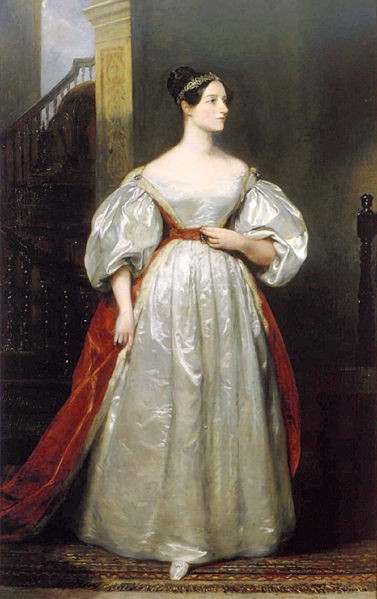
for she illustrates to perfection the importance of cross-disciplinary analogies in creativity.
*
Consider this diagram from Mark Turner‘s The artful mind: cognitive science and the riddle of human creativity, based on those in Arthur Koestler‘s The Act of Creation (eg those on pp 35 and 37):
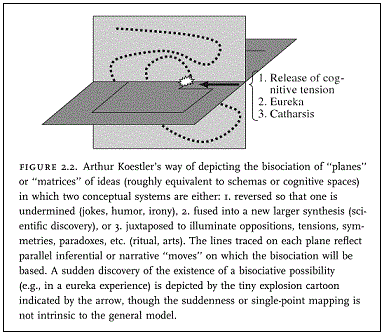
Hesse proposes — in his Nobel-winning novel, the Glass Bead Game (aka Magister Ludi) the building of an architecture of ideas in which the great works of human culture are linked — bound together — by analogies between them.
Beginning players of his Game, he writes, learn “how to establish parallels, by means of the Game’s symbols, between a piece of classical music and the formula for some law of nature.” As I wrote elsewhere, on a more complex level, Hesse speaks of scholars proposing materials for inclusion in the Game Archives, and specifically mentions someone who had been studying “the rhythmic structure of Julius Caesar’s Latin and discovered the most striking congruences with the results of well-known studies of the intervals in Byzantine hymns”… Hesse couldn’t possibly have known about it when writing that particular sentence, of course, but there is actually a book by Jane-Marie Luecke, OSB, entitled Measuring Old English Rhythm: an Application of the Principles of Gregorian Chant Rhythm to the Meter of Beowulf, (Literary Monographs, vol 9, U. Wisconsin Press, 1978).
Hunh? So?
*
Consider what Ada, Countess of Lovelace hath wrought.
She perceived just such an analogy — comparing Charles Babbage‘s Analytical Engine with Jacquard‘s mechanical loom, and writing:
The Analytical Engine … weaves algebraic patterns, just as the Jacquard-loom weaves flowers and leaves.
That analogy between weaving and algebra was the great creative leap: from there to the adoption and adaptation of Jacquard’s punched card system in computation was the lesser step from insight to application.
And think about it: her mind moved unerringly between “art” and “science” — or more exactly, craft and mathematics — in 1843, to deliver a technological insight on which the mainframes of the 1970s still relied…
That, my friends, was a superb move in the spirit of the Glass Bead Game — and impossible without a well-furnished and agile mind.
Chet on TEMPO….Rao on OODA
Tuesday, July 26th, 2011
At Fabius Maximus, Dr. Chet Richards reviews TEMPO by Dr. Venkat Rao, enjoying the book as much as I did, if not more. Chet has some particularly incisive comments, positive and critical, in his review, which I suggest you read in full:
…Rao draws on Boyd in several places, as well on sources ranging from the topical, such as Gladwell and Taleb, to the foundational (e.g., Camus and Clausewitz), to the downright obscure – know anything about The Archeology of Garbage? Do the words wabi and sabi ring a bell?
The result is a synthesis, what Boyd called a “snowmobile,” that combines concepts from across a variety of disciplines to produce a cornucopia of new ideas, insights and speculations. You may be confused, challenged, outraged, and puzzled (some of the language can be academic), but you’ll rarely be bored because every chapter, often every page, has something you can add to the parts bin for building your own snowmobiles.
Let me highlight just a couple, of special interest to folks familiar with Boyd’s concepts. Near the end of the book, Rao introduces an expanded version of “legibility”:
A piece of physical reality is legible if it is obviously the product of coherent human agency, a deliberate externalization of a mental model. When human and natural sources of order are harder to tease apart, you get greater illegibility (p. 133 – and I warned you about the academic language).
Then a couple of paragraphs later, he claims that:
Used with adversarial intentions, Boyd’s OODA can be understood as a deliberate use of illegibility to cause failure.
At first, this seems silly. Boyd only considers conflict between groups of human beings (Patterns of Conflict, 10), so all uses of his strategic concepts would seem to be prima facia examples of legible phenomena. On the other hand, and this is an example of what makes Rao’s little book so valuable, some commentators, such as Stalk and Hout in 1990’s Competing Against Time, point out that victims of a Boyd-style attack can rarely identify the cause of their problems – often blaming bad luck or incompetent, self-serving and treacherous idiots in their own organizations. Boyd made this clear in his own work, such as in Patterns of Conflict, 132, when he suggested that his victims would exhibit a variety of traumatic symptoms including confusion, disorder, panic, chaos, paralysis and collapse – indicating unrelenting attack by forces outside the scope of their own mental models…
Chet concludes with a suggestion for Venkat (with which I concur):
…As for where to go from here, Rao might write more about tempo. This will seem strange to him, I’m sure, but pages go by with hardly a mention of the concept. This means that we need another book from him. I’d suggest expanding on some of the concepts that he raises but doesn’t find space to develop. Here are three ideas: […]
But you will have to go over to Fabius Maximus to read the rest. Venkat, in turn responded to Chet over at his blog, Ribbonfarm:
Chet Richards’ Review of Tempo on Fabius Maximus
….Overall, Chet comes to the conclusion that Tempo resonates with the Boydian spirit of decision-making. I don’t entirely get out of jail free though:
Perhaps his unfamiliarity with the original briefings, however, led him to make one characterization that is incorrect, although widely believed:
The central idea in OODA is a generalization of Butterfly-Bee: to simply operate at a higher tempo than your opponent. (118)
Guilty as charged. I didn’t spend enough time exploring how OODA gets beyond merely “faster tempo” to “inside the adversary’s tempo.” That’s something I hope to explore in a more nuanced way in a future edition. Over the last 6-8 months, I think I’ve come to understand the subtleties a lot better, and the challenge is to now spend more time thinking through clear definitions and examples….
I think everyone who has explored the OODA Loop concept, including John Boyd himself, initially gravitated to the aspect of cycling “faster” than one’s oponent because it is a natural assumption that resonates with our own experiences. We have all seen competitions where one player or athlete was “quicker” in reading situations and arriving at the right intuitive decision – usually most of us have been both the faster as well as the slower and more hesitant person. It’s the first scenario that springs to mind and being “faster” gives an obvious comparative advantages. Obvious does not mean “only” though.
What made the “faster” interpretation of OODA Loop really stick in the culture though, IMHO, was this unfortunate but easily understood graphic:
NOT THE REAL OODA LOOP

As a result, we get critical arguments that the OODA Loop is really something germane only to binary situations similar to the high pressure aerial combat that Boyd experienced in the Korean War or as a tactical fighter pilot instructor (or Musashi’s sword fighting) and not something generally useful in military strategy. An odd argument, given that Clausewitz liked to use binary metaphors to describe the nature of war.
The next graphic, which better illustrates the simultanaeity and dynamic nature of the OODA Loop, with other potential avenues of exploitation than just going “faster” (which will swiftly hit diminishing returns in any event) does not lend itself as easily to nearly instant comprehension:
THE ‘OFFICIAL” OODA LOOP:
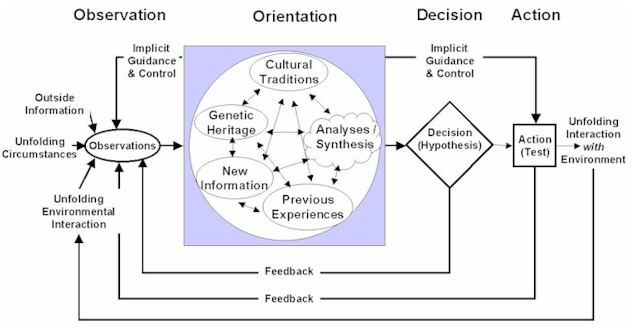
With these cognitive relationships operating continuously, mostly subconsciously with automaticity and in an iterative fashion, a different set of meanings to the phrase “inside your oponent’s OODA Loop” than just going “faster”, like a formula one race car zooming around a track.


