Nothing that the scientist in this article has to say about counterterrorism strategy would be regarded as news in this general area of the blogosphere but it is interesting that a marine biologist came up with conclusions similar to those of leading defense thinkers.
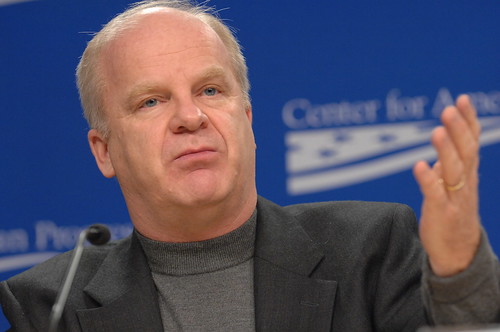
….Sagarin, an ecologist who’s normally more concerned with the urchins and starfish in tide pools, got to thinking about these things as a Congressional science fellow less than a year after the 9/11 terrorist attacks. He saw Washington building an expensive new shell, erecting large barriers around buildings and posting guards and cameras in every doorway.
“Everything was about more guards, more guns, and more gates,” he said. “I was thinking, ‘If I’m an adaptive organism, how would I cope with this?'”
….In nature, a threat is dealt with in several ways. There’s collectivism, where one meerkat sounds the alarm about an approaching hawk, or camouflage, where the ptarmigan hides in plain sight. There’s redundancy, like our wisdom teeth, or unpredictable behavior, like the puffer fish’s sudden, spiky pop.
Under the unyielding pressure of 3.5 billion years of evolution, the variety of defenses is beyond counting. But they all have a few features in common. A top-down, build-a-wall, broadcast-your-status approach “is exactly the opposite of what organisms do,” Sagarin says.
An immune system, for example, is not run by a central authority. It relies on a distributed network of autonomous agents that sense trouble on the local level and respond, adapting to the threat and signaling for backup without awaiting orders from HQ.
….Machines that walk upright will assist civilians and the military alike, said Stefan Schaal, associate professor of computer science and neuroscience at the University of Southern California.“We should at some point be able to create an artificial human being and I think humanoid robots are currently the first step toward that,” he said at the Army Science conference.“This is going to happen,” he predicted. “And it’s going to happen in this century.”It may not be as “polished” as the iRobot movie, he added.While other experts noted that there are huge technological hurdles to overcome, basic research continues on several critical technologies such as vision, movement and computational models that will allow robots to “think” like humans.A parallel effort to map – or reverse engineer – the human brain is going to give robotics experts inspiration that will allow them to create these advanced models, researchers at the conference said.The National Academy of Engineering is spearheading this “Grand Challenge.” Just as researchers successfully mapped the human genome earlier in the decade, the engineering community – not normally thought of as being a part of the life science discipline – says there will be a clear benefit to a Herculean effort to figure out exactly how the human mind works.“If we could determine the software of the human brain, we could embed all sorts of systems so as to provide human like quality for machines,” said John Parmentola, director of research and laboratory management at the Army office of the deputy assistant secretary for research and technology.Neural models will enable robots to better perceive, think, plan and act, said James Albus of the Krasnow Institute at George Mason University, Va.
“Significant economic and military applications will develop undoubtedly early in this century and in fact are already developing,” he said.
The part that makes me a tad skeptical is the “reverse engineering” of the brain. This is no small task. “Wetware” isn’t hardware and the wetware here is dynamically adaptive and to an extent individualized within parameters we do not yet fully understand. Unless I am missing something ( please correct me if I am) in terms of difficulty, reverse engineering the brain would appear to be harder than almost any other question that could possibly be related to the whole field of robotics itself.
While scientists have learned more about the human brain in the last 10 years that the previous 10,000, brain science is still in it’s infancy. The exciting MRI scan studies are primarily exercises in positively identifying correlation of brain activity with specific cognitive and physical tasks; what these studies mean in terms of application requires extrapolative speculation and experimentation.
By all means guys, go for it! I’m behind the effort 100 % as the spillover benefits are going to be enormous. However, I’d wager that this strategy is not the fastest route to functionally useful, autonomously acting, robots on a societal scale.
ADDENDUM:
I just picked up P.W. Singer ‘s new book Wired for War: The Robotics Revolution and Conflict in the 21st Century. Flipping through it quickly, I will say this is an extremely cool book designed to appeal to war nerds, tech geeks and defense policy wonks alike ( For example, if you read Singer’s ref to “the Big Cebrowski” and get it, well, then this book is for you). Some well known figures in the blogosphere also make it into Singer’s book but to find out who, you’ll have to go get a copy. 🙂
ADDENDUM II.
Jeff Hawkins at TED.comon the revolutionary potential of brain science:
The Armed Forces Journal cover story features Colonel T.X. Hammes giving an an “outside the box” reading list to change traditional thinking in defense circles:
Although the wider academic and business communities are coming to grips with the fact that many of these advances are changing the way we understand the world, the defense industry does not seem to see this as an issue. We still tend to view the world as responding to linear approaches applied by bureaucratic entities.
Fortunately, over the past couple of decades, a number of books have provided thought-provoking new theories of how the world works. Unfortunately, these theories do not align with the planning processes we use in the defense industry. The first step in fixing our planning processes is to examine how science’s understanding of reality is changing.The authors of these works highlight aspects of how the world has changed. This forces us to change how we frame problems, how we organize to deal with them and even how to get the best out of our people. For instance, if one still saw the world as a hierarchy, then one looked for the “leadership” of the Iraqi insurgency in 2003. Yet if one saw the world as a network in which emergent intelligence is a key factor, then one quickly saw the networked insurgent entities as they evolved an emergent strategy in Iraq. Our ability to adjust to the rapidly changing future security environment will, to a large degree, depend on our ability to understand the world as it is rather than as we have been taught to understand it. Reading these 12 books should help.
Here is the list, and it is a good one. I’ve read several, have some of the other books in my “antilibrary” and a few are new to me. You can go to the article to get some commentary regarding each book by Dr. Hammes:
Great recs are already in the comment section! I will start putting them together as a linked set of ” Reader’s Reading List”. Note also Smitten Eaglehas posted up.
Shane Deichman leaves his usual perch atWizards of Ozfor a special guest post at Matt Armstrong’s excellent public diplomacy and IO blog MountainRunner:
….In the early 1960s, President Kennedy charged his Science Advisory Committee (chaired by Dr. Jerome Wiesner, Special Assistant to the President on Science and Technology) to charter a panel to review federal information management policies and practices. The “Panel on Science Information” was chaired by Dr. Alvin M. Weinberg, Director of Oak Ridge National Lab (ORNL). ORNL is the site of the world’s first operational nuclear reactor (the Graphite Reactor, where the “pile” from the University of Chicago was moved during World War II to validate the “breeder reactor” concept) and a key national laboratory.
….NASA and the Atomic Energy Commission were acknowledged by Dr. Weinberg as excelling in this area, interpreting their responsibilities quite broadly, and being proactive in providing full-fledged information services (not just a “document repository”) for enabling access to information. The AEC’s culture of openly sharing information is still evident today in the Department of Energy’s “Office of Scientific and Technical Information” (OSTI) in Oak Ridge – the nation’s central repository of scientific information stored in easily searchable databases (including Science.gov, ScienceAccelerator.gov and WorldWideScience.org). [BTW: OSTI is located on the first street in the nation named after a website, “Science.Gov Way”, in Oak Ridge, Tennessee.]
At the other extreme, the Department of Defense was singled out in the Weinberg Report for having an information agency (Armed Services Technical Information Agency [ASTIA], predecessor of today’s Defense Technical Information Center [DTIC]) that only handled internal reports and internal information retrieval requests.
In the spirit of engaging and informing the American public of what the government does and why, Shane Deichman of Wizard of Oz and deep thinker on S&T sent along this post on Openness & Government. He is also the blogger increasingly pictured drinking with fellow bloggers.
John Robb is hard at work on Book II which will be about the building of ” Resilient Communities”. He’s batted a few comments about on twitter and worked up a series of posts on the RC theme at his “formal” site. Here are a few samples to give the flavor of his enterprise:
“Resilience” is a particularly intriguing concept with multiple meanings though John is honing in on those related to Newtonian physics and complexity theory ( one source in the last post, Ilya Prigogine,was a significant influence on John Boyd). I particularly liked this bit by John:
The modification of thermodynamics necessary to accommodate this observable fact was formulated by the Nobel laureate Ilya Prigogine in a theory called “dissipative systems” (read his excellent book: “The End of Certainty” for more). One important leap in this theory is that a dissipative system isn’t a closed system. Rather, it lives within a larger system (an “environment”) that it can interact with.
This upshot of this is that it can extract energy from this larger external environment to increase its structural complexity (build itself up through a process called self-assembly). It can also use this external environment to dump the entropy created during the energy conversion process to minimize the deleterious impact on its structure.
We’ve been pretty good at building up the complexity and are rather poor at dissipating the entropy, mostly for reasons related to the structure of our political system that ties self-interest of politicians and corporate CEOs to short-term frameworks and gives comparative advantage to rentier interests over innovators. The problem has become more difficult because many aspects of “the system” due to globalization are now beyond any state’s control.
Resiliency will involve decentralization and independence within greater interdependence in order to put natural “brakes” on high velocity forces without using draconian state controls ( which won’t work and never did – except with globalization they will be all side effects and no benefits). I’m very much looking forward to reading what solutions Robb proposes in Book II.
Zenpundit is a blog dedicated to exploring the intersections of foreign policy, history, military theory, national security,strategic thinking, futurism, cognition and a number of other esoteric pursuits.
 A parallel effort to map – or reverse engineer – the human brain is going to give robotics experts inspiration that will allow them to create these advanced models, researchers at the conference said.The National Academy of Engineering is spearheading this “Grand Challenge.” Just as researchers successfully mapped the human genome earlier in the decade, the engineering community – not normally thought of as being a part of the life science discipline – says there will be a clear benefit to a Herculean effort to figure out exactly how the human mind works.“If we could determine the software of the human brain, we could embed all sorts of systems so as to provide human like quality for machines,” said John Parmentola, director of research and laboratory management at the Army office of the deputy assistant secretary for research and technology.Neural models will enable robots to better perceive, think, plan and act, said James Albus of the Krasnow Institute at George Mason University, Va.
 . Flipping through it quickly, I will say this is an extremely cool book designed to appeal to war nerds, tech geeks and defense policy wonks alike ( For example, if you read Singer’s ref to “the Big Cebrowski” and get it, well, then this book is for you). Some well known figures in the blogosphere also make it into Singer’s book but to find out who, you’ll have to go get a copy. 🙂
 the world works. Unfortunately, these theories do not align with the planning processes we use in the defense industry. The first step in fixing our planning processes is to examine how science’s understanding of reality is changing.The authors of these works highlight aspects of how the world has changed. This forces us to change how we frame problems, how we organize to deal with them and even how to get the best out of our people. For instance, if one still saw the world as a hierarchy, then one looked for the “leadership” of the Iraqi insurgency in 2003. Yet if one saw the world as a network in which emergent intelligence is a key factor, then one quickly saw the networked insurgent entities as they evolved an emergent strategy in Iraq. Our ability to adjust to the rapidly changing future security environment will, to a large degree, depend on our ability to understand the world as it is rather than as we have been taught to understand it. Reading these 12 books should help.


 by Howard Bloom and
  by Edward O. Wilson.

