zenpundit.com » blogosphere

Archive for the ‘blogosphere’ Category

Recommended reading: the meat

Sunday, July 22nd, 2012

[ by Charles Cameron — a couple of courteous debates on topics of considerable interest ]
.

I’d like to draw your attention to two recent conversations:

The first begins with Mark Jacobsen‘s Armed Forces Journal piece, How to teach about Islam, and continues with a guest post from Tim Mathews at Abu Muqawama, Insha’Allah they learn something useful. Mark then responds to Tim at his own blog, Building Peace.

Mark lays out the problem:

Much of the debate now hinges on which voices educators should trust. The question is no longer “What is Islam?” but “Who should teach about Islam?” Government agencies struggle to answer that question, because they often feel compelled to choose between two camps: those who believe extremism is intrinsic to Islam itself, and those who see no relationship whatsoever between Islamic doctrine and extremism. Although much thoughtful and scholarly discussion of Islam does exist, it is these two camps who now dominate the popular conversation.

Government agencies will never escape their dilemma if they continue searching for an authority who can speak for “true” Islam. Islam is a deeply contested religion, even among Muslims, and the arguments of both extremes are shot through with truth, falsehood, exaggerations, omissions and assumptions. Much of the debate about Islam in the United States is intellectually dishonest. Rival voices are less concerned with sincere discussion than with heavy-handed tactics to dominate the conversation, such as efforts to control government classrooms. The only way out of this dilemma is also the most intellectually honest one: to understand the battle for American perceptions of Islam, to map out the topography of the debate and to teach students to critically evaluate rival arguments.

Tim responds:

As should be clear, I agree with problems that the author identifies in the US. However, I fail to see what this has to do with the issue of educating our personnel. We are not training our personnel to be foot soldiers in a culture war fought on cable television and weblogs in the United States. We are training our personnel to conduct operations in foreign countries.

[ … ]

The problem that he identifies is not relevant to preparing our personnel for deployments to conduct, and provide support for, operations in majority-Muslim countries. What the author has advocated is a program to help our educators avoid being pulled into battles of a culture war on US soil and, along the way, educating our personnel. The primary focus should be educating and the secondary focus on mitigating public pressure from fringe organizations.

Mark’s response:

I’m very glad to see your thoughtful response to my article. More than anything, I had hoped to spark some discussion about how Islam is taught in various government agencies, so am glad to see you carrying the discussion forward.

[ … ]

One reason you might disagree with aspects of my article is because you viewed it primarily through the lens of preparing deploying soldiers. That is an important part of what I’m writing about, but I actually intended the article to encompass a much broader range of government needs. Government employees have many different reasons they might need to understand something about Islam. Congressmen and their staffs are trying to make sense of the alleged “shariah threat” and calls for anti-shariah legislation; law enforcement agencies and the FBI need a way to understand and delineate between “moderates” and “extremists”, so they can hone in on real threats while respecting the civil liberties of ordinary Muslims; military commanders concerned with preventing the next Ft. Hood want to know how they can recognize extremist ideology; government agencies involved in any sort of outreach to Muslim communities struggle to find partners they can work with, because the largest American-Islamic organizations that claim to speak for American Muslims are tarnished by alleged links to extremism and terrorism.

All three pieces are worth reading in full — it was hard to pull quotes that did any of them justice, they’re all packed! And FWIW I do think Mark is right in ranging beyond the constraints of “preparing our personnel for deployments” — Tim’s more focused concern — because the war of ideas is won or lost as much in terms of how the US is perceived WRT Islam as it is by the behavior of troops, village by village, “in the field”.

**

The second begins with a David Briggs piece in Huffington Post, Is It Time to Reconsider the Term Islamist?, which leads Daveed Gartenstein-Ross and Lauren Morgan to respond at Gunpowder & Lead with Islamism in the Popular Imagination — which in turn generated Bernard Finel‘s post On Islamists and Rick Santorum. Daveed then comes back with Islamists and Rick Santorum: A Response to Bernard Finel.

I’m not going to quote Briggs, whose piece strikes me as light-weight, except to note that he introduces the question of comparisons between Obama and Rick Santorum (potential “Christianists”) with “Islamists”:

At this year’s National Prayer Breakfast, President Barack Obama said his policies were grounded in his Christian beliefs. In a 2008 speech, former GOP presidential contender Rick Santorum said America was in the middle of a spiritual war in which “Satan has his sights on the United States of America.”

Are Obama and/or Santorum Christianists?

The answers to those questions would depend on how the term is defined. But it is unlikely you will hear any Christian politician or activist referred to in that way.

What American and western audiences are increasingly hearing, however, since the political and social upheaval that accompanied the Arab spring, is the term Islamist.

Daveed and Lauren:

You would be hard pressed to find anything beyond a few fringe commentators who are worried about Islamism because politicians representing this movement refer to Islamic principles in their rhetoric. Rather, it is the specific relationship between religion and state that worries observers. (I mean, really, does Briggs think that Obama will make canon law the law of the land if given a second term?)

Briggs bolsters his case by quoting Mansoor Moaddel, an Eastern Michigan University sociologist, as saying that in his interviews, he found that “‘in some respects, Mr. Santorum is more extremist’ than leading figures of Egypt’s Muslim Brotherhood.” Nor is Briggs the only Western commentator to fatuously compare Santorum to Islamic extremists. To actually approach the claim being made by Briggs and others — that Islamist politicians possess an agenda that is less extreme than that of Rick Santorum — a better approach is to look at the practice in Middle Eastern states, as well as the policies advocated by Islamist politicians with significant audiences (as opposed to mere fringe players). That is what we do in this entry.

And do they indeed do — detailing with bullet points and commentary the practical behaviors of a variety of Islamic nations in respect to apostasy, blasphemy, the rights of women, and gay rights in the rest of their lengthy and instructive piece.

Enter Bernard Finel, who draws a fine distinction:

GR argues convincingly that policies put in place by Islamist parties throughout the Middle East are more extreme than Santorum. And indeed, on issues like religious freedom, women’s rights, and gay rights, GR is quite correct. Islamist regimes are worse than anything Santorum has proposed.

But I’d argue this is an apples to oranges comparison. Santorum’s limits are defined, I think, more by the limits imposed by American institutions rather his ideology per se. In other words, GR is comparing institutionally unconstrained ideological positions with those heavy constrained by institutions. It actually is not at all difficult to find actors on the right who would like to see religious freedom severely curtailed. Indeed, there is even a “Constitutional theory” out there among right wingers than Muslims should not receive First Amendment protections because either Islam is a “cult” or because it was not extant in any significant way in the United States when the Bill of Rights was ratified.

I’ll get into the issue of “actors on the right who would like to see religious freedom severely curtailed” in an follow up to this post — and touch on the usage “Christianist” there also — here, I’ll just say that Finel is articulating something I’ve “felt but not thought” or perhaps “thought but not articulated” myself quite a few times, and while I’m not entirely satisfied with his phrasing about “constraint by institutions” I think there’s a serious point in there, and I’m glad to see it surfaced.

Back to Daveed:

In comparing the relative extremes of Santorum versus those of Islamist parties, we were not trying to offer a moral judgment on the relative righteousness of those two actors (to be clear: we use “actor” in the loosest possible sense here, since Islamist politicians are by no means a unified actor). Rather, we were comparing exactly what we have just specified: the policies Santorum has advocated or implemented versus those that Islamist parties have advocated or implemented. It is true that institutional constraints play a role in defining said policies, but our goal was illuminating policies that are likely to have an impact on anyone’s life, and not judging Santorum’s “heart of hearts.” Hence, it is a direct apples to apples comparison of what policies are advocated by these two different actors. It would only be an apples to oranges comparison if our goal were moral judgment.

Fair enough: then there are at least two kinds of comparisons to be made… one between policies advocated by the respective parties, and one between the political realities constraining those whose ideals may be comparable.

**

Again, with such rich material it is difficult if not impossible to pick quotes without cherry-picking them — and I must repeat that my intention here has not been to summarize these debates so much as to lead you into them…

Finel actually has a further post today in which he characterizes Daveed (and Laurel) as making “an ill-conceived and pointless attempt to haul Rick Santorum into the mix” on the way to another discussion. For the record, it was Briggs, not Daveed and Laurel, who introduced Santorum into the discussion.

I’ll have two follow-ups to this post, one adding a couple of points to the Gunpowder & Leaf / Finel discussion in regard to “Christianism” and the theological underpinnings of a contemporary movement for church-state fusion, the other adding a couple of other intriguing details to the mix.
Numbers by the numbers: four

Wednesday, July 18th, 2012

[ by Charles Cameron — importance of the ratio form (“this is to that as thus is to so”) as a bridge between domains and silos, creative leaps, the glass bead game, and finally, Chittick’s joke about camels, sex and translations from the Arabic ]
.

.

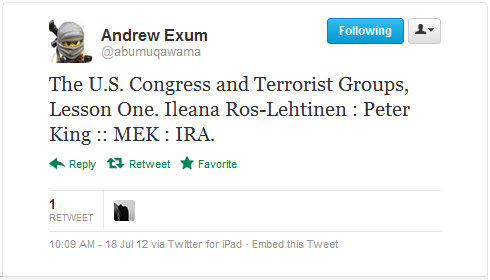
I retweeted this tweet of Andrew Exum‘s to my friend Paul Pilkington because I know he’s working on a project to find out what “this is to that” is to some other “this is to that” — across a wide swathe of human culture.

Note particularly that Exum is using this formal device to illuminate, to give insight, in an area of importance to analysts, strategic thinkers and decision makers.

I’m also retweeting Exum to Paul because I believe Paul’s simple experiment, based as it is on his reading of Hermann Hesse‘s Glass Bead Game, has the capacity to build an architecture of thought (a) crossing all disciplines and (b) spanning the trivial with the profound.

I’m doing something similar with Cath Styles in our Sembl games project — but this time I want to concentrate on Paul’s approach, and since there are four moving parts in an a is to be as c is to d configuration, I’m calling this post Numbers by the numbers: four — number three will just have to wait a while.

**

To get a sense of what Paul is up to, we can go to his Twitter Project page, which describes the fourth in a series of books he’s writing — and also follow him on Twitter, where he posts as Just Knecht.

Two of Paul’s recent tweets express his sense of the task pretty incisively:

The whole of language is the holding up of one unlike thing to compare, contrast and connect with another

Curating is a matter juxtaposition of work against work, artist against artist, place against place – A.Searle on Documenta 13, The Guardian

On his Twitter Project Page, he tells us:

Each tweet is an individual Glass Bead Game move, which is a comparison (metaphor, simile or analogy) across different areas, and may be either a statement or a question.

In question form, these are not unlike analogy questions from SAT tests with an additional dimension of general knowledge, cultural invention and intellectual playfulness. The basic challenge is to work out the relationship between two terms in one context, and apply it in another. Sometimes a tweet will extend an analogy further, which would be the beginning of forming a larger game from an individual move.

Some of the most interesting moves do not have right or wrong answers. Some have canonical or original answers, but they’re not necessarily right. In fact, very often I will post something I’ve picked up from elsewhere which I would love to see improved on, challenged, or at least better explained by others.

He then poses some of the sorts of questions that intrigue him:

Who is the J.H.Prynne of contemporary dance? Like Prynne in contemporary poetry they need to have been ‘out there’ right at the edge of theory and practice for some time, and also deeply steeped in tradition at the same time. Merce Cunningham? Suggestions welcome … And Heston Blumethal or Ferran Adrià might be the Prynne of cookery. But what about the Prynne of contemporary warfare?

What is the equivalent of sonata form in architecture? Goethe and Hegel both said ‘architecture is frozen music’ but neither really explained what they meant. If it is, then is there an architectural equivalent in Western architecture of the key structural form in Western art music? Suggestions welcome …

So, Zenpundit readers — who is the JH Prynne of contemporary warfare?

**

Not so long ago, in Numbers by the numbers: one, I posted a series of self-referential tweets that I’d collected over the last month or two — here I’d like to present some of Paul’s recent tweets:

Let’s start with one that’s a foreign policy insight, arguably as significant to day as it was when Vance first said it:

16 Jul @justknecht
“The Strait of Hormuz is the jugular vein of the West” (Cyrus Vance)

If these tweets can be timeless, they can also be timely:

4 Jul @justknecht
The Higgs boson is the quantum of the Higgs field, just as the photon is the quantum of the electromagnetic field

As they accumulate over time, they can build a conceptual “mesh” that engages an entire field — in this case, recent classical music — while linking it to a variety of other areas:

16 Jul @justknecht
“Boulez’ Derive 2 sounds like birthday cakes ought to” – Philip Clark, Gramophone

22 Jun @justknecht
Wagner was a beautiful sunset that was mistaken for a dawn – Claude Debussy, quoted by Geoffrey Norris in Gramophone

30 May @justknecht
Fauré’s Theme and Variations (no. 9) is like an evening star falling slowly from the sky – Bryce Morrison cites Alfred Cortot in Gramophone

11 May @justknecht
Kraftwerk is the Warhol of pop music – The New Yorker

There’s profundity here:

9 Jun @justknecht
“Space is to place as eternity is to time.” – Joseph Joubert

This could be, as Paul says, “the beginning of forming a larger game from an individual move” — that quote in itself could plausibly be the keystone of an architecture bridging science with religion…

There are historical parallels to consider:

31 May @justknecht
Robert Burton : Oxford :: Jeremy Prynne :: Cambridge

Catty remarks by Nobel laureates:

21 May @justknecht
“Thinking is to humans as swimming is to cats” (Nobel laureate Daniel Kahneman)

Near-tautologies:

21 May @justknecht
Macon Telegraph: Recipes are to food as blueprints are to buildings.

And, ooh, exotic forms of slander!

18 May @justknecht
“[Your daughter] has lovers as numerous as the striking of tablas on Palm Sunday” – Arabic satire by Abu Nawas, 756 – 813 AD

Once again, it’s form that generates insight, not content. Get used to form, play around with it, and content will leap out at you from the page, from the screen.

**

I’m no Arabist myself, but ah! that last quote reminds me irresistibly of the difficulties faced by translators from the Arabic, as recounted by William Chittick in The Self-disclosure of God: Principles of Ibn Al-‘Arabi’s Cosmology (SUNY Press, 1998, pp. xxxv-xxvi.)

An old joke among orientalists tells us that every Arabic word has four meanings: It means what it means, then it means the opposite of what it means, then it has something to do with sex, and finally it designates something to do with a camel …. The rational mind tends to push the meaning of a word away from experience to ‘what it means’ but the imaginal mind finds the self-disclosure of the Real in the sex and the camel … it is in the world’s concrete realities that God is found, not in its abstractions.

I’d been looking for an excuse to post that quote on Zenpundit — now I’ve found it!

Truth in advertising?

Monday, July 9th, 2012

[ by Charles Cameron — British politics and religion: reading billboards as signs of the times ]
.

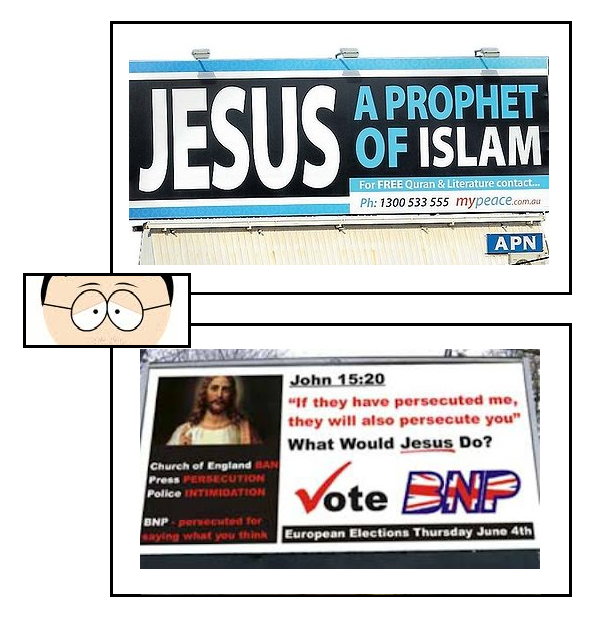
On the Fourth, in my post On the inforced uniformity of religion, I registered my lack of total enthusiasm for a highly-publicized campaign to “declare the plans of heaven” over the British parliament. One of the problems inherent in any such arrangement is the wide diversity of political opinions attributed to the Godhead.

Happily, these days we can quickly ascertain God’s views on matters of religion and politics by watching the signs of the times — billboards:

By way of pointing up the contrast, the BNP is opposed in particular to:

the Crescent Horde — the endless wave of Islamics who are flocking to our shores to bring our island nations into the embrace of their barbaric desert religion.

**

I’m indebted to Archbishop Cranmer, the British blogger on matters of religion and politics, for drawing my attention to each of these billboards (i and ii).

As Abraham Lincoln in a far different context once said: “The prayers of both could not be answered.”

Recommended Reading: Five Notable Posts

Thursday, June 14th, 2012

[by J. Scott Shipman]

Recently, several notable posts have continued, or amplified the ideas introduced by Lt. Benjamin Kohlman’s post at Small Wars Journal calling on “disruptive thinkers.” I’ll be sharing five posts: three are serialized and offer a historical example of disruptive thinking in the U.S. Navy and the resultant lessons. The fourth is written by LTG Walter F. Ulmer, Jr. (USA, Ret) and defines a major obstacle to the disruptive thinker, namely, “toxic leaders.” The fifth is an current example of a young active duty officer, Richard Allain (USMC) thinking deeply about his profession and offering ideas on adaptability and innovation.

VADM William Sims

Navy Lieutenant Commander Benjamin “BJ” Armstrong wrote a three installment post at the US Naval Institute blog, and his topic was an example of not only disruptive thinking, but of courage, persistence, and what LCDR Armstrong calls (correctly) “grit.” Here is an excerpt from the first installment describing then-Lt. William Sims:

In 1900 he was a Lieutenant, fresh off staff duty in Europe as an intelligence officer.  He had orders to China Station to join the U.S. Navy’s newest and most powerful battleship, the USS KENTUCKY.  He arrived aboard the battleship having studied the early Dreadnaught battleships of Europe and the gunnery practices of both potential allies and potential adversaries alike.

Sims checked onboard and discovered that the Navy’s “newest and most powerful” may have been new, but it certainly wasn’t powerful.  There were a number of problems with the ship.  The hull was armored under the waterline, but the sides and gun turrets were open and un-protected.  The gundecks were so low to the waterline that when the ship was fully loaded and took heavy seas water would pour into the turrets.  And there was no separation of the magazines and the weatherdecks and gundecks, so a hit from an enemy shell could directly access the magazines.

Sims was incensed.  He set about recording the deficiencies.  In a letter to a friend he wrote: “The Kentucky is not a battleship at all.  She is the worst crime in naval construction ever perpetrated by the white race.” 

In the second installment, Lt. Armstrong describes then-Lt. Sims “grit:”

Sims had submitted 13 reports in all, over the span of two years, each one continually improving his method and technique.  When he heard that the Bureau of Ordnance had completed a test and proved that what he claimed was impossible, he finally had enough.  He knew that if the United States Navy went up against a force that was using continuous aim fire it would be decimated.  Destruction of the fleet would open up the U.S. coast to invasion, as the Brits had done in the War of 1812 (a war that was roughly as distant to him as World War I is to us).  He believed that the nation’s security depended on his success.

Lieutenant William Sims did something that he later characterized as “the rankest kind of insubordination.”  He wrote a letter to the President.

Writing the President is is pretty disruptive, and the President read the letter and acted.

LCDR Armstrong, in his final installment called, Voice, Grit, and Listening…A Look at the Possible:

Finally, we all need to learn to listen.  This is especially true as we become more senior.  Today we may be the junior leaders, but that means tomorrow some of us will be the mid-grade leaders, and in the future some of us will be the senior leaders of the Navy.  Sims is proof that when you remember it’s not about you but instead it’s about the idea and about the Service, you can continue to innovate as you are promoted.

These three posts are exceptionally relevant, and highly recommended.

LTG Ulmer’s essay in Army magazine, June 2012 issue, is titled: Toxic Leadership, What Are We Talking About? General Ulmer defines toxic leadership:

Defining toxic leader is the first priority before addressing numbers, impact, cause and solution. Webster’s defines toxic as poisonous, not far from destructive or harmful.

Toxic leaders are a major obstacle, and according to General Ulmer’s essay, make up almost 10% of the Army’s officer corps. General Ulmer goes on to define precisely toxic leaders in the military context, explain how they continue to survive, and offer solutions. His analysis is lucid and spot-on. The other services could learn from the Army’s lesson, and take positive action to separate toxic leaders using indigenous resources—essentially using the personnel system to weed these folks out:

A very good soldier and scientist, LTC Larry Ingraham, now deceased, commented on the dramatic differences among subordinate reputations of senior officers, saying that the personnel system that cannot distinguish between the revered and the despised must have a fundamental flaw.

The final essay comes from today’s Small Wars Journal. The title is Innovation in a Small War, and is truly an exercise in deep thinking on how the Marine Corps plans, adapts, innovates, and fights. On creativity, Allain says:

Current theories of creativity support a process consisting of four key themes.  Creativity results from the invention and bounding of a problem, deconstruction of existing mental concepts, synthesis of these concepts in a new way, and test and development of the novelty to become valuable.

Allain recognizes the institutional obstacles to innovation:

It is clear that we need both innovators and adaptors within the Marine Corps to execute our doctrine.  Without a balance we can stagnate or fluctuate wildly, rapidly finding ourselves unable to cope with structured or unstructured situations.  While Marines are elite, they still have a spread in distribution of natural talents and attributes and exercise a spectrum of adaptive and innovative thought processes.

He concludes:

The field of military innovation studies must expand its orientation and re-examine the interconnectedness of adaptability and innovation, appreciation and leadership, and military effectiveness.  Specific focus should be given to the aforementioned instances of resistance to innovation.  It created stagnation and inhibited learning, a sign of ineffectiveness under this theory, and deserving of analysis.

Allain’s essay, along with the other posts, should be required reading for all are instructive, and all offer examples and solutions—and I would offer, an inspiration to those members on the fence about wading into the debate.

Well done to all!

ADDENDUM to original: Mark Tempest over at EaglesSpeak links to some insightful posts (duplicating a few above), and makes a good point about age (us old guys), illustrating you can teach an old dog new tricks—if the dog is paying attention…

Cross posted at tobeortodo.com

A host of lessons on the web, with room for admiration

Thursday, June 14th, 2012

[ by Charles Cameron — Farrall and McCants, debate and discourse]
.


.

There’s a whole lot to be learned about jihad, counter-terrorism, scholarship, civil discourse, online discourse, and social media, and I mean each and every one of those, in a debate that took place recently, primarily between Leah Farrall and Will McCants.

Indeed, Leah still has a final comment to make — and when she makes it, that may be just the end of round one, if I may borrow a metaphor from a tweet I’ll quote later.
.

1.

Briefly, the biographies of the two main agonists (they can’t both be protagonists, now, can they? I believe agonist is the right word):

Dr. Leah Farrall (left, above) is a Research Associate at the University of Sydney’s United States Studies Centre (USSC). She was formerly a senior Counter Terrorism Intelligence Analyst with the Australian Federal Police (AFP), and the AFP’s al Qaeda subject matter specialist. She was also senior Intelligence Analyst in the AFP’s Jakarta Regional Cooperation Team (JRCT) in Indonesia and at the AFP’s Forward Operating Post in response to the second Bali bombings. Leah has provided national & international counter terrorism training & curriculum development. She recently changed the name of her respected blog. Her work has been published in Foreign Affairs, Foreign Policy, The Atlantic, and elsewhere.

Dr. William McCants, (right) is a research analyst at the Center for Strategic Studies at CNA, and adjunct faculty at Johns Hopkins University. He has served as Senior Adviser for Countering Violent Extremism at the U.S. Department of State, program manager of the Minerva Initiative at the Department of Defense, and fellow at West Point’s Combating Terrorism Center. He edited the Militant Ideology Atlas, co-authored Stealing Al Qa’ida’s Playbook, and translated Abu Bakr Naji‘s Management of Savagery. Will has designed curricula on jihadi-inspired terrorism for the FBI. He is the founder and co-editor of the noted blog, Jihadica. He too has been published in Foreign Affairs, Foreign Policy, The Atlantic and elsewhere.
.

2.

Gregory Johnsen, the Yemen expert whose tweets I follow, noted:

Watching @will_mccants and @allthingsct go at it, is like watching heavyweights spar for the title about 17 hours

Daveed Gartenstein-Ross commented on the civility of the exchanges:

it was an excellent model of argument within this sphere. Competitive analysis is important, and it is generally best when conducted in the open, as this has been. Further, the exchange has been respectful and collegial, something that is atypical for today’s debates.

Between those two comments, you have the gist of why this debate is significant — both in terms of topic and of online conduct.
.

3.

The debate started with a blog post by Leah, went to Twitter where the back and forth continued for several days, was collated on Storify, received further exploration on several blogs, turned sour at the edges when an article on Long War Journal discussing Leah’s original blog post draw some less than civil and less than informed drive-by remarks in its comments section, and continues…

And to repeat myself: all in all, the debate is informative not only about its topics — issues to do with terrorism and targeting — but also in terms of what is and isn’t possible in online dialog and civil discourse on the web.
.

4.

Leah Farrall’s Some quick thoughts on reports Abu Yahya al-Libi has been killed was the counter-intuitive (but perhaps highly intuitive) blog post which began the debate, and perhaps her key paras were these:

And if he has in fact been killed, I wonder if those who think this is a victory (and those supporting the strategy of extrajudicial killings more generally) have given ample thought to the fact that he along with others who have been assassinated were actually a moderating force within a far more virulent current that has taken hold in the milieu. And yes, given his teachings I do note a certain irony in this, but sadly, it’s true.

What is coming next is a generation whose ideological positions are more virulent and who owing to the removal of older figures with clout, are less likely to be amenable to restraining their actions. And contrary to popular belief, actions have been restrained. Attacks have thus far been used strategically rather than indiscriminately. Just take a look at AQ’s history and its documents and this is blatantly clear.

I say, “counter-intuitive” because, as Leah herself notes, this is not the received opinion — “Right now you’re probably scoffing at this” she writes. And I say intuitive because Leah may be the one here who whose insight comes from herself not the crowd, who sees things from a fresh angle because she has a more wide angle of vision, who is in fact intuiting a fresh and revealing narrative…

Not that she’s necessarily right in this, and not that it would be the whole picture if she was — but that she’s challenging our orthodoxies, giving us food for thought — and then, having read her, we need to see how clearly thought out the response is, how strongly her challenge withstands its own challenges… how the debate unfolds.
.

5.

I am not going to summarize the debate here, I am going to give you the pointers that will allow you to follow it for yourselves.

It is very helpful indeed for those who are interested in this unfolding debate, that Khanserai has twice Storified the initial bout of tweets between Farrall and McCants.

Khanserai’s second Storify is the one to read first, as it offers the whole sweep of several days of tweeting. That’s the full braid. Khanserai’s earlier Storify is worth reading next. It concerned itself solely with Leah’s significant definitional distinctions regarding discriminate vs indiscriminate targeting and targets vs victims.

There’s a lot to read and even more to mull right there, but the persevering dissertation writer for whom this is the ideal topic will then want to read a number of significant posts triggered by the debate:

Jarret Brachman was among the first to comment on al-Libi’s reported demise, in a post titled In a Nutshell: Abu Yahya’s Death. I don’t know if his post appeared before or after Leah’s, but his comment is congruent with hers:

The cats that Abu Yahya and Atiyah had been herding for so long will begin to wander. They will make mistakes. They will see what they can get away with. Al-Qaida’s global movement cannot endure without an iron-fisted traffic cop.

I look forward to Brachman’s comments on al-Libi’s “other important role: that of Theological-Defender-in-Chief for al-Qaida”. Another day…

McCants’ On Elephants and Al-Qaeda’s Moderation posted on Jihadica first paraphrases Farall:

Leah argues that the US policy of killing senior al-Qaeda Central leaders is wrongheaded because those leaders are “a moderating force within a far more virulent current that has taken hold in the milieu.” Leah compares these strikes to the practice of killing older elephants to thin a herd, which leaves younger elephants without any respectable elder to turn to for guidance as to how to behave. By analogy, killing senior al-Qaeda Central leaders means there will be no one with enough clout to rein in the younger generation of jihadis when they go astray.

He then argues that while there “might be good reasons not to kill al-Qaeda Central’s senior leaders with drones but their potential moderating influence is not one of them” — and proceeds to enumerate and detail them. His conclusion:

It is hard to imagine a more virulent current in the jihadi movement than that of al-Qaeda Central’s senior leaders. Anyone with a desire or capability of moderating that organization was pushed out long ago. AQ Central may have moderated in how it conducts itself in Muslim-majority countries, but it certainly hasn’t moderated toward the United States, which is what has to be uppermost in the minds of US government counter-terrorism policymakers.

Other responses worth your attention — and I know we’re all busy, but maybe this is an opportunity to dig deeper something that shouldn’t only concern those in search of a dissertation topic — would include:

Daveed Gartenstein-Ross’s The Strategy of Targeting al Qaeda’s Senior Leadership posted at Gunpowder and Lead contains the most thoughtful counterpoint to Leah’s point that I have found:

contrary to Farrall’s argument, a strategic opponent actually seems far more dangerous than an indiscriminate opponent

Clint Watts should be read and pondered, too. His post, It’s OK to Kill Senior al Qaeda Members in Pakistan, tackles Leah’s position from several angles, one of which focuses on her “law enforcement” perspective on terror:

I am with Leah that in an ideal world, it would be great to capture, convict and imprison terrorists. This approach only works when there are effective criminal justice methods for implementing it.

I wonder how he views military vs law enforcement attempts to corner Joseph Kony, but that’s off topic. To return..

Bernard Finel, too, posted a thoughtful piece on The Unsatisfying Nature of Terrorism Analysis, and wrapped up his post with the words:

In short, I’ll keep reading Farrall, McCants, and GR because they are smart, talented folks. They know a lot more than I do. But I can’t help by feel that there just isn’t enough there to make their arguments convincing on a lot of scores.

Those are the heavyweights weighing in, as far as I can see — feel free to add others in the comments section. But then…
.

6.

But then there’s Andrew Sullivan in The Daily Beast, asking Are Drones Defensible? in what I found to be a lightweight contribution. As I read it, Sullivan’s key question is:

if you’d asked me – or anyone – in 2001 whether it would be better to invade and occupy Afghanistan and Iraq to defeat al Qaeda, or to use the most advanced technology to take out the worst Jihadists with zero US casualties, would anyone have dissented?

as if such a hypothetical — asking about popular opinion rather than ground realities, which are a whole lot more complicated either way — was the right question to be asking. And his conclusion, interesting but unsubtle: “drones kill fewer innocents”.
.

7.

Oh, lightweight is more or less okay in my book, as is the strong affirmation of a strong position.

The editors at Long War Journal clearly feel strongly about Leah’s suggestion, and make no bones about it in a post titled US killing moderate al Qaeda leaders, like Abu Yahya, says CT analyst — which I don’t think is quite what Leah was saying — and opens with the sentence “This is one of the more bizarre theories we’ve heard in a while.”

That, you’ll notice, is a pretty bluntly phrased attack on Leah’s ideas, not her person. But what follows is interesting.

In the comments section at LWJ we see comments like “I assume this young lady is paid for her thoughts. If so by whom? Is she the ACLU lawyer? If so when was her last interview with Abu Yahya al Libi” and “Leah Farrall is one of these many Peter Panners who form a loosely knit confederation of self identified intellectuals with little or no understanding of violence & of those presently arrayed against ‘us'”…

You don’t see comments like those on the other sites I’ve mentioned, and to my mind they show surface ignorance of the deep knowledge that informs the main participants on both sides — and perhaps as a corrollary, the absence of the civility that characterizes the debate as a whole.
.

8.

My own interest in terrorism / counterterrorism is explicitly limited to the ways in which theological drivers manifest, and while I read a fair amount about the broader issues into which theology enters, I’m no expert, humble and (inside joke) for the moment at least, more or less clean-shaven.

I am waiting for Leah Farrall’s response to the debate thus far, but have no expectation of being the best proponent of any of the positions or nuances involved: I leave that to the experts, and am glad they are on the case, every one of them.

Two broad context pieces that have caught my attention:

Francine Prose, Getting Them Dead in the NY Review of Books
Patrick B. Johnston, Does Decapitation Work?

For myself, then, the main point here is to acknowledge the knowledge and insights of those who know what I can only guess, or perhaps catch out of the corner of my eye. The second lesson: that there’s much to be found in Joseba Zulaika‘s book, Terror and Taboo: The Follies, Fables, and Faces of Terrorism.

Even a brief glimpse of the book when Leah mentioned it has convinced me once again that Zulaika’s is a voice worth attending to.
.

9.

But wait, I am a Howard Rheingold friend, I’m concerned with dialog and deliberation and decency in discourse, not just terrorism and CT — and here I have no need for disclaimers.

What I learn here is that attentive listening to all (the folks in the comments section included) brings knowledge, that incivility frequently accompanies ignorance, and — I hope you will forgive me going all aphoristic here — that nuance is an excellent measure of insight..

This is a debate to admire and follow.


Switch to our mobile site

