zenpundit.com » blogosphere

Archive for the ‘blogosphere’ Category

Two in the wild from @tinyrevolution, plus one

Monday, December 9th, 2013

[ by Charles Cameron — in which my doppelgänger Jon Schwartz of Tiny Revolution comes up with a few of my ideas before I’ve even woken up, see “background” below ]
.

I’m posting this first pair of images with my friends Mike Sellers and Bryan Alexander in mind:

**

This pair, which i snarfed from the same source, is also of interest:

Click here to see the twin texts at a more easily readable size.

**

Okay, here’s some background, fished out of my personal mists of time with an assist or two from the Internet Archive:

On November 9, 2004, a certain Jonathan Schwartz had apparently read a post of mine about OSINT on the Online Journalism Review [now archived], followed me to another site where he found more of my writings — and blogged at A Tiny Revolution:

At this point I became… unsettled. Cameron’s view of the world is EXACTLY THE SAME AS MINE. I briefly asked myself: do I have a split personality, and does my other personality have a website of its own? It is possible that when I think I’m sleeping, I’m actually awake as “Charles Cameron,” busily saying the same things Jonathan Schwarz does? Or is it the other way around, and when Charles Cameron goes to sleep he transforms into “Jonathan Schwarz”? And… is either one of us a superhero?

I then discovered the strangest thing of all. It turns out that unbeknownst to me (or “me”), Cameron was already aware of this website, and had linked to it twice.

So I recommend Cameron’s site. I myself look forward to following it and his work. But he better not start hitting on my girlfriend, because she might like him exactly the same amount as me.

It seems Jonathan Schwartz is still tracking “side by side” quotes and images, just as I’m still tracking “DoubleQuotes”. And sometimes — as today, above — fragments of “his” life surface as half-remembered dreams in mind…

Or as Florence Nightingale once said:

Oh Jonathan my brother Jonathan, my love to thee was very great, passing the love of women

So it looks like your girlfriend is safe after all, Jon.

**

One more from TinyRevolution before we go — not a DoubleQuote this time, but an intersection of two fields — and ZP readers already know how interested I am in the intersections of NatSec and Games

Of nested and coiled serpents in logic

Saturday, August 31st, 2013

[ by Charles Cameron — another exploration into forms of insight — in this case the Matrioshka effect, spiral staircases and the like, with a glance at holy winds and human fingertips ]
.

A mention of blogs about blogs about blogs seems to me to qualify for the “nested serpent” category of forms that are worth watching out for, the nest (or spiral, from which I am guessing the nest is not entirely separable) being of particular interest because while seemingly simple enough, it all too often reaches at one end or both into the infinities, where paradox meets epiphany… as my second example will show.

But first, by sheer good fortune, I came across this verse from the book of Ecclesiastes as I was polishing this post for publication:

The winde goeth toward the South, and turneth about vnto the North; it whirleth about continually, and the winde returneth againe according to his circuits.

**

That’s the pattern we’re looking for, and I ran across it recently in a comment my friend Allen Stairs made, and the response he received:

Okay, I didn’t follow — so I asked Allen for an explanation, and he wrote me:

Actually. “equipollent” was a bad choice of terms. “Equinumerous” wold have been better.

But the thing about numbers and those dolls: natural numbers have their identity intrinsically, so to speak. In set theory, one way to represent them is as the series

1 = {Ø}, 2 = {Ø,{Ø}}, 3 = {Ø,{Ø,{Ø}}}, etc.

In fact, we can even use the simpler construction

1 = {Ø}, 2 = {{Ø}}, 3 = {{{Ø}}}, etc.

So if we’re given the set, its structure tells us which number it is. I

Now a finite set of Russian dolls does much the same thing. We could count the innermost one as 1, the next as 2, the next as 3, and so on, and if you were given the doll, you’d be able to tell which number it represented. Or if we wanted, we could let the outermost doll represent 1, and work our way in. But if we take the set of all natural numbers, things get a little wonkier. The thing about a set of dolls is that there’s an outer one; the charm is in the fact that there’s a place to start opening them. So suppose we have an infinitely nested set of dolls. What number does the outermost one correspond to? It can’t be a natural number, because for any natural number, the nesting would have to be finite. It can’t be the infinite number Aleph-null because among other things, if the nesting is infinite downward then each doll has the same structure as the one that encloses it, and so it seems that there’s no way for the individual dolls to represent distinct integers.

Now if we’re given the whole set of dolls, there’s a sort of substitute: match dolls to numbers depending on how many “predecessors” they have. The outermost doll has no predecessors, so let it be 1; the next one in has 1 predecessor, so let it be 2. And so on. But we still have a problem: there’s nothing about the doll itself that tells us which integer it represents.

So my little point was that Harold’s joke was about “how many?” but the thing about the dolls is that they might seem at first to have the right structure to represent the natural numbers, and yet they don’t — at least, not the whole set of natural numbers.

**

Did Ecclesiastes mention the winds? Here’s a discussion of wind spirals from David Avram‘s The Spell of the Sensuous: Perception and Language in a More-Than-Human World:

Although invisible, the Holy Wind can be recognized by the swirling and spiraling traces that it continually leaves in the visible world. The Winds that enter a human being leave their trace, according to the Navajo, in the vortices or swirling patterns to be seen on our fingertips and the tips of our toes, and in the spiraling pattern made by the hairs as they emerge from our heads. As one elder explains:

There are whorls here at the tips of our fingers. Winds stick out here. It is the same way on the toes of our feet, and Winds exist on us here where soft spots are, where there are spirals. At the tops of our heads some children have two spirals, some have only one, you see. I am saying that those (who have two) live by means of two Winds. These (Winds sticking out of the) whorls at the tips of our toes hold us to the Earth. Those at our fingertips hold us to the Sky. Because of these, we do not fall when we move about.

That last italicized quote is from James Kale McNeley, Holy Wind in Navajo Philosophy — a remarkable book for anyone interested in the holiness of spirit…

Big Pharaoh: Levels of complexity in presentation

Thursday, August 29th, 2013

[ by Charles Cameron — Syria, yes, but with a focus on networks, tensions, mapping, and understanding ]
.

Binary logic is a poor basis for foreign policy, as Tukhachevskii said on Small Wars Council’s Syria under Bashir Assad: crumbling now? thread, pointing us to the work of The Big Pharaoh. Here are two of the Big Pharaoh’s recent (before Obama‘s “undecided” speech) tweets:

Each of those tweets is non-linear in its own way, but via its implications — we “complete the loop” by knowing that the “mass murderer” is the Syrian President, Bashar al-Assad and the “cannibal” is the Syrian rebel, Abu Sakkar, and that Al-Qaeda typically cries “allahu Akbar” after killing Americans, while Americans typically rejoice after killing Al-Qaeda operatives. So these two tweets are already non-linear, but not as complex as what comes next>

**

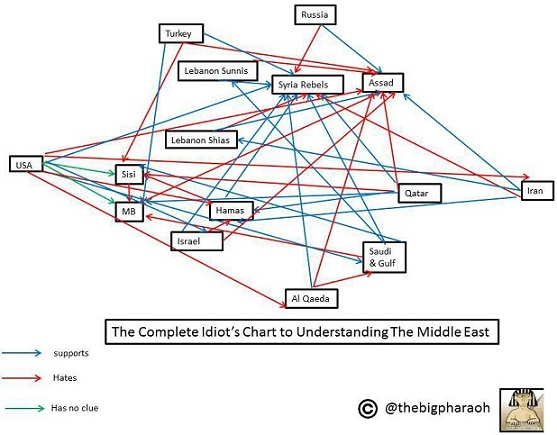
The Big Pharaoh also put this diagram on his blog, and Max Fisher picked it up and blogged it at the Washington Post as The Middle East, explained in one (sort of terrifying) chart:

I’d have some questions here, of course — one about the directionality of the arrows, which only seem to go in one direction — okay for the “supports” and “has nu clue” arrows, perhaps, but surely the “haters” would mostly be two-way, with AQ hating US as well as US hating AQ? There’s no mention of Jordan, I might ask about that… And there are no arrows at all between Lebanese Shias and Lebanese Sunnis — hunh?

**

What really intrigues me here, though, is that while this chart with fifteen “nodes” or players captures many more “edges” or connections between them than either or even both of the two tweets above, the tweets evoke a more richly human “feel” for the connections they reference, by drawing on human memories of the various parties and their actions.

Thus on the face of it, the diagram is the more complex representation, but when taken into human perception and understanding, the tweets offer a more immediuate and visceral sense of their respective situations.

And scaled down and in broad strokes, that’s the difference between “big data” analytic tools on the one hand, and HipBone-Sembl approach to mapping on the other. A HipBone-Sembl board may offer you two, or six, ten, maybe even a dozen nodes, but it fills them with rich anecdotal associations, both intellectual and emotional — a very different approach from — and one that I feel is complementary to — a big data search for a needle in a global needlestack…

**

But I’d be remiss if I didn’t also point you to Kerwin Datu‘s A network analysis approach to the Syrian dilemma on the Global Urbanist blog. He begins:

A chart by The Big Pharaoh doing the rounds of social media shows just how much of a tangled mess the Middle East is. But if we tease it apart, we see that the region is fairly neatly divided into two camps; it’s just that one of those camps is divided amongst itself. Deciding which of these internal divisions are fundamental to the peace and which are distractions in the short term may make the diplomatic options very clear.

and goes on from there, offering a series of network graphs of which is the fourth:

from which he draws the following observation:

What can we do from this position? If the US decides to pursue a purely military route to remove Assad from power, it will incur the ire of Russia, Iran and Lebanese Shias, but it can do so with a broad base of support including the Syrian rebels themselves, Israel, Qatar, Turkey, Lebanese Sunnis, and even Al Qaeda. However if it chooses a diplomatic route to curry support to remove Assad it must isolate him in the above graph by making an ally out of Russia and/or Iran (assuming that making an ally out of Lebanese Shias would have little impact). Russia doesn’t hate the US but it does hate the Syrian rebels, making it an unpromising ally against Assad. Iran hates the Syrian rebels and the US hates Iran, but the Al Qaeda is a thorn in both their sides, making it a potential though unlikely source of cooperation.

Really, you and I should read the whole piece, and draw our own conclusions.

**

Or lack thereof. I’ll give the last tweet to Teju Cole, who articulates my own thoughts, too:

Elkus interviews Charles Cameron at Abu Muqawama

Wednesday, July 31st, 2013

[ by Mark Safranski a.k.a “zen“]

Longtime friend of ZP,  Adam Elkus interviews our own Charles Cameron at the highly regarded Abu Muqawama blog:

Interview Charles Cameron 

[….]  AE: How has the study of apocalyptic tropes and culture changed (if it has at all) since 9/11 focused attention on radical Islamist movements?

CC: USC’s Stephen O’Leary was the first to study apocalyptic as rhetoric in his 1994 Arguing the Apocalypse, and joined BU’s Richard Landes in forming the (late, lamented) Center for Millennial Studies, which gave millennial scholars a platform to engage with one another. David Cook opened my eyes to Islamist messianism at CMS around 1998, and the publication of his two books (Studies in Muslim ApocalypticContemporary Muslim Apocalyptic Literature), Tim Furnish’s Holiest Wars and J-P Filiu’s Apocalypse in Islam brought it to wider scholarly attention — while Landes’ own encyclopedic Heaven on Earth: The Varieties of the Millennial Experience gives a wide-angle view of the field in extraordinary detail.

I’d say we’ve gone from brushing off apocalyptic as a superstitious irrelevance to an awareness that apocalyptic features strongly in Islamist narratives, both Shia and Sunni, over the past decade, but still tend to underestimate its significance within contemporary movements within American Christianity. When Harold Camping proclaimed the end of the world in 2011, he spent circa $100 million worldwide on warning ads, and reports suggest that hundreds of Hmong tribespeople in Vietnam lost their lives in clashes with the police after moving en masse to a mountain to await the rapture. Apocalyptic movements can have significant impact — cf. the Taiping Rebellion in China, which left 20 million or so dead in its wake.

Read the rest here.

Pilgrim visas, the Hajj, and MERS-CoV

Tuesday, June 11th, 2013

[ by Charles Cameron — it’s all a matter of concentric circles and the integration of the vertical — ibn Arabi ]
.


.

The concentric circles around the Kaaba ripple out across our world. This means we should be watchful at the intersection of three overlapping regions in a Venn diagram: pilgrim visas, MERS-CoV epidemiology, and pilgrim dispersal.

John Burgess of Crossroads Arabia is the only one I know focusing on the conjunction, see his Saudis Restrict Pilgrim Visas.

The point I’d like to be hinting at here is that whereas MERS-CoV epidemiology is a scientific monitoring and interpretive matter using Science Rules, and visa issues are mostly matters of bureaucracy, the Hajj itself is a matter of the most passionate devotional concern, and a “purely rational” understanding will hardly scratch its surface.

**

Those with a mixture of poetry and scholarship in their souls may wish to read Love Letters to the Ka’ba: a presentation of Ibn ‘Arabi’s Tâj al-Rasâ’il to glimpse the Kaaba as seen by the al-Sheikh al-Akbar, Muhyiddin ibn Arabi:

Charles-Andre Gilis has pointed out that in the Islamic tradition the Ka’ba symbolises the centre of every state of Being, as is demonstrated by the tradition recorded by Ibn ‘Abbas according to which there exists a Ka’ba, similar to the one belonging to our world, in each of the seven heavens and seven earths (cf. La Doctrine Initiatique du Pélerinage, Paris, 1982, pp. 45-6). In the introduction to the Tâj, Ibn ‘Arabi refers to the Visited House (al-bayt al-ma’mûr), situated in the seventh heaven, the celestial prototype of the Ka’ba (p. 557).

As Gilis also observes, the Ka’ba is perceived by Ibn ‘Arabi as a manifestation of the divine Essence (Tâjallî dhâtî). However, he situates it, due to its mineral nature, in the lowest level of Being. But it is precisely the inferior character of its external aspect that allows it to sustain the ladder of beings and to identify itself on each level. It is thus described as “celestial constitution, angelic reality, young girl with formed breasts, level of the perceptible realm, and Meccan dignity (at the same time this constitutes an excellent example of the assonances of his rhymed prose: nash’a falakiyya wa haqîqa malakiyya wa jâriya falkiyya wa martaba mulkiyya wa rutba makkiyya) (p. 555).” Ibn ‘Arabi himself is astonished at the number of contradictory aspects that this being is able to bring together: “Oh marvel: divine constitution, simil (mithliyya), angelic, human, superior and inferior in which we find validity and deficiency, multiplicity and scarcity.” (p. 556)

The devotional aspect of the Hajj is orthogonal to the realism of bureaucracies and epidemiology — but not on that account any the less powerful!


Switch to our mobile site