zenpundit.com » black swans

Archive for the ‘black swans’ Category

Soon soon coming of the Mahdi?

Monday, March 28th, 2011

[ by Charles Cameron ]

*

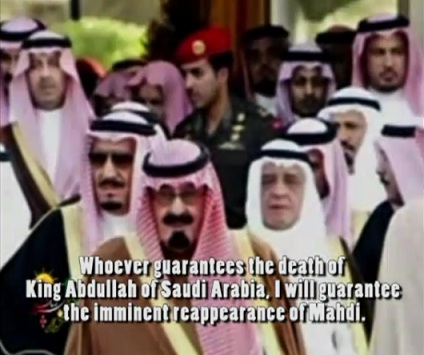
Okay, I’d say things are heating up. Here’s a screen grab from what we are led to believe is a recent video from Iran, made with government backing as described below the fold.

death-of-abdullah-sign-of-mahdi.jpg

This does not bode well…

*

The Christian thriller novelist Joel Rosenberg (author of The Twelfth Imam) has a new blog post up, in which he cites a Christian Broadcasting Network story — which in turn refers to a video posted with some introductory materials on his blog by Reza Kahlili (author of A Time to Betray: The Astonishing Double Life of a CIA Agent Inside the Revolutionary Guards of Iran).

According to Kahlili, who has also posted the full video to YouTube, it is a half-hour long program sponsored by the Basij militia and the Office of the President of Iran, affirming the soon-return of the Mahdi.

And containing “inflammatory language” about King Abdullah of Saudi Arabia (see subtitle above)?  Can I say that?

For what it’s worth, the supposed “hadith” about the death of King Abdullah is discussed in some detail at The Wake-Up Project, so it’s definitely “in the air” — but I don’t recall seeing any references to it in Abbas Amanat, Abdulazziz Sachedina, or any of the lists of Signs of the Coming I’ve read, so my suspicion is that this is an opportunistic addition to the corpus rather than a reliable hadith.

Which brings me to my last point:

I am not posting these materials to encourage panic — that’s what terrorism strives for, and it is the very opposite of what I would wish to see.  If anything, these stirrings of Mahdist sentiment should make us more careful and attentive to the serious scholarly work that has been done in this area.  Jean-Pierre Filiu‘s book Apocalypse in Islam, which I reviewed for Jihadology, would be an excellent place to start.

*

There are plenty of other things going on that I would love to track, blog about or comment on these days, but for the next while I shall try to restrain myself and focus in on this particular issue and its ramifications:

  • Contemporary Shi’ite Mahdist expectation
  • The Iranian nuclear program in the light of Mahdist expectation
  • Iranian attempts to use Mahdism to unite Sunni and Shi’a
  • Mahdism and jihad
  • The role of Khorasan in Mahdist rhetoric
  • Christian apocalyptic responses to Mahdist stirrings
  • Joel Rosenberg‘s book, The Twelfth Imam
  • Joel Richardson‘s book, The Islamic Antichrist
  • Glenn Beck‘s increasing focus on Iranian Mahdism
  • The increasing influence of Islamic and Christian apocalyptic on geopolitics

This is a pretty complex and potent mix of topics, and while I’ll post some individual pieces of the puzzle as I see it, I shall also try to put together a “bigger picture” piece with the whole mosaic laid out.

*

Apart from that, I remain deeply committed to questions of chivalry and peace-making, and will continue to monitor developments and write what I can on those topics as time allows…

DQ Egypt: impact on Israel

Wednesday, February 2nd, 2011

[ by Charles Cameron [hoping Zen’s ISP will be back up shortly] — cross-posted from ChicagoBoyz ]

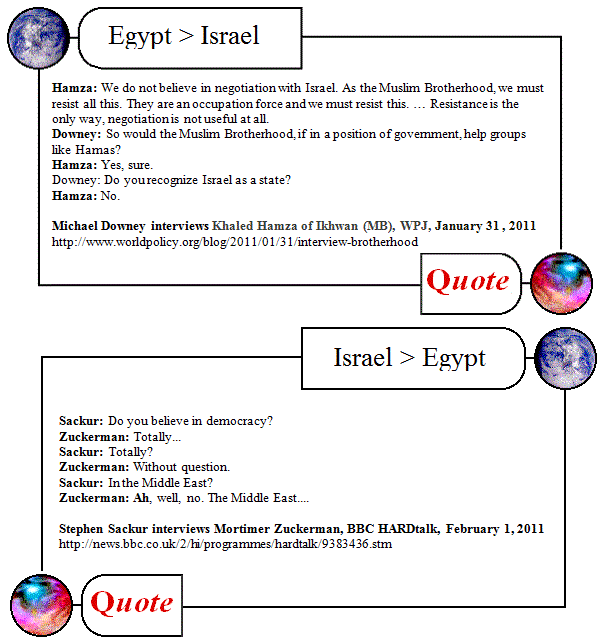
Someone posted an excerpt from an interview with Khaled Hamza, the webmaster of the Muslim Brotherhood, as a comment on an earlier post of mine on ChicagoBoyz, where I also blog, and I was interested enough to track the original interview down, and have presented the key points of the excerpt here in Quote #1.

I am pairing it, in Quote #2, with an excerpt from an interview the BBC recently conducted with Mortimer Zuckerman – because I find the two quotes taken together suggest something of the complexity of the breaking situation in the Middle East.

*

I’d like to float a trial balloon / try a though experiment, if I might. And since I’m more “tail” than “left” or “right wing”, I’ll be posting this in more than one place, and hope to get comments from all sides…

On the face of it, Zuckeman is applying what’s arguably a racist double-standard. He advocates democracy, “totally” and “without question” – but not for the Egyptians, or at least not today or tomorrow.

On the face of it, the Egyptian public seems distinctly unenthused by Mubarak’s regime and will, in a democratic election, presumably vote in a fair number of Muslim Brotherhood representatives – though it’s by no means clear that they would be in the majority, and their present ideology in any case is closer to the processes of electoral politics than those of violent jihad.

So there is reason for Israel to be concerned, and reason for those who support democracy to see some hope for democracy, in the ongoing events in Egypt.

Let me put it this way: Quote #1 illustrates why Zuckerman might make the remarks quoted in Quote #2, while Quote #2 illuminates why Hamza might make the remarks quoted in Quote #1.

*

And here’s the thought experiment — I’d like to come at this from a Maslovian angle.

Maslow’s Hierarchy of Needs

I’d like to suggest that “democracy” is an ideal, or to get away from that word with its somewhat ambiguous political connotations, an activity of the “the better angels of our nature” – and thus, from a Maslovian perspective, an aspect of a group or nation’s “self-actualization” level of interest, whereas “stability” would fall under “safety” or even “physiological”.

If that’s right, Zuckerman is at least arguably articulating a “stability first, eventual democracy would be ideal” position.

Does that “Maslovian” formulation throw any additional light on the situation?

*

The problem with the position I just described is nicely articulated by Mohammad Fadel at the very end of a Foreign Policy post, Can Black Swans lead to a sustainable Arab-Israeli peace? — and it’s only his conclusion I’m quoting here:

Tunisia and Egypt have demonstrated categorically that any peace which relies on the stability of police states is doomed from the outset.

If a butterfly flapping its wings in Brazil can in theory cause a tornado in Texas – heaven alone knows what someone blinking in Cairo or Jerusalem or Washington can do.

Myself, I pray for empathy, which seems a reasonable request, I hope for wisdom, which seems a great deal more chancy — and I long for peace.

In the current environment of hatred and mistrust, that seems entirely beyond the capacity of anyone’s present thinking to achieve.

Signs of the times

Monday, January 3rd, 2011

[ by Charles Cameron ]

Martyrdom, messianism and Julian Assange

Thursday, December 23rd, 2010

[ by Charles Cameron ]

Martyr and messiah are two of the more intense “roles” in the religious vocabulary, and unlike mystics and saints, both martyrs and messiahs tend to have an impact, not just within their own religious circles but in the wider context of the times.

Martyr and messiah are also words that can be bandied about fairly loosely — so a simple word-search on “messiah” will reveal references to a third-person platform game with some gunplay and the white messiah fable in Avatar, while a search on “martyr” might tell you how to become a martyr for affiliate networks, just as a search on “crusade” will turn up crusades for justice or mental health – my search today even pointed me to a crusade for cloth diapers.

1. Martyrdom and messianism in WikiLeaks

Unsurprisingly, perhaps, both terms crop up occasionally in WikiLeaks, with the Government of Iraq, for instance, banning use of the word “martyr” for soldiers who died in the war with Iran, and US diplomats wiring home a report by an opposition psychiatrist to the effect that “Morally, Chavez [of Venezuela] combines a sense of tragedy and romanticism (a desire for an idyllic world) to project a messianic image.” Indeed, the whole paragraph is choc-a-bloc with that kind of imagery, and worth quoting in full:

Ideologically, Chavez wants to project an image of a “utopian socialist,” which de Vries described as someone who is revolutionary, collectivist, and dogmatic. In reality, de Vries argues, Chavez is an absolute pragmatist when it comes to maintaining power, which makes him a conservative. Coupled with Chavez’ self-love (narcissism), sense of destiny, and obsession with Venezuelan symbolism, this pragmatism makes Chavez look more like fascist, however, rather than a socialist. Morally, Chavez combines a sense of tragedy and romanticism (a desire for an idyllic world) to project a messianic image. De Vries, however, said Chavez is a realist who uses morals and ethics to fit the situation.

PM Netanyahu of Israel was using the term “messianic” with a little more precision when he described the Iranian regime as “crazy, retrograde, and fanatical, with a Messianic desire to speed up a violent ‘end of days.'”

2. Julian Assange in the role of martyr

The words martyr and messiah, then, carry a symbolic freight that is at the very least comparable to that of flags and scriptures – so it is interesting that both terms crop up in the recent BBC interview with Julian Assange.

My reading of the interview suggests that it is Assange himself who introduces the meme of martyrdom, though not the word itself, when he answers a question about the impact of the sexual accusations against him, “What impact so you think that will have on your organisation and what sort of figure do you think you, Julian Assange, cut in the face of all this. How will you be regarded? What will it do to you?” with the response, “I think it will be quite helpful for our organisation.”

In the follow up, interviewer John Humphrys twice uses the word “martyr” explicitly:

Q: Really? You see yourself as a martyr then?

JA: I think it will focus an incredible attention on the details of this case and then when the details of this case come out and people look to see what the actions are compared to the reality of the facts, other than that, it will expose a tremendous abuse of power. And that will, in fact, be helpful to this organisation. And, in fact, the extra focus that has occurred over the last two weeks has been very helpful to this organisation.

and:

Q: Just to answer that question then. You think this will be good for you and good for Wikileaks?

JA: I’ve had to suffer and we’ve had incredible disruptions.

Q: You do see yourself as a martyr here.

JA: Well, you know, in a very beneficial position, if you can be martyred without dying. And we’ve had a little bit of that over the past ten days. And if this case goes on, we will have more.

3. Julian Assange in the role of messiah

If the role of martyr implies, at mimimum, that one suffers for a cause, that of messiah implies that one leads it in a profound transformation of the world. Both terms are now found in association with the word “complex” – which applies whenever a individual views himself or herself as a martyr or messiah – but a “messianic complex” is presumably more worrisome than a “martyr complex” if only for the reason that there are many more martyrs than messiahs, many more willing to suffer for a cause than to lead it.

It is accordingly worth noting that it is the interviewer, John Humphrys, who introduces both the word “messianic” and the concept of a “messianic figure” into the interview, although Assange makes no effort to wave it away…

Q: Just a final thought. Do you see yourself… as some sort of messianic figure?

JA: Everyone would like to be a messianic figure without dying. We bringing some important change about what is perceived to be rights of people who expose abuses by powerful corporations and then to resist censorship attacks after the event. We are also changing the perception of the west.

Q: I’m talking about you personally.

JA: I’m always so focussed on my work, I don’t have time to think about how I perceive myself… I had time to perceive myself a bit more in solitary confinement. I was perfectly happy with myself. I wondered what that process would do. Would I think “my goodness, how have I got into this mess, is it all just too hard?”

The world is a very ungrateful place, why should I continue to suffer simply to try and do some good in the world. If the world is so viciously against it ,why don’t I just go off and do some mathematics or write some books? But no, actually, I felt quite at peace.

Q: You want to change the world?

JA: Absolutely. The world has a lot of problems and they need to be reformed. And we only live once. Every person who has some ability to do something about it, if they are a person of good character, has the duty to try and fix the problems in the environment which they’re in.

That is a value, that, yes, comes partly from my temperament. There is also a value that comes from my father, which is that capable, generous men don’t create victims, they try and save people from becoming victims. That is what they are tasked to do. If they do not do that they are not worthy of respect or they are not capable.

4. Julian Assange, martyr and messiah?

I think it is clear that both Assange and his interviewer are in effect reframing the religious terms “martyr” and “messiah” in non-religious, basically psychological senses — although I don’t suppose Assange is exactly claiming to have the two “complexes” I mentioned above.

Here’s what’s curious about this reframing, from a religious studies point of view:

Assange’s implicit acceptance of a “messianic” role undercuts the specific force of the role of “martyr” – one who gives his life for the cause. “Everyone” he says, “would like to be a messianic figure without dying.” Assange wouldn’t exactly object to being a martyr without dying, too.
King Abdullah’s health and the Signs of the Times

Sunday, December 19th, 2010

[ by Charles Cameron ]

King Abdullah of Saudi Arabia is currently recovering from two recent surgeries in hospital in the US, may he, may we all be blessed with good health.

1.

Dr. Kamal El-Helbawy of the Centre for the Study of Terrorism in London was quoted yesterday by [Iranian] Press TV as saying that a coup might take place in Saudi Arabia:

“It is possible that a coup could happen, and I see nothing to prevent that from happening,” Dr. Kamal Helbawy of the Center for the Study of Terrorism said in an interview with Press TV aired on Saturday. “Both in Qatar and Oman in the past, the sons of the kings stole the leadership from their fathers, and I think there is a rift in the house of Saud,” he added. [ … ] “With his old age and sickness, there is suspicion about succession. There has been tension in the family for several decades. I believe there is a political and religious crisis,” Helbawy said.

[ h/t Habiba Hamid ]

2.

I have no special insight into the affairs of the Kingdom. I only mention this press report because just today I ran across a reference to the Kuwaiti Shi’ite author Jaber Bolushi and his book [downloadable here in Arabic], Appearance of Imam Mahdi in 2015 — which brings us back to King Abdullah.

We need (IMO) to get used to the idea that every newsworthy event has the potential to spark some kind of reaction in the apocalyptic mind.

I do not wish to suggest that any given event will necessarily spark a Mahdist response — just that it may — and that we should therefore keep tabs on Mahdist and messianic sentiment in general, and note carefully what “signs of the times” might prove persuasive to those who seek such things.

3.

The Sunni site where I found Bolushi’s book mentioned, contained the following among a list of “signs” of the soon-coming of the Mahdi:

Death of King Abdullah of Saudi Arabia (we wish him long life) in 2015: The Shia believe that King Abdullah will be the last king of the House of Saud before the appearance of the Mahdi. Jaber Bolushi cites a Hadith attributed to Prophet Mohammad [saw] (the Shia claim this Hadith used to be reported in Musnad Ahmad, but was later removed) in which the Prophet mentions that the last man who will govern Al-Hijaz (the region that includes Mecca & Medina) before the Mahdi will be called Abdullah and he will be the successor of his brother who is named by the name of an animal. The previous king of Saudi Arabia was King Fahd (Fahd means leopard). It is worth noting that King Abdullah is currently 84 years old. After he dies, a dispute will occur among the royal family as to who should succeed him. There will be a strife and blood shed. Then, people will search for the Mahdi and offer him allegiance between Rukun and Maqam in the Haram Masjid in Mecca.

4.

My point is not to discuss the health of King Abdullah – I wish him well – nor the specifics of this particular prophecy – date-setting seems to me to be a fool’s errand, even according to the scriptures of the various religions where it is practiced.

My point, again, is that today’s news – whatever it is — will be “read” and understood within dozens of conflicting apocalyptic contexts, most of which we are in general unaware of, with possible repercussions on the world stage that may therefore take us by surprise.

5.

Jean-Pierre Filiu in his recently published book, Apocalypse in Islam, writes that:

ambitious militia leaders, such as Muqtada al-Sadr in Iraq and Hasan Nasrallah in Lebanon, consciously exploit popular messianic feeling in order to assert their authority at the expense of the Shi’i clerical establishment, without allowing themselves to fall captive to apocalyptic rhetoric. [ … ] For the moment, only the Iraqi militia known as the Supporters of the Imam Mahdi has actively sought to translate the rise of eschatological anxiety into political action. Yet one day a larger and more resourceful group, eager (like Abu Musab al-Suri) to tap the energy of the “masses” as a way of achieving superiority over rival formations, may be strongly tempted to resort to the messianic gambit. An appeal to the imminence of apocalypse would provide it with an instrument of recruitment, a framework for interpreting future developments, and a way of refashioning and consolidating its own identity. In combination, these things could have far-reaching and deadly consequences.

That’s the point.


Switch to our mobile site