zenpundit.com » africa

Archive for the ‘africa’ Category

Laura Seay on Invisible Children and the LRA

Friday, March 3rd, 2017

[ by Charles Cameron — for your convenience, Laura Seay’s tweet-streak updating us on the LRA, reformatted as prose — though by no means prosaic ]
.

Foreign Policy @ForeignPolicy

Five years after its “Kony 2012” video broke the internet, Invisible Children is waging covert war against the LRA. http://atfp.co/2ljVz6A

Laura Seay @texasinafrica

This isn’t the full extent of the crazy, naive things IC, Bridgeway, & Laren Poole have undertaken in the last few years. There’s more. And the “more” is capital-I Insane.

I’ve been researching the anti-LRA efforts as part of my book project on how advocacy movements affect US policy in Africa. The US has spent over $1 billion on the anti-LRA mission since 2011. The LRA is now tiny, ~150-250. Whether Kony is still alive is unknown. Innocent people still suffer as a result of the LRA’s much-decreased activity. No doubt about that. But is this the best way to spend $1 billion? Especially given how many other armed groups in the region do far more harm to civilians?Could the skills of the 100 US Army Special Operations Forces posted to the CAR mission to “advise” the UPDF be put to better use elsewhere?

These are not easy questions & there aren’t easy answers to them. And there’s the issue that 5 1/2 years in, we still haven’t caught Kony or eradicated the LRA. At what point do we cut our losses & give up? The folks who are still working on these efforts have been passionately & deeply engaged on the LRA crisis for 10-15 years. They got what they wanted: global attention, abundant funding, a military mission (in which they are deeply involved). And it hasn’t worked. But some dangerous precedents have been set, particularly re the role of private charitable foundations funding a foreign military.

No matter how good their intentions, foundations aren’t accountable to anyone. Nor can foundations control how the UPDF will use training & equipment they provided in the future or in other situations. It’s a risky game. And it won’t be the foundations who suffer the consequences if things go wrong down the line. AFRICOM also can’t control what the UPDF will do with the skills they’ve developed while working alongside US Army Africa. Ideally, the UPDF leaves the mission with more professional soldiers with strong capacity & ethics. But again, we can’t control that. It’s messy with no clear “right” answer.

I think the anti-LRA movement will be remembered as a cautionary case about the role of advocacy movements in shifting US policy. Advocacy movements shouldn’t get all that they want. Their wishes need to be tempered by expert & local opinion. And US charitable foundations should not be allowed to fund foreign military activity. Period.
Seymour Papert, RIP

Wednesday, August 3rd, 2016

[ by Charles Cameron — on a somewhat personal note ]
.

02PapertObit2-blog427
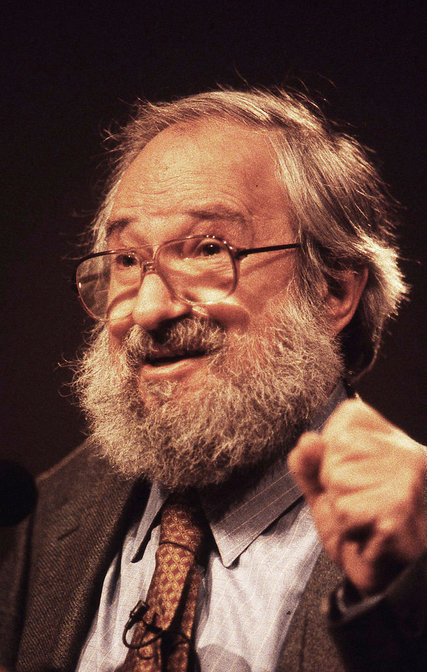
Seymour Papert, photo by L. Barry Hetherington, via Papert’s NYT obit

**

Seymour Papert, artificial intelligence pioneer and one-time research colleague of Jean Piaget who was keenly interested in bringing children, education and computers together, has died.

The Jewish paper, Foward, has an obit which touches me personally, since it turns out that Papert knew and learnjed much from my own mentor, Trevor Huddleston. Key graphs from the obit:

Another activity that became more than a pastime was improving life conditions for his black neighbors in South Africa. Daniel Crevier’s “A. I.,” a history of machine intelligence, notes that Papert grew up in an otherwise all-black area. Papert acquired further insight and sensitivity into the issue of racism from lengthy discussions with Father Trevor Huddleston, an anti-apartheid Anglican clergyman who often collaborated with Jewish activists sharing his views, notably the artist Hyman Segal of Russian Jewish origin, who illustrated Huddleston’s 1956 anti-apartheid study, “Naught For Your Comfort.”

As Desmond Tutu told an interviewer last year, Huddleston visited him regularly “when I nearly succumbed to tuberculosis. He taught me invaluable lessons about the human family; that it doesn’t matter how we look or where we come from, we are made for each other, for compassion, for support and for love.” This interfaith belief impressed young Papert as well, who like other South Africans of his generation was stunned when Huddleston did simple things like politely greeting black people in the street, acknowledging them as fellow human beings; one such recipient of unexpected civility was Desmond Tutu’s mother. In high school, Papert tried to arrange evening classes for illiterate black domestic servants, an activity strictly forbidden by the apartheid government.

Ever a logical thinker, Papert asked why black Africans were not permitted to attend white schools. The response was because of the threat of infectious disease, to which Papert replied that black servants prepared food and cared for children of the same white families, so the thought process at the basis of apartheid was clearly illogical.

For my own recollections of Fr Trevor, see:

  • Between the warrior and the monk (ii): Fr Trevor Huddleston
  • Between the warrior and the monk (iii): poetry and sacrament
  • h/t Derek Robinson

    From the Forgiveness Chronicles: Rwanda

    Wednesday, June 15th, 2016

    [ by Charles Cameron — a reminder from 2014 — for those who preach love, for those who preach mercy ]
    .

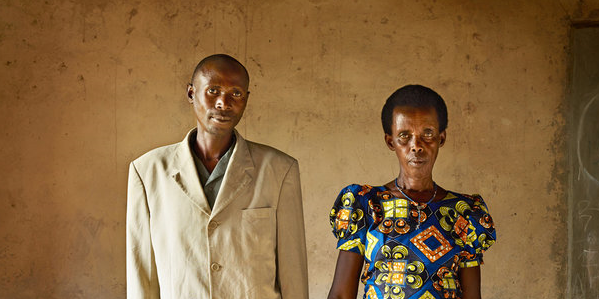
    Rwanda detail
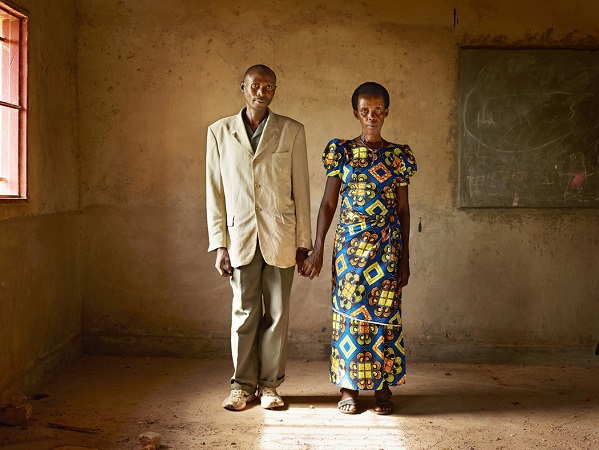
    Dominique Ndahimana, Perpetrator (left); Cansilde Munganyinka, Survivor

    **

    Dominique Ndahimana:

    The day I thought of asking pardon, I felt unburdened and relieved. I had lost my humanity because of the crime I committed, but now I am like any human being.

    Cansilde Munganyinka:

    After I was chased from my village and Dominique and others looted it, I became homeless and insane. Later, when he asked my pardon, I said: ‘I have nothing to feed my children. Are you going to help raise my children? Are you going to build a house for them?’ The next week, Dominique came with some survivors and former prisoners who perpetrated genocide. There were more than 50 of them, and they built my family a house. Ever since then, I have started to feel better. I was like a dry stick; now I feel peaceful in my heart, and I share this peace with my neighbors.

    **

    Rwanda

    **

    Another perpetrator / survivor pair:

    François Ntambara

    Because of the genocide perpetrated in 1994, I participated in the killing of the son of this woman. We are now members of the same group of unity and reconciliation. We share in everything; if she needs some water to drink, I fetch some for her. There is no suspicion between us, whether under sunlight or during the night. I used to have nightmares recalling the sad events I have been through, but now I can sleep peacefully. And when we are together, we are like brother and sister, no suspicion between us.

    Epiphanie Mukamusoni:

    He killed my child, then he came to ask me pardon. I immediately granted it to him because he did not do it by himself — he was haunted by the devil. I was pleased by the way he testified to the crime instead of keeping it in hiding, because it hurts if someone keeps hiding a crime he committed against you. Before, when I had not yet granted him pardon, he could not come close to me. I treated him like my enemy. But now, I would rather treat him like my own child.

    **

    Source:

  • Pieter Hugo, Portraits of Reconciliation: 20 years after the genocide in Rwanda
  • photos by Susan Dominus
  • Sunday surprise: osprey! — & more..

    Sunday, May 15th, 2016

    [ by Charles Cameron — elemental battles — one extraordinary nature video in slomo, and another with an interesting angle on threesidedness ]
    .

    But first, by way of preamble..

    Haniel Long Annie Dillard SPEC

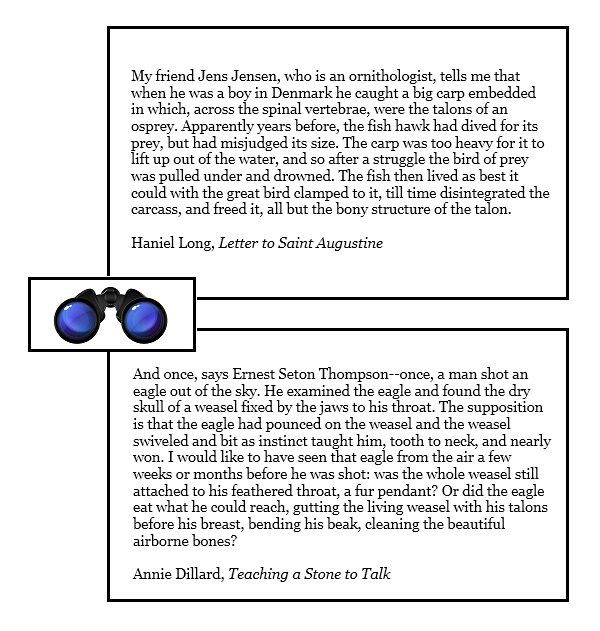
    I’ve told the tale of how I came to appreciate the power of DoubleQuotes by running across these two parallel quotes in the works of two writers I admire, Haniel Long and Annie Dillard, in DoubleQuotes — origins, while in Bobcat jumps shark.. I posted a photo of an encounter that strongly reminded me of the pair of them.

    **

    You can therefore imagine how delighted i was this week to add this fourth entry into what is rapidly becoming a catalogue of fights-to-the-death between creatures of opposing elements:

    The bird, as in Haniel Long’s tale, is an osprey, it’s battle is with a heavy fish — but in this case, it is the osprey that survives the encounter — and the slow motion video capture is simply astonishing.

    Which reminds me..

    **

    I have already posted three times on the subject of ternary logic and three player games — in Of games III: Rock, Paper, Tank, in Spectacularly non-obvious, I: Elkus on strategy & games, and in Spectacularly non-obvious, 2: threeness games — but had somehow omitted any mention of another spectacular wildlife video, this one capturing a three-cornered battle between buffalos, lions and a crocodile or two, which can be found on YouTube under the title Battle at Kruger:

    With 77 million views and counting at the time I post this, it’s a video you may very well have seen before — and a terrific testament to the idea that sheer quantity may on occasion be indicative of real quality.

    Conflict resolution has both positive and negative outcomes

    Friday, May 13th, 2016

    [ by Charles Cameron — paradox: individual health goes down while societal health improves ]
    .

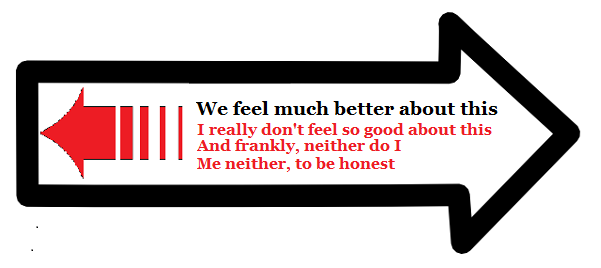
    reverse arrow conflict individual & group

    I knew this “reverse arrows” graphic would find a multitude of uses.

    **

    Here’s the news report:

    Post-conflict reconciliation led to societal healing, but worsened psychological health.

    Key paras:

    Civil wars divide nations along social, economic, and political lines, often pitting neighbors against each other. In the aftermath of civil wars, many countries undertake truth and reconciliation efforts to restore social cohesion, but little has been known about whether these programs reach their intended goals.

    A new study published in Science suggests reconciliation programs promote societal healing, but that these gains come at the cost of reduced psychological health, worsening depression, anxiety, and trauma.

    “Our research suggests that talking about war atrocities can prove psychologically traumatic for people affected by war. Invoking war memories appears to re-open old war wounds,” said Oeindrila Dube, assistant professor of politics and economics at New York University and one of the authors of the study. “At the same time, the reconciliation program we examined was also shown to improve social relations in communities divided by the war.”

    ¶ ¶ 

    The study took place across 200 villages, 100 of which were randomly chosen to be offered the reconciliation program. The research team tracked 2,383 people in both sets of villages, recording their attitudes towards former combatants, their mental health, and the strength of their social ties nine and 31 months after the program.

    The study was made in Sierra Leone a decade after the civil war ended. Assuming the methodology is good and the results are as described, there’s a very interesting paradox here. And hey, a decent paradox really gets my mental feet a-tapping. It will be instructive to see whether similar results are found elsewhere.

    **

    The study is J. Cilliers, O. Dube, B. Siddiqi. Reconciling after civil conflict increases social capital but decreases individual well-being. Science, 2016; 352 (6287): 787 DOI: 10.1126/science.aad9682 — to which I have no access, and which would very likely prove beyond my comprehension in any case.


    Switch to our mobile site