zenpundit.com » africa

Archive for the ‘africa’ Category

Spirals, a quick revisit

Thursday, November 14th, 2013

[ by Charles Cameron — spiraling costs — same pattern, different mechanism, closer to home ]
.

Back in Serpent logic and related, I featured this spiral from Louisa Lombard:

Ha, funny.

How’s this, in today’s opening salvo from Rosa Brooks at POLITICO Magazine?

“If you believe the mission truly requires 50,000 troops and $50 billion, but you know that the White House is going to automatically cut every number in half, you’ll come in asking for 100,000 troops and $100 billion,” says the aforementioned former White House official. “The military eventually starts playing the very game the White House has always suspected them of playing.”

Not for nothing does the phrase “spiraling out of control” garner 7,840,000 hits on Google.

Gaidi Mtaani, the greater scheme of things, I: the story

Thursday, November 14th, 2013

[ by Charles Cameron — in a story, in a nutshell, the very different world of al-Shabaab ]
.


.

The third issue of of the pro-Shabaab magazine Gaidi Mtaani, issued a few months back, contained a long piece titled A Greater Scheme of Things, and in it I’d like to zero in on the extraordinary story which is the heart of the piece — and which offers us a fasacinating insight into jihad:

it was luminously evident, for me personally, in one memorable incident in Mogadishu’s frontline last year. Just after Dhuhur prayer, one particular day in March, the Mujahideen received news that the enemy was preparing to mount a large offensive in the Northern parts of the city – in an area that was then newly captured by the Mujahideen.

In no time, the news spread across the entire frontline and the Mujahideen geared up for a protracted battle. New defence posts were erected, the old ones were fortified, trenches were dug, reinforcements were called in, snipers were placed on rooftops and small groups of well-equipped fighters were strategically positioned to guard every street and every alley. Garrisoned in the makeshift base, a short distance behind the frontline, were dozens of young martyrdom seekers, each eager to engage the enemy once called. A flurry of activity engulfed the bullet-battered neighbourhood as sporadic gunfire resonated across the empty streets and a countless number of vehicle-mounted weapons, such as ZU-23 and B-10, Dhshk, Shilka, were all streaming in and out of the base to take their positions. Upon seeing the long line of military vehicles and artillery, one of the fighters erroneously remarked in amazement: ‘today we will defeat these African invaders.’ Materialistically, all possible preparations were made to defeat the encroaching enemy, but were they enough to achieve victory?

Just after Asr that day, the battle began in deadly earnest, with ear-splitting explosions and exchange of gunfire reverberating from all corners from the city. A salvo of mortars ripped through the fragile rooftops, grenades exploded with alarming ferocity, tanks bulldozed buildings and reduced them to rubble and a hail of bullets cracked into the shell-bestrewn streets. In the backdrop of such a frenzied atmosphere, the Mujahideen maintained remarkable inner tranquillity, for the believer’s heart is an island of santy in such a setting. They’ve put up a sturdy defence in all corners, necessary arrangements were made to outflank the enemy and the chants of Takbeer were gradually rising above the cruel cacophony of gunfire. But something strange was also happening: all the artillery brought by the Mujahideen failed to fire a single shot! The guns were cleaned, lubricated, loaded and reloaded, but they still recoiled without firing a round and with the bullet jammed in the barrel. The field commanders hopped from trench to trench, through tunnels, in order to analyse and resolve the situation, but all their efforts were in vain.

‘Today we will defeat these African invaders’ chimed in the memory of one of the commanders and that’s when they had realised that what was happening was in fact a punishment for a grave sin they had committed: trusting in the abilities of their weapons. The certitude with which the statement was expressed proved to be destructive and no sooner had the Mujahideen recognised the mistake and repented than the very same artillery, almost instantaneously, began firing again. The Mujahideen managed to repel the enemy, but those who’ve uttered the statements also learnt a great lesson: that fortifying the bastion of Eeman must take precedence over building a substantial military arsenal; for military arsenal can never bring victory without Eeman.

Such is the clear manifestation of Allah’s absolute control over all affairs that the Kuffar have failed to comprehend.

I’ll comment on this story in a follow-up post: for now, I’d just like to let this very revealing tale hang in the air for your consideration…

Your comments are most welcome.

**

Source:

  • Gaidi Mtaani #3, safe copy available from Jihadology, pp. 12-15
  • Myanmar between Woolwich and Al-Aqsa 1: interfaith hatred

    Wednesday, October 23rd, 2013

    [ by Charles Cameron — in which jihadis take on Jews, Christians, Muslims and Buddhists, quite an interfaith haul for hatred ]
    .

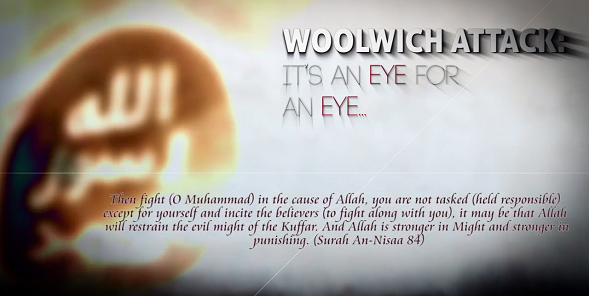
    Aaron Zelin at Jihadology posted an hour-long video entitled Woolwich Attack a week or so ago, and I found it particularly interesting on two accounts: first, that it makes a multi-faith attack that includes Buddhism in its catalogue of enemies of Islam, and second, that it uses an innovative feature of modern digital typography. Here, I’ll concentrate on the first. Here’s the video’s title:

    **

    Christianity as a target is well represented in the form of Dr Justin Welby, the recently-appointed Archbishop of Canterbury:

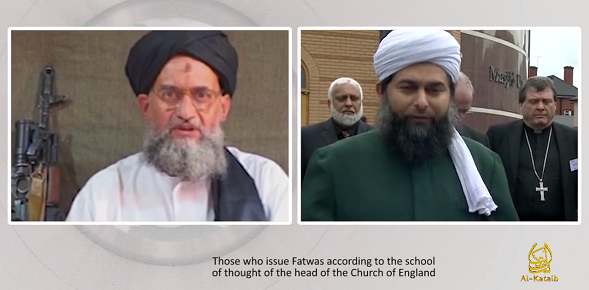
    Notice also the lower of these two screengrabs, this one showing Ayman al-Zawahiri (left) berating a leading Muslim spokesman in the UK, Ibrahim Mogra of the Muslim Council of Britain (right), for speaking at the same event as the Archbishop. The damning subtitle suggests he’s one of those “who issue Fatwas according to the school of thought of the head of the Church of England”.

    **

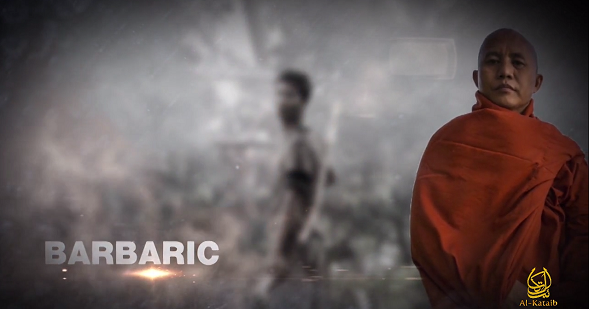
    It wasn’t the attack on Christians or fellow Muslims that caught my eye, though, but the unexpected presence of the monk Wirathu, the rhetorical leader of Myanmar’s recent Buddhist rioting against Burmese Muslims. I’d seen his face on Time magazine and elsewhere, but it came as a bit of a shock here in a jihadist video — I’d filed him and his 969 movement under “Buddhism” rather than “Islam” in my mental listing of violent movements with religious underpinnings.

    Ugly, ugly.

    **

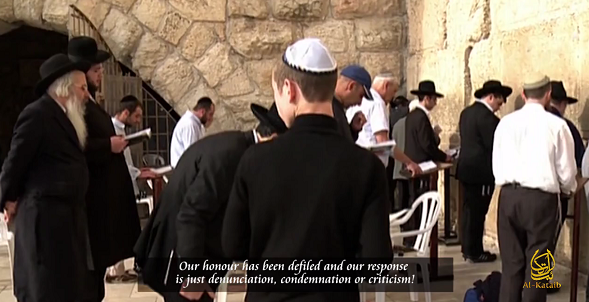
    Finally, no invitation to jihad these days is complete without its mention of the al-Aqsa mosque and Jerusalem — and it is here that Judaism comes in for attack. Consider these two screengrabs:

    **

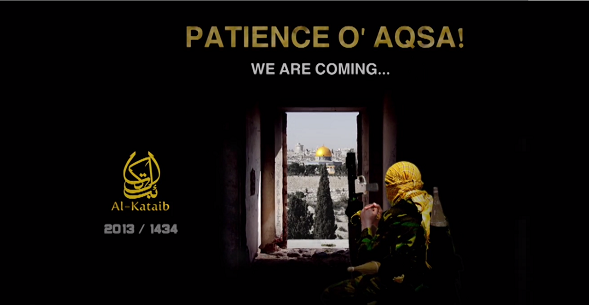
    The video closes, significantly, with a long shot of the Dome of the Rock through a window…

    Yesterday my friend William Benzon made a post titled On Describing a Painting which began:

    Harvard art historian Jennifer Roberts bills her article thus: The Power of Patience: Teaching students the value of deceleration and immersive attention. OK. But I take a different lesson from it, one about one of my current hobby horses: description. Roberts focuses on an 18th Century painting by John Singleton Copley, A Boy with a Flying Squirrel. Her point is that the more you look at the painting, the more you notice and hence the more you can note in a written description. She asks her students to spend a full three hours with a single painting.

    Of her own experience with that painting she observes:

    It took me nine minutes to notice that the shape of the boy’s ear precisely echoes that of the ruff along the squirrel’s belly—and that Copley was making some kind of connection between the animal and the human body and the sensory capacities of each. It was 21 minutes before I registered the fact that the fingers holding the chain exactly span the diameter of the water glass beneath them. It took a good 45 minutes before I realized that the seemingly random folds and wrinkles in the background curtain are actually perfect copies of the shapes of the boy’s ear and eye, as if Copley had imagined those sensory organs distributing or imprinting themselves on the surface behind him. And so on.

    She begins her next paragraph: “What this exercise shows students is that just because you have looked at something doesn’t mean that you have seen it.”

    Looking at that final screengrab with this in mind, I see a close correlation between the golden Dome that focuses our attention on the Noble Sanctuary / Temple Mount, and the round, yellow-gold keffiyeh of the jihadist observing it through his window — “making some kind of connection between” them, to echo the words of Harvard’s Elizabeth Cary Agassiz Professor of the Humanities…

    It’s a skilled and meaning-filled use of the medium.

    **

    In my second post in this series, I’ll point to a significant development in graphics and technology introduced in this video.

    Teju Cole on Nairobi: death and birdsong, death and poetry

    Thursday, September 26th, 2013

    [ by Charles Cameron — on the topic of Nairobi there’s the news — and then there’s Teju Cole ]
    .

    Teju Cole, left, Kofi Awoonor, right -- photo credits Teju Cole & Peace FM Online respectively

    **

    We’re interested in creativity as well as natsec issues here at Zenpundit, so i thought it might be appropriate to see what a fine writer had to say about the hideous attack and siege of the Westgate mall in Nairobi — and perhaps more importantly, how he chooses to say it.

    Teju Cole is a writer (“award winning” and rightly so) whose insightful and skilfully deployed tweets caught my attention some while back, and have only increased my admiration for him over time. I followed his twitterstream along with others while the events in Nairobi were playing out, and today read his New Yorker blog post covering much the same ground in greater detail.

    What is striking to me about Cole’s approach — the approach of a fine writer, in Nairobi at the time, a friend and admirer of the Ghanaian poet Kofi Awoonor who died at the mall — is the care he takes to balance death with birdsong, death with poetry. In treating matters this way — and we can be sure he is every bit as deliberate in his use of 140 characters as he is in longer-form writings — he both gives a world of context to the small world of the mall event itself, and offers us hope to balance our despair and disgust.

    Cole is reading from his novel Open City at the National Museum at the time the attack on the mall begins:

    During the reading, as word of the attack filtered in, people answered their phones and checked their messages, but, onstage and oblivious, I continued taking questions from the audience

    **

    Here, then, I have pulled together most of the tweets Cole posted in recent days for your consideration, in the order in which he posted them… Together, they offer us a very different way to encounter tragic events from those presented by journalists or analysts.

    .
    Nature has entered the picture: next up will be death — the death of his poet colleague and friend, described first obliquely in the poet’s own words:

    .
    Then comes the first of two tweets in which Cole judiciously balances the tragically human and blithely natural worlds, including in his tweet a short soundscape in which those voices are woven together in counterpoint:

    .

    This one is grim — suitable, or a bit overstated, with its echo of the Holocaust? — a question best left to individual taste, perhaps:

    .
    And then his second polyphonic melding of sounds natural and human-made, joyous and terrifying:

    .
    He returns to his friend’s death…

    .
    And then again to birdsong, to the natural world, to the world in which the events of the past days are framed…

    **

    There is something powerfully moving about Cole’s tweeted reflections, and I believe they take their impact from the precision with which Cole himself frames and balances the horror with beauty.

    Just today, my friend Jessie Daniels posted a tweet that caught my eye:

    Teju Cole has gone from a tweet to a blog post on the New Yorker site in a matter of days. Here’s just a brief taster:

    The massacre did not end neatly. It became a siege. In my hotel room, about half a mile from the mall, I was woken in the mornings that followed by the sounds of gunfire, heavy artillery, attack helicopters, and military planes. In counterpoint to these frightening sounds were others: incessant birdsong outside my window, the laughter of children from the daycare next door. I read Awoonor’s poems, and watched a column of black smoke rise from the mall in the distance. The poems’ uncanny prophetic force became inescapable. A section of “Hymn to My Dumb Earth” reads:

    What has not happened before?
    An animal has caught me,
    it has me in its claws
    Someone, someone, save
    Save me, someone,
    for I die.

    .
    But you should really read the whole thing: Letter from Nairobi: “I will say it before death comes”.

    Nairobi tweets 2: Sun Tzu and more

    Sunday, September 22nd, 2013

    [ by Charles Cameron — further hints from the HSM Press twitter stream, following on from part 1 on bullet-proofing ]

    Update:


    As of Monday morning 11am California time:

    I now think it’s clear that the twitter stream I was commenting on in this post and the first in the series was not an official Shabaab feed, and thus untrustworthy as to its statements — although it’s exact status (fan, mimic, troll, loosely connected?) is undetermined.

    I am leaving the post up (a) for the record, and (b) for whatever minor interest it may still have.

    Original post:


    .

    Okay, let’s pick up the thread from my earlier post in this series with this sheer poetry — sheer Anglo-Chinese poetry in fact, the poetry of Sun Tzu from The Art of War — Chapter 7, “Maneuvering”, # 19 in the Lionel Giles translation.

    I won’t be presenting the rest of these tweets in graphical form, since that would be labor intensive and I’m trying to be conservative about my labor, but there’s one more Sun Tzu quote I noticed in their stream, and we’ll come to it.

    In the meantime, HSM Press tweeted on a variety of topics, all of which seem relevant to them:

    **

    Let’s note first the importance given to prayer in these tweets:

  • our mujahideen just prayed salat dhuhr! #westgate #alshabaab #Nairobi
  • our mujahideen are preparing to pray salat maghrib! #westgate #AlShabaab #Nairobi
  • The Qur’an is cited:

  • and kill them wherever you find them! ring a bell? #westgate #AlShabaab
  • Their Islam is a religion of peace —

  • yes islam is a religion of peace! thats undebatable. the debate here is who hit first? #westgate #AlShabaab
  • dont blame islam! islam never told you wage war on another country! #westgate
  • — but peace comes arms-in-arms with justice.

    There are matters of logistics:

  • we tweeted arrival of 2 squads and they are replacing our first two now. hooo-ah! #Westgate
  • update: our third mujahideen squad just crossed the border, enroute to #garisa and other undisclosed locations. #Westgate #AlShabaab
  • update: 4th mujahideen squad rendezvous to undisclosed location! brace yourselves #kenya #westgate #AlShabaab
  • Here’s that other Sun Tzu quote, along with a mention of training camps:

  • the first thing they taught us in training camps: know your enemy! #AlShabaab #Westgate
  • and there, making a fine DoubleQuote, is Margaret Atwood‘s nifty variant on Clausewitz:

  • “War is what happens when language fails.” #westgate @nairobi
  • Now, about those “training camps”?

  • have we mentioned we trained in this same building months ago! our mujahideen know every corner of this building! #alshabaab #westgate
  • But also:

  • our mujahideen are all under 25 years old. 7 of them having completed training in black water facility in north california! #Westgate
  • So they train with Blackwater / Academi and in situ, eh? And they’re all under 25 — when they started naming namesa bit later, they identified at least one 27 year old, but you get the drift — and at least one is a young woman:

  • our female combatant took out 15 kenyan soldier! what an amazing woman! #Westgate
  • They count the cost — though unlike AQC in the case of 9/11, they don’t do so to show what a huge ROI they have, just to be glad it wasn’t a flop:

  • the vast amount of time, money and dedication we contributed to this operation were glad it was carried successfully! #westgate #AlShabaab
  • They call it an op here, but their view of its size and importance is pretty flexible as to scale…

    It’s a game — the “war as game meme” once again!:

  • lets see how yall enjoy this game! #westgate #alshabaab #Nairobi
  • They also call it a war:

  • this is a war and its not going to end well. #westgate #AlShabaab
  • It’s not a Jihad, though:

  • #JIHAD is a big word to use for this drill. #kneyans you will know when jihad is happening its unevitable! #westgate #AlShabaab
  • It’s gonna get worse:

  • you call few hundred death a deadly attack. well see what a deadly attack is. brace yourselves #lenya #westgate #AlShabaab
  • — and hey, it looks as though they have their eye on S Africa as a target further down the road:

  • #southafrica gere we come!!! #Westgate
  • **

    Those are the tweets I found interesting on a first read. HSM followed up with the names and home cities of three American participants, and then their feed was suspended and I was invited to return to my home timeline…

    Credit goes to JM Berger for getting Twitter to be a whole lot quicker in disabling their feeds, but it’s all a bit whack-a-mole, and I suspect they’re probably back up by now, under some variant name or other.

    Switch to our mobile site