zenpundit.com » economics

Archive for the ‘economics’ Category

Newspapers: Putting the “Dead” into Dead Tree

Thursday, May 7th, 2009


The MSM has bumped up against the internet – and lost. 

Clay Shirky called it a while ago in Here Comes Everybody: The Power of Organizing Without Organizations
but big media, if they wish to make the leap to to Web 2.0 life, have to leverage the one thing they do better than everyone else, original investigative reporting, that’s where they create value. Instead they are looking for government protection, subsidies or both.

Rupert Murdoch envisions a walled garden strategy but news has a brief shelf life. A high price on all content is a barrier to entry for older news items that just interest a few people. A flat rate drives down their market share for attention, their traffic and in turn, the market value of all the content they own. A sliding scale would be needed that rapidly discounts toward free as public attention on a news item waned.

Right now the media are like a brontosaurus that has just realized it waded into a tar pit.

Excess Complexity is the Route to Extinction

Friday, April 10th, 2009


Nassim Nicholas Taleb, author of The Black Swan: The Impact of the Highly Improbable and Fooled by Randomness: The Hidden Role of Chance in Life and in the Markets, had an op-ed in FT.com entitled “Ten principles for a Black Swan-proof world” (Hat tip to John Robb and Pundita). Taleb was addressing the global economic crisis, but I was particularly drawn to Taleb’s fifth principle, which has a more general implication:

5. Counter-balance complexity with simplicity. Complexity from globalisation and highly networked economic life needs to be countered by simplicity in financial products. The complex economy is already a form of leverage: the leverage of efficiency. Such systems survive thanks to slack and redundancy; adding debt produces wild and dangerous gyrations and leaves no room for error. Capitalism cannot avoid fads and bubbles: equity bubbles (as in 2000) have proved to be mild; debt bubbles are vicious.

Taleb has encapsulated many important concepts very well here. Up to a certain point, increasing complexity represents a advantage for an evolving system (biological, financial, physical etc.) by increasing efficiency through adding specialization, interconnection, diversification, redundancy and checks for mitigation of risks. Complexity, in the earlier part of a development curve can add to a system’s overall resiliency – to a point.

Superfluous complexity, that which goes beyond the minimum required for additional gains in systemic efficiency or productivity, is a net drag on the system, an economic waste, a source of friction, a cancer,  a useless eater of resources and the earliest sign of the system’s inevitable decay. Worse, excess complexity represents an increasing probability of systemic failure by multiplying the number of variables involved in the normal process of the system. There are more things that can go wrong and more choke points where a catastrophic failure can occur. Increasing the degree of complexity moves the system away from simplicity and reliability and toward chaos and the creativity of emergent properties, but like an ice skater seeking ever greater range, go too far and the ice will crack under one’s feet.

This is an effect familiar to engineers and scientists but one that appears to escape the majority of politicians, corporate executives and economists. My co-blogger at Chicago Boyz, Shannon Love,  took GE to task for trying to get on the Federal dole by advocating needlessly complicating the nation’s power grid:

If Your Grid Had a Brain

GE is advertising to build political support for Obama’s plan to purchase billions of dollars of GE tech in order to make the power grid “smart”.  After all, who would want a “dumb” anything when they could have a “smart” something? 

The reason we should keep things dumb is that in engineering the word “dumb” has a different connotation. In engineering, “dumb” means simple and reliable. 

Increasing complexity in any networked system increases possible points of failure. Worse, the more interconnected the system, i.e., the more any single component affects any other randomly selected component in the system, the faster point-failures spread to the entire system. Power grids are massively interconnected. Every blackout starts with a seemingly trivial problem that, like a pebble failing on a mountain side, triggers an avalanche of failure. 

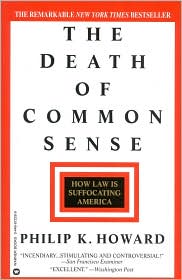
In the social and political domain, back in the 1990’s Philip K. Howard wrote a book called The Death of Common Sense: How Law is Suffocating America in which he detailed example after example of how the overlawyering of regulatory systems in America by an emerging and hyper-aggressive legal class was producing neither restraint on government abuses nor fine-tuned social outcomes but instead created a state of paralyzed rigidity, risk aversion, perverse incentives and general dysfunction; in other words, chaos instead of order.
The Obama-ites in the White House are not “socialists” ( at least not most of them) but there is a great love of liberal-minded technocracy there, and a seemingly boundless self-confidence in the ability of high-minded, upper-middle class, progressive, wonks and lawyers from the “good schools” (or investment houses – in some cases, both) to micromanage not just our lives for us, or even the United States of America but the global economy itself. Sort of a Superempowered Oligarchy of Good Feelings.

The ancient Greeks had a word for that: hubris. More importantly, the Obama-ites are wrong here – adding endless amounts of regulatory complexity is not going to give them the kind of granular control or positive returns that they seek to obtain from the system. Counterintuitively, they should be radically simplifying where and to the degree they safely can instead.

That Was Fast

Wednesday, March 25th, 2009

Recently, discussing the media in the comment section here, Lexington Green had this to say:

Brilliant Shirkey piece.  He only leaves out one thing.  The dying incumbents are going to successfully seek money and protection from the government.  With a Democrat president and congress, their faithful allies, lickspittles, bootlickers, toadies, buttboys, catamites, lackeys also knows as “the media” will come to DC with palm extended, upright, demanding the payment that their partisan loyalty has earned.  They will get protection and money. 
.
They will not survive that much longer as a result.

In the same thread, democratic core remarked:

The Shirky piece raises fascinating issues.  The question of what the new economic model for journalism will be is interesting, and I appreciate the fact that this piece raises the question explicitly.  Contrary to Lexington’s comment, I doubt that there will be a government bailout, as the First Amendment issues would seem to make that unpalatable to both parties.  The non-profit approach is one logical evolution, where “newspapers”, i.e., centers of journalistic activites, get absorbed into non-profit institutions such as think tanks or universities to provide content to organs of information dissemination.  Another model might be the C-span model, where profitable internet organizations such as Google fund the entities we used to call “newspapers” in order to provide content for the web.  Most likely, you could have some combination of the two, as for example in the way that profit-making organizations subsidize research activities by non-profit institutions such as universities.

Now we have this. A remarkable turn-around time:

WASHINGTON (Reuters) – With many U.S. newspapers struggling to survive, a Democratic senator on Tuesday introduced a bill to help them by allowing newspaper companies to restructure as nonprofits with a variety of tax breaks.

“This may not be the optimal choice for some major newspapers or corporate media chains but it should be an option for many newspapers that are struggling to stay afloat,” said Senator Benjamin Cardin.

A Cardin spokesman said the bill had yet to attract any co-sponsors, but had sparked plenty of interest within the media, which has seen plunging revenues and many journalist layoffs.

Cardin’s Newspaper Revitalization Act would allow newspapers to operate as nonprofits for educational purposes under the U.S. tax code, giving them a similar status to public broadcasting companies.

Under this arrangement, newspapers would still be free to report on all issues, including political campaigns. But they would be prohibited from making political endorsements.

Advertising and subscription revenue would be tax exempt, and contributions to support news coverage or operations could be tax deductible.

Because newspaper profits have been falling in recent years, “no substantial loss of federal revenue” was expected under the legislation, Cardin’s office said in a statement.

Cardin’s office said his bill was aimed at preserving local and community newspapers, not conglomerates which may also own radio and TV stations. His bill would also let a non-profit buy newspapers owned by a conglomerate.

“We are losing our newspaper industry,” Cardin said. “The economy has caused an immediate problem, but the business model for newspapers, based on circulation and advertising revenue, is broken, and that is a real tragedy for communities across the nation and for our democracy.


The Official Gloom

Friday, March 6th, 2009

The Armed Forces Journal on the economic decline of America.

The author makes too many assumptions regarding China’s resiliency.  The opacity of China’s hybrid, mercantilist-driven, political economy makes estimates of it’s true strengths and weaknesses difficult. We know how many treasury bills China has bought from us but not the real extent of hidden debt, underemployment or inflation. China’s leadership did not vastly increase the size of it’s paramilitary forces in the past decade because they were confident that it would all be smooth sailing ahead.

ADDENDUM:

Chinese premier takes on politics 2.0

Statesmanship, Failure of….

Friday, February 13th, 2009

President Obama’s biggest political headaches in the next four years will come not from Republicans or Rush Limbaugh but the cosmically egocentric and ideologically blinded Boomer  Watergate Baby cadre in the House Democrats.  

A global economic crisis and they seized an opportunity to pass an incoherent host of nickel and dime appropriations on their leftwing wish list along with huge giveaways to special interests that rival anything constructed by Bush-Paulson. They have managed to make an $ 800 billion dollar stimulus bill “non-stimulating”. That takes some doing to waste three quarters of a trillion dollars without anticipating any economic growth, even as spillover benefits, at a time of rising unemployment.

Is everything in this mega-bill bad ? No. Is it reasonable to expect Democrats not to pass some of their agenda items along the way ? No. What we have though is a bill apparently so embarrassing that Speaker Pelosi, who seems to be acting more and more like she is the uncrowned co-president, doesn’t even want her own members to have time to read it, much less Republicans or the general public. It is all dessert and no vegetables and it was the Democrats very first order of business.

The aging Watergate Babies, the Left-wing of the Left-wing of the Democratic Party, now in the drivers seat in the House of Representatives once “rolled” Jimmy Carter and helped destroy his presidency. They did the same to Bill Clinton in his first two years in office. They will hijack Obama’s administration agenda as well, or try to do so.

Given that the result of the first instance was the election of Ronald Reagan in 1980 and that of  the second was Newt Gingrich’s 1994 takeover, 2010 is suddenly looking a lot brighter for conservatives if they can manage to get their act together. Their opponents are gearing up for the overrerach of a lifetime.


Switch to our mobile site