zenpundit.com » intellectuals

Archive for the ‘intellectuals’ Category

Book Review: Kill Decision

Saturday, October 6th, 2012

Kill Decision by Daniel Suarez 

Shlok Vaidya did an early review of Kill Decision here previously. I finally have caught up to Shlok and I’m ready to add my two cents without giving away any spoilers:

First, I enjoyed the book. Kill Decision is a tense, fast-moving,  page-turner. As I tend to read books at night before bed, Kill Decision kept me up later than I should have been and I was reluctant to put it down. I fully agree with Shloky that this book is a movie waiting to happen.

Secondly, the plot is all too plausible. While there is some of the normal deus ex machina in action-thriller novels of this kind, readers who are knowledgeable about the defense and intel worlds will have the uncomfortable feeling that while the first lethal autonomous drones would not operate on exactly the clever and disturbing premises outlined by Suarez , they will be within shouting distance. And with all the same dangerous societal implications.

Third, like William Gibson, Daniel Suarez excels as a conceptual novelist – the writer as futurist ( a near-term futurist in the latter case) with his labor of love going into theme, setting and plot. Suarez creates dynamic hooks for his books. Unlike Gibson, character development is still a weakness for Suarez. Of all the characters in Kill Decision, only Odin, the SOF covert operative, projects real depth and motivational development; he is the Sun around which the other, mostly one-dimensional characters, orbit – including the book’s nominal protagonist. The good news is that you’ll be so wrapped up in the flow of the story that you won’t much care. I can also commend Suarez for having a George R.R. Martin kind of willingness to ruthlessly terminate his characters with extreme prejudice because it kept me wondering until the very end as to who would survive.

Kill Decision by Daniel Suarez is strongly recommended.

On Eric Hobsbawm

Wednesday, October 3rd, 2012

I was going to comment on the death of the famed historian who was the Soviet Union’s most venerable and shameless apologist, but I was beaten to it in a brilliant piece by British blogger and fellow Chicago Boyz member, Helen Szamuely:

A great Communist crime denier dies

On my way to and from Manchester yesterday and today I read Anne Applebaum’s latest book Iron Curtain about the subjugation of Eastern Europe between 1944 and 1956. Ms Applebaum’s knowledge and understanding of the European Union is not quite what it ought to be, given that she usually appears in the guise of one of our leading political commentators but she does know the history of Communism and what it did to the countries and peoples who, for various reasons, found themselves under its rule. The first few chapters describe in some detail the brutality, violence, whole scale looting and widespread rapine that marked the Red Army’s route across Eastern and Central Europe, regardless of whether they were in enemy or friendly countries, with soldiers or civilians, men or women, adults or children, friend or foe. And then came the NKVD and the organized violence and looting. How many people know, for instance, that several of the Nazi camps, Auschwitz and Buchenwald included, were reopened by the Soviets for their own purposes? Not a few of the people they imprisoned there had been liberated only a few weeks previously.

As I was reading this horrible tale I got a text message from somebody who saw on the news that Professor Eric Hobsbawm, the best known apologist for Stalin and denier of Communist crimes, has died. We are entering a period of unrestrained mourning for this man who has on various occasions been described as the greatest living historian and one of the most influential ones. Sadly, the last part of it is true. He has been influential.

While Holocaust deniers are rightly excoriated Professor Hobsbawm has been treated in life and will be in death with the greatest adulation. Channel 4 lists some of the misguided souls who are pronouncing sorrowfully on the demise of this supposedly great man and asks rather disingenuously whether he was an apologist for tyranny.

Well, yes, as a matter of fact, he was….

Read the rest here.


Luttwak on the Australian Strategic Pivot

Sunday, September 30th, 2012

Iconoclastic strategist Edward Luttwak has characteristically caustic words on an Australian -American strategic entente to contain an “autistic” rising China:

Australia counters Chinese threat 

AUSTRALIA has been quietly building a regional defence coalition to restrain China’s increasingly ”aggressive” and ”autistic” international behaviour, an influential adviser to the Pentagon says.

Edward Luttwak bluntly contradicts Australian and US denials that they see China as a threat or want to contain its rise. ”Australians view themselves as facing a strategic threat,” he writes in his coming book, The Rise of China v The Logic of Strategy.

The emerging latticework of regional defence arrangements augments ”the overall capacity of the US-Australian alliance to contain China”.

The book praises Australia’s strategic initiative in forging ties with countries such as Malaysia, Indonesia and India that lie beyond America’s natural security orbit, as well as broadening the defence networks of close US allies such as Japan.

”Each of these Australian initiatives derives from a prior and broader decision to take the initiative in building a structure of collective security piece by piece, and not just leave it all to the Americans,” it says.

….The Australian National University’s Hugh White has argued that the US needs to ”share power” with what is going to be ”the most formidable power the US has ever faced”. But for Mr Luttwak, the ”logic of strategy” dictates that neighbours will naturally coalesce against the new rising threat, thus preventing China from realising anything like the relative military power that has been projected.

”The rapid accession to prosperity has been a very common way for countries to lose their sanity,” Mr Luttwak told the Herald. He said China suffered from ancient and new foreign policy weaknesses.

”The Chinese are autistic in dealing with foreigners, they have no sense of the ‘other’,” he said. ”They think they are incredibly brilliant strategists as if they had been conquering other nations, when in fact it’s been the other way around for 1500 years.”

Ouch.

China’s political system is in the midst of a particularly edgy and uncertain generational transition of power, following the succession machinery designed by China’s last “paramount leader”, Deng Xiaoping, to retain harmony among the ruling Communist Party elite.  Deng’s successors are following his script, but their hearts no longer appear to be in it – 15 years after Deng’s death, cracks have appeared in the facade of unity. Not a fatal flaw, but lacking a leader of Deng’s stature who, even in retirement, remained the supreme arbiter of China’s political system, factions of China’s elite have more room to push conflicting agendas.

In foreign policy we see the effects in China’s erratically belligerent, then conciliatory behavior towards it’s East Asian neighbors and the United States. Strategically, it makes little sense for China to repeatedly generate friction over territorial claims to the entire South China Sea with Vietnam, Philippines, Taiwan, Brunei, Malaysia, Indonesia and the United States and push a separate dispute with Japan simultaneously, yet because of intra-elite, domestic politics, Beijing is unable or unwilling to restrain enthusiast Chinese officials from doing so.

Bassford’s Dynamic Trinitarianism, Part II.

Monday, September 24th, 2012

In Part I.  we looked at a working paper by Professor Christopher Bassford that he he has posted at Clausewitz.com entitled  Tiptoe Through the Trinity, or, The Strange Persistence of Trinitarian Warfare.  As I said previously:

At 31 pages of analytic prose, diagrams and footnotes regarding the nature of  Carl von Clausewitz’s“fascinating” trinity; how Bassford thinks Michael Howard and Peter Paret got some important points in their translation of On War wrong ; the real meaning of Politik and on the perfidy of non-trinitarians – Bassford’s paper is not a quick read but a worthwhile one. I learned some important things about On War from reading this paper and had some uncertain speculations strengthened by Bassford’s expertise on Clausewitz and Clausewitzians.  I am not going to attempt a summary of so long and abstruse an argument, but I would instead like to highlight some of Bassford’s more valuable insights. There were also a couple of points where, in stretching to make analogies with other fields, I think Bassford may be going astray, as well as some commentary I might make regarding “non-state war”.

This paper will be more digestible if we blog the topics one at a time, in succession. 

Having previously tackled Bassford’s interpretation of the “fascinating” trinity and his argument for it’s dynamic nature, the time has come to observe how he explains a concept almost as important for understanding On War, what Clausewitz meant by “Politik“. We have all heard the often quoted maxim that Clausewitz said that “War was the continuation of politics by other means”, but what that sentence actually meant has been subject to both misunderstanding and debate. Here is Bassford:

….That leaves us with the problem of Politik. This is a huge subject, for it encompasses the entire issue of the relationship between it and war; perhaps 90% of debates about Clausewitz turn on it. Let us pause for a (long) moment and consider the meaning of those problematic words, Politik, politics, and policy.

Clausewitz seldom overtly defines Politik in any detail, and when he does so the definition is shaped to fit the immediate context. In translating Politik and related words, English-speakers feel compelled to choose between “politics” and “policy.” Some even prefer the much more specialized term “diplomacy,” which limits the discussion to relations among organized states—that is how Jomini’s Politique was usually rendered into English. Our choices can seriously distort Clausewitz’s argument. Clausewitz himself would probably have been very comfortable with the word “statecraft,” the broad zone of concerns and activities within which “statesmen” operate. But that term avails us no greater clarity and might even lock him exclusively into the state, where so many modern writers want to (uselessly) maroon him. We are interested in what Clausewitz meant by Politik, of course, but our focus here is even more on the question of what we mean by policy and politics. The latter two terms are related but far from equivalent. Each captures a part of the meaning of Politik, but even used together they do not cover quite the same ground.

…..1. Politics and policy are both concerned with power. Power comes in many forms. It may be material in nature: the economic power of money or other resources, for example, or possession of the physical means for coercion (weapons and troops or police). Power is just as often psychological in nature: legal, religious, or scientific authority; intellectual or social prestige; a charismatic personality’s ability to excite or persuade; a reputation, accurate or illusory, for diplomatic or military strength. Power provides the means to attack, but it also provides the means to resist attack. Power in itself is therefore neither good nor evil. By its nature, however, power must be distributed unevenly, to an extent that varies greatly from one society to another and within the same society over time.*25

2. “Politics” is the highly variable process by which power is distributed in any society:the family, the office, a religious order, a tribe, the state, an empire, a region, an alliance, the international community. The process of distributing power may be fairly orderly—through consensus, inheritance, election, some time-honored tradition. Or it may be chaotic—through intrigue, assassination, revolution, and warfare. Whatever process may be in place at any given time, politics is inherently dynamic and the process is always under pressures for change. Knowing that war is an expression of politics is of no use in grasping any particular situation unless we understand the political structures, processes, issues, and dynamics of that specific context…..

….The key characteristics of politics, however, are that it is multilateral and interactive—always involving give and take, interaction, competition, struggle. Political events and their outcomes are the product of conflicting, contradictory, sometimes cooperating or compromising, but often antagonistic forces, always modulated by chance…..

….War—like politics—is inherently multilateral, of course, though Clausewitz often uses the term sloppily in the sense of a unilateral resort to organized violence…..

….3. “Policy,” in contrast to politics, is unilateral and rational. Please do not confuse rationality with wisdom, however. As you may already suspect, there is no shortage of unwise policy out there. Policy (like strategy) represents a conscious effort by one entity in the political arena to bend its own power to the accomplishment of some purpose—some positive objective, perhaps, or merely the continuation of its own power or existence. Policy, is the rational and one-sided subcomponent of politics, the reasoned purposes and actions of each of the various individual actors in the political struggle.

….The key distinction between politics and policy lies in interactivity. That is, politics is a multilateral phenomenon, whereas policy is the unilateral subcomponent thereof.

….This makes policy and politics very different things—even though each side’s policy is produced via internal political processes (reflecting the nested, fractal *27 nature of human political organization).*28 This is not of merely semantic importance. The distinction is crucial, and there is a high price for confusion.

….In general, H/P’s word-choice reflects this logic, despite its strong bias towards “policy.” Whenever the context can be construed as unilateral, as in the Trinity discussion, we see “policy.” In Clausewitz’s final and most forcefully articulated version of the concept, however, the context is unarguably multilateral, with so strong an emphasis on intercourse and interactivity that, ultimately, even H/P is forced to use “politics” and “political”:

We maintain, on the contrary, that war is simply a continuation of political intercourse, with the addition of other means. We deliberately use the phrase “with the addition of other means” because we also want to make it clear that war in itself does not suspend political intercourse or change it into something entirely different. In essentials that intercourse continues, irrespective of the means it employs. The main lines along which military events progress, and to which they are restricted, are political lines that continue throughout the war into the subsequent peace. How could it be otherwise? Do political relations between peoples and between their governments stop when diplomatic notes are no longer exchanged?*30

….The clash of two or more rational, opposing, unilateral policies brings us into the realm of multilateral politics. Thus there really is no reason to avoid translating the Trinity’s politischen Werkzeuges literally, i.e., as “political instrument.”
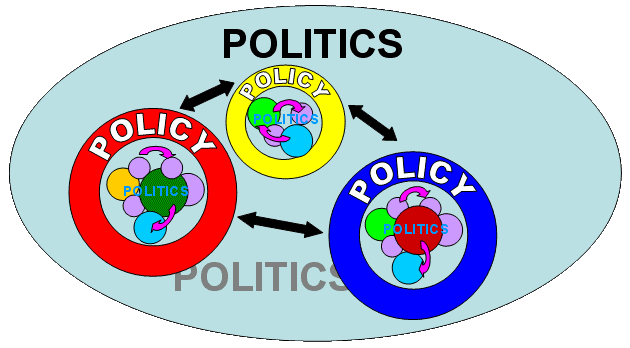
That brings us to the problem of instrumentality. Force or violence is, of course, an instrument, in the sense of a hand-tool or weapon, of unilateral policy. War, however, must be bi- or multilateral in order to exist. Thus, while military force is indeed an instrument of unilateral policy, we should see war as an instrument of politics only in a very different, multilateral sense, as the market is an instrument of trade or the courtroom an instrument of litigation (“which,” as Clausewitz says, “so closely resembles war”)

….Clausewitz seems simply to assume that his readers will distinguish, on the fly, whether he is speaking in the unilateral or the multilateral sense. After all, he has stressed time and again the interactive nature of war, and, of course, his own language’s term Politik encompasses both our multilateral politics and our unilateral policy. But this casual stance results in constant confusion for the translator and the reader.

….We sometimes forget, of course, that Clausewitz’s magnum opus is not about policy or politics, nor about human nature or the nature of reality. It is merely a mark of the book’s profundity that these matters arise immediately in any serious discussion of it. In fact, Clausewitz himself dismisses the political complexities of policy in order to focus on his true subject, the conduct of military operations in war

….On the other hand, he’s offering some good advice here, not necessarily a prediction. It seems rather superfluous to suggest that perhaps Clausewitz actually grasped the facts that there is such a thing as bad policy, that bad policy has military consequences, and that this in turn may have consequences for both the political leadership and the community whose interests it is supposed to represent.

Clausewitz’s analogy to markets and litigation are interesting, partly because they are strained.  Still useful, but strained.

In the case of the former, the relationship is actually the reverse: trading is an instrumentality of economic relationships and economic laws which continue to operate even if their “natural” manifestations are suppressed by political power wielded by the state (i.e. the Soviet Union or North Korea could fix prices or set quotas but then had shortages, surplus goods and black markets instead). However, in CvC’s defense, he was still correct that there was a degree of parallel between economic competition and war and economics was then still in it’s infancy. Some of the classical economists had yet to become regarded as such by wrestling with their own conception of iterative, friction-generating, relationships. Furthermore, in Clausewitz’s day, the heavy hand of the state in economic life was traditional in continental Europe while “liberalism” (allowing freer markets) seemed like a radical innovation rather than an underlying mechanism behind an existing system of distortions.

The same might be said that litigation is the instrument of the courtroom or justice, but I am less sure here. Continental legal traditions and assumptions are sometimes very different from the Anglo-American legal systems based more upon common law and the evolution of judicial independence from the executive. And unfortunately, early 19th century Prussian royal courts are a subject beyond my competence. In any event, the adversarial and zero sum nature of litigation carries through in Clausewitz’s analogy.

In regard to Politik, I think Bassford has done an excellent job teasing out the ambiguities of a German word that does not translate or transliterate precisely into an English equivalent. He offers the reader a method for sensibly discerning when to use “politics” or “policy” in interpreting Clausewitz’s text and reasonably assumes that Clausewitz expected the reader to infer the correct meaning from the surrounding context. That’s how most of us write when dealing with multi-layered, abstract topics – we sacrifice exact clarity for useful brevity and expect (or hope) the audience will intuitively grasp the right nuance in our line of reasoning.

I am also intrigued by Bassford’s diagram. The representation of internal political dynamics is very useful but I am curious how he would weave a visual representation of strategy flowing from policy or (more accurately, policies) and strategy’s relationship with politics, beyond being subsumed. Many a potential strategy is stillborn in the tumult of bureaucratic-military politics, never mind the larger societal kind.

As complex as the text of On War sometimes seems, it really was a brilliant simplification by Clausewitz of the dynamics mediating conflict and war.

Where in the world is Abu Musab al-Suri?

Thursday, September 20th, 2012

[ by Charles Cameron –on the whereabouts of the jihadist thinker, and the importance of careful reading ]
.

For those interested in the question of whether Abu Musab al-Suri has been released by the Syrians, where he is and how he’s doing, this tweet today from Mr. Orangetracker is probably the state of the art:

**

I sat up and took notice of this tweet today, both because I think al-Suri’s whereabouts is and should be a matter of considerable concern and interest — and also because it reminded me of a conversation a day or two back, which began (or at least, those parts that I can see from my own feed began) with a comment from Will McCants on the recently posted Institute for the Study of War report, Jihad in Syria, and led Jane’s analyst Charles Lister to comment that the report “Also concretely claims Al-Suri was released in Feb; that wasn’t confirmed, right?”

The exchange continues:

McCants: i haven’t seen anything credible. but Aaron tracks the story more closely
Aaron Zelin: Credible sources at the forums said al-Suri was released then, but no word on him since.
Raff Pantucci: I wonder if he was ever actually freed tho. maybe a scare story from Syrian intelligence?

I hadn’t particularly noticed the conversation up to this point, but here is where I noticed a tweet from Zelin to Pantucci:

Raff Pantucci is another student of these matters whom I follow. As the discussion continues, he agrees with Zelin’s assessment:

Pantucci: that would make sense. he certainly wouldn’t be on their side if they let him loose at home!
Yassin Musharbash: the thing is that we simply cannot know what kind of state – physically, psychologically and ideologically – he is in
Zelin: Agreed.

**

As a matter of fact, the report did indeed state [p. 15] that Abu Musab al-Suri has been released:

In early February 2012, the Syrian government released Mustafa bin Abdel Qadir Sitt Mariam Nassar, also known as Abu Musab al-Suri. Al-Suri is an important jihadist ideologue and a top al-Qaeda operative, with experience fighting against the Assad regime during the 1979—1982 Islamic Uprising. As the alleged mastermind of the July 2005 London Bombings, Al-Suri had been in Syrian custody since he was allegedly transported there by the CIA six years ago.

But here’s where it gets interesting. In connection with these sentences, the report carries this footnote [# 29]:

“Syria’s Assad releases alleged al-Qaida mastermind of 2005 London bombings,” Haaretz, February 5, 2012.

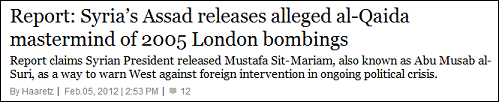
Significantly IMO, that footnote omits the first word of the Haaretz headline, which reads:

**

“Report claims Syrian President released” is simply not the same as “Syrian President released”.

On such tiny details are the webs and fogs of misunderstanding often based.


Switch to our mobile site