zenpundit.com » connectivity

Archive for the ‘connectivity’ Category

Government 2.0 and National Security

Saturday, April 18th, 2009

Dr. Mark Drapeau and Dr. Linton Wells II in a National Defense University paper:

Social Software and National Security: An Initial Net Assessment (PDF)

….We have approached this research paper as an initial net assessment of how social software interacts with government and security in the broadest sense.1 The analysis looks at both sides of what once might have been called a “blue-red” balance to investigate how social software is being used (or could be used) by not only the United States and its allies, but also by adversaries and other counterparties. We have considered how incorporation of social software into U.S. Government (USG) missions is likely to be affected by different agencies, layers of bureaucracy within agencies, and various laws, policies, rules, and regulations. Finally, we take a preliminary look at questions like: How should the Department of Defense (DOD) use social software in all aspects of day-to-day operations? How will the evolution of using social software by nations and other entities within the global political, social, cultural, and ideological ecosystem influence the use of it by DOD? How might DOD be affected if it does not adopt social software into operations?

Saw this a day or two ago. Just finished reading the intro. Read the rest here.

Excess Complexity is the Route to Extinction

Friday, April 10th, 2009


Nassim Nicholas Taleb, author of The Black Swan: The Impact of the Highly Improbable and Fooled by Randomness: The Hidden Role of Chance in Life and in the Markets, had an op-ed in FT.com entitled “Ten principles for a Black Swan-proof world” (Hat tip to John Robb and Pundita). Taleb was addressing the global economic crisis, but I was particularly drawn to Taleb’s fifth principle, which has a more general implication:

5. Counter-balance complexity with simplicity. Complexity from globalisation and highly networked economic life needs to be countered by simplicity in financial products. The complex economy is already a form of leverage: the leverage of efficiency. Such systems survive thanks to slack and redundancy; adding debt produces wild and dangerous gyrations and leaves no room for error. Capitalism cannot avoid fads and bubbles: equity bubbles (as in 2000) have proved to be mild; debt bubbles are vicious.

Taleb has encapsulated many important concepts very well here. Up to a certain point, increasing complexity represents a advantage for an evolving system (biological, financial, physical etc.) by increasing efficiency through adding specialization, interconnection, diversification, redundancy and checks for mitigation of risks. Complexity, in the earlier part of a development curve can add to a system’s overall resiliency – to a point.

Superfluous complexity, that which goes beyond the minimum required for additional gains in systemic efficiency or productivity, is a net drag on the system, an economic waste, a source of friction, a cancer,  a useless eater of resources and the earliest sign of the system’s inevitable decay. Worse, excess complexity represents an increasing probability of systemic failure by multiplying the number of variables involved in the normal process of the system. There are more things that can go wrong and more choke points where a catastrophic failure can occur. Increasing the degree of complexity moves the system away from simplicity and reliability and toward chaos and the creativity of emergent properties, but like an ice skater seeking ever greater range, go too far and the ice will crack under one’s feet.

This is an effect familiar to engineers and scientists but one that appears to escape the majority of politicians, corporate executives and economists. My co-blogger at Chicago Boyz, Shannon Love,  took GE to task for trying to get on the Federal dole by advocating needlessly complicating the nation’s power grid:

If Your Grid Had a Brain

GE is advertising to build political support for Obama’s plan to purchase billions of dollars of GE tech in order to make the power grid “smart”.  After all, who would want a “dumb” anything when they could have a “smart” something? 

The reason we should keep things dumb is that in engineering the word “dumb” has a different connotation. In engineering, “dumb” means simple and reliable. 

Increasing complexity in any networked system increases possible points of failure. Worse, the more interconnected the system, i.e., the more any single component affects any other randomly selected component in the system, the faster point-failures spread to the entire system. Power grids are massively interconnected. Every blackout starts with a seemingly trivial problem that, like a pebble failing on a mountain side, triggers an avalanche of failure. 

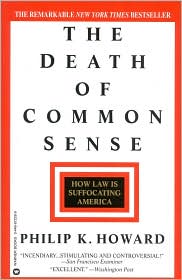
In the social and political domain, back in the 1990’s Philip K. Howard wrote a book called The Death of Common Sense: How Law is Suffocating America in which he detailed example after example of how the overlawyering of regulatory systems in America by an emerging and hyper-aggressive legal class was producing neither restraint on government abuses nor fine-tuned social outcomes but instead created a state of paralyzed rigidity, risk aversion, perverse incentives and general dysfunction; in other words, chaos instead of order.
The Obama-ites in the White House are not “socialists” ( at least not most of them) but there is a great love of liberal-minded technocracy there, and a seemingly boundless self-confidence in the ability of high-minded, upper-middle class, progressive, wonks and lawyers from the “good schools” (or investment houses – in some cases, both) to micromanage not just our lives for us, or even the United States of America but the global economy itself. Sort of a Superempowered Oligarchy of Good Feelings.

The ancient Greeks had a word for that: hubris. More importantly, the Obama-ites are wrong here – adding endless amounts of regulatory complexity is not going to give them the kind of granular control or positive returns that they seek to obtain from the system. Counterintuitively, they should be radically simplifying where and to the degree they safely can instead.
Depth, Breadth and Velocity

Wednesday, August 27th, 2008

I thoroughly enjoyed John Hagel’s post Stupidity and the Internet where he analyzed the implications of the book vs. snippet debate initiated by Nick Carr’s  Atlantic article “Is Google Making Us Stupid?”. Hagel properly broadened the debate away from content format to encompass the social sphere:

But if the concern is about intelligence, thinking and the mind, then isn’t content just one small piece of the puzzle?  Nick and many of the digerati who line up against Nick have one thing in common – they are content junkies.  They consume content voraciously and care deeply about the form that content takes. 

In the heat of debate, they seemed to often lose sight of the fact that most people are not content junkies.  Most people use the Internet as a platform to connect with each other.  Sure, they are exchanging information with each other, but they are doing a lot more than that.  They are learning about each other. They are finding ways to build relationships that expand their understanding of the world and enhance their ability to succeed in their professions and personal lives.

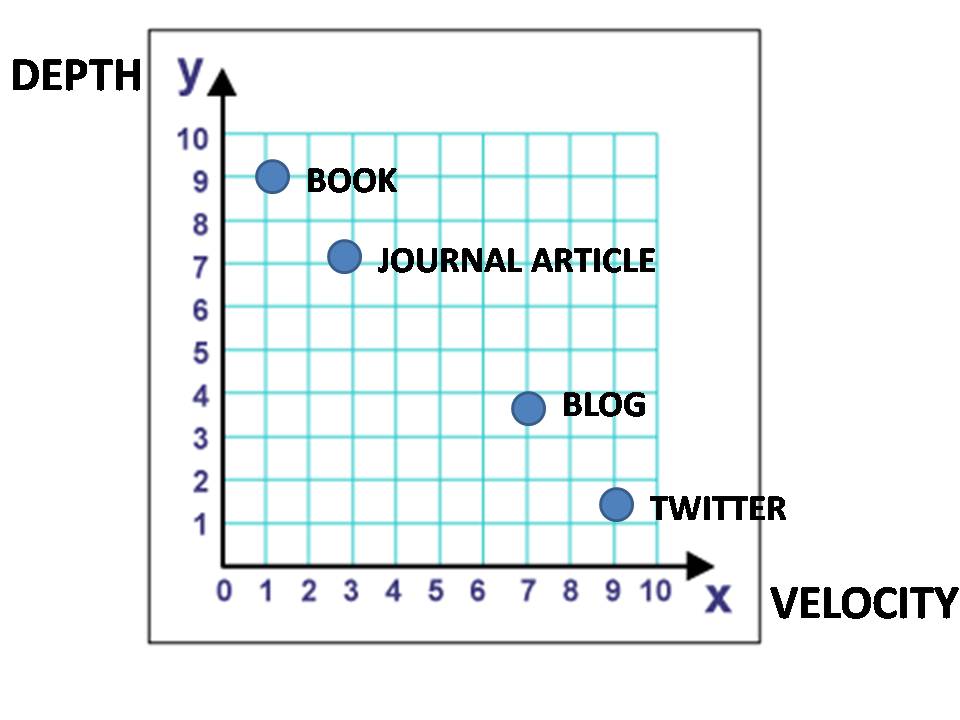
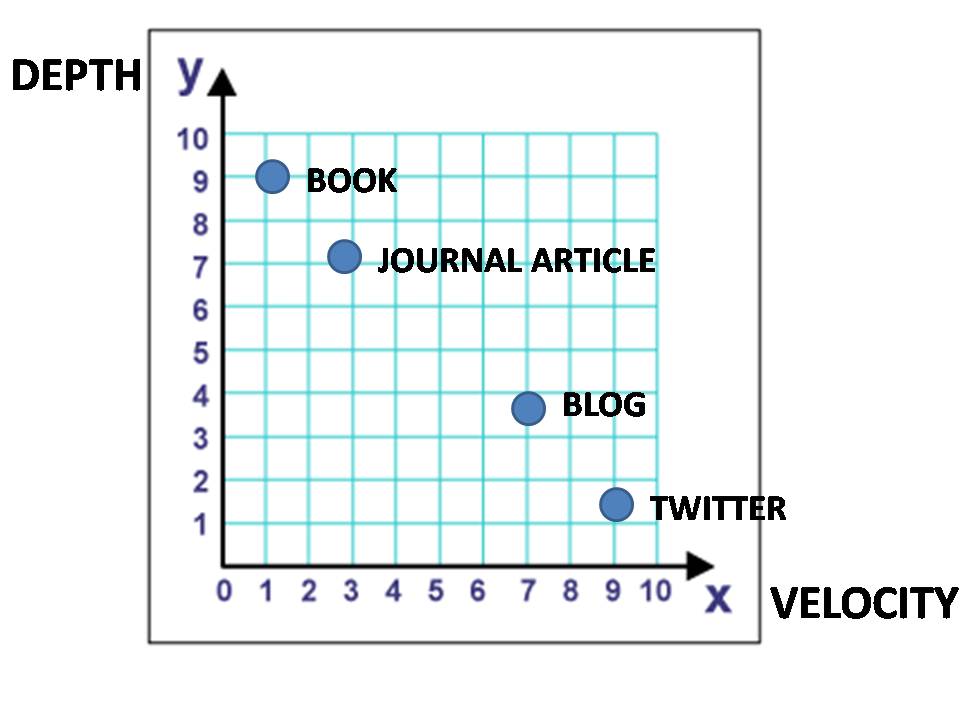
I’m going to back the discussion up a half-step by pointing out that these online relationships are often, initially of a transactional nature. Information is being exchanged and the kind of information used as a “hook” to capture attention may be determinative to the trajectory the social relationship may take and the rate of information exchanged may determine if the social connection can be sustained. To simplify, we are discussing Depth, Breadth and Velocity of information:

graph1.jpg

Books, journal articles, blog posts and Twitter “tweets” ( 140 character microblogging) could have their relative informational and transactional qualities be represented on a simple graph. Books have the greatest potential depth but the least level of timely, qualitatively reciprocal, informational transaction for the author ( primarily gained from the relationship with the editor or a “sounding board” colleague). Peer review journals are next, with a narrow community of experts sanctioning the merit of the article or rejecting it for deficiencies that put the work below or outside the field’s recognized professional standards. Blog posts can potentially generate an enormous volume of feedback, though at the cost of a dramatically inferior “signal to noise ratio“. Microblogging services like Twitter have hyperkinetic transaction rates but unless used strategically ( for example, by Robert Scoble) or within an existing social network, they generate little other than useless noise.

Attention can be attracted by a clever “snippet” – particularly if the concept itself has ambiguity or nuance that would intrigue more people than if it were precisely defined – but the attention will not be held unless the author can sustain the flow of interesting material, something that requires depth of knowledge about a subject.  Even better is to have depth in a subject along with breadth, the ability to think horizontally across many domains to spot emergent patterns, construct powerful analogies and distill a meaningful synthesis. In turn, pulling a willing audience of useful collaborators into a relationship around such intellectual pursuits hinges on first gaining their attention with a comprehensible simplification of complex abstractions and exhibiting a willingness to interact on a reciprocal basis.

It’s not a case here of “Books vs. Google”. Depth, breadth and velocity of information are interdependent and mutually reinforcing.

Nice Post on Social Networking Connectivity

Tuesday, July 29th, 2008

Picked this up on Socialmedian:

Broadcasting BrainHyperconnectivity shakes up six degrees of separation

Type 0 and 1 plus:

  • Social media and Web 2.0 (social news, social bookmarking, and social networking)
  • Microblogging, aggregators, lifestreaming, blog commenting
  • Audio and video blogging
  • Open IM clients (e.g. GTalk)
  • Wireless connectivity

Communication advances have generally created faster and easier to use methods. In the pre-Internet era, nothing was faster than a phone call except for a face-to-face meeting (although travel time to arrange a face-to-face meeting was often prohibitive). Today we have a number of methods that allow virtually real-time interaction and more variations on them seem to appear on a regular basis.

Lots of visuals in this post. The author seems to be alluding to attention economy variables in Part II.

Kilcullen Returns to SWJ Blog

Friday, April 25th, 2008

Dr. Dave Kilcullen begins a COIN series at SWJ Blog:

Political Maneuver in Counterinsurgency

Like the Romans, counterinsurgents through history have engaged in road-building as a tool for projecting military force, extending governance and the rule of law, enhancing political communication and bringing economic development, health and education to the population. Clearly, roads that are patrolled by friendly forces or secured by local allies also have the tactical benefit of channeling and restricting insurgent movement and compartmenting terrain across which guerrillas could otherwise move freely. But the political impact of road-building is even more striking than its tactical effect

….But the effects accrue not just from the road itself, but rather from a conscious and well-developed strategy that uses the road as a tool, and seizes the opportunity created by its construction to generate security, economic, governance and political benefits. This is exactly what is happening in Kunar: the road is one component, albeit a key one, in a broader strategy that uses the road as an organizing framework around which to synchronize and coordinate a series of political-military effects. This is a conscious, developed strategy that was first put in place in 2005-6 and has been consistently executed since. Thus, the mere building of a road is not enough: it generates some, but not all of these effects, and may even be used to oppress or harm the population rather than benefit it. Road construction in many parts of the world has had negative security and political effects, especially when executed unthinkingly or in an un-coordinated fashion. What we are seeing here, in contrast, is a coordinated civil-military activity based on a political strategy of separating the insurgent from the people and connecting the people to the government. In short, this is a political maneuver with the road as a means to a political end.

A nice piece, one that reveals the multiple dimensions of connectivity inherent in something so seemingly straightforward as a “road”. The connectivity itself is a weapon against disconnecting, isolating, hyperideological, insurgencies like the Taliban.

Incidentally, this isn’t America’s first foray into road building in Afghanistan; the Eisenhower administration, as a Cold War intrusion into the Soviet sphere of influence, built a modern highway for Zahir Shah that constituted, for many years, Afghanistan’s only paved road outside of Kabul.


Switch to our mobile site