“Trust, but verify” and Pakistan: II
Sunday, May 8th, 2011[ by Charles Cameron — second of three ]
*
.
Trust — or mistrust — but verify.
So: can you trust crowd-sourcing, can you trust officialdom?
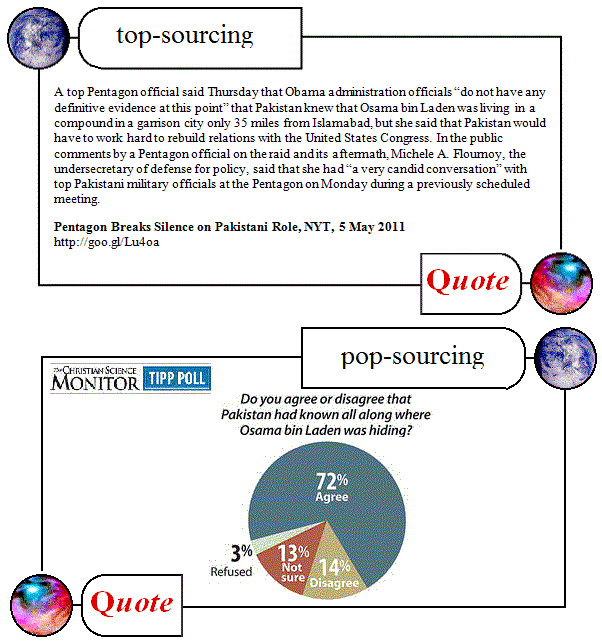
Can you trust Pakistan?
[ by Charles Cameron — second of three ]
*
.
Trust — or mistrust — but verify.
So: can you trust crowd-sourcing, can you trust officialdom?
Can you trust Pakistan?
[ by Charles Cameron ]
*
.
Ronald Reagan said “Trust, but verify.” Gorbachev said, “You repeat that at every meeting.” Reagan said, “I like it.”
*
Zen claimed a couple days ago that “Osama bin Laden was caught and killed in an ISI safe house in Abbottabad” — while over at ChicagoBoyz, Trent Telenko asserted:
We already knew Pakistan is what we feared a nuclear-armed Iran would be — a nuclear-armed, terrorist supporting, state. Just ask India about Mumbai and the Lashkar-e-Taiba. Now we know that Pakistan is attacking us too. Al Qaeda is the operational arm of Pakistani intelligence (ISI) attacking us just as Lashkar-e-Taiba is its operational arm attacking India.
Those are “strong” versions of claims that have been made in “weaker” forms for some time now.
*
Thus the NY Times refers to “the belief among administration officials that some elements of the ISI may have ties to Bin Laden and the Afghan Taliban” while according to the BBC, Adm. Mike Mullen recently claimed the ISI had a “long-standing relationship” with the Haqqani network. A Guardian report used the phrase “rogue elements” in discussing recently wikileaked documents from Guantanamo:
The documents show the varying interpretations by American officials of the apparent evidence of ISI involvement with insurgents in Afghanistan. There are repeated “analyst’s notes” in parentheses. Several in earlier documents stress that it is “rogue elements” of the ISI who actively support insurgents in Afghanistan.
So: is it “some elements of the ISI”—or “rogue elements of the ISI” — or simply “the ISI”?
*
The Pakistani Inter-Service Intelligence Directorate was included in the “list of terrorist and terrorist support entities identified as associate forces” in one of the leaked documents, the “JTF-GTMO Matrix of Threat Indicators for Enemy Combatants” with the notation:
This list is not all inclusive but provides the primary organizations encountered in the reporting from and about JTF-GTMO detainees. Through associations with these groups and organizations, a detainee may have provided support to al-Qaida or the Taliban, or engaged in hostilities against US or Coalition forces.
“Association with Pakistan ISID, especially in the late 1990s up to 2003” was listed in the same document as among the “the primary indicators for assessing a detainee’s membership or affiliation with the Taliban or ACM elements other than al-Qaida.”
BTW, what happened to the ISI in 2003?
*
And what of Pakistan itself? is it just the ISI that’s problematic, or the entire state of Pakistan? Time magazine reports:
CIA ruled out participating with its nominal South Asian ally early on because “it was decided that any effort to work with the Pakistanis could jeopardize the mission. They might alert the targets,” Panetta says.
Indeed, the problem may not be that there are rogue elements in ISI, nor that the ISI is a rogue element in Pakistan, but that Pakistan itself may be a rogue state, and a nuclear one at that.
How simple it is to write such a sentence – and how subtle the task of understanding – not leaping to conclusions but penetratingly understanding – just what the real situation is.
*
As Zen says in the same post:
It is long past time for a deep, strategic, rethink of what ends America wants to accomplish in Central Asia and some hardheaded realism about who our friends really are.
Intelligence needs to be intelligent, and to be seen to be intelligent. Whether we trust or mistrust — we need to verify.
[ first of three, at least ]
[ by Charles Cameron ]
*
.
My friend Bryan Alexander‘s book, The New Digital Storytelling: Creating Narratives with New Media, hit the shelves a short while ago (recommended) — and this month Bryan is exploring the various forms of digital story-telling on his new digital storytelling blog.
I’m interested in narrative, too – even when it isn’t digital – because it’s the prime way in which we humans figure out what’s going on around us…
Here, then, are two “tellings and retellings” of the Abbottabad raid and the death of Osama bin Laden.
.
1. The fog of war
In his first briefing on bin Laden’s death from the White House, John Brennan, Assistant to the President for Homeland Security and Counter-Terrorism, dismissed bin Laden with the words, “I think it really just speaks to just how false his narrative has been over the years.”
Narrative is important, and the narrative John Brennan was proposing as a corrective to bin Laden’s version went as follows:
here is bin Laden, who has been calling for these attacks, living in this million dollar-plus compound, living in an area that is far removed from the front, hiding behind women who were put in front of him as a shield. I think it really just speaks to just how false his narrative has been over the years. And so, again, looking at what bin Laden was doing hiding there while he’s putting other people out there to carry out attacks again just speaks to I think the nature of the individual he was.
A writer in the Atlantic commented today:
And that’s the message our counterterrorism officials would, I expect, like the world — and especially any potential followers of al-Qaeda’s anti-American ideology — to get about our newly vanquished enemy, responsible to the single deadliest attack on American soil. The leader of the terrorist group was soft, a coward in the end who hid behind a woman’s skirts like a little girl, having grown accustomed to living in luxury in a mansion. Almost everything about this narrative seemed calculated to diminish any possible perception of strength or masculinity in bin Laden’s reaction to the raid by an elite team of U.S. Navy Seals — men who are in contrast among the most mythic and valorized in our armed forces, known for slogans like “pain is just weakness leaving the body.”
But just a day after Brennan’s briefing, the President’s Press Secretary, Jay Carney, gave a second briefing, in which he revised the official narrative, saying:
Well, what is true is that we provided a great deal of information with great haste in order to inform you and, through you, the American public about the operation and how it transpired and the events that took place there in Pakistan. And obviously some of the information was — came in piece by piece and is being reviewed and updated and elaborated on.
.
So what I can tell you, I have a narrative that I can provide to you on the raid itself, on the bin Laden compound in Pakistan.
I have a narrative…
The revised narrative featured an unarmed bin Laden in a far from palatial house with no visible air-conditioning, who didn’t in fact use a woman as a human shield… all of which “really just speaks to just how false” Brennan’s own original narrative was.
But then – you don’t believe everything you read in the press, do you? And besides, the first news reports of almost any big story are almost invariably inaccurate, it takes time for clarity to emerge… which adds up to the idea that it’s not so easy to distinguish between how the world actually spins — and how the world is spun.
So that’s a telling and retelling of the Abbottabad raid in “real life” as transmitted to us by various media and recorded on the web…
.
2: The twitter-stream and the analyst
A little earlier a more “purely” digital version of the story – no less confused by the “fog” that inevitably surrounds the reporting of highly volatile situations – had emerged quite spontaneously via Twitter, when the delightfully-named ReallyVirtual (an IT specialist who had moved to Abbottabad for some peace and quiet) was kept awake by the noise of helicopters overhead and sounds of explosions, and tweeted a couple of late-night friends… and a stream of tweets began which quickly led to an almost thousandfold spike in Yahoo searches on bin Laden, and bin Laden related searches occupying all top twenty spots on Google trends…
You might call that spontaneous, distributed story-telling – but it’s also the raw material for a collated and curated twitter narrative, using Chirpstory, a tool for curating and presenting stories from the twitter-stream:
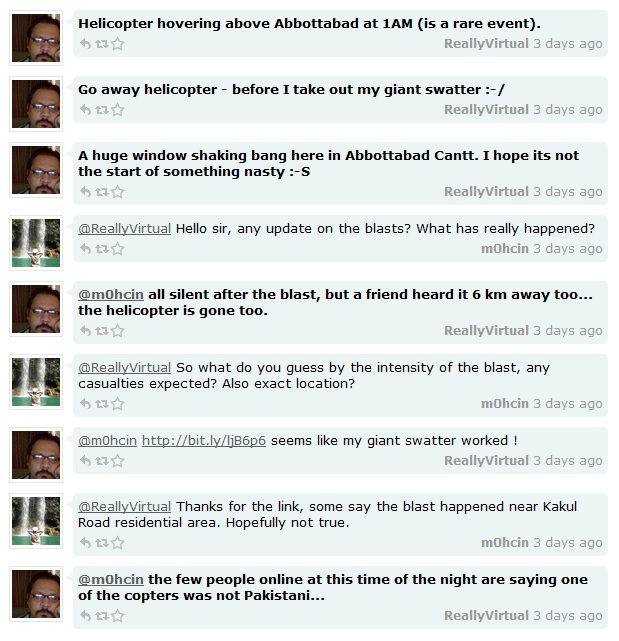
We’re not done yet…
That in turn provides grist for the analytic mill of B Raman, a highly-regarded Indian analyst, blogger, and former chief of counter-terrorism with India’s R&AW intelligence agency – who winnowed out the chaff and added in his own commentary to create a denser, tighter analytic narrative of his own:
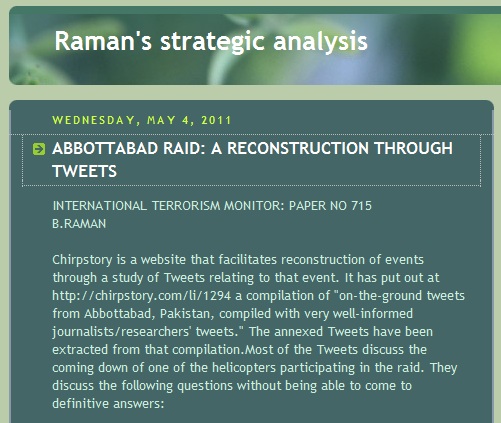
To my way of thinking, the spontaneous twitter-stream version, the Chirpstory adaptation and B. Raman’s midrash on it are at least as interesting as the successive White House narratives…
.
3. Further reading:
Also relevant to our narrative here, and your own readings on the topic of our tale:
How the Bin Laden Announcement Leaked Out
Bin Laden Reading Guide: How to Cut Through the Coverage

J. Scott Shipman is the owner of a boutique consulting firm in the Metro DC area that is putting Boyd’s ideas into action.
Boyd and Beyond, 2010
by J. Scott Shipman
Boyd & Beyond 2010, 15-16 October 2010
Mr. Stan Coerr (GS-15 Marine Corps, LtCol, USMCR), coordinator. Hosted by the USMC Command and Staff College at the Marine Corps University, Quantico, VA.
This was my first Boyd conference. I discovered Boyd in early 2005 through Robert Coram’s book, BOYD, The Fighter Pilot Who Changed the Art of War. I did not know what to expect of the conference, and was anxious to meet guys I’d corresponded with over the last couple of years (the ones who made it: Robert Coram, Fred Leland, Don Vandergriff, and Adam Elkus); so my thinking going in was at least I’d get to meet these guys regardless, and besides Quantico is right down I-95 from my home.
As others have already observed, Boyd 2010 exceeded any expectation. It was a pleasure to be in the same room with such an impressive collection of talent and intellect and listen to what they have done and continue to do with Boyd’s work and ideas. At the end of the first day, I felt my head was going to explode—and heard many others echoing similar sentiment. I told a friend, those two days were like drinking from a fire hydrant.
As many readers are probably already aware, the reaction to the conference has been universally positive, and calls for a 2011 event have been heard and is scheduled for 14-15 October 2011 at Quantico, same location. Stan Coerr and the USMC University deserve our gratitude for this recent event and the opportunity to reconvene next year. The bar, has indeed been set high.
What follows is from my notes, and I apologize in advance if I leave out something I should have remembered. I will try and avoid repeating too much of Adam Elkus’ excellent review, so all presenters are not covered—while all presenters provided valuable and enlightening insights. At the conclusion, I’ve added the references of books and online links that I heard (there were many more) recommended, and books and articles I recommended during the conference.
The day began with a colorful introduction to Boyd by Robert Coram. He related the circumstances of how he came to write BOYD, and shared several stories of the evolution of the book and the people he met. Coram reported that as of the conference, 73,000 copies of BOYD are in print—not bad for a book about someone most people have never heard of.
Ray Leopold, PhD, (the third acolyte) gave a touching and penetrating retrospective of how he came to be associated with John Boyd, and how that association changed his life for the better. Of interest, Ray shared a common introduction that he and Boyd used when they visited other Air Force officers. They would write the following on the blackboard:
DUTY, HONOR, COUNTRY
They would then cross these familiar words out, and replace with:
Pride, Power, Greed
From Boyd’s perspective, the military industrial complex and the inherent bureaucracy had (and in my humble opinion, continues) corrupted the original intent of those core principles military members are taught to embrace.
Don Vandergriff followed with a fast-paced explanation of his continuing efforts within the US Army to advocate Outcome Based Training and Education (T&E). He follows with successful practical examples of allowing his student to think and adapt-“off-script.” Vandergriff also recommended the work of Dr. Robert Bjork, Dean of the School of Psychology at UCLA, particularly his presentation “How We Learn Versus How We Think We Learn: Implications for the Organization of Army Training.”
General Paul Van Riper (LtGen, USMC, Ret) was the keynote and gave a compelling address on mental models and systems theory. Throughout his talk, he added insight into how John Boyd’s ideas found a home in the USMC. Gen Van Riper made the distinction between informational knowledge and transformational knowledge, and the “eloquent schema” that is OODA. He also discussed systems theory, and distinguished between linear systems (cause & effect), complex systems, and interactive complex systems. Of the later, he reminded that these systems are non-linear and unknowable using a deductive approach, and one output is emergent behavior(s).
Marcus Mainz (Major, USMC) provided insight into how he is using Boyd’s ideas in the training and development of young Marine officers and how he and his colleagues are creating the desire to learn. LtCol Mike Grice (USMC) provided our group with insight into how Boyd’s ideas translate in the field—having just returned from Afghanistan and a tour in one of Iraq’s more dangerous provinces. Both of these officers reflect well on the USMC—and if this caliber of leadership and thought is any indication, the USMC is in good hands in the years to come.
On the second day, Linton Wells, PhD, (CAPT, USN, Ret) gave a talk on naval maneuver warfare. Dr. Wells was providing a preview of his update to a seminal article of the same title he wrote for Proceedings in December 1980. Dr. Wells also provided one of the best quotes of the two days: “make knowledge accidents happen.”
Fred Leland’s presentation revolved on how he has used Boyd’s work to teach law enforcement personnel how to make good decisions. Fred began his talk with an absolutely frighteningly disturbing video from the dash-cam of a young police officer caught in a dangerous place. Fred lives his curricula, as he is an active duty police lieutenant, so his presentation had a resonance unique to our gathering.
Terry Barnhart, PhD, (Pfizer R&D) provided unique insight into how he is using Boyd’s ideas (OODA, to be specific) in his company’s R&D efforts. Barnhart, in my estimation, is onto something very powerful. He repurposed Boyd’s OODA from the traditional vernacular into: See, Reframe, Experience, Grow—but the intent remains. Dr. Barnhart placed great emphasis on “SEE” where his definition is: “assume it is wrong” and see without prejudice. He reported exciting results from using this and another model derived from Boyd’s work.
Chip Pearson, Managing Partner of a software company in Minnesota, gave an impassioned recounting of how he used/uses Boyd’s concepts to start and successfully operate his software company. His philosophy, “we make meaning, not money.” Chip focused on values, capability, and objectives. On his management philosophy, he remarked, “complete independent action scares the hell out of people”—which is how he wants his organization to operate.
Jussi Jaakonahon, from Nokia, travelled the furthest, coming from Norway, to give his talk on his experience using OODA in IT security exercises. He confirmed Boyd’s emphasis on sharing information of validity and integrity, and adapting on the fly to the mission. During this exchange someone remarked: “companies die because they do the right thing too long.” We hope he will be able to join us for both days next year.
CORRECTION:
I was contacted by Jussi Jaakonaho, I misspelled his name—this is the correct spelling. He came from Finland, not Norway. This quote should be attributed to Jussi: “companies won’t die because of their false actions. they die because of the continuing of the same actions for too long (which once were right).”
My sincere apologies for the inaccuracies.
There was a language barrier, and as a Southerner, English is my second language:))
Dave Foster provided an introduction to his draft paper on portfolio complexities in the fog of war. One goal of his paper is helping to shrink the knowledge-doing gap. Foster is on to something, and I’m guessing this forum will help him advance his ideas.
TJ Jankowski (Col, USMCR) was the anchor man for our two days. His talk, COIN Technology and Universal Structures of Technical Knowledge, dealt with emerging theories of a taxonomy of technologies. His ideas are based on the work of Dr. Rias van Wyk which advances the idea of “a fundamental structure of technological knowledge, based in part on a very precise definition of technology and a functional classification of all technological knowledge.” (TJ Jankowski follow-up email) The implications of these ideas could be revolutionary in our ability to conduct macro technology analysis.
Alan D. Beyerchen, Clausewitz, Nonlinearity ?and the Unpredictability of War http://www.clausewitz.com/readings/Beyerchen/CWZandNonlinearity.htm
DoD Command and Control Research Program (CCRP) by Tom Czerwinski: http://www.dodccrp.org/events/13th_iccrts_2008/CD/library/html/pdf/Czerwinski_Coping.pdf
Hew Strachan, Clausewitz’s On War: A Biography
http://www.amazon.com/gp/product/0802143636/ref=ord_cart_shr?ie=UTF8&m=ATVPDKIKX0DER
John Shook, Managing to Learn: Using the A3 Management Process
Nik Gowing, “Sky Full of Lies and Black Swans” (free registration required to access whole article)
http://www.bbcworldnews.com/Pages/Programme.aspx?id=362
Richard E. Neustadt and Ernest R. May, Thinking in Time: The Uses of History for Decision-Makers
A few titles I recommended:
Seen recently here at Zenpundit comes with a hearty recommendation:
Magic and Mayhen, The Delusions American Foreign Policy from Korea to Afghanistan by Derek Leebaert
Jim Storr, The Human Face of War. Storr does not hold Boyd and OODA in high regard, however there is much in this excellent book to admire and much to learn—it is worth the $100 price tag.
Robert Leonhard, The Principles of War For the Information Age. Again, Leonhard is not a Boyd fan, but an important contribution to how we think—his IT ideas are dated, but the core is thought-provoking.
Michael Van Nooten, The Law of the Somalis. The late Mr. Van Nooten married into a Somali tribe and used his training as an attorney to propose innovative ideas for the peaceful coexistence of Western jurisprudence with systems based on tribes or clans.
Fredrich Hayek, Economics and Knowledge.
http://www.virtualschool.edu/mon/Economics/HayekEconomicsAndKnowledge.html
Fredrich Hayek, The Use of Knowledge in Society.
http://home.uchicago.edu/~vlima/courses/econ200/spring01/hayek.pdf
Many thanks to Mark for making this venue available, and I hope to see you next year at Boyd & Beyond 2011.
At Fast Company, Jamais Cascio unveiled a short bibliography for the general reader on Futurist thinking.
Futures Thinking: A Bibliography
As you probably picked up from earlier entries in the Futures Thinking series, foresight work is intensely information-based. If you’re going to make grounded projections of future possibilities, you have understand both what has led us to the point we’re at today, and what kinds of issues seem to be shaping up as emerging drivers. A few pieces to trigger some creative thoughts can help, too.
As I suggested in Futures Thinking: Scanning the World, a good deal of the reading you’ll be doing will be in the form of websites and journals. This isn’t surprising; part of the service provided by foresight workers is sensitiv
ity to early warnings of big changes. It will be tempting to focus on science and technology materials, in part because there tends to be an overlap between people interested in futures work and people interested in new tech toys, and in part because the pace and pattern of change is easier to see in science and technology than it is in many other realms. It’s not necessarily more “objective,” but it’s perceived as less ambiguous.
That was the introduction, you can read the rest here. Now on to Cascio’s recommendations:
Practice
These two books are good resources for understanding methodologies of futures work. Schwartz co-founded Global Business Network, and Johansen is a Distinguished Fellow at the Institute for the Future. (Disclosure: I’ve worked with Peter, and currently work with Bob.)
- Art of the Long View, Peter Schwartz
- Get There Early, Bob Johansen
History
Foresight is anticipatory history. These three books offer very different perspectives on how to think about the past — which, in turn, help to shape how we should think about the future. Polanyi is a classical theorist, looking at ideas and states; Zinn is a populist, looking at the lives of regular people; Diamond is an ecologist, looking at the intersection of culture and environment. I end up mixing these three approaches in my own work.
- The Great Transformation, Karl Polanyi
- A People’s History of the United States, Howard Zinn
- Collapse, Jared Diamond
Analysis
Easily the largest section of my personal library, I could have made the list of Analysis books ten times longer. The ones I’ve picked here, however, offer for me a set of cogent insights into how we live with the tools we make. The ideal result from reading a book in this category should be an epiphany moment where you can see all sorts of links from the book’s ideas to other books/ideas you’ve encountered. All of these books gave me that kind of moment.
- Smart Mobs, Howard Rheingold
- The Death and Life of Great American Cities, Jane Jacobs
- Everyware, Adam Greenfield
- Plan B, Lester Brown
- Radical Evolution, Joel Garreau
- Brave New War, John Robb
- No Logo, Naomi Klein
Inspiration
The highest compliment I can give a science fiction book is that it’s “plausibly surreal” — it manages to feel like a relentless extrapolation from today even as it overwhelms with unexpected consequences of that extrapolation. I’ve read each of these are books multiple times, and I still get a giddy feeling of discovery every time.
- Accelerando, Charlie Stross
- Transmetropolitan series, Warren Ellis & Darrick Roberts
- Holy Fire, Bruce Sterling
- The Bohr Maker, Linda Nagata
- Rainbows End, Vernor Vinge
- Red Mars/Green Mars/Blue Mars trilogy, Kim Stanley Robinson
I am not familiar with all of these books. The Art of the Long View is considered to be a classic and I will give a very strong recommendation to Brave New War and Smart Mobs.
What would I add to this list?:
Practice:
Pearl Harbor: Warning and Decision
The Next Two Hundred Years: A Scenario for America and the World
History:
From Dawn to Decadence: 500 Years of Western Cultural Life 1500 to the Present
A History of Knowledge: Past, Present, and Future by Charles van Doren
Analysis:
Masks of the Universe: Changing Ideas on the Nature of the Cosmos
Consilience: The Unity of Knowledge
Powershift: Knowledge, Wealth, and Violence at the Edge of the 21st Century
I’m not a frequent enough consumer of science fiction to have noteworthy recommendations for “Inspiration”. There are obvious authors who come to mind – Asimov, Dick, Heinlein, Gibson, Clarke – but I’ll leave it to readers here to nominate titles in the comments section.

Zenpundit is a blog dedicated to exploring the intersections of foreign policy, history, military theory, national security,strategic thinking, futurism, cognition and a number of other esoteric pursuits.
Customized Web Site & Blog Design


