zenpundit.com » 21st century

Archive for the ‘21st century’ Category

Syria is Not Rwanda

Monday, April 29th, 2013

Anne-Marie Slaughter had a short but bombastic WaPo op-ed on Syria and chemical weapons use that requires comment:

Obama should remember Rwanda as he weighs action in Syria 

….The Clinton administration did not want to acknowledge that genocide was taking place in Rwanda because the United States would have been legally bound by the Genocide Convention of 1948 to intervene to stop the killing. The reason the Obama administration does not want to recognize that chemical weapons are being used in Syria is because Obama warned the Syrian regime clearly and sharply in August against using such weapons. “There would be enormous consequences if we start seeing movement on the chemical-weapons front or the use of chemical weapons,” he said. “That would change my calculations significantly.”

….But the White House must recognize that the game has already changed. U.S. credibility is on the line. For all the temptation to hide behind the decision to invade Iraq based on faulty intelligence about weapons of mass destruction, Obama must realize the tremendous damage he will do to the United States and to his legacy if he fails to act. He should understand the deep and lasting damage done when the gap between words and deeds becomes too great to ignore, when those who wield power are exposed as not saying what they mean or meaning what they say.

This is remarkably poorly reasoned advice from Dr. Slaughter that hopefully, President Obama will continue to ignore.
.
The President, on the basis of advice very much in the spirit of this op-ed, drew a public “red-line” about chemical weapons use for Bashar Assad, or some variation of that, on six occasions, personally and through intermediaries. On the narrow point, Slaughter is correct that this action was ill-considered, in that the President wisely does not seem to have much of an appetite for jumping into the Syrian conflict. Bluffing needlessly is not a good practice in foreign policy simply to pacify domestic critics, but it is something presidents do from time to time. Maybe the POTUS arguably needs better foreign policy advisers, but doubling down by following through with some kind (Slaughter fails to specify) military intervention in Syria is not supported in this op-ed by anything beyond mere rhetoric.
.
First, as bad as the Syrian civil war is in terms of casualties it does not remotely approximate the Rwandan Genocide in scale, moral clarity, military dynamics or characteristics of the major actors. This is a terrible analogy designed primarily to appeal to emotion in the uninformed. Syria is engaged in civil war, not genocide.
.
Secondly, the “credibility” argument has been lifted by Slaughter from it’s Cold War historical context where the United States capacity to provide a nuclear umbrella and effective deterrent for allied states was tied to the perception of our political will to assume the appropriate risks, which in turn would help avoid escalation of any given conflict to WWIII. This psychological-political variable of “credibility” soon migrated from the realm of direct US-Soviet nuclear confrontation in Europe to all manner of minor disputes (ex. –Quemoy and Matsu, civil unrest in the Dominican Republic) and proxy wars. It was often misapplied in these circumstances and “credibility” assumed a much greater exigency in the minds of American statesmen than it it did in our Soviet adversaries or even our allies, to the point where American statecraft at the highest level was paralyzed by groupthink in dealing with the war in Vietnam. By 1968, even the French thought we were mad.
.
Absent the superpower rivalry that kept the world near the brink of global thermonuclear war, “credibility” as understood by Johnson, Rusk, Nixon and Kissinger loses much of it’s impetus. If “credibility” is the only reason for significant US intervention in Syria it is being offered because there are no good, hardheaded, reasons based on interest that can pass a laugh test.
.
The historical examples President Obama should heed in contemplating American intervention in Syria is not Rwanda, but Lebanon and Iraq.

Only Amateurs Negotiate in Public

Friday, April 26th, 2013

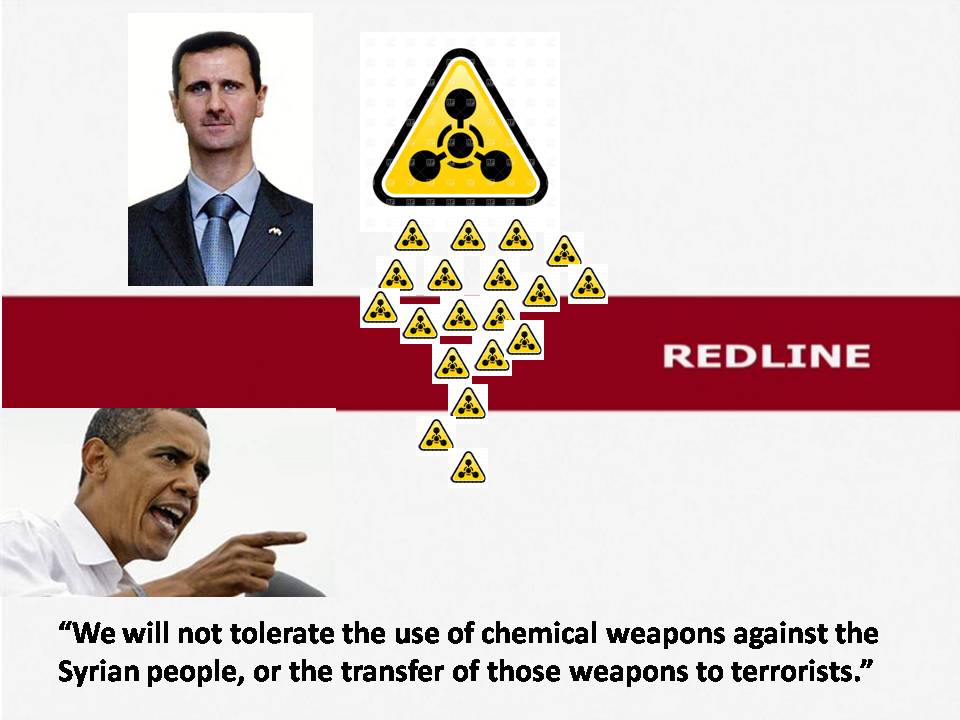
There is much buzz right now about whether the cruel Syrian Baathist-Alawite regime of Bashar Assad, struggling to hold on to power in the midst of civil war against rebel Sunni forces, crossed   President Obama’s “red line” by using Sarin gas, a war crime. That is not really the important point for Americans. There are two things to consider here.

First, specifically how would intervening militarily in Syria’s awful civil war be in American national interest?

It is important to get a clear cut answer here because everyone arguing that Assad has “crossed a red line” that we will “not tolerate” is making a de facto argument for some kind of intervention on our part. Maybe if no one can define such an interest it is because there isn’t any and intervening will bring the US nothing but costs in blood and treasure without gaining anything of strategic value. I’m not against intervention per se but there really ought to be a coherent reason so we can rationally measure it against the potential costs which, from where I sit, look rather large.

Secondly, in important matters of state, you don’t negotiate in public with a potential adversary if you really hope to gain a concession from them and if you reach the point of issuing a public ultimatum, you don’t bluff.

The people who have advised President Obama to make these “red line” statements to Syria through the media instead of quietly through diplomatic channels are either professionally incompetent at statecraft or they were hoping to manipulate the President by getting him to back himself into a corner with tough rhetoric so that if Assad did not blink then Obama would have the choice of looking weak and foolish or of approving some kind of action against Syria. Either way, the President was poorly served by this advice. Maybe he needs some new foreign policy and national security advisers who actually know something more about the world than domestic politics and being lawyer-lobbyists.

As a result that the President never really had any intentions of, say, invading Syria this year, we are now being treated to nervously asserted, lawyerly parsing of what really counts as “red lines” and what technical level of Sarin gas particulates constitutes “use”. It is an embarrassing climb down for the administration but also for the United States that never needed to happen. Empty posturing is not a substitute for a policy. Saying “Do something!” is not a strategy.

This is no brief for Assad’s regime. He’s definitely a bad actor and runs a nasty and now democidal police state he inherited from his mass-murdering father, Hafez Assad. I’m open to hearing why the US should aid in a regime change because the outcome will be in our interests in some concrete and definable way. Oh, yeah, and it might help if the person making the pitch knew something about Syria and regional geopolitics, or was at least consulted about it.

Let’s think long and hard this time.

Boston 4/15/13

Tuesday, April 16th, 2013

The Boston Marathon was bombed today near the finish line with allegations of multiple other unexploded devices:

CBS Boston station WBZ-TV reports one of the three who died from the attack was an 8-year-old boy.

 Two bombs exploded near the crowded finish line of the Boston Marathon on Monday, killing three people and injuring more than 125 others in a terrifying scene of broken glass, smoke and severed limbs, authorities said.

Police reportedly set off at least one other explosive device with a water cannon. On Monday night, a federal law enforcement source told CBS News correspondent Bob Orr that an earlier report was incorrect that authorities had found one other device that was intact and had not been detonated. Orr reports that authorities are not in possession of such a device.

 CBS News senior correspondent John Miller reports that a Saudi national is being questioned by authorities. He was seen “acting suspiciously” running from the explosion, and a civilian chased him down and tackled him. He was turned over to Boston police and is being questioned by the FBI. He is being cooperative and denies any involvement.

 “This could mean a lot, or this could mean very little,” Miller said. “It’s too soon to call him a suspect.”

 Miller reported earlier that authorities are also reviewing surveillance video that shows a man from behind carrying two backpacks near the site of the explosions. Authorities are not sure whether the subject in the video is linked to the blasts.

Boston police say no suspect has been taken into custody. 

There is much speculation and misinformation at the present time and a rush to analytic judgement is premature when crucial physical evidence is in the early stages of being found, identified and tested by expert investigators. White House officials have classified the attack – which featured a second blast to harm first responders and bystanders – “terrorism”.

Terrorism would appear to be accurate. Whether this is by a group or a “lone wolf” is not yet determined. The presence of multiple, coordinated bombs would be very difficult for one person acting alone to plant without detection but not impossible, a small cell is more likely. A high failure rate of bombs may indicate a determined amateur rather than a professional bomb-builder from a group like the IRA, Hezbollah or Lashkar-e- Taiba, all of which are noted for their skill with explosives. Nor can a foreign state security agency be definitively ruled out at this time, though that is much less likely a possibility ( Pointlessly bomb the Boston Marathon and get yourself a 2 carrier group aerial “regime decapitation” campaign).

Before jumping to conclusions about the possible identity of the Boston Bomber, recall first guesses are frequently wrong and as with the “Anthrax Letters”, we may never know for certain. Or the FBI may run down the culprits in the next 48 hours. People using this attack to score cheap partisan political points right now in the media or on social network sites  are supreme asshats

The Iron Lady, 1925 -2013

Monday, April 8th, 2013

Margaret Thatcher, RIP 

There are leaders and then there are “Leaders” who shape and help define the spirit of their times.  Margaret Thatcher was of the latter kind.

A true friend of the United States and an indomitible Prime Minister of Britain is now gone.

Tributes Pour In for Margaret Thatcher 

….Mrs. Thatcher, 87, was Britain’s first female prime minister, serving for 11 years beginning in 1979. She was known as the Iron Lady, a stern Conservative who transformed Britain’s way of thinking about its economic and political life, broke union power and opened the way to far greater private ownership.

The daughter of a grocer, she was leader of Britain through its 1982 war in the Falklands and stamped her skepticism about European integration onto her country’s political landscape for decades.

Though Mrs. Thatcher had been in poor health for months, the news of her death still overwhelmed many. Within moments of the announcement by Lord Bell, Queen Elizabeth II and Prime Minister David Cameron offered tributes to what Mr. Cameron called “a great leader, a great prime minister, a great Briton.”

Indeed.

The Apple II of 3 D Printing?

Thursday, February 28th, 2013

It may be 1977 all over again.

Check out the Form 1 Kickstarter page 

The Formlabs home page and their blog.

I recently reviewed Chris Anderson’s book Makers. What 3 D printing needs is the affordable, user-friendly, versatile device to move 3 D printing from the arcane realm of  techno-hobbyist geeks to the general population’s “early adapters”, which will put the next “consumer model” generation on everyone’s office desk; eventually as ubiquitous as cell phones or microwaves.

Formlabs should send one of these to John Robb and Shloky for a product review.

Hat tip to Feral Jundi


Switch to our mobile site

